Interfacial Shear Stress Concentrations across Crease Lines in Laminated Packaging
Optimize creasing matrix channel widths to twice board caliper plus rule thickness plus twenty percent to prevent interfacial shear delamination along creases.
Strain
Creasing a paperboard substrate laminated with an oriented polymer film forces two mechanically disparate materials through a severe localized deformation. The fibrous paperboard core possesses an elastic modulus between two and six gigapascals in the machine direction, while typical bi-axially oriented polypropylene laminates exhibit an elastic modulus between one and three gigapascals accompanied by high tensile ductility. When the creasing rule strikes the board into the female channel, the paperboard structure delaminates internally along shear planes to generate a hinge.
The polymeric surface film, simultaneously adhered across the score zone, experiences localized tensile extension while restraining the outer plies of the board from spreading freely. This displacement incompatibility creates acute interfacial shear stress concentrations at the edges of the crease shoulder.
During the subsequent ninety-degree folding action on the carton packaging line, the neutral axis shifts inward toward the compressive face of the fold. The outer film and the underlying adhesive layer stretch over the bent fibrous crown. Finite element calculations and physical shear-strain profiling demonstrate that the peak shear stress does not reside at the geometric center of the crease.
Peak shear concentrates within a narrow zone situated approximately 0.3 to 0.8 millimeters from the creasing line center, coinciding precisely with the shoulder where the board delamination ceases and the uncreased board maintains full structural rigidity.
Peak shear stress across a laminated crease concentrates precisely at the shoulder boundary where internal ply delamination stops.
Uncreased laminated structures carry nominal interfacial shear stresses near zero under ambient thermal conditions. When mechanical bending forces the laminated board to a sharp radius, the outer fiber layers attempt to slip relative to the unyielding film. Adhesive layers with excessive shear stiffness transfer this displacement mismatch directly to the fiber-adhesive boundary.
If the local shear stress exceeds the internal z-directional tensile strength of the paperboard, the top fiber layer peels away beneath the adhesive, creating a visible blister commonly misidentified as lamination failure. High converting speeds intensify this effect because viscoelastic adhesive films stiffen markedly under millisecond-scale deformation rates.
Board caliper governs the magnitude of this interfacial shear gradient. Heavier folding boxboards, ranging from 450 to 600 micrometers in thickness, generate substantially higher interfacial strains than 250-micrometer stocks folded along identical tooling radii. Thicker boards force the outer polymer laminate further from the fold neutral axis, directly multiplying tensile elongation along the outer face.
When high-grammage laminated cartons fail along the crease shoulders, packaging automated lines suffer unrecoverable jams and structural panel bowing that invalidates container top-load compression ratings.

Rule
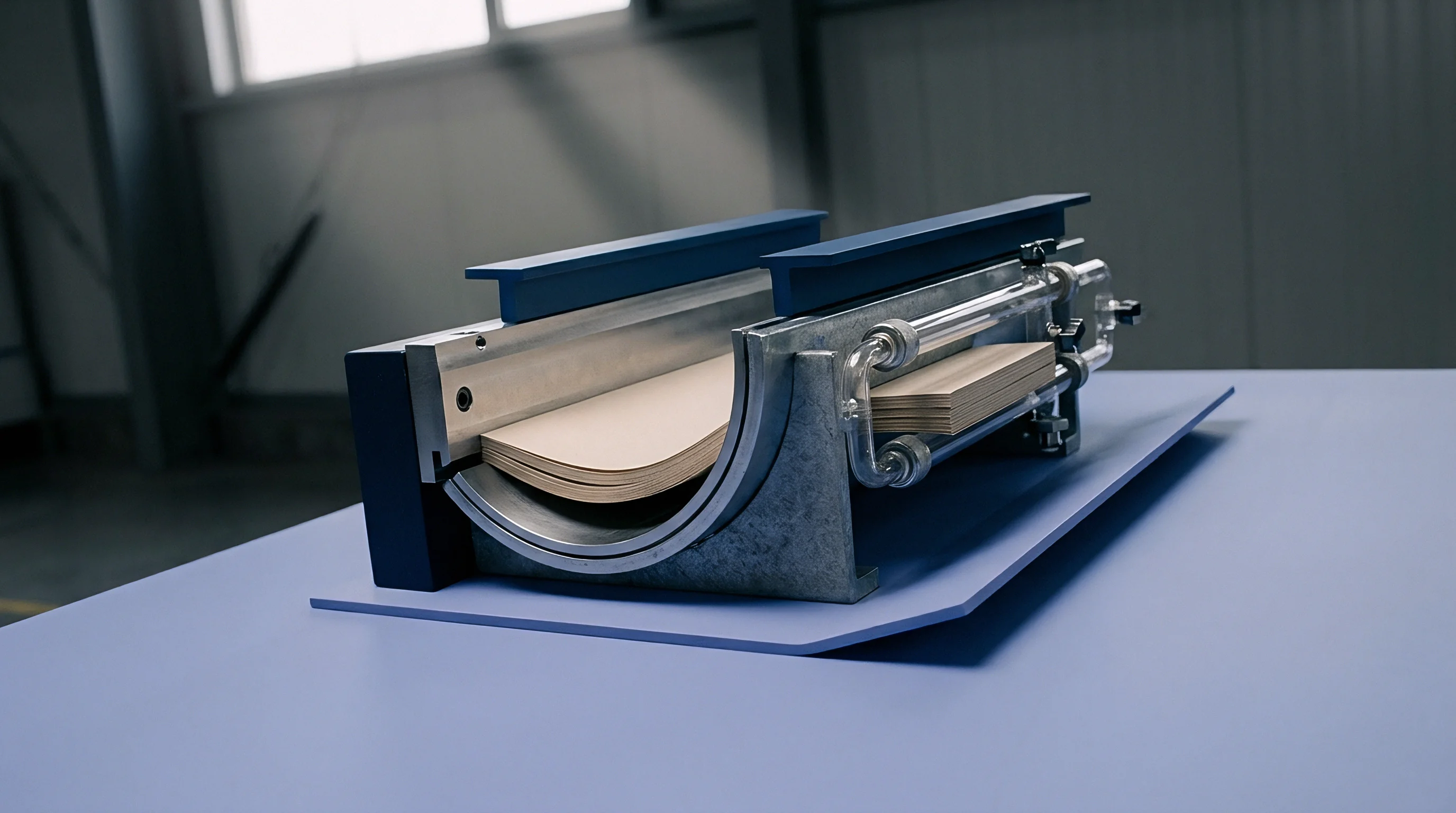
Tooling geometry dictates the distribution of shear stresses across the creasing zone before folding operations begin. The creasing make-ready controls the width and depth of the initial depression, defining the precise boundary of internal ply shearing. Setting the male creasing rule width and the female matrix channel width according to board thickness establishes the clearance envelope necessary for clean hinge formation.

Matrix Channel Dimensions
Selection of the channel width determines whether the board plies delaminate cleanly into multiple independent thin shear layers or crush into an unyielding monolithic block. The industry standard formulation defines channel width as twice the board caliper added to the rule thickness. In laminated packaging, this formula creates severe pinching along the crease shoulders.
Adding fifteen to twenty percent extra channel width allows the outer laminate film to draw into the channel without sustaining excessive localized shear traction from the female counter-edges.
| Board Caliper (microns) | Film Type and Thickness | Rule Thickness (pt / mm) | Matrix Channel Width (mm) | Matrix Channel Depth (mm) |
|---|---|---|---|---|
| 300 | 12-micron BOPP | 1.5 pt (0.53 mm) | 1.25 | 0.38 |
| 350 | 15-micron Matt BOPP | 2.0 pt (0.71 mm) | 1.55 | 0.45 |
| 400 | 14-micron Metallized PET | 2.0 pt (0.71 mm) | 1.70 | 0.50 |
| 450 | 20-micron Soft-Touch BOPP | 3.0 pt (1.05 mm) | 2.10 | 0.58 |
| 500 | 18-micron Gloss BOPP | 3.0 pt (1.05 mm) | 2.30 | 0.65 |
Die setup requires strict balance between rule penetration and channel depth. If the rule sinks too far, the film experiences cutting action at the creasing tip. If the penetration is shallow, the board retains bending stiffness, driving extreme interfacial shear stresses through the film laminate when folding to ninety or one hundred and eighty degrees.
Make-ready sheets tell the story across a production run. Calibrated shims placed under the die plate adjust local creasing rule height in increments of twenty-five micrometers. Uneven make-ready pressure generates erratic score depths across a multi-up layout.
A carton positioned over an over-shimmed rule displays milky stress-whitened film edges on the crease shoulder. Cartons creased across under-shimmed rules show pristine visual surfaces until cartoning plows force the panel down, whereupon the high bending resistance splits the interface beneath the score.
- Rule profiling check verifies the crown profile of steel creasing rules with optical micrometer gauges across forty points before inserting into the die chase.
- Counterplate register inspection locks the milled steel or pertanax matrix into positional tolerance within 0.05 millimeters of the rule centerlines.
- Pressure balancing step runs sacrificial carbon paper or pressure-sensitive film across the platen to confirm uniform impression density throughout all packaging blanks.
- Dynamic deflection assessment measures creasing depth across initial blanks running at full production speed rather than relying on slow hand-turned test pulls.
Wider matrix channels distribute interfacial shear stress across a broader radius and preserve lamination integrity.

Interface
The boundary between the paperboard fibers and the laminating adhesive layer forms a distinct mechanical composite zone. Paperboard surface sizing, mineral clay coatings, printing inks, and adhesives interact chemically and mechanically within a depth of five to thirty micrometers. When a lamination pass applies film to solid bleached sulfate or folding boxboard, liquid adhesive penetrates the porous network of the top clay coating before cross-linking or solidifying.
Adhesive Film Mechanics
Laminating adhesives distribute across two primary chemical families in commercial packaging production: polyurethane reactive hotmelts or solventless polyurethanes, and waterborne acrylic emulsions. Solventless polyurethanes cure by moisture polymerization into elastomeric layers characterized by moderate elongation at break and resilient shear dampening. Waterborne acrylic adhesives form thinner, more glassy polymer films after drying tunnels remove moisture.
Under the severe mechanical rotation of a crease line, acrylic adhesive layers with high glass transition temperatures exhibit brittle fracture when shear stresses peak. Polyurethane adhesives absorb interfacial displacement through viscoelastic shear deformation, shielding the brittle mineral coating below.
Ink coverage beneath the laminate introduces an additional boundary layer prone to cleavage. Solid ink layouts, especially UV-cured offset and flexographic formulations, display high cross-link density and negligible elongation capacity. A heavy layer of cyan or black ink forms a slick barrier that inhibits adhesive anchorage into the paperboard fibers.
The interfacial bond energy drops from six hundred joules per square meter on raw clay coating to below one hundred and fifty joules per square meter over cured UV ink films.
Adhesive systems operating below their glass transition temperature crack along crease shoulders under dynamic shear loads.
Corona treatment applied during the lamination pass determines the wetting dynamic and thermodynamic adhesion between the film and adhesive. Polypropylene films require surface oxidation to reach minimum wetting tensions of thirty-eight to forty-two dynes per centimeter. If dynes decline during storage roll aging, wetting incomplete spots form microscopic interfacial voids along the film-adhesive plane.
Under the compressive and tensile forces of the creasing rule, these unbonded voids act as primary stress concentrators, initiating rapid delamination cracks that track parallel to the score line.
| Material Layer | Tensile Modulus (MPa) | Elongation at Yield (%) | Glass Transition (°C) | Interfacial Shear Strength (MPa) |
|---|---|---|---|---|
| BOPP Gloss Film (15 µm) | 2100 | 12 | -10 | 4.2 |
| Matt BOPP Film (18 µm) | 1850 | 8 | -8 | 3.5 |
| Metallized PET Film (12 µm) | 4100 | 4 | 78 | 5.8 |
| Solventless Polyurethane | 45 | 220 | -35 | 6.4 |
| Waterborne Acrylic | 180 | 65 | 15 | 2.9 |
Mineral pigment composition within the paperboard coating layer also governs failure location. Coatings rich in coarse ground calcium carbonate exhibit lower internal cohesion than formulations dominated by fine engineered kaolin clay or plastic pigment binders. When interfacial shear stresses peak during creasing, structural separation frequently occurs within the pigment matrix itself.
The film tears away carrying a chalky layer of mineral coating and ink, while the fibrous core of the board remains undisturbed.
Film manufacturers regularly attribute crease line peeling to excessive creasing rule depth rather than acknowledging low surface dyne retention on converted rolls.

Recovery
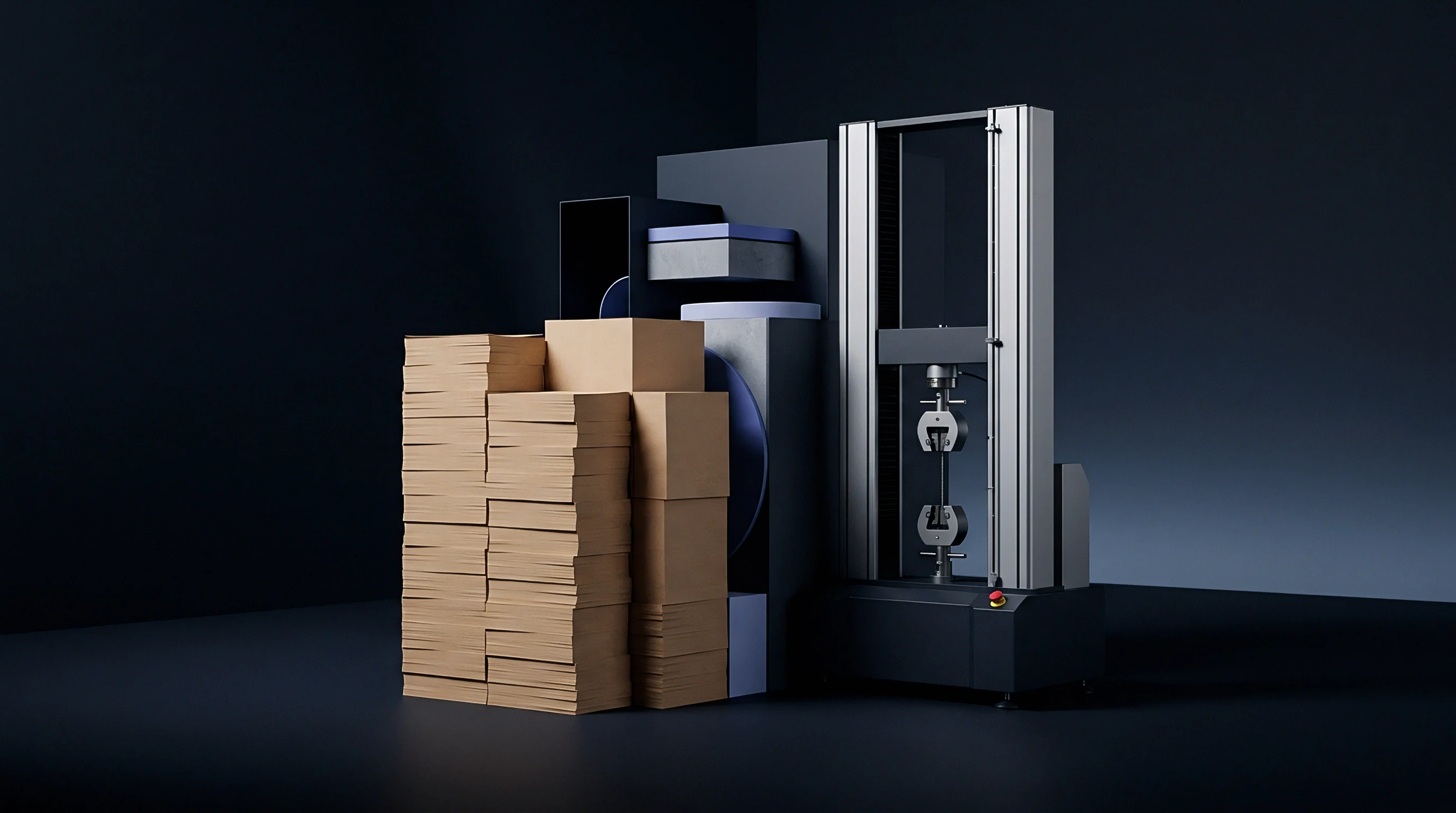
Carton opening force and crease spring-back behavior serve as direct mechanical indicators of interfacial integrity along score lines. Laboratory testing according to standard methods isolates the moment required to fold a crease to ninety degrees and monitors the subsequent relaxation behavior. Substrates with intact interfacial bonds demonstrate steady, predictable crease recovery angles.
Substrates experiencing interfacial shear failure show abrupt drops in bending resistance accompanied by localized bubbling along the panel borders.

Instrumental Evaluation Protocols
The standard ISO 2493 method measures board bending resistance, while ISO 5628 outlines general principles for calculating crease stiffness using two-point loading geometry. The test involves clamping the uncreased portion of a test specimen, deflecting the creased panel to ninety degrees at a controlled angular velocity of fifteen degrees per second, and recording the peak bending resistance in milli-Newtons. A pristine, non-laminated crease exhibits a typical reduction in bending resistance of fifty to seventy percent compared to the uncreased board stiffness.
Laminated boards behave differently due to the tension of the unbroken outer film. The film provides an elastic restoring force that attempts to pull the folded panel back toward its original planar configuration. The crease recovery ratio expresses the residual moment after a hold time of fifteen seconds divided by the initial peak folding resistance.
- Crease moment determination captures the maximum mechanical resistance offered by the creased board hinge during initial deflection through ninety degrees.
- Relaxation angle tracking charts the decay of spring-back moment across an interval of sixty seconds under controlled atmospheric conditioning of fifty percent relative humidity.
- Shoulder strain mapping utilizes digital image correlation with high-magnification telecentric lenses to quantify displacement discontinuities between the film surface and board edge.
- Delamination peel verification applies ninety-degree mechanical adhesive peeling along the crease axis at three hundred millimeters per minute to establish remaining peel strength.
Atmospheric conditioning strongly impacts test outcomes. Paperboard absorbs environmental moisture, lowering its elastic modulus and shifting internal failure modes from crisp shear fracture to ductile fiber compaction. At thirty percent relative humidity, the fibers stiffen and paperboard internal bond strength drops, forcing interfacial shear stresses to jump sharply during creasing.
Testing at fifty percent relative humidity yields optimal hinge mechanics. Packaging specified for refrigerated cold-chain environments faces extreme hazards because low temperatures drop adhesive flexibility below the glass transition point, prompting spontaneous shoulder delamination upon final cartoning.
Purchase contracts specifying zero delamination along carton scores invoke DIN 55437 crease test procedures to settle supplier rejection thresholds on delivery.
Ledger
Finishing passes carry exact production costs and waste rates that compound across high-volume folding carton manufacturing. Lamination is not a free decorative upgrade. Applying a sixteen-micron film requires an off-line or in-line roll laminator running at speeds between eighty and one hundred and eighty meters per minute, drawing make-ready sheets, thermal energy, and costly specialty adhesives.
Pass Economics and Spoilage Dynamics
Adding a film lamination pass introduces material scrap and setup losses. Make-ready for a standard laminating pass consumes eighty to one hundred and fifty sheets of expensive coated board before adhesive spread, nip pressure, and temperature reach steady state. Running waste accounts for an additional 1.5 to 3.0 percent of the total run volume.
When defective creasing setup induces shoulder delamination on automated erecting lines, reject costs multiply because discarded blanks carry board cost, printing ink cost, lamination pass expense, and die-cutting charges.
| Finishing Configuration | Added Passes | Make-Ready Waste (Sheets) | Finishing Cost per 1k (€) | Crease Defect Rate (%) |
|---|---|---|---|---|
| Waterborne Dispersion Barrier Coating | 0 (In-line coater) | 35 | 4.20 | 0.12 |
| 15-micron Gloss BOPP (Solventless) | 1 (Off-line roll) | 120 | 18.50 | 0.45 |
| 18-micron Matt BOPP (Solventless) | 1 (Off-line roll) | 140 | 22.10 | 1.85 |
| 14-micron Metallized PET (Solventless) | 1 (Off-line roll) | 160 | 31.00 | 2.40 |
| 20-micron Soft-Touch BOPP (Thermal) | 1 (Thermal laminator) | 110 | 38.50 | 3.10 |
Consider a practical converting run of 100,000 high-end cosmetic cartons produced from 350-micrometer solid bleached sulfate board. Standard sheetfed offset printing costs forty-five euros per thousand sheets. Adding an off-line thermal soft-touch lamination pass adds thirty-eight euros per thousand sheets in conversion fees, plus fifteen hundred euros in specialty film raw material stock.
If incorrect matrix channel width causes film delamination on three percent of the finished blanks during automated cartoning at the brand owner facility, the resulting product line stoppage incurs penalty charges and replacement converting obligations.
Recyclability penalties in European markets add further operational liabilities to laminated boards. Under modulated extended producer responsibility schemes like those operating in Germany and France, paper packaging containing non-separable polymer laminations incurs higher recycling disposal fees per metric ton than monomaterial fiber packaging. Film-laminated boards requiring intensive repulping energy receive lower recyclability scores, and packaging with greater than five percent polymer content face total exclusion from standard paper waste streams.
When specifying an extra lamination pass, packaging engineers balance the sensory and barrier advantages against the compounding burdens of tooling precision, interfacial failure risk, line spoilage, and end-of-life tax liabilities.