Predicting Interlayer Delamination Boundaries in Down-Gauged BCTMP Core Folding Boxboard during High Speed Creasing
Predicting delamination boundaries in down-gauged BCTMP board requires narrowing matrix clearance to match reduced core mass under millisecond impact.
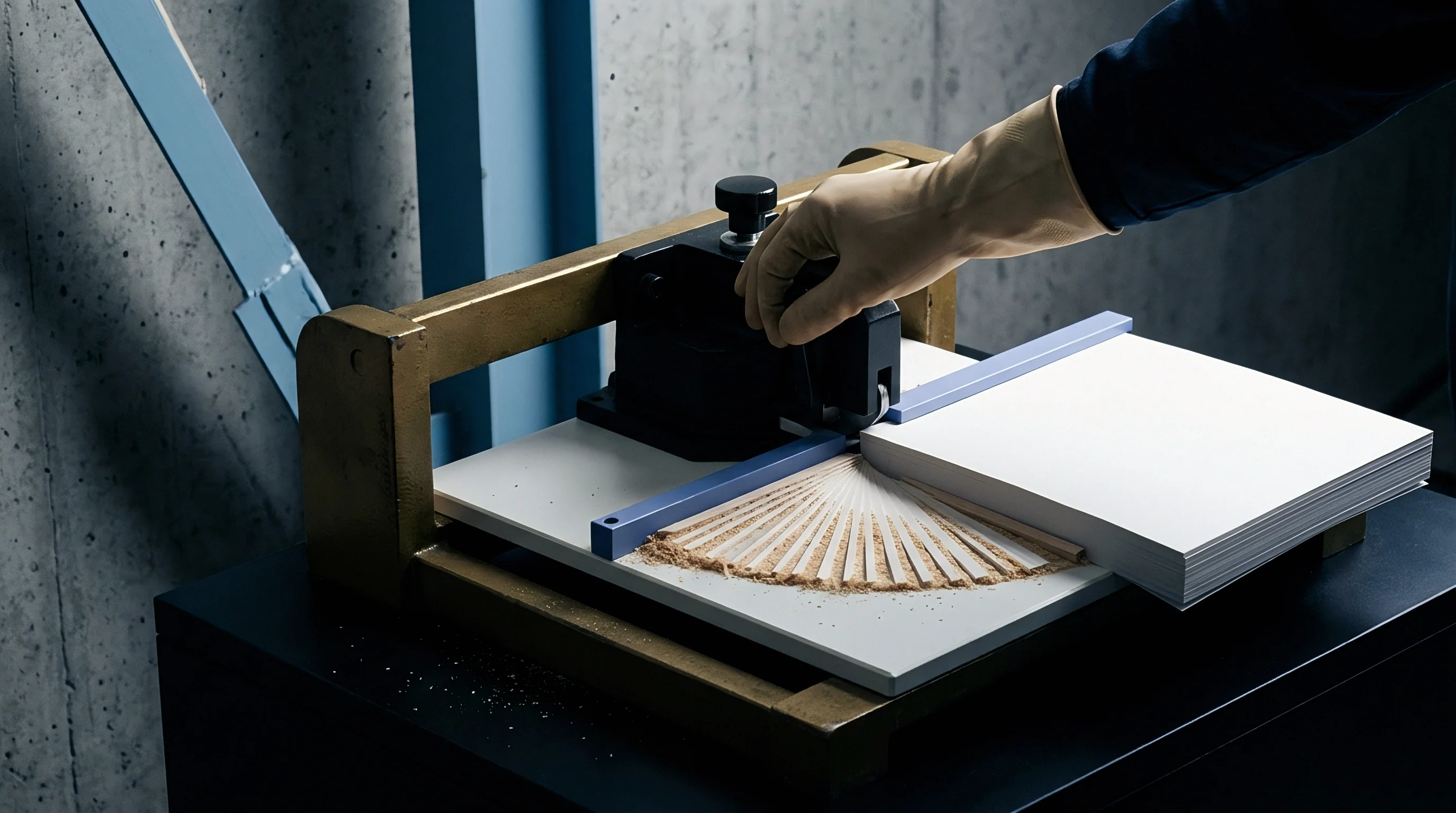
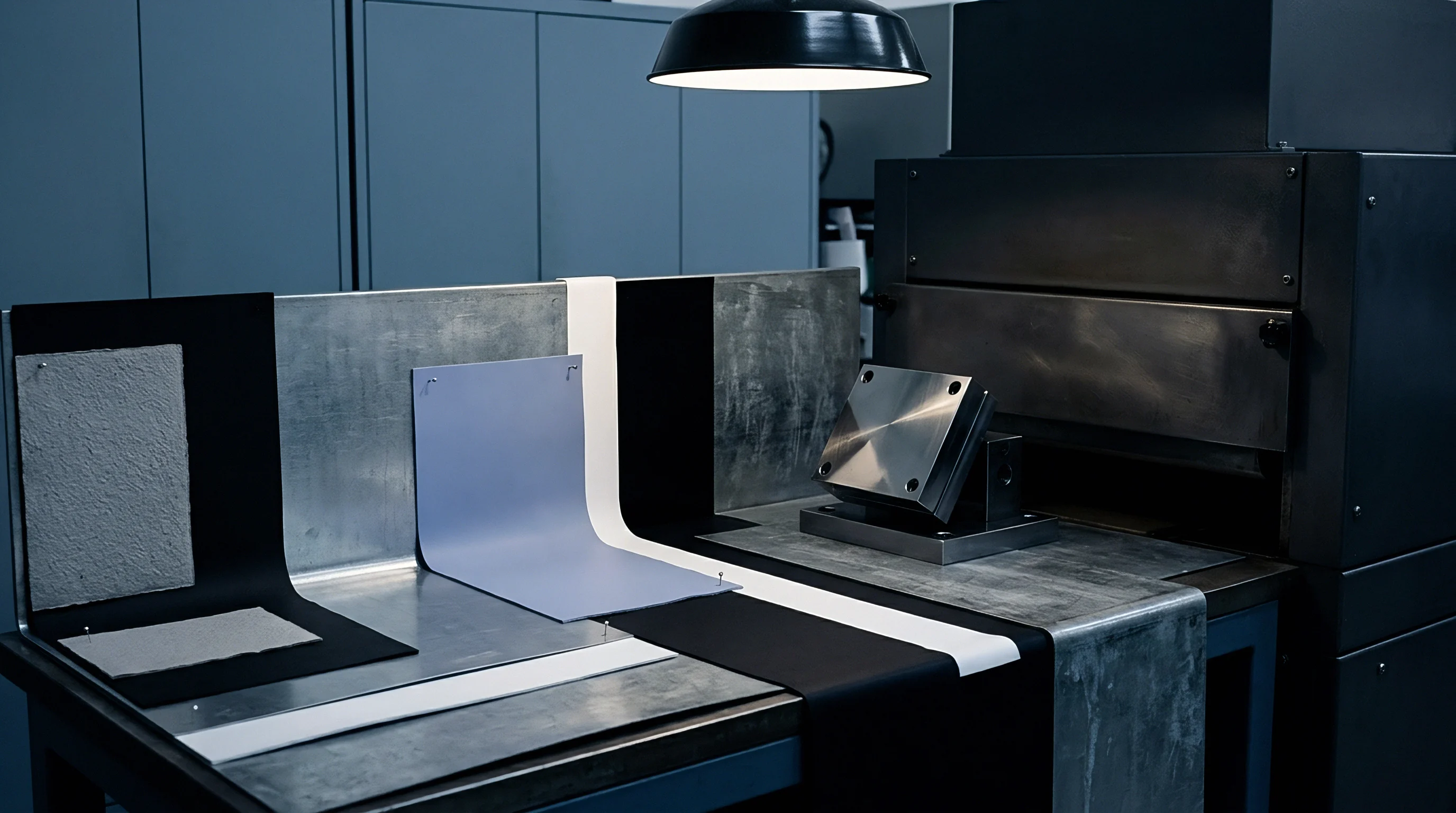
Anvil
Creasing down-gauged folding boxboard on high-speed flatbed or rotary die-cutters exposes mechanical boundaries that thicker, chemical-pulp boards absorb without incident. When machine speeds hit 8,000 sheets per hour on modern autoplatens or web speeds reach 300 metres per minute on rotary packaging lines, the impact duration of the creasing rule falls below five milliseconds. In this narrow contact interval, the multi-ply structure of folding boxboard (FBB) experiences intense localized transverse shear and out-of-plane compression.
The bleached chemi-thermomechanical pulp (BCTMP) core, engineered specifically to elevate bending stiffness at lower basis weights through high specific volume, reacts differently than chemical kraft plies under rapid indentation.
A creasing rule forces the sheet into a grooved female die. This displacement generates a deliberate network of internal micro-delaminations within the middle plies. Controlled internal rupture allows the board to hinge smoothly along the bead without outer liner rupture or liner buckling when folded 90 or 180 degrees on a folder-gluer.
The down-gauging of the middle ply reduces the internal shear volume available to absorb this deformation. The core plies consist of stiff, lignin-rich BCTMP fibres with high wall thickness and coarse cross-sections. When the indentation depth exceeds the elastic limit of the chemical pulp top and bottom plies, the mechanical stress concentrates entirely within the thin, low-density middle stratum.
Crease groove clearance determines whether the BCTMP matrix divides cleanly into parallel delamination planes or crushes into a localized structural shear fracture.
Controlled failure is the foundational operational goal of any scoring operation. The process fails when crack propagation pierces through the bleached chemical pulp print liner or tears the bottom liner adjacent to the female channel edges. Operators running down-gauged virgin FBB frequently observe carton flaking, surface cracking over dark solid ink layouts, and elevated carton opening force on automated cartoning equipment.
These defects trace back to imprecise initial tool geometry selections that ignore the altered Poisson ratio and transverse shear moduli of high-yield pulp cores.

Mechanical Action of High-Speed Indentation
During dynamic impression, the steel rule delivers kinetic energy across a stroke depth ranging between 0.30 and 0.65 millimetres. The indentation process divides into three distinct physical phases:
- Initial Top Liner Compression occurs as the rounded crown of the steel rule makes contact, loading the outer surface in localized out-of-plane compression while stretching the bottom ply across the channel opening.
- Transverse Core Shear Initiation develops across the BCTMP furnish as the shear stress surpasses the internal bond strength of the mechanical fibres, causing deliberate delamination between fibre layers.
- Bead Consolidation and Extraction forces the delaminated core material into the female matrix cavity, plastically setting the hinge line before stripping forces disengage the web.
Standard virgin folding boxboard utilizes outer plies of bleached kraft pulp refined to lower freeness, creating high tensile strength and high Scott bond values. The BCTMP middle ply features a far looser fibre network with an open bulk profile typically between 1.5 and 2.1 cubic centimetres per gram. Lowering the overall grammage while maintaining board caliper shifts the core bulk toward its upper boundary.
This shift alters the internal stress transfer during rule entry.
The core yields under combined compression and shear stresses. In down-gauged grades, the thickness of this middle layer drops by 15 to 25 percent compared to historical standard-bulk equivalents. The reduced physical distance between the top and bottom chemical plies leaves minimal margin for error in rule penetration depth.
Excessive penetration clips the core, severing load-bearing capacity. Insufficient penetration fails to trigger internal delamination, producing a rigid bead that forces the outer liner into tensile rupture during final carton erection.
A rounded creasing profile preserves board integrity better than narrow tool edges on mechanical pulp furnish.
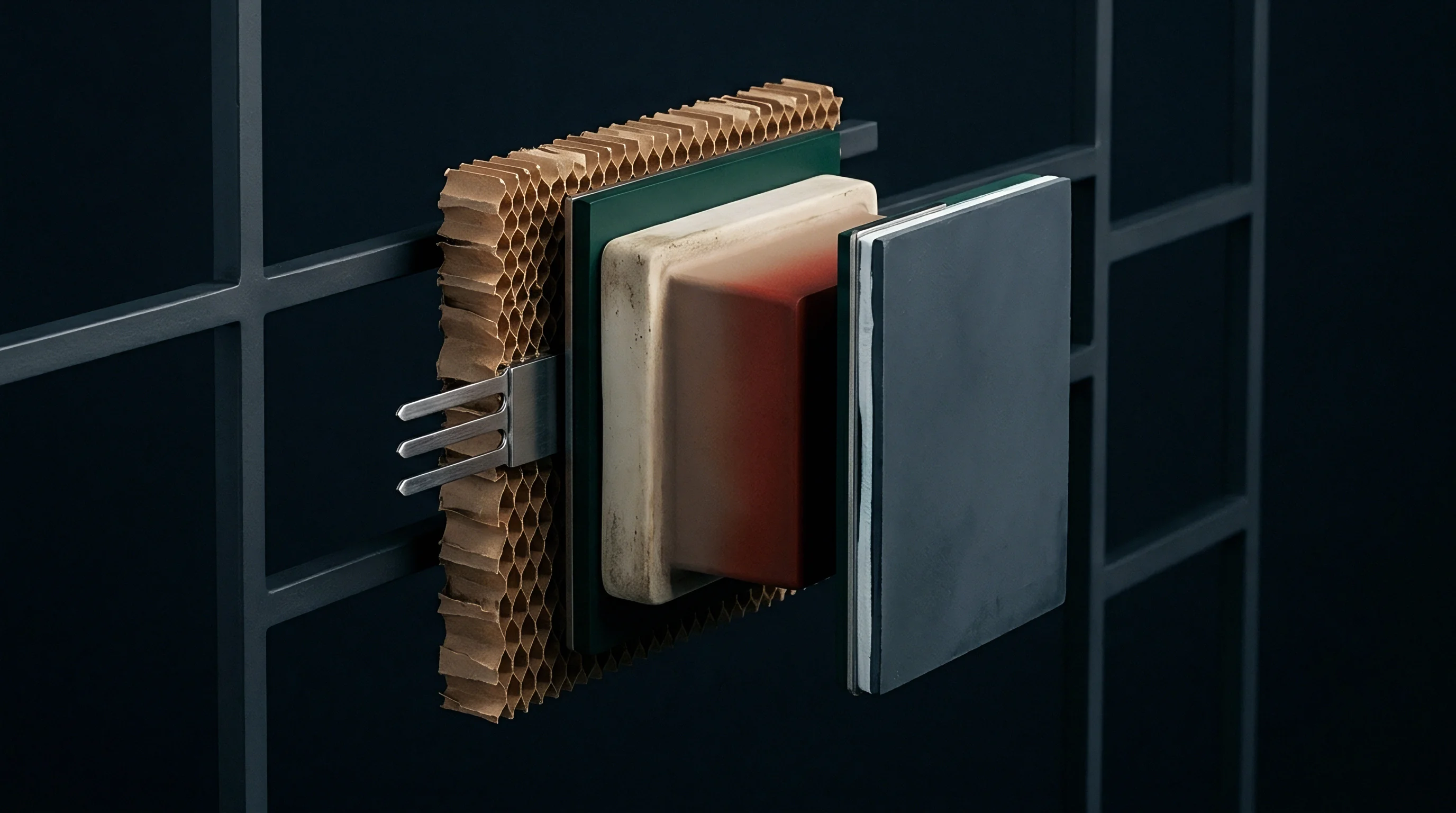

Rupture
Predicting the precise threshold between functional ply separation and destructive shear cracking demands an evaluation of out-of-plane stress states. The internal structure of BCTMP possesses low z-directional tensile strength, typically tested between 120 and 220 kilopascals under ISO 15754. Its transverse shear strength along the cross-machine direction governs how cracks travel outward from the punch axis.
Down-gauging reduces total basis weight, stripping out mechanical fibre mass and elevating local shear stress levels under identical converting tonnage.
When the creasing rule enters the sheet, shear stress concentrates at the tool edges. The delamination boundary represents the spatial limit to which micro-cracks propagate away from the centerline into the creasing bead flanks. In an ideal crease, delamination spreads symmetrically, creating multiple thin horizontal fissures throughout the core thickness.
These fissures allow the layers to slide over one another during folding, functioning mechanically like the leaves of a leaf spring.

Shear Crack Propagation and Boundary Envelopes
In down-gauged BCTMP substrates, crack paths turn unpredictably. Because high-yield fibres retain residual lignin and exhibit limited surface fibrillation, fibre-to-fibre contact area is diminished compared to chemical furnish. Inter-fibre bonding relies heavily on starch additives and dry-strength resins introduced in the wet end.
Under rapid tool deceleration, shear fractures take the path of least resistance through the resin-starved zones of the core.
Two primary failure boundaries govern this mechanism. The lower boundary defines the minimum energy required to initiate z-directional delamination within the BCTMP stratum. The upper boundary defines the threshold beyond which crack propagation veers obliquely toward the outer bleached liners, causing macroscopic shear cleavage or surface flaking.
When the converting line operates outside this safe envelope, the resulting crease exhibits asymmetric spring-back, uneven folding torque, and broken scorelines.
| Board Caliper (microns) | Grammage (ISO 536, g/m²) | Bulk (ISO 534, cm³/g) | Z-Tensile (ISO 15754, kPa) | Scott Bond (TAPPI T 569, J/m²) | Critical Shear Strain Boundary (%) |
|---|---|---|---|---|---|
| 350 | 215 | 1.63 | 185 | 155 | 14.2 |
| 400 | 235 | 1.70 | 160 | 140 | 12.8 |
| 450 | 260 | 1.73 | 145 | 130 | 11.5 |
| 500 | 280 | 1.79 | 130 | 115 | 9.8 |
| 550 | 305 | 1.80 | 125 | 110 | 8.9 |
Data recorded across these test series demonstrate an inverse relationship between sheet bulk and critical shear strain capacity. Higher bulk correlates directly with reduced internal bond strength. For a converter running high-speed packaging lines, this trade-off alters the runnability envelope on long carton blanks.
As board caliper increases through down-gauging, Scott bond metrics slip toward the lower processing limits. The Scott internal bond values fall from 155 Joules per square metre at 350 microns down to 110 Joules per square metre at 550 microns. This shift compresses the allowable tooling tolerance.
A variation of only 15 microns in rule height or channel depth will push a down-gauged board past its critical shear strain limit, initiating structural failure across the scoreline.
ISO 15754 z-directional tensile strength below 130 kilopascals combined with board bulk exceeding 1.75 cubic centimetres per gram leads to premature liner cleavage under high-speed scoring.
Running outside the verified delamination envelope yields cartons that split during high-speed case packing, generating catastrophic line jams that halt filling operations and trigger full pallet rejections.
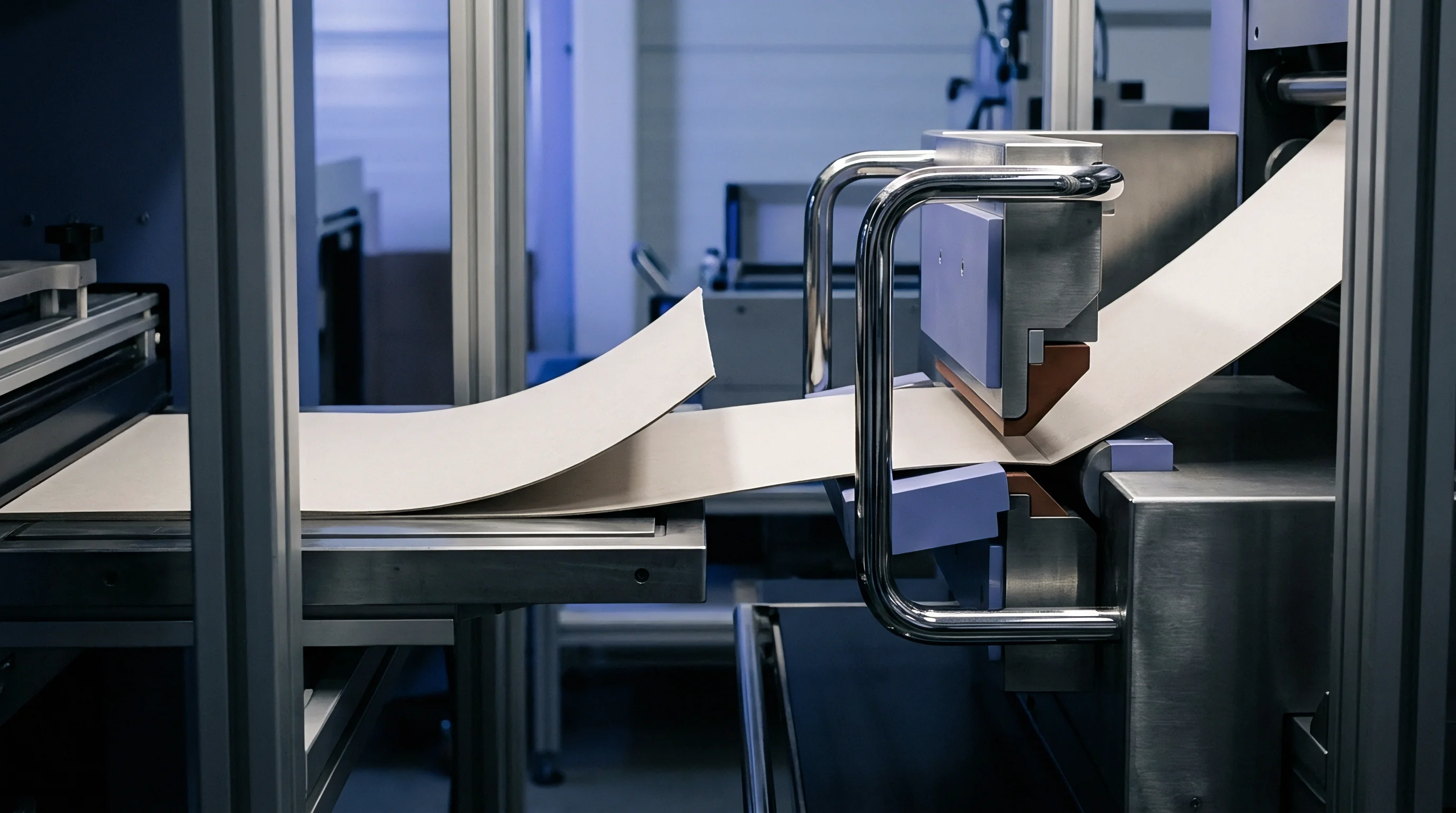

Strain
High-speed converting separates static laboratory measurements from dynamic production reality. Creasing measurements carried out at standard bench velocities of several millimetres per second do not capture the material response occurring at full operational press speeds. At production rates, strain rates inside the board core reach values between 1,000 and 3,000 reciprocal seconds.
Cellulose fibres and residual lignin exhibit pronounced viscoelastic behavior under these conditions, stiffening significantly as deformation times shrink.
The time-dependent stiffness of the BCTMP core means that higher initial forces are required to trigger yield. As tool entry velocity climbs, the apparent shear modulus of the mechanical pulp plies escalates. Less strain energy dissipates through progressive fibre rearrangement.
The energy instead releases through sudden, uncontrolled micro-fractures along weak material planes. This strain-rate sensitivity explains why a tooling configuration that delivers perfect creases during slow make-ready setup generates split liners and flaking once the operator brings the flatbed platen up to production speed.

Does Dynamic Strain Rate Shrink the Processing Window?
The processing window narrows substantially at production velocity. In down-gauged BCTMP boards, the viscoelastic margin is constrained by the low basis weight of the core. As impact dwell time drops from 50 milliseconds down to 3 milliseconds, internal relaxation phenomena disappear from the mechanical calculation.
The core acts as an elastic, brittle medium rather than an elastoplastic matrix.
Moisture content plays an active role in modulating this high-rate strain sensitivity. Folding boxboard conditioned to equilibrium under ISO 187 at 23 degrees Celsius and 50 percent relative humidity contains roughly 6.5 to 8.0 percent moisture by weight. Water plasticizes the amorphous hemicellulose and lignin networks within the BCTMP fibres.
When pallet storage conditions permit moisture drop below 6.0 percent, the glass transition temperature of the lignin components remains well above ambient converting temperatures, eliminating ductility.
- Substrate Moisture Desiccation drives the internal core fibres into an unyielding, brittle condition, preventing progressive fibre slip under impact.
- Rapid Impact Tool Deceleration spikes instantaneous peak forces across the narrow contact zone of the rule, overloading the dried outer plies before the core yields.
- Premature Transverse Cleavage ruptures the upper interface between the top bleached chemical liner and the rigid BCTMP centre, causing visible score cracking.
Cross-direction (CD) creases experience greater strain-rate vulnerability than machine-direction (MD) creases. In the CD crease, the rule aligns parallel to the majority of fibre axes, requiring the tool to part fibres transversely against their inter-fibre bonds. In the MD crease, the tool deforms fibres across their longitudinal axes, where axial bending compliance helps absorb the rapid impact shock.
Down-gauged FBB displays cross-direction shear stiffness values that change abruptly across varying press speeds, shifting the operational tolerance band by up to 20 percent between setup and full run speeds.
Pulp suppliers regularly claim that high bulk formulations maintain equivalent converting behavior across all press operating speeds through advanced chemical bonding packages.


Gauge
Tooling geometry calculations established for solid bleached sulphate (SBS) boards or standard-bulk folding boxboards produce immediate defects when applied to down-gauged BCTMP grades. Because down-gauged boards replace solid chemical pulp mass with a thicker, more porous mechanical core per unit of grammage, the physical space the compressed bead occupies within the matrix channel differs completely from conventional substrates. The width of the creasing rule, the matrix channel opening, and the counter-die groove depth must be calibrated directly against the real core thickness.
Standard empirical formulas traditionally determine matrix channel width by summing the rule thickness with a substrate factor, often expressed as 1.5 to 1.7 times board caliper. For down-gauged BCTMP grades with bulk metrics exceeding 1.70 cubic centimetres per gram, this conventional spacing results in excessive clearance. Excess matrix clearance fails to generate sufficient lateral constraint during tool entry, allowing the mechanical core to spread sideways without generating the vertical compression needed to cleave internal layers.

Predictive Calculations for Delamination Tools
The calculation of effective creasing parameters demands rigorous dimensional controls. The core ratio represents the proportion of total caliper occupied by the BCTMP mechanical pulp. In down-gauged boards, this ratio commonly reaches 0.65 to 0.78 of total sheet thickness.
Matrix channel width calculation for high-speed conversion follows this mechanical relationship:
Channel Width = Rule Thickness + (1.35 × Board Caliper) + (0.10 × Core Thickness)
Counter-die groove depth relies directly on the compressed state of the chemical liners:
Groove Depth = Board Caliper × (1.0 – Core Densification Factor)
The core densification factor for BCTMP generally falls between 0.40 and 0.52, reflecting the maximum compressibility of mechanical fibres before absolute crushing occurs. If groove depth is selected too shallow, the rule over-compresses the material at the crease apex, destroying the tensile capability of the print surface.
| Board Caliper (microns) | Standard Grammage (g/m²) | Rule Thickness (pt / mm) | Channel Width (mm) | Groove Depth (mm) | Clearance Ratio (Channel / Caliper) |
|---|---|---|---|---|---|
| 300 | 190 | 1.5 pt / 0.53 mm | 1.00 | 0.28 | 3.33 |
| 350 | 215 | 2.0 pt / 0.71 mm | 1.25 | 0.32 | 3.57 |
| 400 | 235 | 2.0 pt / 0.71 mm | 1.35 | 0.36 | 3.37 |
| 450 | 260 | 2.0 pt / 0.71 mm | 1.45 | 0.40 | 3.22 |
| 500 | 280 | 2.0 pt / 0.71 mm | 1.55 | 0.44 | 3.10 |
| 600 | 330 | 3.0 pt / 1.05 mm | 2.00 | 0.52 | 3.33 |
These dimensional standards show that the matrix channel width does not expand linearly with board caliper. The clearance ratio shifts downward as board thickness increases, preventing excessive lateral escape of the low-density core. Tool steel selection also influences this performance.
Rules featuring double-bevel edge geometries concentrate vertical stress efficiently, triggering internal cleavage at lower machine pressures.

What Mathematical Formulation Predicts the Failure Envelope?
Predicting the safe operating boundary involves balancing shear stress against normal stress within the core layer. An envelope equation maps the operational boundary using the ratio of indentation depth to total sheet thickness. In this framework, the critical parameter is the Delamination Index (DI):
DI = (Peak Indentation Force × Tool Velocity) / (Core Shear Modulus × Residual Z-Tensile Strength)
When the Delamination Index falls below an empirical value of 1.15, the crease fails to delaminate internally, causing high folding resistance and carton bulge. When the index exceeds 2.85, through-thickness cracking initiates, tearing the outer coatings. Down-gauged BCTMP core boards narrow this window.
Standard virgin grades function safely across an index range of 0.85 to 3.40.
A worked engineering assessment illustrates this sensitivity. Take a conversion run using a 400-micron down-gauged FBB with a basis weight of 235 grams per square metre, running on an autoplaten press at 7,500 sheets per hour. Assume a baseline core shear modulus of 45 megapascals and a z-directional tensile strength of 160 kilopascals measured under ISO 15754.
If make-ready adjustments increase the rule penetration by a mere 0.05 millimetres to flatten a stubborn flap, the localized indentation force climbs from 240 Newtons per metre to 380 Newtons per metre. This small adjustment drives the Delamination Index from a stable 2.20 straight to 3.48, crossing the upper boundary into severe top-liner rupture.
It remains unresolved how ambient temperature swings on the converting plant floor alter the dynamic shear modulus of modified starch binders used in ultra-low grammage mechanical cores during multi-million impression runs.

Waste
Tooling adjustments and mathematical predictions eventually intersect with unit economics on the converting line floor. Down-gauging folding boxboard is specified to lower material mass, increase sheet yield per purchased tonne, and reduce packaging levy exposure tied to extended producer responsibility schemes. When down-gauged BCTMP core stock cracks during high-speed creasing, the financial yield savings evaporate across the finishing department.
Production waste from poor scoreline formation manifests in multiple operational areas:
- Die-Cutter Stripping Scrap increases when split creases tear during mechanical dynamic waste stripping, snagging blanks in the press delivery section.
- Folder-Gluer Infeed Jams occur as asymmetric delamination causes blanks to fishtail through the pre-breaking section, halting lines running at 400 metres per minute.
- Cartoning Machine Rejection escalates when irregular crease resistance prevents vacuum pickers from erecting sleeves within programmed cycle windows.
- Liner Delamination Sorting forces manual offline inspection of suspect pallets whenever ink flaking appears across primary display panels.
The economic balance between yield gain and converting spoilage is exacting. A typical yield comparison demonstrates the narrow operational window packaging buyers navigate.
| Specification Parameter | Standard Virgin FBB | Down-Gauged High-Bulk FBB | Operational Variance |
|---|---|---|---|
| Specified Caliper | 400 microns | 400 microns | Zero caliper difference |
| Basis Weight (ISO 536) | 260 g/m² | 235 g/m² | 9.6 percent mass reduction |
| Delivered Tonnes Required | 125.0 tonnes | 113.0 tonnes | 12.0 tonnes material saved |
| Substrate Price per Tonne | €1,350 | €1,440 | 6.7 percent price premium |
| Total Substrate Landed Cost | €168,750 | €162,720 | €6,030 gross savings |
| Make-Ready and Tooling Setup Cost | €3,200 | €4,800 | €1,600 precision tooling cost |
| Converting Spoilage Rate | 1.2 percent | 3.8 percent | 2.6 percent increased scrap |
| Unusable Finished Scrap Cost | €2,025 | €6,183 | €4,158 net spoilage loss |
| Net Commercial Outcome | Baseline balance | €272 total net benefit | Financial margin eliminated |
The worked figures demonstrate that an increase of only 2.6 percent in converting spoilage neutralizes the entire financial benefit of down-gauging twelve tonnes of board. The packaging buyer captures savings only when the die-cutting tooling, matrix sizing, and scoring geometry are matched perfectly to the mechanical properties of the high-bulk BCTMP middle ply.
Down-gauged stocks run successfully when converting operations implement tight quality control over goods-in moisture levels and enforce strict wear limits on matrix channels. Steel rules must undergo replacement schedules based on impression counts rather than visible wear. As rule crowns round off through continuous abrasion against abrasive titanium dioxide pigments in clay coatings, contact surface area spreads.
This wear reduces effective pressure and halts proper core cleavage.
Creasing quality verification relies on standardized testing methodologies to ensure consistent performance. DIN 55437-1 defines specific methods for testing the folding behavior of boxboard using creasability testers that measure bending moment and folding torque at high angular velocities. Measuring the ratio of creased folding resistance to uncreased bending stiffness confirms whether internal delamination developed without damaging outer liners.
Down-gauged FBB must achieve a creasing ratio between 0.40 and 0.55 to guarantee trouble-free carton erection.
Commercial purchasing agreements for down-gauged folding boxboard frequently incorporate standard quality clauses based on ISO 2859-1 acceptance sampling plans. These terms govern allowable defect levels for scoreline integrity, defining any through-liner fracture exceeding five millimetres along a major carton crease as a critical defect that justifies rejection of the entire production lot.