Folding Boxboard Mechanical Core Thickness for High Stiffness Cartons
Folding boxboard mechanical core thickness increases total caliper and bending stiffness at low grammage, reducing material weight and landed carton cost.
Ply
Bonding bleached chemical pulp faces to a high-bulk mechanical core produces structural rigidity per unit mass. Engineered under this multi-layer geometry, paperboard places dense, high-modulus chemical fibres at the outer surfaces and concentrates low-density mechanical pulp in the center. The structure functions like an I-beam: outer skins carry tensile and compressive loads during flexure, while the central core maintains web thickness and resists transverse shear.

I-Beam Structural Configuration
Outer chemical layers absorb the main tensile and compressive stresses during bending. Bleached kraft pulp refined to lower freeness provides a high elastic modulus alongside a smooth printing surface. The central mechanical layer serves primarily as a spacer; by pushing high-density chemical plies further from the neutral bending plane, the moment of inertia rises exponentially relative to sheet caliper.
Although fibre length dictates sheet tear, mechanical pulping processes such as Chemi-Thermomechanical Pulping (CTMP) or Thermomechanical Pulping (TMP) rely on thermal softening and disc refining of wood chips to preserve lignin within the cell walls. This residual lignin prevents fibres from collapsing flat during pressing and drying, maintaining high specific volume inside the central structure.
- Chemical Skin Elasticity provides tensile yield resistance exceeding seventy megapascals under machine-direction loading, preventing surface rupture when the outer face undergoes tension.
- Mechanical Core Bulk maintains spatial separation between outer skins with a specific volume ranging from 1.5 to 2.2 cubic centimetres per gram.
- Interlayer Bond Strength resists internal z-direction tension during high-speed web converting, preventing spontaneous separation under tension.
- Refining Freeness Differential balances surface smoothness on outer faces against porous bulk preservation within internal layers.

Chemi-Thermomechanical Pulp Density Distributions
Mechanical refining preserves volumetric bulk by keeping lignin intact inside fibre walls. Chemically treating wood chips before refining lowers energy consumption and preserves longer fibre fragments than stone groundwood. The resulting CTMP furnish contains stiff, uncollapsed fibres forming an open, porous network.
Because density governs structural stiffness, a typical chemical pulp ply compresses to 1.1 to 1.3 grams per cubic centimetre under wet pressing, whereas a CTMP middle layer maintains a density between 0.45 and 0.65 grams per cubic centimetre.
Adjusting the ratio of chemical face weight to mechanical core thickness alters overall bending resistance without changing target weight. Increasing the proportion of the CTMP core expands sheet caliper while keeping total grammage constant.
Conditioned at 23 degrees Celsius and 50 percent relative humidity, a CTMP core achieves a specific volume of 1.8 cubic centimetres per gram under ISO 534 testing.
Whether mill refiners can push core bulk further without compromising internal bond shear remains a central debate across paper laboratories.
Flexure
Structural resistance to bending scales with the third power of total sheet caliper. Because mechanical core thickness dictates overall sheet thickness, core volume acts as the primary governor of carton rigidity. Doubling the distance between the top and bottom chemical plies increases bending stiffness up to eightfold, provided outer ply modulus remains constant.
Specifying substrates for heavy retail cartons relies on this relationship to achieve top-load stacking strength without exceeding transport mass limits.
Mathematical Basis of Bending Resistance
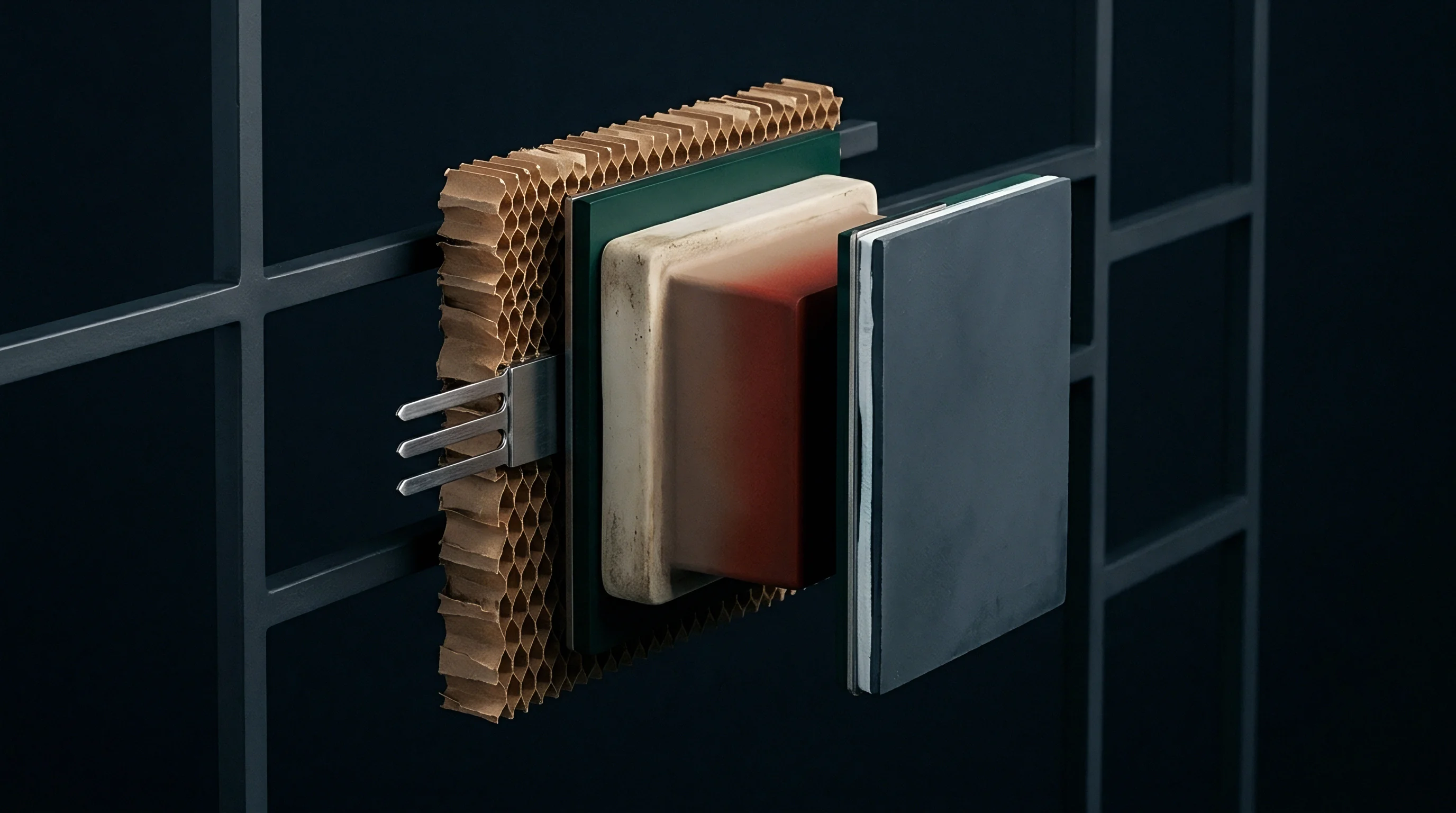
Calculating composite stiffness requires evaluating the second moment of area for each distinct layer. The flexural rigidity of multi-ply folding boxboard sums the elastic moduli of the layers multiplied by their respective moments of inertia relative to the central axis. Because the middle mechanical layer sits directly across the neutral axis where flexural stresses approach zero, its elastic modulus contributes minimally to overall stiffness; its primary job is keeping the outer chemical plies spatially separated.
- Outer Ply Modulus governs ultimate flexural load capacity through the intrinsic tensile stiffness of bleached chemical kraft fibres.
- Core Thickness Dimension determines the second moment of area by displacing skin layers away from the neutral bending plane.
- Z-Direction Shear Modulus prevents lateral sliding between plies when the composite structure experiences severe bending moments.
- Moisture Content Equilibrium alters hydrogen bonding networks within mechanical fibres, changing core thickness under humid ambient conditions.
Taber and Resonance Test Measurements
Standard laboratory evaluations measure force at a fifteen-degree deflection angle. Bending resistance testing under ISO 2493-1 uses a 50-millimeter bending length to record torque in millinewton-meters, whereas ISO 2493-2 specifies the 15-degree Taber method expressed in Taber Stiffness Units. Comparing folding boxboard (GC1 and GC2) with solid bleached board (SBB) highlights the structural efficiency of high-bulk mechanical cores, as SBB requires higher basis weight to match the caliper and bending stiffness of a CTMP-cored board.
| Grade Designation | Pulp Core Type | Grammage (g/m²) | Caliper (µm) | Bulk (cm³/g) | L&W Bending Resistance 15° MD (mN) | Taber Stiffness 15° MD (mN.m) |
|---|---|---|---|---|---|---|
| GC1 Folding Boxboard | Bleached CTMP | 215 | 350 | 1.63 | 240 | 11.8 |
| GC1 Folding Boxboard | Bleached CTMP | 280 | 480 | 1.71 | 580 | 28.4 |
| GC2 Folding Boxboard | Unbleached CTMP | 250 | 425 | 1.70 | 410 | 20.1 |
| GC2 Folding Boxboard | Unbleached CTMP | 330 | 590 | 1.79 | 990 | 48.5 |
| SBB Solid Bleached | Chemical Kraft | 270 | 350 | 1.30 | 230 | 11.3 |
| SBB Solid Bleached | Chemical Kraft | 350 | 460 | 1.31 | 540 | 26.5 |
| Data measured under ISO 534 for caliper and ISO 2493-1 for L&W 15-degree bending resistance. MD indicates Machine Direction. | ||||||
Machine-direction stiffness exceeds cross-direction stiffness because fibres align during wet-end sheet formation. The anisotropy ratio of machine-direction to cross-direction stiffness typically ranges between 1.8 and 2.4. Packaging designers orient carton main panels parallel to the machine direction to prevent wall bulging during automated filling.
Increasing mechanical core caliper yields greater carton rigidity than adding extra fiber mass to outer chemical plies.
Selecting substrate caliper based on carton face width rather than total grammage prevents panel bulging on automated packing lines.


Score
Creasing forces induce controlled internal delamination across the mechanical middle layer during carton blank formation. High-stiffness cartons require sharp, clean 90-degree and 180-degree folds without outer face cracking or surface rupture. As a steel rule presses paperboard into a matrix channel, the sheet experiences intense localized shear and compressive forces.
A properly engineered mechanical core yields internally along fibre boundaries, absorbing deformation while leaving the outer chemical plies intact.

Delamination Mechanics during Matrix Indentation
Female channel dies compress the board, forcing core fibres to fracture along horizontal planes. Internal bond strength ~ measured via Scott Bond testing according to ISO 16260 ~ defines the energy required to delaminate the middle layer. If the internal bond of the mechanical core exceeds 220 Joules per square meter, the core resists shear failure during creasing, driving strain outward into the chemical face plies and causing visible liner cracking along printed package edges.
Conversely, an internal bond strength below 90 Joules per square meter creates inadequate shear resistance. Under low bond strength, the middle layer delaminates prematurely during transport handling, leading to panel collapse under top-load compression.
Does Mechanical Core Bulk Determine Carton Stack Rigidity?
Compressive resistance under vertical loading depends directly on maintaining core thickness across folded vertical corners, which determines how high filled cartons can stack on warehouse pallets. When a creased corner folds 90 degrees, the mechanical core forms a localized hinge; if it collapses completely into a high-density crushed zone, the carton loses vertical column strength at its load-bearing corners.
| Crease Rule Width (mm) | Matrix Channel Width (mm) | Penetration Depth (mm) | Scott Bond Range (J/m²) | Folding Moment 90° (mN.m) | Visual Liner Cracking Status |
|---|---|---|---|---|---|
| 0.71 | 1.20 | 0.30 | 140 | 45 | Clean fold, no cracking |
| 0.71 | 1.00 | 0.40 | 240 | 78 | Severe top liner rupture |
| 1.05 | 1.60 | 0.35 | 130 | 38 | Clean fold, intact liner |
| 1.05 | 1.40 | 0.25 | 80 | 22 | Delamination outside fold zone |
Mechanical pulp fibres absorb atmospheric moisture rapidly when exposed to ambient air. Elevated moisture softens native lignin within CTMP cores, dropping internal shear resistance and altering optimum creasing matrix dimensions. Converters setting male-to-female tool clearances must monitor plant relative humidity continuously to preserve score integrity.
Compliance with ISO 16260 internal bond requirements ensures that crease score lines delaminate internally rather than rupture outer printed coatings.
Inadequate internal shear strength in the mechanical middle layer leads to cracked outer print surfaces and split corner edges during high-speed folding.


Tolerance
Cross-web thickness variations create unpredictable runnability on automated carton erecting machinery. Converting lines running at six hundred cartons per minute depend on uniform substrate caliper to control feed rates, glue application, and blank transfer. Caliper drift across a master reel alters bending resistance, leading to inconsistent fold angles on folder-gluers and jams inside packing line hoppers.

Caliper Variation across Web Profiles
Headbox dilution control systems regulate grammage profiles to limit thickness drift within specified bands, alongside moisture content, pressing uniformity, and calender roll nip pressure. ISO 534 specifies caliper measurement under an applied static load of 50 kilopascals with a parallel anvil surface area of 200 square millimetres. Paperboard buyers evaluate caliper variation across three distinct zones: machine-direction stability, cross-web profile, and sheet-to-sheet deviation within a single pallet.
- Extract ten full-size sample sheets from top, middle, and bottom sections of the delivered pallet shipment.
- Condition all specimens at 23 degrees Celsius and 50 percent relative humidity for twenty-four hours per ISO 187 requirements.
- Calibrate a digital micrometer using gauge blocks certified to ISO 534 static load specifications.
- Measure caliper at ten points across each sheet, recording profile variance against mill certificate targets.
Goods-in Inspection of Mill Certificates
Verifying delivered paperboard reels involves checking conditioning history against test standard requirements. Mill test reports list average values for basis weight, thickness, and bending stiffness, but a certificate citing compliance with nominal target numbers can mask wide cross-web variations if sampling during reel production was sparse. Buyers establish statistical process control acceptance limits based on standard deviation across delivered shipments.
| Property Metric | Test Method Standard | Nominal Specification Unit | Permissible Tolerance Band | Action Limit for Lot Rejection |
|---|---|---|---|---|
| Grammage | ISO 536 | g/m² | ± 3.0 % | > ± 5.0 % |
| Caliper (Thickness) | ISO 534 | µm | ± 4.0 % | > ± 7.5 % |
| Bending Stiffness | ISO 2493-1 | mN (L&W 15°) | ± 10.0 % | > ± 15.0 % |
| Moisture Content | ISO 287 | % H₂O | ± 1.0 % (Abs) | > 9.0 % Total |
| Scott Internal Bond | ISO 16260 | J/m² | 100 to 200 | < 90 or > 230 |
High winding tension on paper machine popes compresses high-bulk CTMP cores, permanently destroying up to five percent of total sheet caliper near the reel core. Unwinding damaged reels on converting lines then causes sudden drops in carton wall stiffness.
Unconditioned paperboard stored below forty percent relative humidity loses thickness through cell wall shrinkage in mechanical pulp fibers.
Incorporating ISO 534 thickness variation limits into purchase contracts allows converters to reject paperboard lots exhibiting caliper drift greater than four percent.
Tonnage
Purchasing paperboard on a mass basis while selling finished cartons by unit area makes commercial yield the primary metric of procurement efficiency. Mills bill shipments per metric tonne, while converters stamp out individual carton blanks measured in square meters. Optimizing mechanical core thickness allows buyers to specify lower-grammage grades that deliver equivalent caliper and bending rigidity, maximizing the printable carton blanks produced per tonne of raw material.

Yield Calculations for Mechanical Core Substitution
Replacing solid bleached chemical board with high-bulk folding boxboard reduces raw material weight while preserving bending stiffness. A 350 micrometre caliper solid bleached board requires a basis weight of 270 grams per square meter, whereas a GC1 folding boxboard with a high-bulk CTMP core achieves that same 350 micrometre caliper at a basis weight of only 215 grams per square meter. This grammage reduction of 55 grams per square meter delivers a twenty percent material saving per square meter of converted board.
Commercial Comparative Worked Example
Evaluating a production run of one hundred thousand cartons illustrates the financial impact of core bulk selection. Assuming a carton blank area of 0.12 square meters per unit, total required surface area equals twelve thousand square meters before make-ready waste. Substituting a 350 g/m² SBB sheet with a 295 g/m² GC1 high-bulk board yields an identical 450 micrometre structural stiffness, while freight costs drop proportionally with overall shipment weight.
| Substrate Specification Grade | Caliper (µm) | Grammage (g/m²) | Required Tonnage (Tonnes) | Substrate Price per Tonne (€) | Material Outlay (€) | Landed Cost per 1,000 Cartons (€) |
|---|---|---|---|---|---|---|
| Solid Bleached Board (SBB) | 450 | 350 | 4.41 | 1,650 | 7,276.50 | 72.76 |
| Standard GC1 Folding Boxboard | 450 | 310 | 3.91 | 1,580 | 6,177.80 | 61.78 |
| High-Bulk GC1 Mechanical Core | 450 | 280 | 3.53 | 1,620 | 5,718.60 | 57.19 |
| High-Bulk GC2 Cream Back | 450 | 265 | 3.34 | 1,510 | 5,043.40 | 50.43 |
Calculations account for a five percent process scrap rate during die-cutting and folding-gluing operations. The high-bulk GC1 option reduces material consumption by 0.88 tonnes compared to SBB, lowering direct material expenditure by twenty-one percent. Extended producer responsibility (EPR) packaging fees assessed per tonne of placed material yield further operational savings, confirming that high-bulk mechanical core folding boxboard lowers raw material weight while keeping structural box strength intact.