Resolving Interlaminar Shear Deformation Errors in Non Linear Paperboard Flexural Rigidity Testing
Correcting flexural rigidity tests for interlaminar shear prevents paperboard over-specification and reduces landed material costs by up to ten percent.

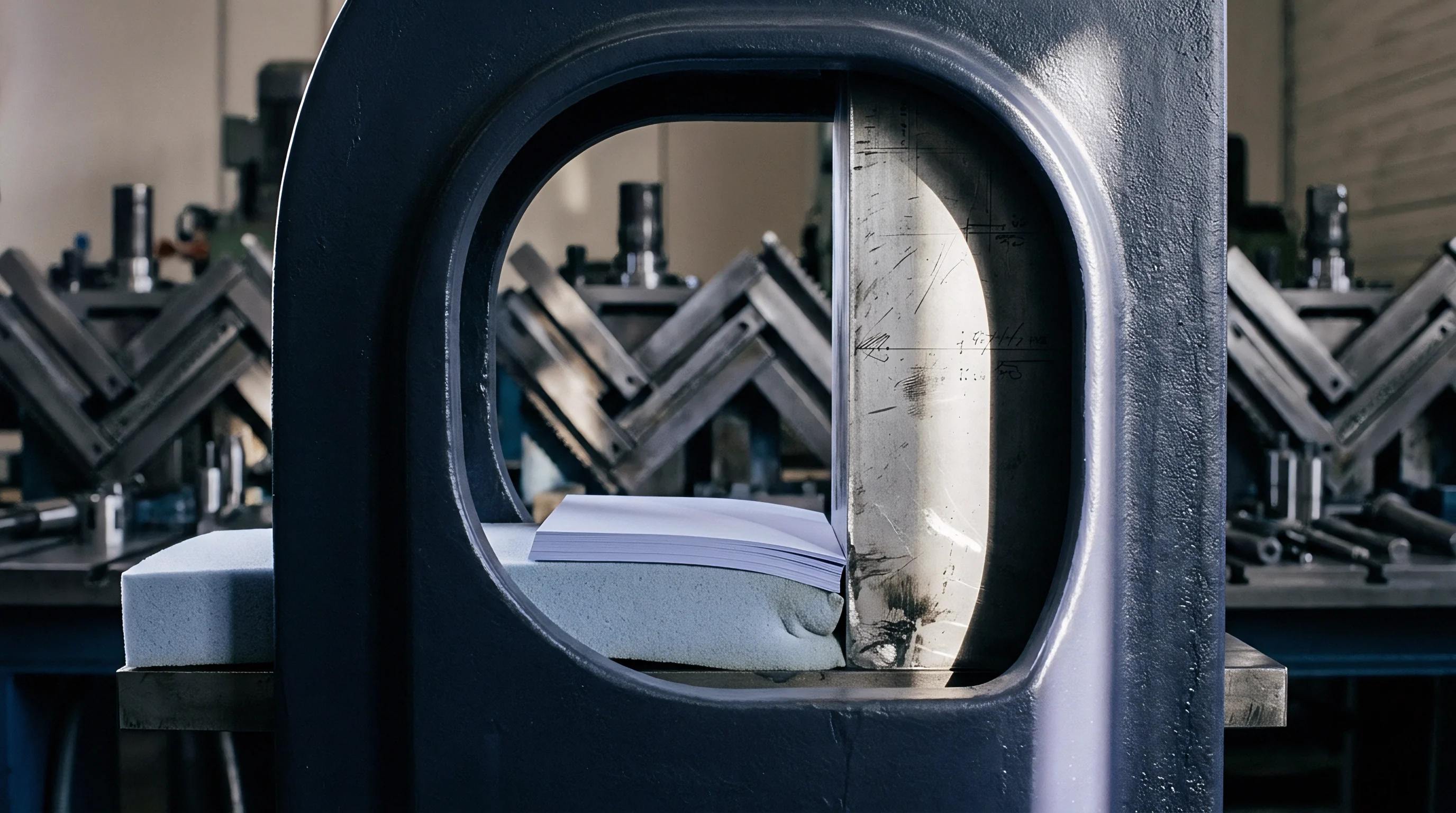
Shear
A dead-weight micrometer closes on a 450-micrometer folding boxboard sample at one hundred kilopascals to establish the baseline caliper for flexural rigidity evaluation. In standardized testing, flexural stiffness calculations rely on Euler-Bernoulli beam theory, treating paperboard as a thin, homogeneous, isotropic beam whose cross-sections remain planar and normal to the neutral axis during bending. Flexural stiffness governs box compression strength, but high-caliper multi-ply board structures routinely violate these assumptions under standard laboratory conditions.
Multi-ply paperboard combines distinct fiber layers to balance density, stiffness, and cost. The outer plies use dense, high-modulus bleached chemical pulps to handle peak tensile and compressive stresses during flexure. Middle plies incorporate bulk-yielding mechanical pulps or deinked recycled furnish to build sheet caliper efficiently.
Core plies carry transverse shear load, but these low-density central layers have low out-of-plane shear moduli relative to their in-plane elastic moduli. Under bending loads, that low core modulus permits internal sliding displacement between adjacent plies, generating interlaminar shear strain.
Standard test setups mask this shear compliance. When a two-point or three-point bending instrument applies force over short spans, total specimen deflection combines pure bending curvature with transverse shear strain. Standard instrument software calculates apparent flexural rigidity from total deflection alone, treating the sheet as a pure bending element.
Shear deformation inflates deflection and depresses measured rigidity, understating the intrinsic flexural capacity of the paperboard structure over longer functional spans.
Measured flexural rigidity drops by eighteen percent on a 500-micrometer folding boxboard when the test span decreases from 50 millimeters to 10 millimeters under ISO 2493-1 conditions.
The error from interlaminar shear escalates rapidly as the ratio of test span to sheet thickness narrows. Over short spans, shear stress becomes a primary driver of specimen displacement. Routine laboratory evaluations on heavy boxboard grades frequently capture high shear deformation, generating false indicators of material failure or subpar stiffness performance.
- Core Ply Transverse Yielding ~ Mechanical and recycled middle plies suffer low out-of-plane shear stiffness, inducing internal displacement under transverse load.
- Clamping Edge Stress Concentration ~ Fixed jaw boundaries in two-point testers create localized shear gradients that exaggerate apparent sheet compliance.
- Non-Linear Curvature Decoupling ~ Elastic-plastic transitions in outer bleached kraft liners shift the neutral axis, invalidating linear shear stress distribution models.
- Span Ratio Compression Artifacts ~ Short test lengths force shear deformation to account for up to thirty percent of measured specimen deflection.
Uncorrected shear errors lead packaging engineers to over-specify board caliper by twenty to thirty grams per square meter, generating thousands of dollars in unnecessary raw material costs per production run.

Theory
Structural analysis of flexural rigidity requires separating pure bending deformation from transverse shear compliance. Timoshenko beam theory provides the mathematical framework for this correction by incorporating out-of-plane shear strain into the global beam deflection equations. In a three-point bending configuration, total mid-span deflection equals the sum of bending deflection and shear deflection.
Pure bending assumes zero shear stress, but actual total deflection links specimen geometry, load, elastic modulus, and transverse shear modulus. The bending component scales with the cube of the test span length, whereas shear deflection scales linearly with span length. As a result, the relative contribution of interlaminar shear to total measured deflection expands rapidly as the test span contracts.
| Test Method | Standard Reference | Loading Geometry | Typical Span Ratio Range | Shear Deformation Error Magnitude |
|---|---|---|---|---|
| Two-Point Bending | ISO 2493-1 | Cantilever Clamp with End Load | 15:1 to 35:1 | High (12% to 25% underestimation) |
| Three-Point Bending | TAPPI T 556 | Center Load on Simple Supports | 20:1 to 40:1 | Moderate (8% to 18% underestimation) |
| Four-Point Bending | ISO 5628 | Dual Load Points on Simple Supports | 30:1 to 60:1 | Negligible (below 2% in central span) |
| Taber V-5 Stiffness | TAPPI T 489 | Two-Point Loading Driven Rollers | 10:1 to 25:1 | Severe (15% to 32% underestimation) |
The out-of-plane shear modulus of paperboard varies considerably by furnish type and multi-ply construction. Solid bleached sulfate boards exhibit relatively homogeneous transverse shear properties due to consistent chemical pulp refinement throughout all plies. Folding boxboard grades featuring high-bulk thermo-mechanical pulp cores exhibit pronounced shear compliance.
Coated unbleached kraft substrates possess high tensile stiffness in the outer plies, which creates severe shear stress gradients across the core interface during flexure.
ISO 2493-1 specifies a fifteen-millimeter bending length for general paperboard testing, which introduces measurable shear deformation errors on substrates exceeding three hundred micrometers in caliper.
Non-linear deformation behavior emerges when bending forces induce stress levels beyond the elastic limit of the core furnish. As the bending angle increases beyond standard initial deflection thresholds, internal shear stresses exceed the interlaminar shear strength of the fiber network. Micro-delamination initiates within the core layer.
This structural failure causes a rapid degradation of apparent flexural rigidity, altering the slope of the moment-curvature response.
While bleached chemical pulp exhibits higher shear resistance, standard test instruments operating at fixed bending angles of fifteen degrees often drive heavy paperboard past its elastic yield point. The recorded force then reflects post-yield shear damage rather than elastic flexural rigidity.
Compliance with TAPPI T 556 Annex A1 mandates reporting the span-to-thickness ratio alongside measured stiffness values to prevent uncorrected shear deflections from invalidating commercial mill certificate comparisons.


Geometry
Managing interlaminar shear errors requires strict control over test specimen dimensions and instrument clamp configurations. Testing across short spans distorts apparent bending stiffness; increasing the ratio of test span to sheet thickness provides the simplest physical method to isolate pure flexural performance during laboratory testing.
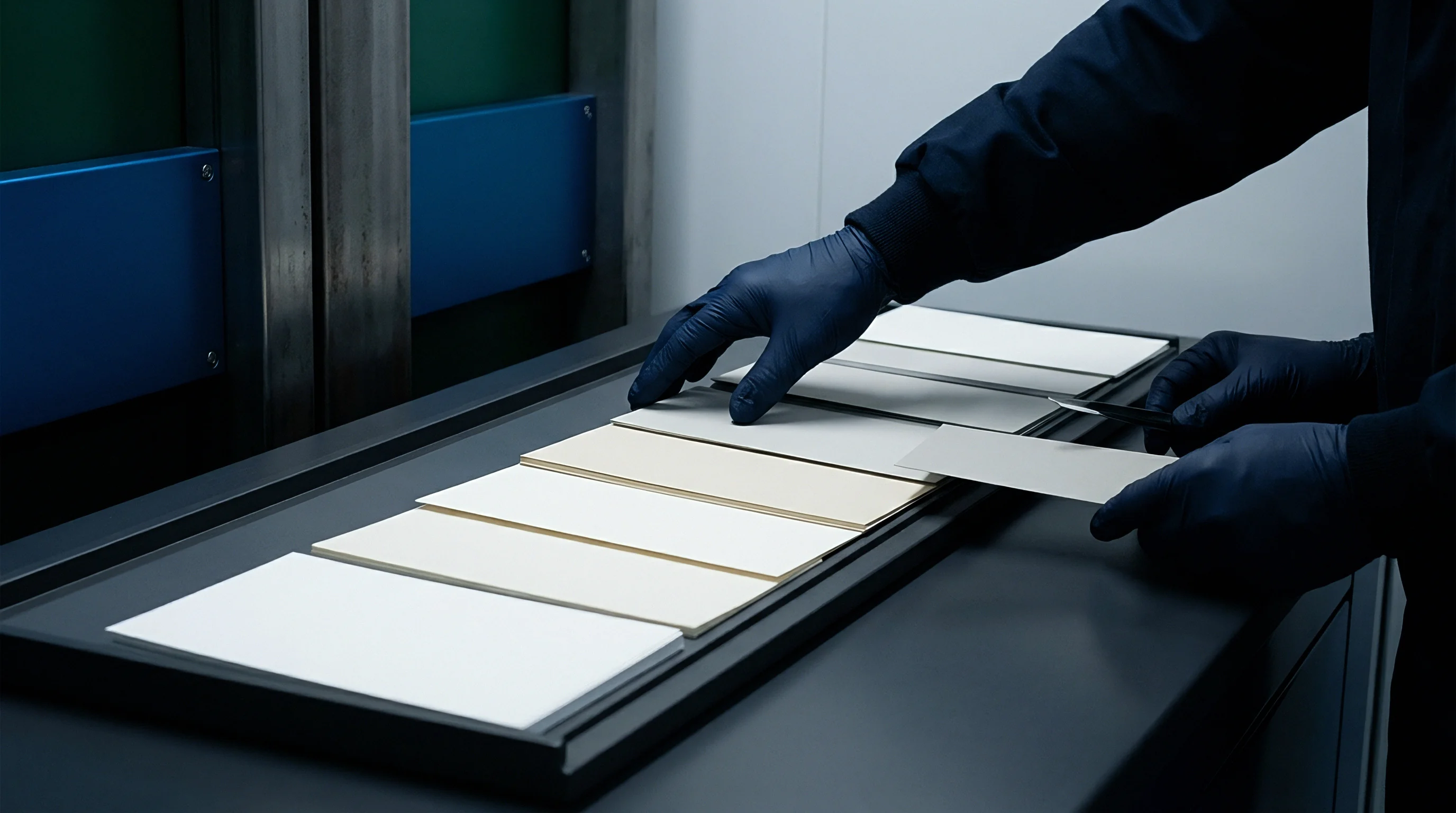
What Span Ratio Eliminates Interlaminar Shear Errors?
Experimental validation across diverse paperboard grades confirms that maintaining a span-to-thickness ratio above thirty to one reduces interlaminar shear error below five percent of measured flexural rigidity. For heavy cartonboard exceeding five hundred micrometers in caliper, standard fifteen-millimeter bending spans prove inadequate. Testing high-caliper materials at short spans generates severe shear contamination, obscuring real structural differences between substrate samples.
Four-point testing eliminates transverse shear forces across the evaluation area. In a four-point bending arrangement, the region between the two central loading points experiences pure bending moment with zero transverse shear force, rendering the measurement immune to core layer shear compliance. Four-point bending systems require precise specimen alignment, accurate load-cell zeroing, and frictionless contact points to yield repeatable flexural rigidity data.
- Measure exact sheet thickness using a dead-weight micrometer operating under ISO 534 standard pressure of one hundred kilopascals.
- Select a test span setting that maintains a length-to-thickness ratio of at least thirty to one across all sample orientation cuts.
- Calibrate instrument load cell and angle sensor against certified reference weights to eliminate mechanical tare resistance.
- Perform dual-span flexural testing at two distinct lengths to mathematically separate bending rigidity from interlaminar shear modulus.
- Record moment-deflection curves up to fifteen degrees of bending, identifying the linear elastic slope prior to internal ply yield.
Two-point bending instruments remain widespread in production quality control due to quick sample mounting and automated cycle times. However, clamping jaw mechanics introduce localized shear concentration at the fixed boundary edge. High clamping pressure crushes the core furnish near the grip line, lowering local out-of-plane shear modulus before testing begins.
Low clamping pressure allows micro-slippage within the jaw, which alters the effective cantilever span length.
Increasing flexural testing span length isolates pure bending behavior by diminishing the proportion of deflection caused by internal layer shear movement.
Thick boxboard demands these extended test spans. Adjusting jaw pressure to fifty kilopascals prevents cell-wall collapse in mechanical pulp core layers while securing the sample against root rotation. Consistent environmental conditioning at twenty-three degrees Celsius and fifty percent relative humidity maintains stable equilibrium moisture, preventing shear strength loss in moisture-sensitive core plies.
Selecting four-point bending over two-point clamping guarantees pure moment distribution across the central evaluation zone.
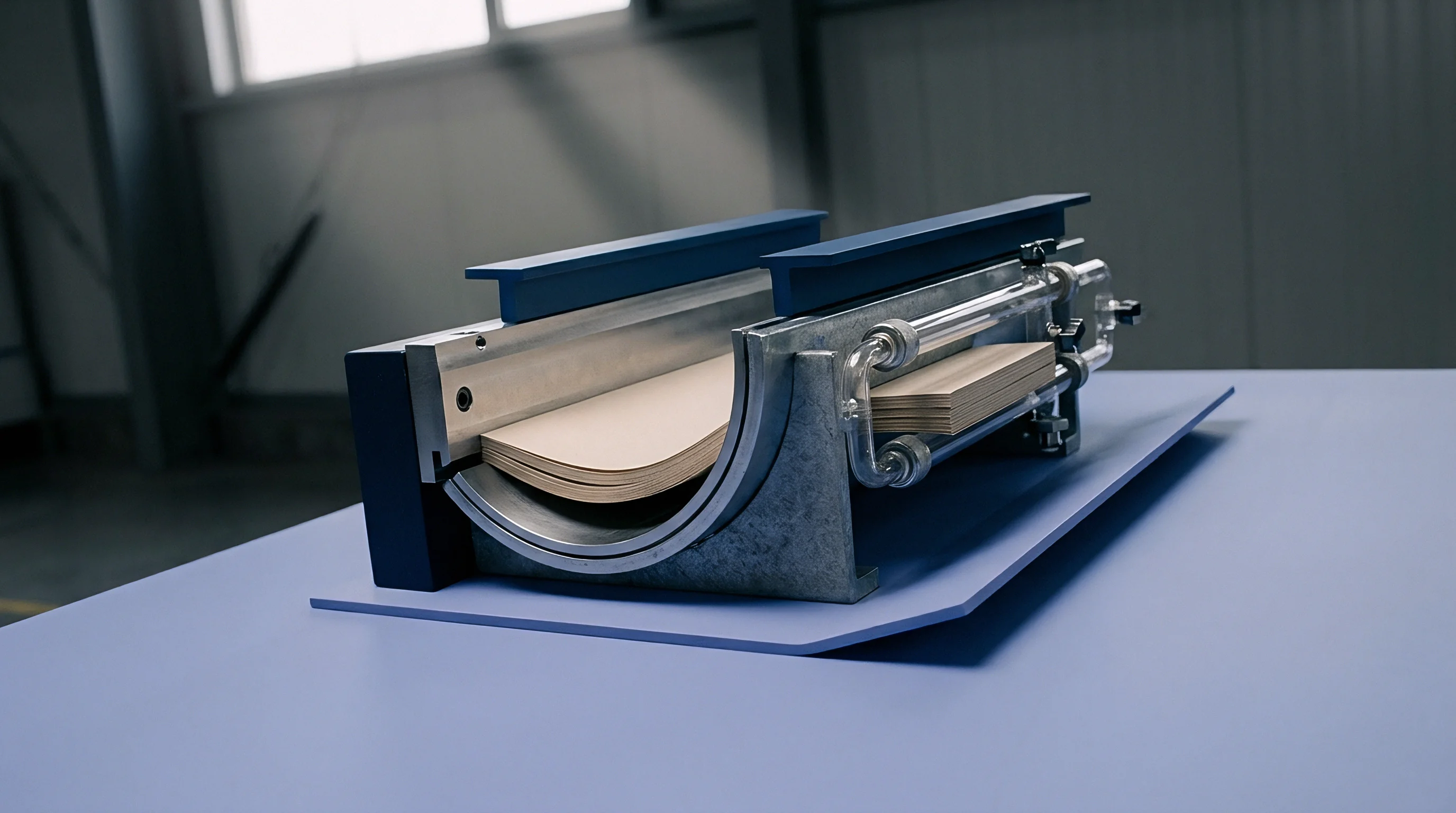
Calculus
Extracting absolute flexural rigidity from test data corrupted by shear compliance requires mathematical decoupling algorithms. The variable span method provides a rigorous empirical framework for isolating true bending stiffness without requiring destructive shear testing. This methodology evaluates the same paperboard sample across multiple span lengths to plot apparent compliance against geometric parameters.
Apparent flexural compliance represents the reciprocal of measured apparent stiffness. Under Timoshenko beam principles, apparent compliance scales linearly with the square of the thickness-to-span ratio. Plotting measured compliance against this squared ratio yields a straight line for elastic deformation.
Extrapolating this linear regression line to a theoretical infinite span length isolates the true bending compliance at the vertical axis intercept.
| Substrate Grade | Grammage (g/m²) | Caliper (µm) | Apparent Stiffness 15mm (mN·m) | True Bending Stiffness (mN·m) | Transverse Shear Modulus (MPa) |
|---|---|---|---|---|---|
| Solid Bleached Sulfate (SBS) | 300 | 380 | 18.5 | 21.2 | 185 |
| Folding Boxboard (FBB) | 280 | 450 | 22.1 | 27.8 | 72 |
| Coated Unbleached Kraft (CUK) | 330 | 460 | 28.4 | 33.6 | 140 |
| Coated Recycled Board (CRB) | 350 | 480 | 16.2 | 21.9 | 58 |
Plotting reciprocal stiffness isolates true flexural rigidity. The slope of the regression line directly determines the out-of-plane transverse shear modulus of the paperboard core layer. Low slope values indicate rigid, shear-resistant middle plies typical of dense chemical pulp constructions.
Steep slope values highlight compliant cores composed of high-yield mechanical pulp or recycled fibers.
The variable span method plots reciprocal apparent stiffness against squared thickness-to-length ratio to extract absolute bending rigidity at the vertical axis intercept.
Non-linear flexural response introduces mathematical complexity when testing extends beyond small deflection angles. At large bending deflections, stress distribution across the sheet thickness becomes non-linear as outer fibers undergo tension strain hardening and compression yielding. Paperboard anisotropic properties and internal micro-delamination further complicate the modulus calculations, invalidating linear flexural equations.
- Substrate Caliper Thresholds ~ Board samples above four hundred micrometers mandate multi-span evaluation to decouple shear compliance from intrinsic flexural modulus.
- Core Furnish Density ~ Low-density thermo-mechanical pulp middle layers exhibit lower shear moduli, requiring higher geometrical correction factors during non-linear deflection.
- Bending Angle Selection ~ Testing restricted to five degrees prevents non-linear delamination yield from distorting the fundamental elastic bending slope calculation.
- Machine Direction Anisotropy ~ Cross-direction specimens exhibit lower flexural stiffness and heightened shear susceptibility, necessitating independent dimensional parameter calibration.
High caliper board requires this precise calibration. Automated laboratory software executing real-time shear correction models calculates true bending stiffness instantaneously by processing dual-span sensor inputs. The system computes both true flexural rigidity and transverse shear modulus, outputting fully corrected physical metrics to mill certification dossiers.
Whether dynamic moisture equilibrium changes during high-speed converting alter the non-linear interlaminar shear yield point before the box blank completes high-speed folder-gluer square-up remains an open subject of mill testing.
Standard
Resolving interlaminar shear errors directly alters substrate selection arithmetic and packaging landed cost structures. Mill certificates frequently cite flexural rigidity figures derived from short-span two-point bending tests without disclosing shear deformation losses. When structural designers rely on uncorrected apparent stiffness data, they routinely select higher grammage options to meet carton top-load strength requirements.
Substrate selection directly governs finished carton yield. Consider a high-volume folding carton procurement program requiring five million packaging units. The baseline specification calls for a 350 gsm folding boxboard with a caliper of 500 micrometers, priced at 1,400 dollars per metric tonne.
Physical testing under standard ISO 2493-1 fifteen-millimeter span conditions records an apparent stiffness of 24.5 millinewton-meters. Applying Timoshenko shear correction calculations reveals that the true flexural rigidity of this sheet equals 30.2 millinewton-meters. The short-span test method introduces a nineteen percent error by capturing core layer shear deformation.
Correcting for shear compliance proves that a lighter 310 gsm folding boxboard grade delivers the actual 24.5 millinewton-meters of true bending rigidity required for structural carton performance. The optimized 310 gsm substrate carries a unit price of 1,420 dollars per metric tonne due to advanced fiber processing. Each parent sheet measures 700 by 1000 millimeters, yielding six carton blanks per sheet, resulting in 833,333 required sheets for the five-million-unit order.
The 350 gsm specification requires 204.16 metric tonnes of substrate, producing a total raw material cost of 285,824 dollars. The shear-corrected 310 gsm specification requires 180.83 metric tonnes of material, landing a total raw material cost of 256,778 dollars. Implementing shear-corrected testing algorithms delivers 29,046 dollars in direct substrate savings on a single packaging run while reducing freight weight by 23.33 metric tonnes and lowering Extended Producer Responsibility eco-fee exposure.
Integrating shear-corrected stiffness algorithms into incoming goods inspection allows converter quality teams to enforce precise structural performance standards across all board shipments.