Constitutive Viscoelastic Creep Modeling under Non Isothermal Cyclic Humidity Transient Gradients
Cyclic humidity accelerates containerboard creep through mechano-sorptive strain, requiring increased compression safety multipliers for cold-chain transit.


Matrix
Paperboard behaves as a time-dependent orthotropic solid when subjected to mechanical forces. In steady laboratory environments, cellulose fibers demonstrate classic viscoelastic behavior. Elastic deformation occurs immediately upon loading, followed by time-dependent strain that accumulates under constant stress.
Tensile and compressive moduli depend heavily on fiber alignment, inter-fiber bonding, and moisture content. When containerboard operates within standard environmental limits, mechanical responses remain within predictable linear viscoelastic bounds.

Cellulosic Structure and Viscoelastic Strain
Refined softwood fibers yield measurable deformation under continuous sustained loads. Wood pulp consists of crystalline cellulose microfibrils embedded in an amorphous matrix of hemicellulose and lignin. Moisture acts as a plasticizer within these amorphous regions.
As relative humidity rises, ambient water vapor penetrates the fiber matrix, weakening intermolecular hydrogen bonds and lowering the glass transition temperature of hemicellulose. Fiber orientation dictates structural stiffness. Machine-direction orientation yields higher tensile strength and lower strain accumulation, while cross-direction orientation exhibits greater compliance and susceptibility to creep.
Static viscoelastic creep models rely on classical mechanical analogies, such as the four-parameter Burgers model. This model combines a spring and dashpot in series with a parallel Kelvin-Voigt element. The spring captures instantaneous elastic response, while the uncoupled dashpot represents permanent viscous flow.
The parallel combination models retarded elastic strain. Under fixed temperature and relative humidity, these parameters remain constant, allowing accurate predictions of long-term deformation. Paper strength drops rapidly.
Stacking loads remain constant. When ambient humidity remains static, strain accumulation decreases logarithmically over time.
| Grade | Grammage (g/m²) | Conditioning Climates | Elastic Modulus E0 (MPa) | Retarded Elastic Modulus E1 (MPa) | Viscous Strain Rate (1/s) |
|---|---|---|---|---|---|
| Virgin Kraftliner | 175 | 23°C, 50% RH | 7200 | 14500 | 1.2e-8 |
| Virgin Kraftliner | 175 | 23°C, 85% RH | 4100 | 8200 | 8.5e-8 |
| Recycled Testliner | 140 | 23°C, 50% RH | 4800 | 9600 | 3.1e-8 |
| Recycled Testliner | 140 | 23°C, 85% RH | 2300 | 4100 | 2.4e-7 |
| Semi-Chemical Fluting | 120 | 23°C, 50% RH | 5400 | 11000 | 1.8e-8 |
| Semi-Chemical Fluting | 120 | 23°C, 85% RH | 3100 | 5900 | 1.1e-7 |
Elevated moisture levels reduce the elastic modulus E0 and accelerate the viscous strain rate across all paper grades. Recycled fibers exhibit greater performance degradation at high relative humidity compared to virgin fibers. Recycled fibers absorb water quickly.
Severe Hornification during repeated repulping cycles damages internal cell wall structures, reducing total hydrogen bonding potential and increasing compliance under load. Underestimating static compliance shifts panel deformation into non-linear failure regimes before container ships complete their ocean transit, exposing importers to total cargo claims.
Swell
Water molecules enter the amorphous regions of the fiber wall and force microfibrils apart. This molecular interaction drives hygro-expansion across all three dimensional axes of paperboard. Dimensional changes occur disproportionately along the thickness direction, where fiber swelling causes out-of-plane expansion up to ten times greater than in-plane dimensional shifts.

Transient Moisture Diffusion and Thickness Expansion
Relative humidity changes alter the internal moisture distribution across a containerboard sheet. Transient moisture transport follows Fickian diffusion equations during early adsorption phases, but departs from linear predictions as moisture levels approach saturation. As water diffuses through the web, localized moisture gradients develop between surface layers and the inner core.
Differential swelling across the sheet cross-section generates severe internal stress fields, even without external mechanical loads.
A 10 percent rise in equilibrium moisture content reduces the machine-direction compressive modulus of unbleached kraftliner by 38 percent under 23 degrees Celsius ambient storage.
Structural failure modes in corrugated containers emerge directly from these localized moisture dynamics under load:
- Compression Loss Moisture uptake reduces hydrogen bonding density between adjacent fibers, triggering localized web buckling under compression.
- Thickness Distortion Non-uniform moisture absorption causes z-direction expansion, weakening internal bond strength measured under ISO 16260.
- Creep Acceleration Hygro-expansion strains combine with mechanical stresses, driving continuous deformation beyond static predictions.
- Delamination Risk Shear stresses between outer liners and corrugated fluting exceed adhesive bond limits during rapid humidity swings.
Delamination destroys stack integrity. When moisture absorption occurs under continuous compression, hygro-expansion strains do not simply add linearly to viscoelastic strains. Instead, the combination creates synergistic structural degradation.
Virgin fibers resist hygro-expansion. Uncoated paper surfaces absorb ambient moisture rapidly, causing rapid stiffness loss during the first two hours of humidity exposure. Mills frequently claim that laboratory re-wetting tests reproduce field performance, ignoring the structural impact of cyclic sorption histories.

Coupling
Simultaneous application of mechanical stress and cyclic relative humidity produces accelerated deformation rates. This phenomenon, known as the mechano-sorptive effect, drives strain accumulation far exceeding the sum of independent viscoelastic creep and hygro-expansion. Paper subjected to cyclic moisture fluctuations under sustained stacking loads fails at stress levels far below its static compressive strength.
Mechano-Sorptive Strain Derivation
Mathematical formulations combine elastic compliance with moisture-induced softening terms. Constitutive modeling of mechano-sorptive creep incorporates a stress-dependent strain term tied directly to the rate of moisture change, rather than moisture content alone. Strain accelerates during both sorption and desorption phases, with desorption producing particularly severe creep rates.
Moisture breaks hydrogen bonds. As water molecules migrate through cellulose structures under load, temporary disruption of inter-fiber bonds allows micro-slippage before new bonds form in relaxed configurations.
| Board Substrate | Mechano-Sorptive Coefficient mu (m2/kg) | Transient Strain Rate (1/hr) | Static Creep Rate (1/hr) | Strain Acceleration Factor |
|---|---|---|---|---|
| Unbleached Kraftliner | 0.0018 | 4.2e-4 | 3.5e-5 | 12.0 |
| Recycled Testliner | 0.0029 | 1.1e-3 | 6.8e-5 | 16.2 |
| Semi-Chemical Fluting | 0.0014 | 3.1e-4 | 2.9e-5 | 10.7 |
| Recycled Fluting | 0.0034 | 1.6e-3 | 8.2e-5 | 19.5 |
The acceleration factor measures the ratio of transient creep rate to static creep rate at equivalent peak humidity. Recycled fluting demonstrates extreme sensitivity to cyclic environments, displaying a strain acceleration factor of 19.5 under severe relative humidity swings. Desorption increases total strain.
Semi-chemical virgin fluting retains structural performance due to higher lignin content and superior fiber length distribution, which limit inter-fiber micro-slippage.
DIN EN ISO 12048 stacking tests conducted at static 50 percent relative humidity omit mechano-sorptive creep effects, invalidating warehouse life predictions in tropical supply chains.
Standard laboratory testing under static conditions severely overstates packaging survival times. When relative humidity cycles between 50 percent and 85 percent, structural life drops by up to 80 percent compared to static 85 percent storage. Static tests understate transport risks.
The exact atomic mechanism by which transient water transport unlocks trapped stress in amorphous hemicellulose remains open to academic dispute.

Hysteresis
Adsorption and desorption paths across cellulose networks follow distinct thermodynamic equilibrium curves. At any given relative humidity, paperboard retains a higher equilibrium moisture content during desorption than during adsorption. Temperature cycles exacerbate this thermodynamic hysteresis.
Cold storage elevates equilibrium moisture. Non-isothermal conditions, such as those in refrigerated supply chains, alter both diffusion kinetics and mechanical compliance continuously.
What Triggers Accelerated Creep during Moisture Desorption?
Hydrogen bonds break and reform rapidly while water molecules escape the wood fiber assembly under load. Moisture loss increases internal stress concentrations around structural defects. Temperature accelerates moisture diffusion.
When warm, humid packaging enters cold storage facilities, rapid surface cooling creates steep thermal gradients. Thermal expansion acts in opposition to hygro-shrinkage during cooling phases, generating complex internal shear stresses near surface boundaries.
Laboratory evaluation of non-isothermal creep requires strict environmental control and precise load application:
- Mount the specimen in an environmental chamber with precise load control to establish baseline mechanical equilibrium.
- Condition the chamber to 50 percent relative humidity at 20 degrees Celsius until mass variation drops below 0.05 percent over four hours.
- Apply a sustained axial load corresponding to 30 percent of the short-term compressive failure threshold.
- Ramp ambient relative humidity between 50 percent and 85 percent over two-hour intervals while maintaining temperature within 0.2 degrees Celsius.
- Record total vertical deflection continuously using optical displacement sensors to isolate transient strain responses.
- Repeat the environmental cycle across temperature steps from 5 degrees Celsius to 35 degrees Celsius to measure thermal activation parameters.
Defrost cycles trigger moisture spikes. Moisture desorption under continuous compressive stress drives permanent cell wall collapse. As water evaporates, capillary forces pull microfibrils together while external load guides the direction of strain, locking in permanent deformation.
Uncoated boards fail first. Selecting linerboards based solely on dry compression performance guarantees box failure when packaging passes through non-isothermal distribution channels.
Desorption phases under mechanical load drive higher strain rates than sorption phases at identical moisture levels.


Distortion
Panel deflection in loaded shipping cartons increases exponentially under ambient humidity fluctuations. Corrugated boxes carry stacking loads primarily through their vertical corners. When transient relative humidity cycles weaken the fluting medium, load transfers from panels to corners, accelerating corner post creep and triggering panel bulging.
Fluting profiles resist bending.
Corrugated Fluting Buckling Mechanisms
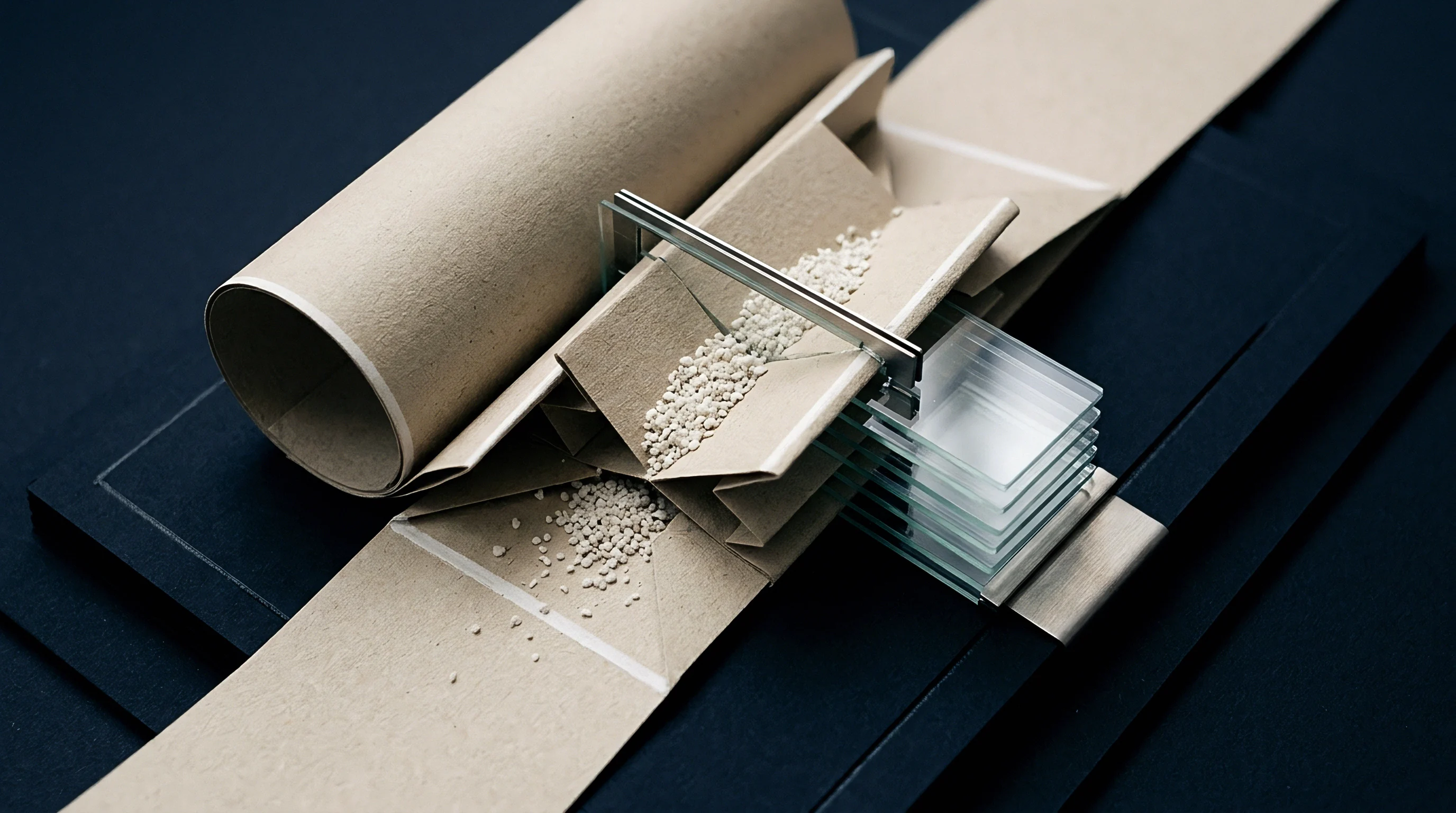
Structural collapse in double-wall boxes initiates at the central medium under compression. High moisture levels degrade shear stiffness in the fluting layer, allowing linerboards to buckle laterally. Stress concentrations initiate panel buckling.
Creep deformation distorts geometry, reducing the Box Compression Test (BCT) capacity continuously throughout the storage period.
| Storage Environment | Relative Humidity Range (%) | Temperature Cycle (°C) | Standard BCT Retention (%) | Corrected Safety Multipliers |
|---|---|---|---|---|
| Standard Warehouse | 50 – 65 | 18 – 22 | 80 | 1.6 |
| High Humidity Export | 70 – 90 | 20 – 30 | 45 | 2.8 |
| Reefer Cold Chain | 80 – 95 | 4 – 15 | 32 | 3.5 |
| Uncontrolled Tropical | 60 – 95 | 25 – 40 | 22 | 4.8 |
Safety multipliers require careful adjustment. Standard packaging specifications rely on static safety factors between 1.5 and 2.0. In environments featuring non-isothermal cyclic humidity, proper engineering practice demands safety multipliers between 3.5 and 4.8 to prevent structural collapse over extended shipping durations.
Uncoated recycled fluting loses structural rigidity faster during moisture desorption than virgin semi-chemical fluting.
Packaging buyers manage transit exposure by implementing technical qualification protocols prior to contract execution:
- Substrate Sourcing Verify that fluting mediums utilize virgin semi-chemical pulp for export routes exceeding 80 percent relative humidity.
- Safety Factors Apply corrected compression multipliers that incorporate mechano-sorptive strain factors rather than static lab values.
- Chain Verification Match paper mill test certificates directly against physical batch shipment documentation before packaging assembly.
- Coating Application Specify moisture-barrier coatings to damp peak humidity absorption during cold storage transit.
Custom holds disrupt delivery schedules. Material compliance files must demonstrate that specified containerboard grades meet required physical performance standards. Incorporating ISO 2233 conditioning schedules into supply contracts forces packaging suppliers to reimburse cargo damage resulting from cyclic humidity creep.
Limitation
Numerical simulations of containerboard deformation depend heavily on laboratory conditioning data. Finite Element Analysis (FEA) models implement constitutive viscoelastic equations to predict container failure under stack loads. Most commercial FEA solvers assume homogeneous material properties across individual paper plies.
Paperboard manufacturing introduces density variations, localized grammage non-uniformity, and fiber orientation fluctuations that alter localized creep rates across single panels.
Predictive Boundary Conditions for Finite Element Analysis
Computational models assume uniform material density across the entire sheet cross section. Real corrugated sheets display thickness variations up to eight percent across the machine direction. Fiber orientation governs structural stiffness.
When non-isothermal cyclic humidity gradients interact with non-uniform density distributions, localized stress peaks emerge unpredictable by standard linear constitutive solvers.
Consider a 40-tonne consignment of fresh produce packed in corrugated cartons stacked six pallets high in a reefer container held at 4 degrees Celsius and 90 percent relative humidity. Assume the baseline Box Compression Test strength of each box equals 3.2 kilonewtons under standard laboratory conditions of 23 degrees Celsius and 50 percent relative humidity. Under static laboratory testing, a safety multiplier of 1.6 predicts an allowable load of 2.0 kilonewtons per box, sufficient for the 1.4 kilonewton bottom-box static load.
When accounting for cyclic relative humidity transitions between 70 percent and 95 percent during refrigeration defrost cycles, mechano-sorptive creep reduces effective compression capacity by 62 percent over 21 days. Actual load capacity falls to 1.22 kilonewtons, creating a 0.18 kilonewton overload per box. Overload causes creep buckling of bottom container panels, resulting in pallet tipping and product crushing.
Landed loss across forty tonnes of cargo equals 68,000 EUR in damaged produce and disposal fees.
Uncertified linerboard carries duty risks. Certification scopes under FSC-STD-40-004 or PEFC ST 2002 verify chain of custody integrity, but provide no warranty regarding mechanical performance under transient moisture gradients. A certified recycled testliner document proves sustainable fiber sourcing without guaranteeing that the substrate will resist mechano-sorptive strain in humid transit.
Documenting paperboard performance through certified test reports and verifying material origin through FSC or PEFC chains of custody protects buyers against uncertified grade substitutions that fail under harsh transit environments.