Viscoelastic Creep Compliance Analysis in Heat Embossed Boxboard Packaging
Heat embossing lowers boxboard creep resistance by disrupting fiber bonds, demanding higher safety factor allowances in carton top-load calculations.
Deformation
Cellulosic webs subjected to localized mechanical pressure exhibit immediate elastic straining followed by long-term time-dependent structural shift. In packaging boxboard, the application of heated male and female embossing dies reconfigures the internal network of bleached chemical and mechanical pulp plies. Creep compliance defines the ratio of time-dependent strain to applied constant stress.
When a board panel undergoes high-pressure stamping, the local modulus of elasticity drops significantly across the compressed relief zones. Fiber-to-fiber bonded joints, crushed during tool closure, lose their original orientation and undergo permanent shear deformation. The resulting structural transition leaves the converted carton vulnerable to progressive creep under sustained compression during warehouse palletization.
Polymer networks yield under load. Mechanical stress fields inside the stamping nip are highly non-uniform. The top liner experiences sharp shear gradients along the male die edges, while the middle bulking plies undergo intense z-direction densification.
Fiber bonds slip instantly. Immediate elastic recovery occurs within milliseconds after die separation, restoring a fraction of the uncompressed caliper. The remaining strain persists as viscoelastic and plastic set.
The time-dependent portion of this strain continues to accumulate whenever the package encounters external forces. Boxboard structural integrity relies on the middle ply maintaining flexural rigidity. Thermal stamping crushes the middle mechanical pulp layer, reducing the moment of inertia across the embossed panel and elevating long-term compliance under static top loads.
Boxboard loaded at thirty percent of short-span compressive strength under sixty percent relative humidity exhibits double the compliance rate measured at fifty percent relative humidity.

Microstructural Displacement under Thermal Compression
The application of localized force alters internal fiber arrangement within the multi-ply structure. High-magnification cross-sectional analysis reveals that heated embossing tools melt the surface coating binders while simultaneously plasticizing the underlying cellulose fibers. Heat transfers from the die face into the board core at a rate governed by thermal conductivity and moisture content.
As temperature rises within the compressed zone, the modulus of the hemicellulose and lignin matrix drops sharply. Fiber wall collapse occurs in the central mechanical pulp plies, permanently altering the local density profile. Local density spikes alter strain.
This localized crushing reduces flexural rigidity across the stamped impression, transforming a previously stiff, flat panel into a series of rigid peaks joined by compliant, thin structural troughs.
Stress relaxation occurs simultaneously with strain accumulation during die contact. Long dwell times under high heat permit structural relaxation of internal stresses, reducing post-stamping springback. Short dwell times at ambient temperatures leave high residual elastic stresses within the fiber network, driving rapid debossing decay post-conversion.
Mechanical stamping without applied thermal energy forces cellulose microfibrils to store strain energy elastically, causing the embossed image to flatten as the package ages. Applying heat during stamping forces permanent molecular slip, locking the structural profile into place while sacrificing local compressive load resistance. The sacrifice in panel stiffness directly elevates the creep compliance coefficient of the finished folding boxboard panel.
Deep relief impressions create severe localized strain concentration along the wall angle of the male tool. Fiber network tearing occurs when the local shear strain exceeds the ultimate tensile strain of the wet-strength chemical pulp top liner. Even without micro-tearing, the severe thinning of the board caliper along impression edges creates localized compliance hot spots.
These regions act as hinge points under top-load compression, accelerating panel bowing and vertical creep failure during storage.
Glass
Polymeric components within wood pulp fibers change state when thermal energy disrupts hydrogen bonding networks. Unbleached kraft pulp, bleached chemical pulp, and groundwood mechanical pulp contain varying ratios of cellulose, hemicellulose, and lignin. Native lignin exhibits a glass transition temperature ranging from 120°C to 150°C in dry states, whereas hemicellulose transitions between 160°C and 180°C. Water acts as a powerful plasticizer within these natural polymers.
Increasing fiber moisture content to eight percent depresses the glass transition threshold of lignin down to a range between 60°C and 80°C. Heated embossing operations operating between 90°C and 130°C capitalize on this moisture-driven reduction in glass transition thermal limits to shape the board web under moderate platen pressures.
Moisture lowers critical threshold values. Surface mineral coatings composed of calcium carbonate, clay, and synthetic latex binders undergo concurrent thermal transitions during stamping passes. Styrene-butadiene rubber latex binders feature glass transition points designed near ambient temperature to ensure film formation during mill coating operations.
Under heated embossing dies, these latex particles soften and flow, filling micro-voids in the pigment matrix and forming a smoothed, dense surface skin. Surface coating consolidation seals moisture within the core plies during tool contact, temporarily elevating internal vapor pressure and aiding in the thermal softening of the central mechanical pulp plies.
Tool dwell fixes permanent deformation. The duration of die contact dictates the depth of heat penetration into the central bulking plies. If die contact ends before the central ply reaches its localized glass transition threshold, deformation remains purely mechanical, resulting in severe profile recovery after stripping.
Conversely, reaching softening temperatures throughout the entire board caliper allows internal stress relaxation, yielding sharp image retention at the cost of catastrophic loss in flexural stiffness.
Moisture Plasticization and Matrix Phase Changes
Water molecules act as active softening agents within amorphous cellulose regions. Hydrogen bonds between cellulose chains break and reform rapidly in the presence of heat and moisture, permitting microfibril sliding under applied shear stresses. Heated tools drive water vapor away from the hot die face toward the cooler interior of the board web, creating a dynamic moisture gradient across the caliper during stamping.
This moisture migration temporarily softens the core plies, accentuating z-direction compression while preserving the dry strength of the opposing unheated liner face.
Re-equilibration of moisture post-stamping restores the rigid hydrogen-bonded network, fixing the physical shape of the embossed relief. Rapid moisture loss to dry factory air locks in high internal stress levels if cooling occurs too fast. Subsequent exposure to elevated ambient humidity reactivates molecular mobility within the amorphous zones, initiating secondary creep deformation.
The board web expands laterally, relief sharpness degrades, and the overall creep compliance of the panel rises under static stacking forces.
| Substrate Constituent | Dry Glass Transition (°C) | Plasticized Glass Transition at 8% Moisture (°C) | Deformation Mechanism Under Die Pressure | Contribution to Creep Compliance |
|---|---|---|---|---|
| Amorphous Cellulose | 200–250 | 90–110 | Hydrogen bond rearrangement and microfibril slip | Primary driver of delayed elastic compliance |
| Hemicellulose | 160–180 | 40–60 | Rapid molecular chain sliding | Main contributor to transient secondary creep |
| Native Lignin | 120–150 | 60–80 | Viscous flow and permanent shear set | Determines irrecoverable plastic deformation |
| Styrene-Butadiene Latex | 10–25 | 5–15 | Polymer film deformation and void filling | Governs surface coating micro-cracking rate |
Process variables during heated conversion follow a defined chronological sequence from initial tool contact to final moisture equilibration. Skipping thermal controls during any step alters the viscoelastic balance of the converting web.
- Web pre-conditioning adjusts board moisture to target levels between six and eight percent to ensure adequate molecular mobility during stamping.
- Die engagement applies synchronized mechanical pressure and thermal flux, driving local board temperatures above the plasticized glass transition threshold.
- Thermal dwell maintains compressive loading while internal stresses relax within the softened polymer matrix across all plies.
- Die release frees the web from mechanical restraint, permitting immediate elastic springback of the unSoftened microfibril structure.
- Cooling phase drops local sheet temperatures below the glass transition point, locking in the permanent viscoelastic set.
- Moisture re-balancing brings the converted board into equilibrium with ambient storage conditions, settling residual hygroscopic strain gradients.
Compliance with ISO 187 conditioning mandates thermal equilibrium prior to mechanical stress testing to prevent artificial creep suppression.
Converters frequently attribute post-emboss panel collapse to ambient warehouse fluctuations rather than incomplete thermal bonding during the stamping pass.

Spectrum
Predicting long-term mechanical response requires mathematical functions that isolate elastic, delayed elastic, and viscous components. Creep compliance compliance function J of t represents total time-dependent strain divided by constant applied stress. The four-element Burgers model models this behavior by combining a Maxwell element with a Kelvin-Voigt element in series.
Equation formulations define total compliance as the sum of instantaneous elastic compliance, retarded compliance, and pure viscous flow. Instantaneous compliance accounts for initial structural deformation upon load application. Retarded compliance captures delayed elastic movements governed by cellulose molecular uncoiling.
The viscous flow component accounts for permanent, irrecoverable displacement caused by sliding at fiber-to-fiber interfaces.
Unembossed board retains flexural stiffness. Introducing heat-embossed geometry introduces non-linear structural compliance into the constitutive equations. The Findley power-law model provides an accurate empirical fit for long-term creep in paperboard under variable atmospheric conditions.
The model expresses compliance as initial compliance plus a stress-dependent multiplier multiplied by time raised to a fractional power exponent n. For unembossed boxboard, the time exponent n ranges between 0.15 and 0.20. Deep heat embossing crushes internal fiber architecture, driving exponent n values up to 0.28 to 0.35, indicating a accelerated rate of long-term dimensional degradation under static load.
Analytical Mechanics and Time-Dependent Modeling
Constitutive equations describe how mechanical strain accumulates under sustained static loading. Time-temperature-humidity superposition principles allow short-term compliance test data gathered at elevated temperatures or relative humidities to predict multi-month warehouse creep rates. Creep amplitude escalates with heat.
Shift factors calculated via the Williams-Landel-Ferry equation map compliance curves measured over hours into continuous master curves predicting performance across months of pallet storage.
Consider a practical engineering evaluation comparing an unembossed boxboard panel against a heat-embossed panel on a 350 grams per square meter Folding Boxboard (FBB) substrate with an uncompressed caliper of 450 micrometers. The embossing pass uses a heated male-female tool set with a relief depth of 180 micrometers, operating at a die temperature of 110°C and a dwell time of 80 milliseconds. The evaluation applies a constant compressive stress of 1.2 megapascals across both samples in an environmental chamber maintained at 23°C and 50 percent relative humidity for 1,000 hours.
Baseline empirical measurements yield the following Findley model parameters for the unembossed control board:
- Instantaneous elastic compliance J0 equals 0.18 inverse gigapascals.
- Creep coefficient k measures 0.042 inverse gigapascals per hour raised to power n.
- Time exponent n measures 0.18 dimensionless.
Applying these parameters to the Findley compliance equation at t = 1,000 hours:
J(1000) = 0.18 + 0.042 (1000^0.18)
J(1000) = 0.18 + 0.042 3.467 = 0.18 + 0.1456 = 0.3256 inverse gigapascals.
Total accumulated strain under 1.2 megapascals stress equals stress multiplied by compliance:
Strain = 1.2 0.3256 = 0.3907 millimeter per millimeter, representing a 39.07 percent structural strain.
The heat-embossed board panel, tested under identical load and environmental conditions across the stamped relief area, yields altered parameters due to ply crushing and fiber bond disruption:
- Instantaneous elastic compliance J0 increases to 0.27 inverse gigapascals due to reduced local flexural rigidity.
- Creep coefficient k increases to 0.085 inverse gigapascals per hour raised to power n.
- Time exponent n increases to 0.31 dimensionless as a direct result of internal matrix softening and micro-fracturing.
Recalculating compliance at t = 1,000 hours for the heat-embossed structure:
J(1000) = 0.27 + 0.085 (1000^0.31)
J(1000) = 0.27 + 0.085 8.511 = 0.27 + 0.7234 = 0.9934 inverse gigapascals.
Total accumulated strain for the heat-embossed panel under 1.2 megapascals stress equals:
Strain = 1.2 0.9934 = 1.1921 millimeter per millimeter, representing a 119.21 percent structural strain.
Heat embossing increases total creep compliance after 1,000 hours by a factor of 3.05 compared to the unembossed board. Strain accumulation accelerates under cyclic humidity conditions, where transient moisture adsorption accelerates microfibril slippage, further increasing long-term dimensional decay.
Dwell time under hot embossing dies locks structural orientation faster than ambient mechanical stamping.
Inserting TAPPI T 839 short-term compliance limits into board supply contracts shifts financial liability for stack lean directly onto the board mill.

Stacking
Container top-load resistance depends on the structural integrity of vertical corner edges and flat side panels. Box compression strength is reliably estimated using the McKee formula, which calculates compressive resistance as a function of board short-span compressive strength, flexural stiffness in both machine and cross directions, and box perimeter. Heat embossing directly alters two key inputs of this relationship: short-span compressive resistance and flexural stiffness.
Compressive forces acting on a stacked pallet place side walls under vertical creep loading. Localized crushed ridges formed during hot stamping act as initial geometric imperfections, lowering the threshold load required to trigger elastic panel buckling.
Static loads accelerate profile decay. Corner crease lines carry top-load. When embossed features lie close to vertical crease lines or cover large surface areas on main panels, the reduced panel bending stiffness reduces overall top-load capability over time.
As warehouse storage time extends from days to months, viscoelastic creep lowers the effective compressive strength of the board walls. The box load capacity gradually drops until the applied load exceeds the decaying capacity, causing abrupt structural failure and pallet collapse.
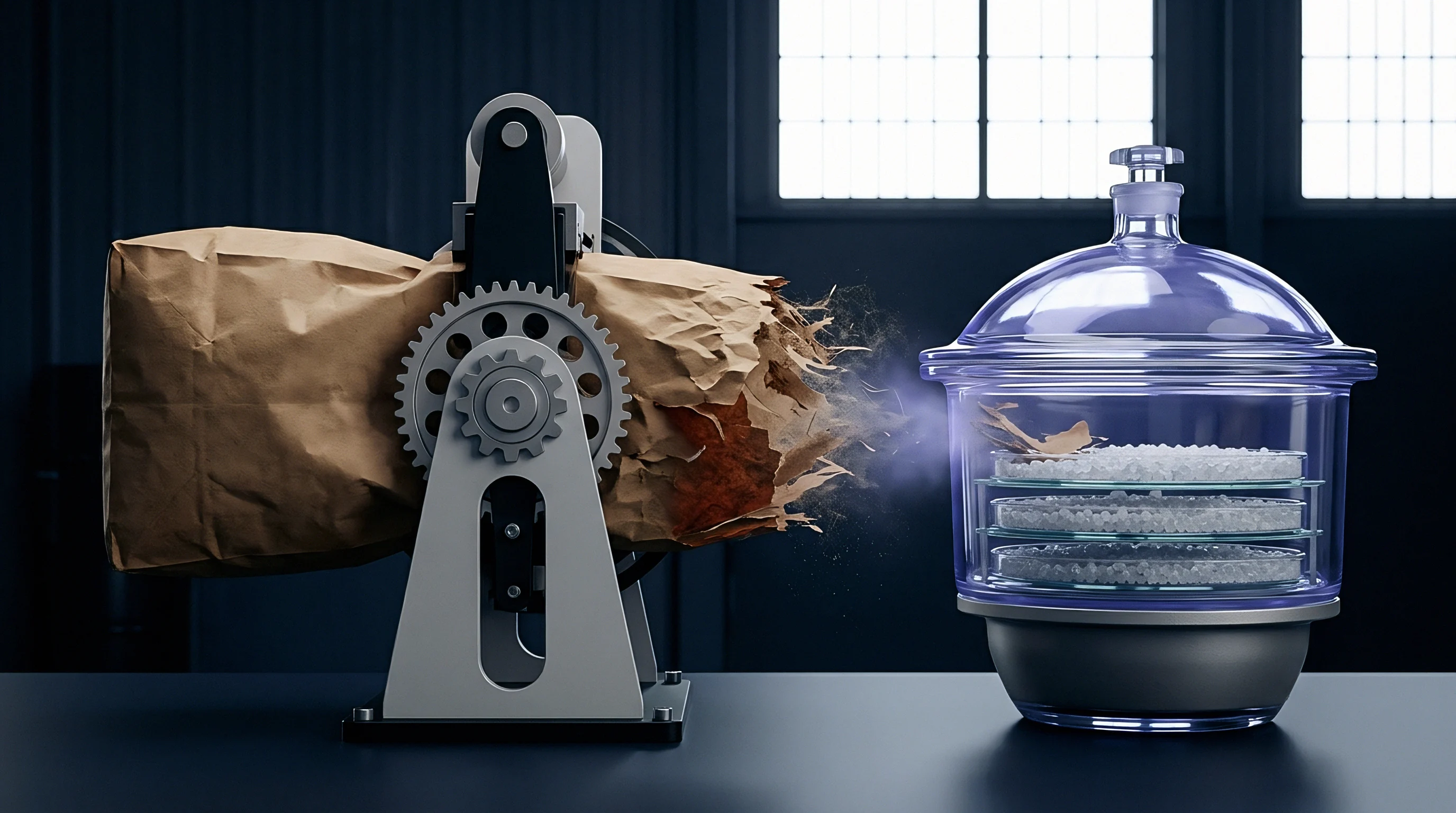
How Does Deep Embossing Reduce Long Term Stack Durability?
Pressing high-relief patterns into structural board panels weakens local flexural rigidity. Thermal crushing lowers the effective thickness of the middle mechanical pulp ply, reducing section modulus across embossed zones. Under sustained top-load weights, these weakened zones yield continuously, causing progressive panel bowing.
Vertical compressive stresses translate into out-of-plane bending moments along relief contours. As side panels bow outward, the structural load shifts toward box corners, exceeding local strength limits and triggering catastrophic corner creasing.
Creep-Induced Panel Buckling Mechanics
Compressive stresses distributed across side walls trigger out-of-plane deflection along high-relief tool impression lines. Relative humidity cycles force movement. Moisture absorption reduces hydrogen bonding strength, allowing compressive forces to collapse weakened zones.
Debossing decay occurs as the raised embossed image flattens under long-term compression, converting intended decorative depth into permanent structural deformation. Coating layers crack under strain. Fine cracks in mineral coatings expose underlying fibers to atmospheric moisture shifts, accelerating creep rates during seasonal shipping transitions.
Structural failure modes observed in heat-embossed boxboard packages follow distinct physical pathways determined by tool geometry and panel stress distribution.
- Hinge line buckling occurs along horizontal male impression lines where flexural rigidity drops below critical stability thresholds.
- Debossing collapse occurs when vertical compressive stacking loads flatten raised image peaks back into the board core over time.
- Corner load concentration arises when side panel creep forces top-load stresses outward onto vertical score lines, crushing carton corners.
- Hygral creep tearing occurs under fluctuating relative humidity, causing micro-cracks along stretched relief shoulders to propagate through the top liner.
Debossing depth degrades systematically as relative humidity cycles across shipping container thresholds.
Ignoring viscoelastic creep factors in packaging design leads directly to pallet failure, damaged interior product containers, and expensive commercial freight rejections.
Gauge
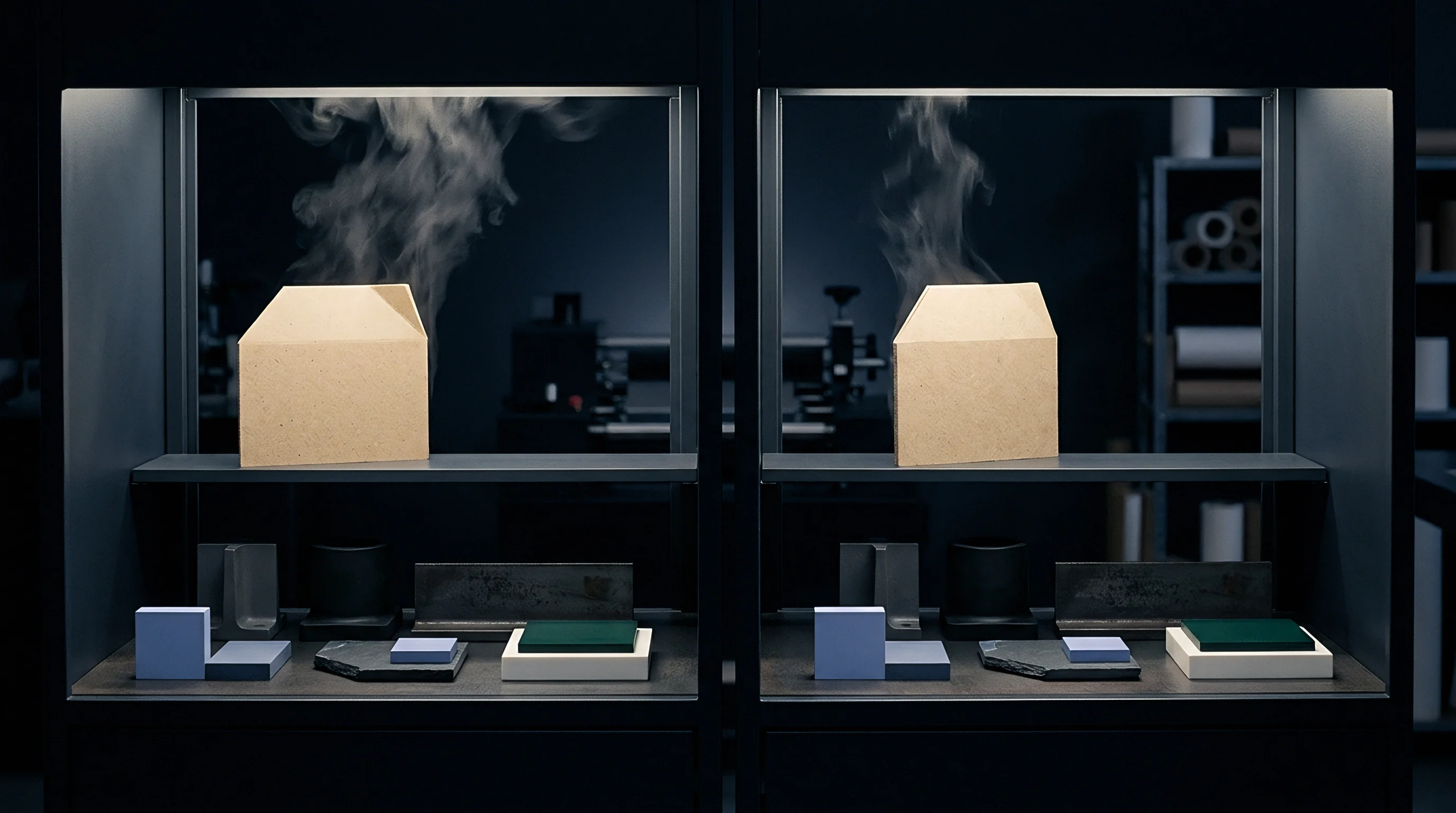
Material selection and specification tolerances control boxboard performance under extended warehouse loading. Substrate choice directly impacts how severe a compliance penalty a package pays for carrying decorative heat-embossed details. Solid Bleached Board (SBS), composed entirely of chemical pulp, features high initial tensile strength and microfibril integrity, offering superior resistance to local cracking along impression shoulders.
However, Folding Boxboard (FBB), which utilizes a high-bulk mechanical pulp core sandwiched between chemical pulp liners, delivers higher flexural stiffness per unit weight. Heat embossing FBB requires careful depth control to avoid crushing the central bulking ply and destroying its stiffness advantage. Coated Recycled Board (CRB) contains shorter, previously recycled fibers that exhibit elevated viscous flow coefficients, resulting in the highest creep compliance rates under static compressive loads.
Safety factors adjust for decay. Engineering calculations for load-bearing containers must account for loss of compressive resistance over time. Standard safety factor multipliers applied to static Box Compression Test (BCT) values range between 1.5 and 2.0 for unprinted, flat folding cartons stored in controlled environments.
Adding deep heat embossing over more than twenty percent of panel surface area requires adjusting this safety multiplier upward to 2.5 or 3.0 to offset long-term creep compliance losses in high-humidity logistics chains.

Substrate Selection and Creep Resistance Parameters
Differing fiber pulping processes and ply architectures produce varying dimensional stability under static loads. Virgin chemical fibers form stable hydrogen-bonded networks that resist long-term viscous shear slip. Mechanical pulp plies contain higher proportions of residual lignin, providing high initial bulk but exhibiting elevated thermal sensitivity during hot stamping.
Board buyers must match substrate mechanics, embossing die geometry, and target shelf life to balance decorative impact against long-term stacking performance.
| Boxboard Grade | Fiber Composition | Initial BCT Retained Post-Embossing (%) | 1000-Hour Creep Exponent (n) | Recommended Maximum Relief Depth (% Caliper) | Required BCT Safety Factor Multiplier |
|---|---|---|---|---|---|
| Solid Bleached Board (SBS) | 100% Virgin Chemical Pulp | 88–92 | 0.20–0.24 | 45 | 1.8–2.1 |
| Folding Boxboard (FBB) | Chemical Liners / Mechanical Core | 75–82 | 0.28–0.33 | 35 | 2.2–2.6 |
| Coated Recycled Board (CRB) | 100% Recycled Mixed Fiber | 65–72 | 0.34–0.40 | 25 | 2.8–3.2 |
| Solid Unbleached Board (SUB) | Unbleached Virgin Chemical Pulp | 90–94 | 0.18–0.22 | 50 | 1.6–1.9 |
Quality assurance programs evaluate creep compliance parameters using short-term stress relaxation tests and accelerated dynamic mechanical analysis. ISO 11520 methods measure compressive creep properties of paperboard under controlled environmental cycles. Standard verification routines mandate conditioning samples at 23°C and 50 percent relative humidity per ISO 187 before applying static test loads.
Mechanical short-span compressive strength measurements taken via TAPPI T 839 provide baseline data for estimating panel stiffness loss. Integrating creep compliance testing into pre-production qualification protocols prevents structural field failures, ensuring converted heat-embossed cartons retain dimensional stability and top-load strength across their entire commercial service life.