Defect Profile
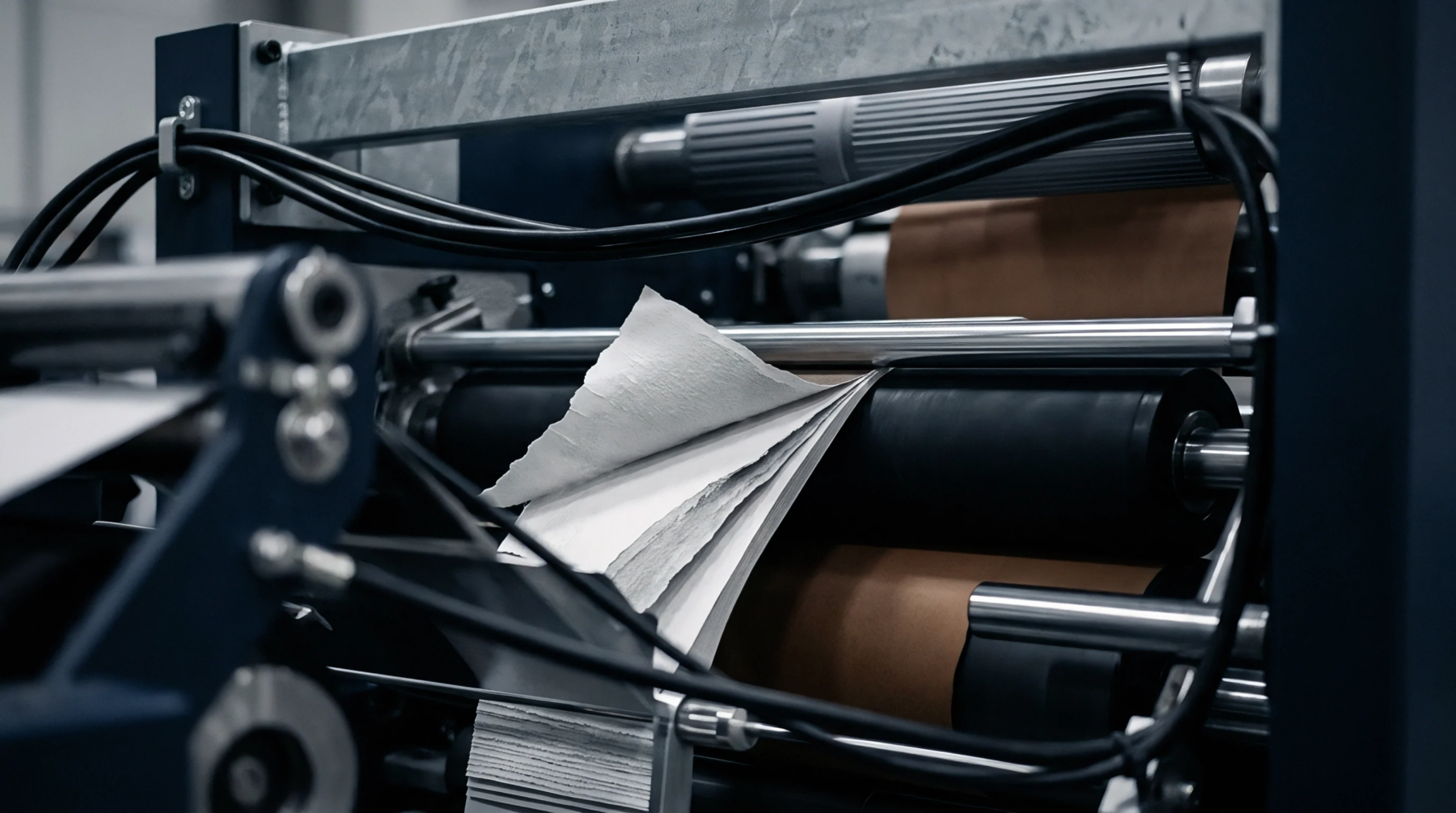
Surface disruption on blade-coated paper and board occurs when foreign particles or agglomerates lodge beneath the metering edge during application. The resulting blade scratching leaves narrow, continuous machine-direction streaks stripped of coating slip, exposing raw base paper across hundreds of linear metres before an operator intervenes or the particle washes away. Severity spans from microscopic depressions that vanish under subsequent calender nip compaction to deep fissures that cut through the raw fibres, creating sharp optical contrast and causing gravure cell skip or offset ink rejection.
Particles responsible for this mechanical dragging typically originate from dried coating crusts dislodged from recirculation pipework, oversized pigment flakes, unrefined calcium carbonate grinds, or detached base paper fibres pulled into the coating pond.
Mechanical Cause
Solid contaminants wedged between the flexible steel metering tip and the supported web disrupt the uniform hydrodynamic boundary layer required for laminar metering. When a solid exceeding the narrow clearance gap reaches the nip, the elastic blade tip deflects upward locally, permitting fluid bypass on either side while maintaining direct drag across the contact point. This dynamic produces a raised lateral ridge alongside a depleted central trough.
Viscous pigment formulations with rapid shear-thickening tendencies worsen the gouge, because local stress concentrations solidify the slurry behind the trapped contaminant. Running softer, bevelled blades or ceramic-coated tips alters the wear profile, yet coarse slurry fractions above forty-five microns inevitably force physical lifting of the working edge.
Process Limitation
Online filtering assemblies and continuous backwash screens establish the physical boundary where particle entrapment can be suppressed. Screening mesh apertures commonly set between sixty and one hundred microns arrest external dirt and slushed binder agglomerates, but cannot trap flakes formed directly inside the applicator head through localized liquid evaporation. Blade angle adjustments between thirty-five and fifty degrees shift the hydraulic pressure distribution, clearing minor web dust while increasing mechanical sensitivity to dense mineral grit.
Beyond this hydraulic threshold, web tension variations and raw base roughness dictate whether an abrasive particle shears cleanly away or anchors into the web to create an extended defect track. Calendering suppresses gloss variations over mild depressions but cannot restore ink receptivity to bare base stock exposed by severed mineral layers.