Phase Transition
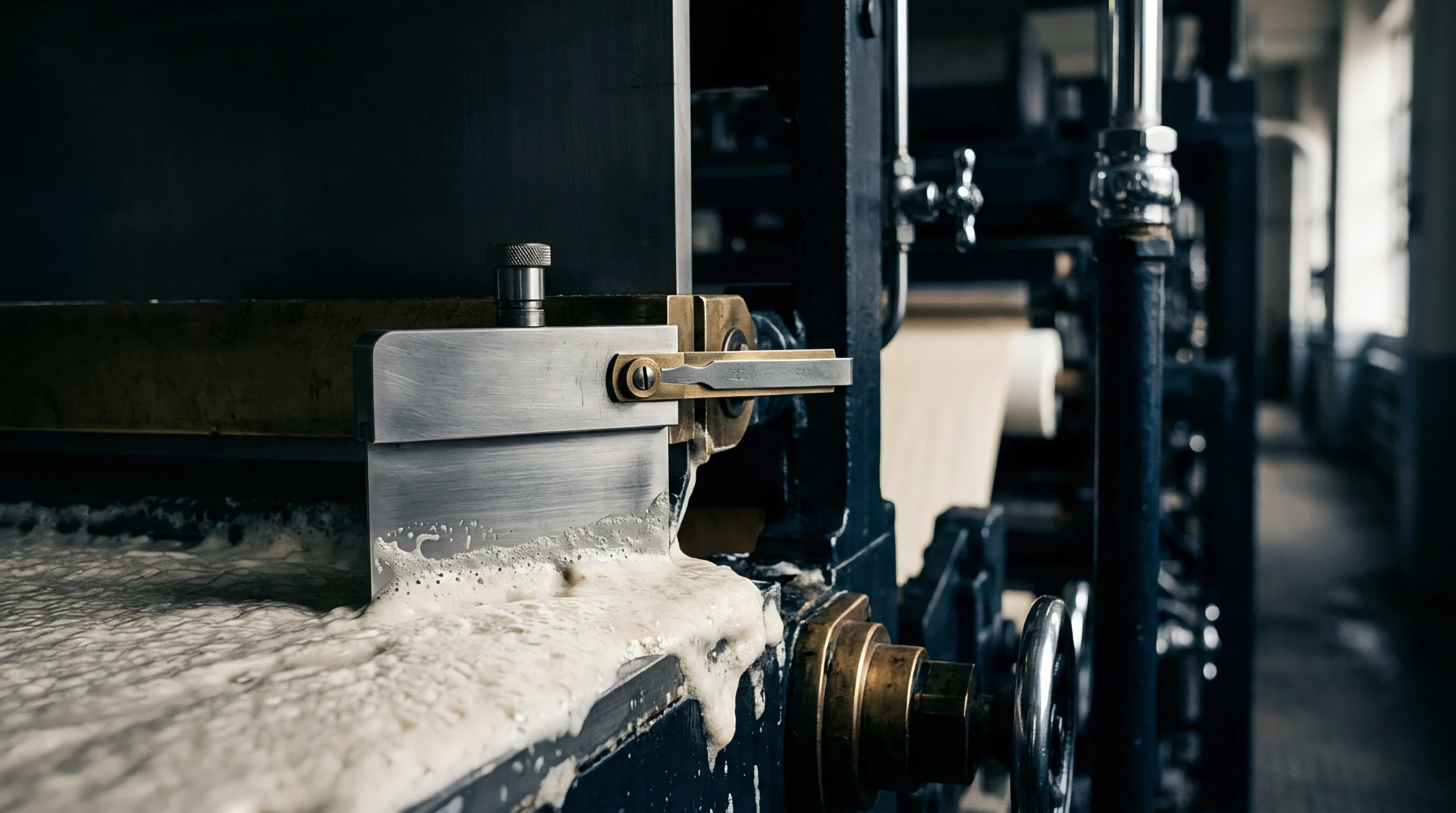
Unintended liquid water droplet formation on internal hood surfaces and distribution manifolds occurs when steam vapor contacts surfaces colder than its saturation temperature. Termed steam shower condensation, this process poses severe operational hazards directly above moving wet paper webs. Liquid accumulation leads to droplet drop-out, which impacts the sheet beneath and leaves visible blemishes, pinholes or full sheet breaks at the press section.
The governing boundary of this thermodynamic hazard encompasses steam delivery headers, internal baffles and machine hoods situated between the wire pit and the dryer entrance.
Thermodynamic Cause
When superheated or dry saturated steam expands into ambient papermachine air, rapid cooling against uninsulated metal headers pushes steam vapor below its dew point. Condensate droplets collect rapidly on cold horizontal flanges and structural framework beams. Without continuous vacuum extraction or electrical header heating, accumulated drops detach when their gravitational weight overcomes surface tension.
If condensate enters internal spray nozzles, it disrupts the transverse distribution velocity profile, discharging liquid slugs onto the fibre web. Droplets striking high-speed webs cause localized structural dispersion, washing away fine fibres, mineral fillers and starch coatings.
Operating Hazard
Drops falling onto the wet web cause soft lumps, translucent spots and edge tears that snap fragile webs running through open press draws. In subsequent high-speed rotary printing, pinholes and water spots formed by early steam shower condensation cause web breaks, delamination and severe blanket wash stops. High-speed optical cameras continuously monitor paper surfaces downstream of steam showers, triggering automatic actuator shutdowns when moisture streaks or water drop clusters are detected.
Machine builders eliminate condensation drop risks by integrating insulated jackets, internal scavenging sumps and continuously heated drip lips around every steam ejection manifold. Drain valves must clear accumulating condensate continuously.