Thermoroll Temperature Profiling and Moisture Shower Application in Multi-Ply Board Finishers
Zonal induction thermoroll heat combined with segmented spray moisture balances cross-web board caliper while preserving bulk and internal ply bond.
Dew
Moisture application across a running multi-ply paperboard web governs cross-machine moisture equilibrium, surface smoothness development, and sheet curl stability. In Folding Boxboard (FBB) and White Lined Chipboard (WLC) manufacturing, cross-direction moisture profiles leaving the main dryer section display inherent non-uniformities due to pocket ventilation imbalances and edge-drying phenomena. Applying targeted water droplets or steam re-hydrates dry lanes, equalizing moisture levels before entering calender nips.
Precise moisture application reduces cross-machine thickness variations and prevents sheet curling caused by unbalanced moisture profiles across plies.
High-pressure hydraulic atomizing nozzles and rotor dampening systems deliver finely atomized water droplets directly onto outer board plies. Water volume governs web expansion. Droplet size control proves essential: droplets exceeding 50 microns create localized wet spots, causing surface mottle, top-ply fiber raise, and coating pick during subsequent offset or flexographic printing.
Conversely, atomized droplets smaller than 5 microns evaporate into boundary-layer air currents without penetrating web fibers. Optimum penetration requires droplet diameters between 15 and 30 microns, delivered at spray velocities that overcome web boundary air pressure.
Cross Direction Moisture Uniformity and Spray Nozzle Mechanics
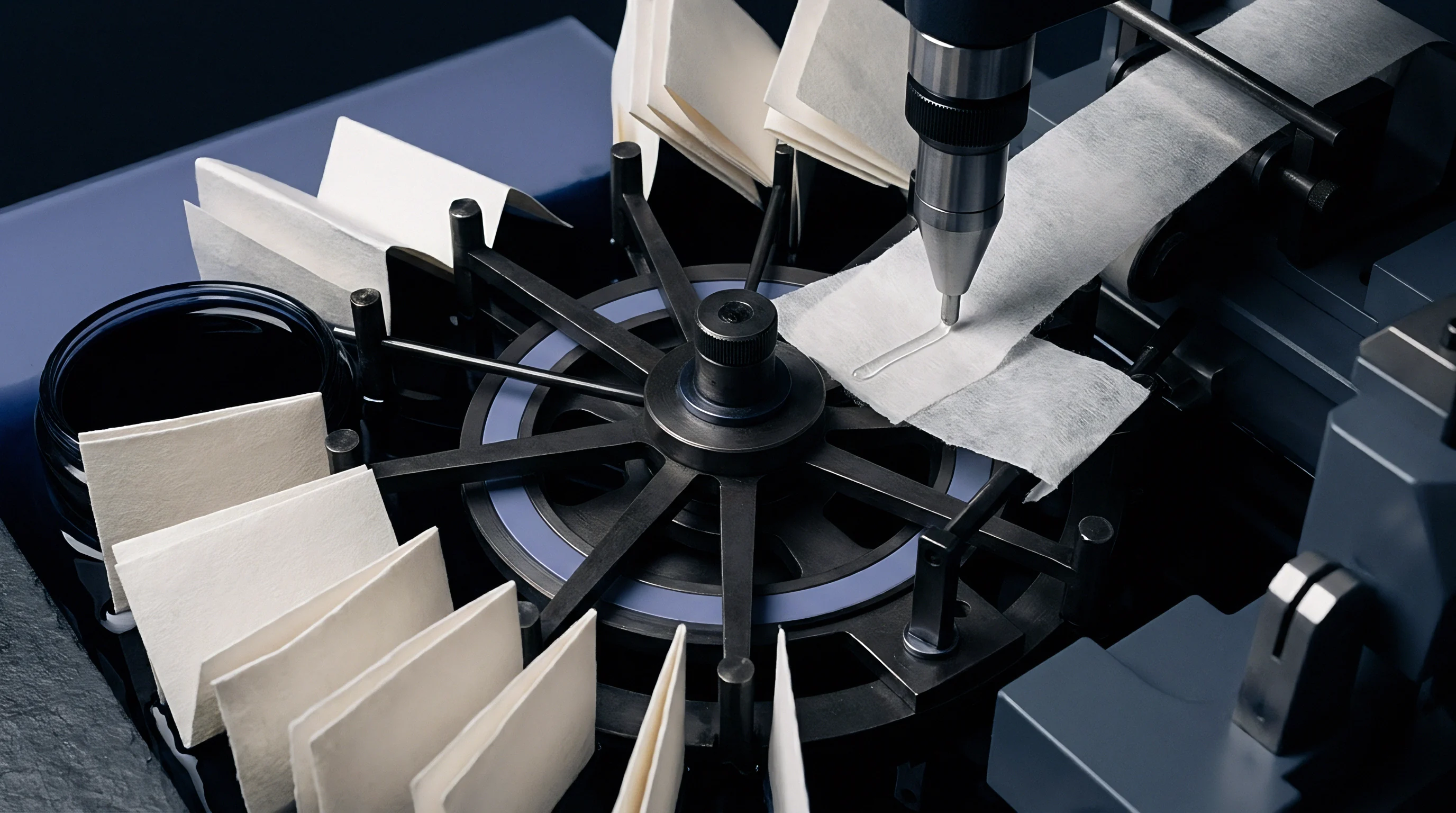
Atomization technology dictates droplet size distributions applied to moving webs. High-pressure hydraulic spray showers operate between 2.0 and 6.0 MPa, utilizing precision-machined ruby or tungsten carbide orifices spaced at 25 mm to 50 mm intervals across the web width. Segmented control valves adjust flow rates to individual nozzle zones based on feedback from downstream infrared or microwave moisture sensors.
When local moisture drops below target setpoints, corresponding zone valves open to deliver incremental water volume, maintaining a flat moisture line prior to surface finishing.
Rotor dampening systems offer an alternative mechanism by using high-speed spinning discs to throw a controlled liquid mist onto the sheet. Discs rotating at 10,000 to 14,000 revolutions per minute generate uniform droplets without relying on narrow nozzle orifices prone to mineral scaling and clogging. Water temperature control plays a parallel role; maintaining supply water at 50°C to 65°C reduces surface tension, speeding water absorption into bleached chemical pulp top plies before the web reaches the calender nip.
Cold sheets resist thickness compression.
| Atomization Technology | Droplet Size Range (µm) | Operating Pressure (MPa) | Zone Resolution (mm) | Primary Failure Mode |
|---|---|---|---|---|
| High-Pressure Hydraulic Nozzle | 15 ~ 35 | 2.5 ~ 5.5 | 25 ~ 50 | Orifice erosion and streak formation |
| High-Speed Rotor Discs | 20 ~ 40 | 0.1 ~ 0.3 | 50 ~ 100 | Edge mist turbulence and overlap striping |
| Low-Pressure Air-Atomized Nozzle | 10 ~ 25 | 0.2 ~ 0.5 | 35 ~ 75 | Compressed air oil contamination |
| Segmented Steam Injection Shower | Gaseous Phase | 0.05 ~ 0.15 | 40 ~ 80 | Condensate dripping and wet spot bursting |
Remoisturizing System Comparative Operational Limits
Engineers balance water flux rates against web speed when selecting moisture profile hardware. Moisture changes local web strain. At machine speeds exceeding 600 meters per minute, boundary air layer turbulence disrupts spray patterns from low-pressure air-atomized nozzles.
Steam showers counter this disruption by condensing steam directly within the outer fiber matrix, simultaneously raising web temperature and moisture. Steam condensation raises surface energy. Condensation heating increases fiber temperature by 10°C to 25°C, lowering fiber yield stress and enhancing calender compaction efficiency without adding excess liquid water that demands post-finishing drying.
Moisture shower performance collapses when improper droplet sizes or misaligned spray angles create physical defects across the multi-ply structure. Defect patterns emerge directly from incorrect fluid pressure, nozzle wear, or chemical fouling within water supply manifolds:
- Coating streak defects stem from nozzle orifice degradation where concentrated water streams erode local sizing, creating un-sized lanes that absorb excess liquid coating during later blade application.
- Cross-direction wave distortion occurs when adjacent spray zones overlap excessively, generating high-moisture bands that expand differentially against drier web lanes.
- Top ply delamination arises when high-velocity water impact loosens outer chemical pulp fibers from mechanical pulp core plies before entering high-load calender nips.
- Pinhole micro-foaming develops when air entrained in high-pressure water lines creates air pockets within atomized droplets, leaving un-moistened craters across the web surface.
Equipment vendors frequently attribute edge web dampening inconsistencies to ambient draughts rather than addressing droplet velocity decays across extended spray distances.
Zone
Induction coils mounted along hard roll calender shells deliver localized heat flux to alter local roll diameter through thermal expansion. In multi-ply board finishing, thermoroll temperature profiling functions as a primary tool for cross-direction caliper control. Soft-nip and hard-nip calenders utilize chilled cast iron or forged steel thermorolls capable of surface temperatures up to 200°C. By applying differential electromagnetic energy across narrow transverse zones, operators expand or contract the roll shell by several micrometers, selectively raising or lowering peak line loads across specific web lanes.
High thermal flux softens lignin. Zone-controlled induction systems operate at frequencies between 10 kHz and 30 kHz, inducing eddy currents directly inside the outer steel wall of the thermoroll. Heating occurs within a shallow surface layer of two to four millimeters, allowing rapid thermal response times compared to internal oil-drilled rolls.
Zone widths typically range from 25 mm to 50 mm, matching the spatial resolution of scanning caliper gauges situated at the reel. Increasing thermal output in a specific zone expands the local roll radius, increasing nip pressure on thick sheet sections to smooth out web profile peaks.
Inductive Heating Profiling versus Peripheral Oil Drilling
Energy transfer into the rotating calender shell occurs through electromagnetic field coupling or conductive fluid circulation. Peripheral oil-drilled thermorolls pump synthetic thermal oil through sub-surface channels drilled parallel to the roll axis. While oil systems provide high total thermal energy transfer, their cross-direction profiling capability remains constrained by fluid mixing between channels and slower thermal response times.
Zone-controlled induction systems deliver localized thermal gradient changes within seconds, correcting transient web caliper spikes before thick lanes cause uneven winding tension on the parent reel.
Zonal temperature dictates local density. Peripheral oil rolls achieve deep, uniform thermal penetration appropriate for bulk heating, whereas induction systems supply precise surface heat gradients. Combining peripheral oil heating for base heat loads with external induction coils for dynamic profiling creates a flexible finishing configuration for heavy multi-ply board grades ranging from 250 to 450 grams per square meter.
Zone-controlled induction profiling adjusts thermoroll shell diameter by three to eight microns, sufficient to correct caliper variations across fifty-millimeter web bands.
Thermal Expansion Kinematics and Nip Profile Control
Local diameter changes on a hard roll modify the mechanical gap across the web. The magnitude of local diameter expansion depends on the thermal expansion coefficient of the shell steel, the localized heat flux, and heat conduction through the roll body. For a forged steel thermoroll with a linear thermal expansion coefficient of 12 × 10-6 K-1, raising local shell temperature by 15°C across a 50 mm zone increases the local roll radius by approximately 4.5 micrometers.
In a rigid calender nip operating at a nominal line load of 80 kN/m, a 4.5 micrometer localized radius expansion yields a localized nip pressure increase of 8 to 12 percent, depending on backing roll cover hardness.
Consider a 350 g/m² Folding Boxboard running at 450 meters per minute through a soft-nip calender equipped with an induction-heated hard thermoroll. Scanner data reveals a 6-micrometer positive caliper peak in lane four. The control system ramps inductive power to lane four by 3.2 kW.
Local thermoroll shell surface temperature rises from 140°C to 152°C over 45 seconds. The resulting localized roll expansion increases nip load in lane four from 70 kN/m to 78 kN/m, reducing local web caliper by 5.8 micrometers, bringing the sheet within specification while maintaining an overall caliper standard deviation below 0.8 micrometers across the 4.2-meter web width.
Improper zonal thermal expansion creates localized line load spikes that permanently crush the mechanical pulp core and destroy stiffness across discrete mill lanes.
Swell
Fibre networks in multi-ply paperboard react dynamically when surface moisture meets elevated calender temperatures. Multi-ply boards combine distinct furnish layers: outer plies composed of bleached chemical softwood and hardwood pulp for strength and printability, surrounding a core of stone groundwood (SGW), thermomechanical pulp (TMP), or recycled fibers (WLC). Each ply exhibits unique hygroscopic and viscoelastic properties.
Surface remoisturizing causes cell walls in chemical fibers to absorb water, swelling fiber diameters and temporary lowering internal hydrogen bonding energy before entering the calender nip.
Glass transition temperatures (Tg) of amorphous pulp components dictate the degree of structural deformation achieved under heat and pressure. Dry lignin exhibits a Tg between 130°C and 150°C, whereas hemicellulose softens between 100°C and 120°C. Water acts as an effective plasticizer, dropping the Tg of hemicellulose down to 20°C ~ 40°C and lignin down to 70°C ~ 90°C at moisture levels above 8 percent. By applying a controlled moisture shower immediately prior to heated thermoroll contact, the top chemical pulp layer reaches plastic deformation conditions under moderate nip pressure, improving surface smoothness while keeping the inner mechanical pulp core dry and uncompressed.
Lignin and Hemicellulose Thermal Softening Mechanics
Amorphous polymers within the cell wall experience structural transition under combined thermal and moisture exposure. When thermoroll surface temperatures exceed the plasticization threshold of moist surface fibers, chemical pulp fibers flow into surface micro-cavities without permanent cell wall collapse. This selective surface smoothing preserves internal core bulk, maintaining high bending stiffness (Sb) proportional to the third power of total board caliper (h3) as modeled by Euler-Bernoulli beam mechanics:
Sb = fracE · h312
Where E represents the equivalent modulus of elasticity across the multi-ply matrix. If high heat penetrates into the mechanical core, the stiff, lignin-rich core fibers collapse, causing catastrophic loss of packaging panel stiffness. Uncontrolled dew yields structural twist.
Exceeding a cross-direction moisture variation of plus or minus zero point five percent under ISO 287 testing voids converter runnability guarantees on high-speed packaging lines.
Calibration Procedure for Multi Ply Calender Profiling
Stepwise setup begins with establishing baseline dry sheet caliper across all machine sections. Calibration steps ensure thermal profiling and remoisturizing systems operate in unison without destabilizing web structure:
- Run the multi-ply web through the calender at target production speed with induction coils and moisture showers set to neutral baseline power.
- Measure cross-direction caliper, moisture, and PPS surface roughness profiles using post-calender scanning instruments under ISO 187 standard conditioning atmospheric principles.
- Engage moisture shower zones to eliminate CD moisture variations, targeting a flat moisture profile within a tolerance of ±0.3 percent moisture content across the web.
- Activate zone-controlled induction thermorolls, applying baseline power to establish an even roll surface temperature profile verified by fixed infrared pyrometer arrays.
- Apply closed-loop control linking scanner caliper peaks directly to individual induction coil outputs, limiting zone adjustments to increments below 0.5 kW per step.
- Verify internal ply bond strength using TAPPI T 569 (Scott Bond) to ensure localized line load increases do not induce internal web delamination.
| Board Grade | Thermoroll Surface Temp (°C) | Applied Moisture Delta (%) | PPS Roughness ISO 8791-4 (µm) | Scott Bond TAPPI T 569 (J/m²) |
|---|---|---|---|---|
| Folding Boxboard (FBB) 280 g/m² | 120 ~ 160 | +1.2 ~ 1.8 | 1.2 ~ 1.8 | 160 ~ 190 |
| White Lined Chipboard (WLC) 350 g/m² | 140 ~ 180 | +1.5 ~ 2.2 | 1.5 ~ 2.2 | 120 ~ 150 |
| Solid Bleached Board (SBB) 300 g/m² | 100 ~ 140 | +0.8 ~ 1.4 | 0.8 ~ 1.2 | 200 ~ 240 |
| Solid Unbleached Board (SUB) 380 g/m² | 130 ~ 170 | +1.0 ~ 1.6 | 1.8 ~ 2.5 | 170 ~ 210 |
| Test conditioning per ISO 187 (23°C, 50% RH). PPS measured under 1.0 MPa clamping pressure with soft backing. Scott Bond measured via pendulum impact mechanism. | ||||
Standard supply agreements enforcing ISO 287 moisture limits without CD range caps allow mills to ship board that twists during offset lithographic dampening.
Calibre
Thickness control across multi-ply board grades demands precise balancing of mechanical nip loading against thermal surface plasticization. Sheet caliper dictates both structural package strength and yield for converted cartons. High mechanical nip loads compress the sheet uniformly, reducing Parker Print-Surf (PPS) surface roughness but destroying valuable sheet bulk (v = fraccalipergrammage).
Employing heated thermorolls paired with moisture showers substitutes mechanical compression with surface thermo-plasticization, yielding smooth printable surfaces at lower line loads.
Uniform moisture limits score cracking. Standard calender nips operating dry require line loads exceeding 120 kN/m to achieve a PPS 10 µm roughness target of 1.5 micrometers on FBB top plies. Adding pre-calender moisture showers (1.5 percent added water) and elevating thermoroll surface temperatures to 150°C achieves identical surface roughness at a reduced line load of 45 kN/m.
This load reduction preserves up to 8 percent total sheet bulk, translating into significant fiber cost savings or increased carton bending resistance for end-user packaging.

Can Thermal Profiling Preserve Bulk While Achieving Smoothness?
Elevated surface temperatures lower the yield stress of top ply chemical fibres without compressing the unheated mechanical pulp core. Thermal contact duration inside soft calender nips typically spans only 2 to 5 milliseconds at commercial machine speeds. Heat transfer modeling proves that within this narrow contact time, temperature rises above 100°C occur only within the outer 20 to 30 micrometers of the board surface.
The central mechanical core remains at ambient temperature, resisting plastic deformation and preserving core bulk.
Induction coils alter shell geometry. Zonal heating creates precise localized pressure adjustments that correct micro-caliper variations without subjecting the entire web width to excess load. Soft-nip roll covers (ranging from 88 to 95 Shore D hardness) conform to macro-scale grammage variations, ensuring uniform surface gloss across local thickness valleys while thermoroll profiling corrects wide cross-machine caliper trends.
Hot roll surface contact plasticizes outer fibre plies before heat penetrates to alter the density of the mechanical core.
Calender Configuration Decision Parameters
Selecting line load and temperature setpoints forces a tradeoff between Parker Print-Surf roughness targets and final sheet bulk. Mill engineers utilize structured decision criteria when configuring multi-ply board finishing lines:
- Target PPS Roughness Range ~ Establish required printing surface quality; offset lithography demands PPS under 1.8 µm, while high-end gravure requires PPS under 1.2 µm.
- Bulk Retention Threshold ~ Set maximum allowable bulk loss limits; commercial FBB production typically restricts calender bulk reduction to under 6 percent of incoming un-calendered volume.
- Moisture Application Window ~ Define shower operating limits based on downstream dryer capacity; added moisture must stay within 0.8 to 2.0 percent to prevent post-finishing web fluting.
- Thermoroll Thermal Limit ~ Cap roll surface temperatures based on soft cover cover heat ratings; standard polyurethane covers tolerate up to 120°C, whereas specialized epoxy composite covers endure 180°C continuous operation.
Increasing roll surface temperature preserves sheet bulk far better than increasing mechanical nip pressure to achieve target surface smoothness.
Tariff
Calculating the total financial impact of finisher conditioning systems involves linking utility inputs with converting yield improvements. Thermoroll induction heating and segmented moisture showers represent significant electrical and thermal energy draws on the board machine. However, the commercial return manifests through raw fiber reduction via bulk preservation, lower waste rates during carton converting, and reduced off-spec reel rejections at goods-in inspection.
Energy balances demonstrate that zone-controlled induction profiling systems draw between 150 kW and 450 kW of electrical power per machine, depending on web width and operational thermal targets. Water atomization systems consume modest pumping power (10 to 30 kW), but applying excess moisture imposes an indirect thermal energy cost downstream if post-dryers must evaporate excess water. Hot rolls decrease surface roughness.
Narrow nip widths preserve bulk. Balancing electrical induction costs against fiber yield metrics dictates the economic optimum for board finishing operations.

Energy Balance and Financial Metrics for Finishing Retrofits
Utility inputs for steam generation and inductive power draw alter the manufacturing cost per ton of finished board. Overwetting degrades top ply brightness. Consider a 4.0-meter trim multi-ply board machine producing 150,000 metric tons per year of Folding Boxboard at a nominal basis weight of 300 g/m².
Upgrading from a conventional dry hard-nip calender to a dual soft-nip calender equipped with 40-zone induction thermorolls and a segmented moisture shower system alters both variable operating costs and finished product valuation.
| Operating Parameter / Metric | Base Dry Calender Configuration | Induction + Moisture Finisher Upgrade | Net Annual Variance |
|---|---|---|---|
| Inductive Power Consumption (kWh/ton) | 0.0 | 18.5 | +2,775,000 kWh |
| Moisture Shower Utility Consumption (m³ water/ton) | 0.00 | 0.015 | +2,250 m³ |
| Sheet Bulk Preservation Gain (cm³/g) | 1.25 (Baseline) | 1.34 (+7.2%) | +0.09 cm³/g |
| Furnish Yield Fiber Reduction (%) | 0.0% | -4.5% | -6,750 tons virgin fiber |
| Carton Converting Score-Cracking Rejects (%) | 2.4% | 0.6% | -1.8% customer waste |
| Net Landed Production Cost ($/ton board) | $780.00 | $752.40 | -$27.60 / ton net savings |
Poor profiling distorts ream flatlines. Fiber raw material savings dominate the financial calculation. By maintaining board caliper at a 4.5 percent lower virgin fiber grammage, the mill saves 6,750 tons of virgin pulp annually.
At a blended furnish cost of $650 per ton, raw material cost reductions total $4,387,500 per year. Subtracting annual electricity costs for the induction coils ($277,500 at $0.10/kWh) and maintenance costs for moisture shower nozzle replacements yields a net operating expenditure savings exceeding $4.0 million annually.
Excess heat boils internal moisture. Target caliper dictates line load. Furthermore, converting performance improvements create substantial commercial value for packaging buyers.
Board finished with optimized CD moisture and thermal profiles exhibits near-zero cross-machine curl variations (under 5 mm deflection on a 300 mm test sheet per ISO 11552). Eliminating moisture-driven reel twist lowers carton misfeed rates on high-speed gluing and folding lines from 2.4 percent down to 0.6 percent, reducing customer claims and protecting mill margin structures.
Uncontrolled moisture application raises drying energy costs while destroying sheet stiffness through excessive fibre network compression.
Evaluating thermal energy consumption against converting spoilage reductions yields a clear threshold where induction retrofits lower total finished pack cost.