Differential Plasticization
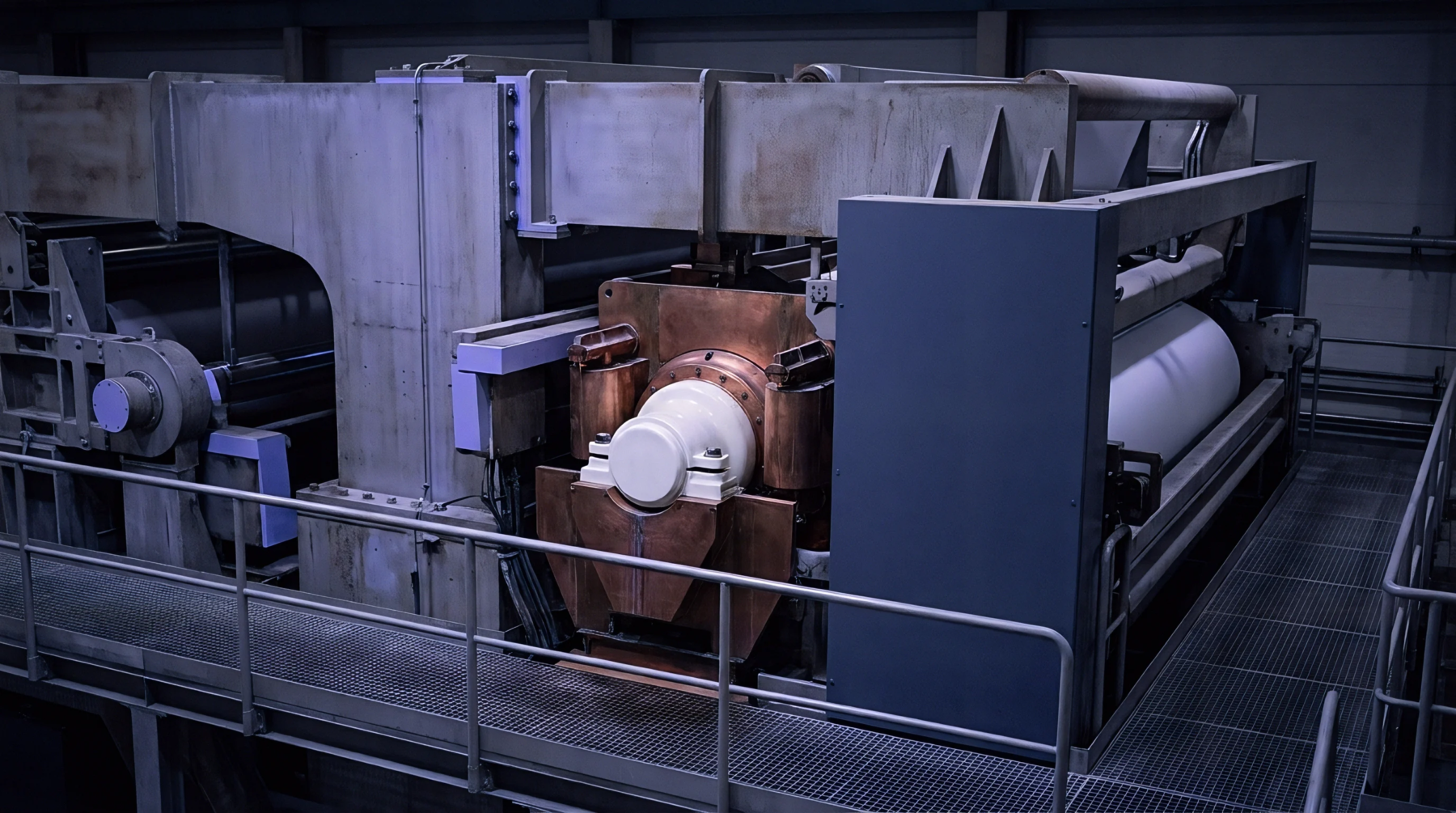
Heated calender rolls apply thermal energy to a running web under brief nip dwell times to smooth board surfaces without collapsing internal sheet bulk. Operating as temperature gradient calendering, this mechanical finishing process exploits the poor thermal conductivity of cellulose networks by creating a sharp temperature drop between the hot surface plies and the cold core. Surface fibers and polymeric coating binders soften under the combined influence of localized heat and high pressure, yielding exceptional smoothness and print gloss.
The method stops delivering benefits if web contact times extend too long, as excess heat conduction into the core leads to bulk loss and stiffness degradation.
Viscoelastic Response
Heat transfers into the paperboard surface via conduction while the web passes through a nip formed by a heated polished steel roll and a resilient polymer-covered backing roll. Moisture present in the outer layers shifts the glass transition temperature of hemicelluloses and lignins downward, permitting plastic flow under localized pressure peaks. Roll surface temperatures range between one hundred and fifty and two hundred and fifty degrees Celsius, while nip dwell times remain between one and ten milliseconds.
Because the internal plies remain below their respective glass transition thresholds, their structural fiber lumens remain uncompressed. The resulting finished board retains the caliper required for panel bending stiffness, while its outer surfaces acquire the dense, uniform profile required for high-definition gravure and flexographic printing.
Stiffness Preservation
Packaging grades such as folding boxboard and solid bleached sulfate rely on this processing window to satisfy both tactile and mechanical criteria. Traditional calender stacks compress the entire sheet evenly, sacrificing up to thirty percent of bending stiffness to achieve acceptable printing smoothness. By decoupling surface replication from bulk consolidation, modern gradient calenders maintain carton panel rigidity, allowing converters to use lighter basis weight boards for identical carton volumes.
If roll temperatures are miscalculated, excessive core heating collapses the z-direction density gradient, leaving cartons weak against compressive top-loads. Careful control of moisture profiles, roll surface temperatures and nip entry angles ensures that the plasticization depth does not exceed ten to fifteen percent of the total board thickness.