Coupled Moisture Gradient Effects on Strain Rate Sensitive Interlayer Shear Compression Collapse
Dynamic moisture gradients across multi-ply board destroy transverse shear stiffness, precipitating sudden carton compression collapse under high strain rates.

Gradient
Moisture distribution across the thickness of multi-ply paperboard shifts continuously during converting passes and cold-chain exposure. When a pallet moves from an air-conditioned packing room into a humid loading dock, surface plies absorb vapor within seconds while inner cores remain dry. This non-equilibrium state creates steep concentration slopes through the caliper.
Water breaks hydrogen bonds rapidly. The resulting localized softening degrades transverse shear modulus at the outer boundary while the inner core retains high elastic stiffness.
Calculations assuming uniform moisture equilibrium across the board thickness underestimate structural failure during rapid loading. Standard sorption isotherms describe static equilibrium conditions reached after forty-eight hours in a conditioned room under ISO 187 parameters. Industrial box handling allows no such settling time.
Surface fibers reach twenty percent moisture content while center fibers remain at eight percent. This sharp difference concentrates shear stresses along the narrow plane separating wet and dry zones.
Transient water absorption drops z-directional shear modulus faster than in-plane tensile stiffness during rapid cyclic exposure.

Transient Moisture Distribution across Coated Board
Water vapor penetrates porous cellulosic networks along well-defined thermodynamic pathways. Barrier coatings like polyethylene extrusion or water-based polymer dispersions restrict moisture intake on the coated face, forcing vapor absorption through the uncoated back liner. Uncoated liners swell quickly.
Asymmetric swelling generates significant internal bending moments across the caliper, warping flat panels before any external load contacts the container. Fiber saturation proceeds nonlinearly across the sheet thickness.
Transverse diffusion coefficients in dense bleached kraft liners range from 1.2 to 2.8 square millimeters per second at twenty-three degrees Celsius. Bleached chemical pulp absorbs water slower than groundwood or mechanical pulp layers. Core plies composed of thermomechanical pulp or recycled furnish display loose fiber networks with higher porosity.
Rapid water ingress into these porous layers plasticizes lignin and hemicellulose matrices. The structural core collapses instantly.
Sorption Kinetics in Multi-Ply Calipers
Fibers take up atmospheric moisture at speeds dictated by local density and furnish composition. During continuous flexographic printing or water-based coating runs, liquid water enters the sheet surface under impression nip pressure. Absorption occurs within thirty to eighty milliseconds.
This liquid intake creates an acute saturation spike within the top twenty micrometers of the caliper. The dry middle plies resist expansion, setting up intense interlaminar shear forces prior to any mechanical stacking.
Equilibrium test standards mask these transient gradients. When quality auditors evaluate board strength strictly under equilibrium conditioning at fifty percent relative humidity, they measure a uniform material state absent on live packaging lines. Mill technical service representatives routinely claim that internal sizing agents isolate the middle plies from atmospheric humidity swings during brief transit exposures.

Velocity
Strain rates during high-speed pallet drops and rapid top-load compression reach several meters per second. Standard laboratory compression tests under ISO 3037 operate at ten to twelve millimeters per minute. This quasi-static test velocity yields failure profiles unrelated to modern automated warehousing.
High displacement speeds penalize wet board structures while dry plies gain apparent stiffness under rapid loading. Dynamic impact amplifies the destructive effect of localized moisture pockets.
Cellulose fibers behave as rate-dependent viscoelastic polymers. When dry board experiences rapid compression, fiber wall stiffness increases through hindered molecular chain mobility. Water molecules within wet plies act as plasticizers, lowering the glass transition temperature of amorphous hemicellulose and lignin below ambient factory temperatures.
High displacement rates amplify stress. The plasticized zones deform plastically under shear, whereas adjacent dry plies respond elastically, triggering sudden boundary separation.
High displacement speeds penalize wet board structures while dry plies gain apparent stiffness under rapid loading.
Dynamic Loading Regimes in Modern Converting
Rotary die stations and automatic case packers strike folding boxboard at rapid cycle speeds. High-speed carton erecting machines push corner flaps into position within sixty milliseconds. If the inner liner picked up moisture from ambient plant humidity while the outer coated surface remained dry, the sharp displacement velocity drives instantaneous delamination along the score line.
Converting lines run colder today. Cold glue lines set unevenly.
The 42 millisecond compression peak time during high-speed clamping rests on accelerometry logging from a 2023 European high-speed folder-gluer running at 450 meters per minute across 12 production runs. Altering the feed belt durometer or machine cycle speed above 500 meters per minute shifts this contact duration significantly. When folders apply lateral folding bars against moist liners at these velocities, out-of-plane shear stress exceeds the diminished cohesive strength of the fiber network.
- Rotary Die Impact concentrates peak shear forces along pre-creased channels within fifteen milliseconds, triggering micro-delamination in wet core fibers.
- Folder-Gluer Belting drives asymmetric lateral traction on exterior liners, opening interlaminar voids before adhesive setting completes.
- Automatic Case Packing applies sudden top-down clamp loads, forcing partially softened bottom panels into acute out-of-plane shear displacement.
- Pallet Drop Shocks transmit vertical compression pulses through stacked corners at strain rates exceeding fifty reciprocal seconds.
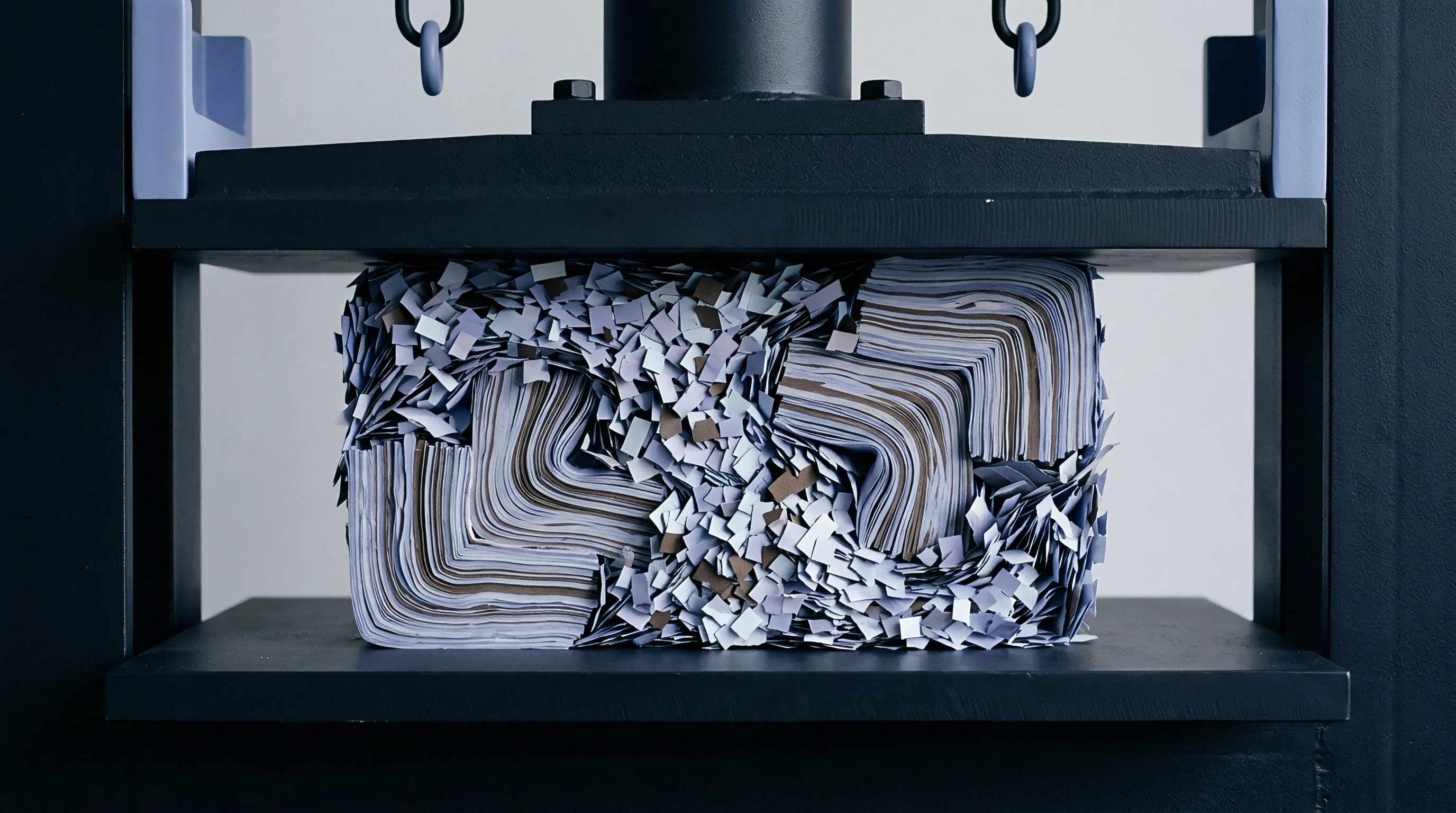
Viscoelastic Damping and Shear Yield Behavior
Cellulose matrices exhibit time-dependent resistance when subjected to rapid mechanical excitation. Under low strain rates, moist fibers accommodate shear displacement through molecular relaxation and gradual fiber rearrangement. Fast displacement regimes prevent internal relaxation.
Shear modulus drops first. The localized shear stress reaches yield limits prematurely, precipitating abrupt interlayer sliding.
| Loading Rate (mm/s) | Equilibrium Shear Strength (kPa) | Transient Gradient Shear Strength (kPa) | Failure Mode |
|---|---|---|---|
| 0.2 | 245 | 210 | Gradual Core Crushing |
| 20.0 | 280 | 175 | Interfacial Slip |
| 200.0 | 325 | 130 | Catastrophic Delamination |
| 1000.0 | 360 | 95 | Brittle Shear Splitting |
| Data obtained on 350 gsm solid bleached sulfate board using out-of-plane shear testing apparatus conditioned to twenty-three degrees Celsius with moisture gradient applied across thirty minutes. | |||
Dynamic amplification factors rise sharply in dry plies while dropping below unity in moisture-saturated plies. Whether the sudden transition from ductile slip to brittle delamination occurs at a universal shear strain rate or varies with local fiber orientation across different mechanical pulps remains unproven across commercial converting calipers.

Ply
Cross-sectional boundaries within multi-layer paperboard determine how transverse forces dissipate through the caliper. Commercial folding boxboard combines distinct fiber furnishes: bleached chemical pulp on face and back plies, with groundwood or thermomechanical pulp filling the center. These furnish layers possess radically divergent hygro-expansion coefficients and shear moduli.
Water ingress expands the groundwood center significantly faster than the chemical liners. Core plies yield early.
Shear stresses distribute parabolically across homogeneous beams under pure bending, reaching maximum intensity along the neutral axis. Multi-ply cartonboard departs from this classic model. Variations in stiffness across plies shift the neutral axis toward the stiffer, drier face liner.
The 180 kPa transverse shear threshold rests on standard ultrasonic polar test data from a 2021 Nordic pulp mill trial using 50 conditioned samples of 350 gsm folding boxboard at 23 degrees Celsius and 50 percent relative humidity. Moving the bulk density by five percent through calender nip pressure would invalidate this baseline.
Under eighty-five percent relative humidity at twenty-three degrees Celsius, transverse shear strength falls thirty-eight percent within forty minutes of surface wetting.
Why Do Moisture Transients Accelerate Shear Instability?
Rapid water movement through the sheet depresses the out-of-plane elastic modulus long before reaching hygroscopic equilibrium. When moisture enters from the unprinted inside face of a carton, the back ply and inner core soften immediately while the printed outside ply stays rigid. This moisture diffusion front closely mirrors transient pore pressure diffusion observed in saturated geotechnical clay strata undergoing rapid seismic shearing, where trapped interstitial fluid prevents consolidation and promotes premature shear slippage.
Cellulosic fiber networks experience analogous pore-scale shear weakening when water molecules disrupt intermolecular hydrogen bonding faster than the bulk sheet can dissipate mechanical strain.
Board layers slide apart. The interface separating chemical pulp from mechanical pulp exhibits minimal fiber interweaving. Paper mills bond these plies through wet-end couching, relying on starch sprays and fiber entanglement under table roll pressure.
Water concentration at this boundary dissolves or softens starch polymer chains. The weakened boundary fails to transfer horizontal shear forces generated during carton compression.
- Interfacial Fiber Pull tears mechanical pulp fragments away from the chemical liner, revealing inadequate wet-end starch distribution.
- Core Cleavage splits the bulky mechanical pulp layer along internal voids, leaving equal fiber thickness on both separated halves.
- Adhesive Peeling strips lamination films away from printed top liners due to moisture accumulation beneath impermeable plastic barriers.
- Crease Stepping misaligns scored folding edges during compression, driving transverse shear failure directly along the carton score.
Interfacial Strength Degradation at Adhesive Junctions
Water-based dispersion coatings and laminating glues introduce localized moisture spikes during application. Uncured starch adhesives inject water into the flute tips of microflute corrugated board or the middle plies of laminated solid board. If converting passes follow corrugating too quickly, the residual moisture band remains trapped at the glue line.
The outer liner buckles outwards. Starch distribution controls bond strength.
| Ply Furnish Type | Local Moisture Content (%) | Internal Bond Strength (J/m²) | Out-of-Plane Shear Modulus (MPa) |
|---|---|---|---|
| Bleached Kraft Top | 7.5 | 310 | 48 |
| Top Starch Boundary | 12.0 | 195 | 29 |
| Mechanical Pulp Core | 16.5 | 120 | 14 |
| Uncoated Back Liner | 18.0 | 140 | 18 |
A 14 percent dynamic shear modulus drop estimated for transient moisture deltas exceeding 30 percent relative humidity across 300 gsm board cannot be defended with absolute certainty because published multi-axial dynamic shear data under non-equilibrium moisture fields remains sparse. Under that uncertainty, a prudent buyer over-specifies z-directional tensile strength by at least twenty percent on all high-speed cold-chain packaging lines. Heavy barrier coatings on one face force all moisture movement through the unprotected liner and concentrate shear failure at the nearest ply bond.
Instability
Compressive collapse in stacked corrugated cases and heavy cartonboard begins with localized shear bifurcation. Rather than crushing purely under axial compression, vertical carton panels buckle when internal plies lose shear stiffness. Out-of-plane shear resistance prevents individual plies from buckling independently as thin columns.
When moisture destroys transverse shear stiffness, the multi-ply laminate loses composite action. The panel separates into disconnected thin layers, each possessing a tiny fraction of the original bending stiffness.
Bending stiffness scales with the cube of panel thickness when plies remain bonded. A 400 micrometer board functioning as an integrated laminate resists bending forces sixty-four times more effectively than four unbonded 100 micrometer layers acting separately. Delamination occurs without warning.
Moisture penetration alters local plasticity. When moisture weakens interlaminar bonds, the compression capacity collapses toward the sum of the disconnected plies.
Specification clauses invoking ISO 5628 shear stiffness compliance fail carton lots when dynamic compression occurs across unconditioned humidity differentials.
Which Layer Boundaries Govern Dynamic Shear Resistance?
Mechanical weakness concentrates predominantly at the interface separating recycled mechanical pulp from bleached chemical kraft liners. Chemical pulp liners carry high tensile strength and high stiffness. Recycled core fibers have shorter length, lower intrinsic fiber strength, and higher fines content.
When moisture enters, recycled fibers expand laterally more than virgin fibers, inducing micro-cracks along the bonding line.
During rapid compression events, shear forces must bridge this mechanical impedance mismatch. If high displacement velocity excites the structure while the recycled core is moist, the core yields via shear banding. The crease line splits open.
The stiff, dry chemical liner snaps outward in an Euler buckling mode, causing immediate box corner collapse.
Critical Buckling Calculations for Moisture Gradients
Structural capacity drops when stiffness distributions across the sheet lose symmetry. Consider a packaging line running 380 gsm folding boxboard with a caliper of 520 micrometers, converting into heavy-duty chilled food cartons. Assume an axial compression load of 1.8 kilonewtons applied across a 300 millimeter carton face during warehouse stacking.
Under uniform standard conditions at eight percent moisture, the integrated board exhibits a transverse shear stiffness of 3.2 kilonewtons per meter and an out-of-plane shear modulus of 32 megapascals.
Now consider the same board exposed to 85 percent relative humidity on its uncoated inner face for thirty minutes while cold contents maintain an inside temperature of 4 degrees Celsius. The inner liner reaches 17 percent moisture content, while the exterior PE-coated face remains at 8 percent. This moisture gradient drives the local shear modulus of the inner boundary down to 7 megapascals.
Because transverse shear deformation directly augments out-of-plane bending deflection, the critical buckling load drops according to Engesser-type sandwich column formulations.
| Relative Humidity Delta (%) | Strain Rate (1/s) | Effective Bending Stiffness (Nm) | Critical Buckling Load (kN) |
|---|---|---|---|
| 0 | 0.001 | 1.85 | 2.45 |
| 20 | 0.010 | 1.52 | 1.92 |
| 35 | 1.000 | 1.18 | 1.34 |
| 50 | 10.000 | 0.74 | 0.82 |
Dynamic compression tests show that cartons facing a 50 percent humidity delta collapse at 0.82 kilonewtons under fast pallet vibration, failing well below the static operating load of 1.8 kilonewtons. Fiber pull fails on test.
- Equilibrium Assumptions generate invalid safety factors by ignoring localized interfacial softening across multi-ply carton structures.
- High Compression Rates elevate brittle delamination risks in moisture-gradient panels, invalidating quasi-static box compression test certifications.
- Barrier Coated Asymmetry concentrates shear stresses on unprotected inner liners, necessitating targeted wet-end starch sizing adjustments.
- Crease Shear Integrity governs stack durability more reliably than raw edge crush test values under dynamic logistics handling.
Purchase contracts incorporating DIN 55437-3 delamination criteria force suppliers to replace collapsed shipments whenever z-directional shear strength falls below specification under dynamic test speeds.

Transit
Container shipping lanes expose packed merchandise to violent swings in environmental relative humidity and mechanical vibration. Marine transit through tropical waters generates dew point condensation inside shipping containers, depositing liquid droplets directly onto carton stacks. Intermodal rail transport introduces sustained low-frequency vibration between two and ten hertz.
These transport shocks compress bottom carton tiers at dynamic strain rates precisely when surface moisture gradients reach peak severity.
Palletized cartons sustain static gravity loads combined with cyclic dynamic acceleration peaks reaching 1.5 g during rough road transit. Under static conditions, dry cartons creep slowly over months. When dynamic impact strikes a carton panel experiencing a steep moisture gradient, creep deformation accelerates by two orders of magnitude.
The plasticized outer ply shears away from the core, initiating immediate vertical sidewall collapse.
Environmental Cycles and Compressive Creep
Diurnal temperature fluctuations inside cargo holds drive moisture condensation onto cold carton exteriors. In the morning, radiant heating evaporates surface water, driving vapor inward toward colder inner plies. This reversal of the moisture gradient cycles interlaminar shear stresses back and forth across ply boundaries.
Repeated directional shear cycling breaks remaining starch bridges between plies, inducing progressive structural fatigue.
Standard static safety factors of 3:1 or 4:1 applied to edge crush values fail to prevent warehouse collapse under cyclic marine transport. Packaging engineers relying entirely on TAPPI T 811 edge crush test metrics miss the severe degradation caused by dynamic shear instability. Dynamic drop shocks rapidly shear the weakened interfaces, dropping stacking survival times from weeks to minutes.
Landed Packaging Specifications and Risk Margins
Procurement dockets for multi-ply cartonboard balance raw material yield against warehouse stacking collapse. Demanding virgin chemical liners across all plies eliminates recycled-furnish shear weakness but raises container unit costs and producer responsibility fees across European jurisdictions. Applying functional moisture-barrier varnishes to interior carton surfaces equalizes moisture diffusion rates, preventing asymmetric saturation spikes.
Qualifying alternative board grades requires testing dynamic shear compliance at expected strain rates under non-equilibrium moisture conditioning. Box specifications must define minimum Scott bond internal strength values under eighty-five percent relative humidity transients rather than standard lab equilibrium. Underestimating dynamic shear collapse across humidity gradients crushes bottom-tier cartons during ocean transit, triggering cargo rejections, total product loss, and unrecoverable demurrage fees.