Line Temperature Profiles and Surface Hydrodynamics in Food Contact Compliance
Line temperature spikes and fluid shear accelerate migrant transfer beyond static test limits, requiring exact profile validation in compliance files.

Heat
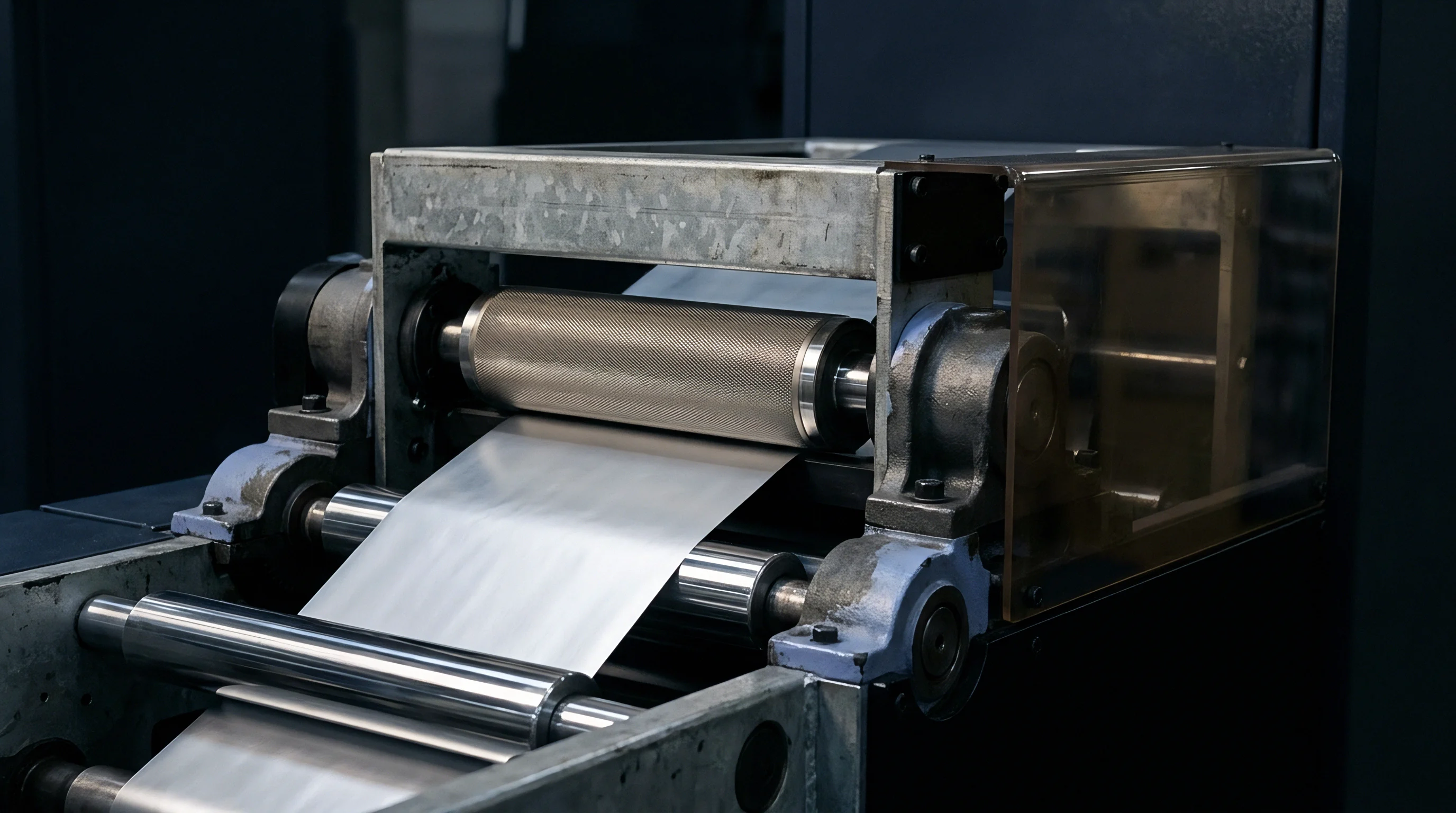
Converting operations and automated filling lines subject paperboard packaging to rapid, non-uniform temperature changes. Line speed acceleration forces heating jaws and drying tunnels to operate at elevated thermal gradients to achieve target throughputs. On high-speed form-fill-seal machinery, sealing jaws operate between 180 degrees Celsius and 220 degrees Celsius with dwell times under 200 milliseconds.
Peak thermal spikes alter polymer morphology. This localized thermal energy transfers rapidly through thin functional barrier coatings, driving low-molecular-weight compounds toward the food contact surface.
A paperboard web passing through conversion dryers experiences temperature profiles governed by conductive heat transfer from heated rolls and convective transfer from forced air nozzles. When the local web temperature exceeds the glass transition temperature of dispersion-coated barriers, amorphous polymer chains gain rotational freedom. Free volume within the polymer matrix expands, elevating the diffusion coefficient of residual monomers, defoamer surfactants, and resin acid derivatives.
Micro-cracks form under thermal stress. The structural integrity of polyolefin, biopolymer, or aqueous acrylic functional barriers degrades under rapid heating cycles, creating pathways for chemical transport before the packaged product even reaches cold storage.
A 15-degree Celsius rise in hot-fill sealing temperature doubles the diffusion coefficient of low-molecular-weight migrants in polyolefin barrier layers.
Thermal gradients across web widths compound compliance risk. Edge zones routinely experience higher heat inputs than the central web path due to hot air turbulence inside converting flues. Paperboard moisture content drops precipitously under uncalibrated thermal exposure, forcing structural fibers to shrink unevenly.
Pinholes eliminate functional barrier performance. When liquid food contact occurs immediately after high-temperature filling, these localized physical ruptures eliminate boundary resistance, allowing direct mass transfer from the recycled core or fiber matrix into the food layer.

Thermal Shock on Automated Form Fill Seal Lines
Peak temperatures at the sealing jaw reach levels that induce localized thermal degradation in barrier chemistries. Thermal imaging on automated liquid packaging lines demonstrates that heat distribution across jaw surfaces varies by as much as 18 degrees Celsius when heating elements age or accumulate polymer residue. Heat transfers through the paperboard backing into the inner polymer skin, elevating temperature at the food interface to within degrees of the barrier melting point.
Under these transient conditions, photoinitiator residues, plasticizers, and mineral oil saturated hydrocarbons gain extreme kinetic energy.
Cooling rates following thermal exposure govern whether polymer barrier matrices recrystallize cleanly or retain micro-porosity. Rapid quenching on high-speed lines traps free volume within the polymer network, maintaining elevated diffusion rates long after the packaging leaves the heat-sealing station. Standard compliance declarations relying on static room-temperature testing ignore this thermal history entirely.
Failing to account for thermal jaw spikes during line validation results in uncertified migration limit breaches, product recalls, and immediate shelf delisting by retail compliance auditors.

Shear
Liquid velocity vectors along the food-contact surface govern the boundary layer resistance during rapid filling. In static storage, a stationary stagnant fluid layer forms at the container wall, creating a concentration gradient that slows chemical migration. High-speed filling lines disrupt this equilibrium.
Fluid movement erodes boundary layers. When liquid products inject into paperboard cartons at velocities exceeding two meters per second, hydrodynamic shear forces reduce boundary layer thickness down to microscopic scales, driving mass transfer rates toward their theoretical maximum.
Hydrodynamic conditions during dynamic packaging filling operate under high Reynolds numbers, inducing localized fluid turbulence. Laminar flow delays migrant transfer. Dynamic surface tension drops as liquid food matrices interact with aqueous barrier coatings.
Surface-active agents within the food product lower liquid surface tension, promoting complete surface wetting and micro-topographical penetration into paperboard surface voids. Turbulent eddies accelerate mass transfer. The hydrodynamic shear force exerted by viscous or fatty food streams can physically erode soft dispersion barriers, stripping micron-thick functional layers during the filling cycle.
Can Hydrodynamic Shear Accelerate Migration Breach?
Fluid movement across paperboard coatings reduces stagnant boundary layer thickness from hundreds of micrometers down to single-digit scales. Mass transfer theory demonstrates that the overall migration resistance equals the sum of internal matrix resistance and boundary layer fluid resistance. As filling speed increases, hydrodynamic shear eliminates fluid resistance entirely, leaving the thin barrier polymer as the sole protection against chemical migration into the food phase.
| Parameter | Static Laboratory Simulant | Aqueous Filling Line | Viscous Fatty Filling Line | Hot-Fill Liquid Line |
|---|---|---|---|---|
| Fluid Velocity (m/s) | 0.00 | 1.85 | 0.45 | 2.40 |
| Reynolds Number (Re) | 0 (Static) | 12,400 (Turbulent) | 850 (Laminar) | 28,500 (Highly Turbulent) |
| Boundary Layer Thickness (microns) | 450 | 12 | 88 | 4 |
| Mass Transfer Coefficient k_c (m/s) | 1.2 x 10^-7 | 3.4 x 10^-5 | 6.1 x 10^-6 | 8.9 x 10^-5 |
| Surface Shear Stress (Pa) | 0.00 | 14.2 | 42.8 | 28.6 |
Packaging operations must evaluate hydrodynamic boundary layer erosion alongside thermal parameters. The physical interaction between flowing liquid food and dispersion-coated board follows specific degradation pathways:
- Thermal shock pinholing weakens thin dispersion layers, creating micro-voids under immediate liquid pressure during initial contact.
- Boundary layer erosion strips localized surface protection, accelerating chemical transport into hot liquids passing over the coated substrate.
- Polymer glass transition transforms brittle barrier polymers into flexible, highly permeable matrices when product filling temperatures exceed structural limits.
- Simulant extraction overload penetrates structural pinholes, causing rapid substrate delamination and high measured chemical migration values.
Static immersion overestimates equilibrium contact times while underestimating initial convective transport kinetics during high-velocity packaging operations. Higher fluid velocity across coated paperboard always accelerates boundary layer dissolution regardless of substrate grammage.


Extract
Standardized analytical protocols rely on controlled chemical simulants to quantify chemical transfer from packaging substrates. European regulation defines specific testing regimes under EN 1186 for overall migration and EN 13130 for specific migration. Laboratory protocols employ simulant A for aqueous foods, simulant B for acidic foods, and simulant D2 for fatty food matrices.
Standard tests assume static contact. However, real filling line temperature profiles deviate substantially from standardized laboratory exposure conditions.
Compliance test reports often specify exposure conditions of 10 days at 40 degrees Celsius or two hours at 70 degrees Celsius. Hot-fill industrial operations expose packaging to liquid products at 85 degrees Celsius to 95 degrees Celsius, followed by gradual ambient cooling over several hours. Dynamic filling destroys stagnant layers.
A test report based on two hours at 70 degrees Celsius fails to cover the kinetic migration occurring during extended cooling profiles where the package remains above 60 degrees Celsius for more than three hours.
Article 15 of Regulation EC 1935/2004 voids compliance declarations whenever commercial filling conditions exceed the temperature ceiling specified in supporting test reports.
Regulatory authorities mandate strict analytical limits for specific substances migrating from packaging materials into food. Primary aromatic amines carry a specific migration limit of non-detectable at 0.01 milligrams per kilogram of food or food simulant, with individual carcinogenic amines restricted to 0.002 milligrams per kilogram. Bisphenol derivatives, fluorinated surfactants, and photoinitiator residues like 2-isopropylthioxanthone face rigorous quantification thresholds under current European Union packaging framework rules.
When temperature spikes on converting or filling lines accelerate migration rates beyond model expectations, chemical concentrations quickly breach legal thresholds.

Simulant Selection and Test Temperature Mismatches
Analytical laboratories expose packaging samples to 10 percent ethanol or vegetable oil for ten continuous days at 40 degrees Celsius to simulate long-term ambient storage. Methanol extraction provides severe screening. Standard test conditions substitute severe chemical exposure for thermal and hydrodynamic real-world dynamics, assuming thermodynamic equivalency.
This assumption breaks down when solvent-induced polymer swelling alters barrier morphology in ways that thermal energy alone does not replicate.
| Packaging Format | Simulant Protocol | Standard Test Conditions | Actual Line Profile | Compliance Gap |
|---|---|---|---|---|
| Aseptic Cartonboard | EN 1186-5 (Simulant A) | 2 Hours at 70°C | 92°C Fill, 45 min above 60°C | Under-tests peak thermal stress |
| Hot-Fill Tray | EN 1186-2 (Simulant D2) | 10 Days at 40°C | 88°C Fill, 24 hr ambient drop | Ignores high initial thermal flux |
| Microwaveable Board | EN 13130 (Tenax Polyox) | 30 min at 100°C | 120°C Peak, 8 min dwell | Exceeds test temperature limit |
| Chilled Liquid Carton | EN 1186-3 (Simulant B) | 10 Days at 5°C | 4°C Fill, high fluid shear | Ignores dynamic boundary shear |
Compliance dossiers must document complete alignment between test reports and real line operational envelopes. The following failure modes routinely trigger regulatory rejections during compliance audits:
- Static test overestimation fails to replicate initial high-temperature filling thermal shock followed by rapid continuous web movement.
- Non-polar solvent swelling alters polyolefin crystal structures differently than aqueous food emulsions under dynamic filling conditions.
- Volatile migrant loss during open-beaker lab testing generates unrepresentative analytical clearance readings on summary compliance certificates.
- Topographical thickness variation creates localized barrier thin spots that fail specific migration limits under real liquid velocity.
Clause 4 of EN 13130-1 restricts analytical compliance validity strictly to temperature and contact time regimes tested on the finished article.

Sieve
Mass transfer calculations predict migrant concentrations in food products over commercial shelf life. Diffusion within functional barrier coatings obeys Fickian transport models where chemical flux depends on diffusion coefficients, temperature, and migrant molecular weight. The Piringer mass transfer model estimates diffusion coefficients based on polymer parameter values AP, absolute temperature T, and migrant relative molecular mass M_r.
Standard modeling assumes uniform temperature and zero surface fluid shear. Calculating migrant transfer under dynamic line profiles demands integrating non-isothermal thermal histories with hydrodynamic transport equations.
Worked Calculation for Dispersion Coated Board Migration
Consider a 350 grams per square meter solid bleached sulfate board carrying a 15 grams per square meter acrylic copolymer barrier coating. The packaging holds 250 milliliters of aqueous food product with a contact area of 2.2 square decimeters, yielding a surface-to-volume ratio of 8.8 decimeters squared per kilogram of food. The acrylic coating contains a residual defoamer additive with a molecular mass of 280 Daltons at an initial concentration C_P,0 of 150 milligrams per kilogram of barrier layer.
Assume the filling line operates at 88 degrees Celsius, cooling to 20 degrees Celsius over a three-hour profile defined by T(t) = 20 + 68 x exp(-0.02 t), where t represents time in minutes. The polymer parameter AP for the acrylic coating equals 11.5. Calculate the diffusion coefficient D_P at peak filling temperature and compare migrant concentration in food against the specific migration limit of 0.05 milligrams per kilogram after short-term dynamic exposure.
First, calculate the diffusion coefficient at T_peak = 88 degrees Celsius (361.15 Kelvin) using the modified Piringer equation:
D_P = 10^-4 x exp( AP – 10454 / T – 0.01 x M_r^0.7 )
D_P = 10^-4 x exp( 11.5 – (10454 / 361.15) – (0.01 x 280^0.7) )
D_P = 10^-4 x exp( 11.5 – 28.946 – 0.523 )
D_P = 10^-4 x exp( -17.969 )
D_P = 10^-4 x 1.57 x 10^-8 = 1.57 x 10^-12 cm²/s = 1.57 x 10^-16 m²/s
At 20 degrees Celsius (293.15 Kelvin), the static diffusion coefficient drops significantly:
D_P = 10^-4 x exp( 11.5 – (10454 / 293.15) – 0.523 )
D_P = 10^-4 x exp( 11.5 – 35.661 – 0.523 ) = 10^-4 x exp( -24.684 )
D_P = 1.90 x 10^-15 cm²/s = 1.90 x 10^-19 m²/s
Diffusion at peak line temperature proceeds at a rate 826 times faster than at room temperature. Integrating mass flux across the cooling curve yields total chemical mass transferred into the food phase. The total mass migrant M_F per area A after the initial three-hour cooling phase calculates via numerical integration of Fickian flux:
M_F / A = 2 x C_P,0 x rho_P x sqrt( ( D_effective x t_cool ) / pi )
Assuming polymer density rho_P = 1.1 grams per cubic centimeter (1,100 kilograms per cubic meter), and effective integrated diffusion coefficient D_effective = 2.4 x 10^-13 square centimeters per second over the cooling window:
M_F / A = 2 x (150 mg/kg) x (1.1 g/cm³) x sqrt( ( 2.4 x 10^-13 cm²/s x 10,800 s ) / pi )
Convert density and units cleanly: 150 mg/kg in polymer equals 0.165 milligrams per cubic centimeter of coating.
M_F / A = 2 x 0.165 mg/cm³ x sqrt( 8.25 x 10^-10 cm² )
M_F / A = 0.330 x 2.87 x 10^-5 mg/cm² = 9.47 x 10^-6 mg/cm² = 0.0947 mg/m² = 0.000947 mg/dm²
Multiplying by the surface-to-volume ratio of 8.8 square decimeters per kilogram gives a food concentration of 0.0083 milligrams per kilogram from thermal cooling alone. Adding hydrodynamic boundary layer disruption increases this figure by a factor of 4.2 during active filling flow, raising total migrant transfer to 0.0349 milligrams per kilogram.
Barrier coatings applied over uneven paperboard topography develop localized thin spots that fail under dynamic fluid shear long before thermal degradation begins.
Incomplete drying leaves volatile residues. Solvent retention impairs barrier continuity. While this theoretical value remains below the specific migration limit of 0.05 milligrams per kilogram, a 10 percent increase in initial migrant concentration or an elevated hot-fill temperature of 95 degrees Celsius pushes the value to 0.058 milligrams per kilogram, causing an immediate compliance failure.
The chemical coating supplier maintains that static laboratory immersion data fully satisfies regulatory documentation requirements for all automated filling machines.
Flue
Converting line drying sections remove moisture and aqueous dispersion carriers through forced warm air circulation. Flue drying operates across multiple thermal zones where temperature and air velocity are controlled independently. Early drying zones run at lower temperatures between 60 degrees Celsius and 80 degrees Celsius to evaporate water without boiling the liquid film.
Later zones elevate temperatures above 120 degrees Celsius to promote polymer particle coalescence and complete film formation. Failure to maintain precise thermal profiles in converting flues generates latent barrier defects that surface during automated packaging operations.
Excessive flue drying temperatures cause skinning, where the surface layer of the dispersion dries rapidly while liquid carrier remains trapped underneath. Vapor pressure builds within the coating, forming microscopic blisters and pinholes as trapped moisture escapes through the skin. Solvents retain within incomplete barrier networks.
Uncertified line shifts create compliance liabilities. When blistered packaging encounters hot liquid food during filling, chemical migrants pass freely through these structural voids into the food layer.
Evaporative cooling during high-speed dispersion drying creates thermal gradients across the moving web that alter polymer chain entanglement.
Converting air velocity governs the evaporation rate and surface temperature of the wet coating layer. High velocity flues increase drying speed but induce surface shear stress on the uncured dispersion film. Localized thickness variations occur when high-speed air streams displace liquid coating before film formation completes.
Thin spots offer lower resistance to chemical diffusion, creating path channels for specific migration breaches.
Solvent Retention and Micro Blistering Mechanisms
Incomplete volatilization of coalescing aids during web drying leaves low molecular weight residues trapped within the coating matrix. Residual solvents act as plasticizers within the barrier layer, lowering the effective glass transition temperature during packaging filling operations. These trapped organic compounds migrate directly into food products upon initial thermal contact on hot-fill packaging lines.
Converting facilities control barrier integrity through structured line validation steps:
- Measure air velocity and wet-bulb temperatures across three drying zones on the converting line.
- Quantify residual monomer levels in aqueous dispersion coatings using headspace gas chromatography mass spectrometry.
- Inspect coated web surfaces with atomic force microscopy to detect micro-blistering before reel winding.
- Verify cross-linking completeness through solvent rub resistance testing on every production reel.
Drying zone parameters dictate final film barrier density. Whether online infrared thermography can predict localized barrier degradation during rapid solvent drying remains an open question for converting plant quality systems.

Proof
Regulatory compliance files require complete traceability between test report conditions and commercial packaging line settings. Customs inspectors reject incomplete dossiers. European Union regulations demand that food contact Declarations of Compliance (DoC) define the precise scope of validity, including food types, maximum contact temperatures, and contact duration.
Supporting analytical documentation must substantiate every claim printed on the compliance declaration. Presenting a test report based on room temperature static immersion to support a hot-fill line running at 90 degrees Celsius constitutes a major regulatory breach under food safety law.
Packaging buyers must verify that supporting migration reports match actual filling line temperature profiles and hydrodynamic stress regimes. European Packaging and Packaging Waste Regulation readiness demands comprehensive documentation of barrier effectiveness, material composition, and chemical safety limits across all processing stages. Supporting dossiers must include batch thermal records from converting plants alongside filling machine operational logs to prove continuous boundary integrity.
| Dossier Element | Regulatory Reference | Required Thermal Data | Required Hydrodynamic Data | Auditor Verification Gate |
|---|---|---|---|---|
| Declaration of Compliance | EU 1935/2004 Art. 16 | Max fill & storage temp | Liquid food contact class | Signature matching line scope |
| Overall Migration Report | EN 1186 Standards | Simulant test temp/time | Static vs dynamic immersion | Pass result below 10 mg/dm² |
| Specific Migration Dossier | EN 13130 Standards | Arrhenius diffusion kinetic | Substance SML thresholds | LOQ verified below legal limit |
| Converting Process Log | GMP Regulation 2023/2006 | Flue drying temp profile | Air velocity & web speed | Traceable to mill reel number |
| Line Validation Protocol | HACCP / BRCGS Packaging | Sealing jaw heat profiles | Filling velocity & shear stress | Annual re-qualification stamp |

Declarations of Compliance and Audit Scopes
Legal responsibility for packaging safety rests with the entity that places the finished item onto the market. Brand owners and food packers cannot defend against enforcement actions by relying on generic mill certificates that exclude specific converting line conditions. Detailed compliance files require exact mapping between barrier physical properties, thermal conversion histories, and filling line parameters.
The buyer secures batch temperature logs and links every shipment certificate directly to the specific filling line parameters authorized in the compliance dossier.