Directional Temperature Difference
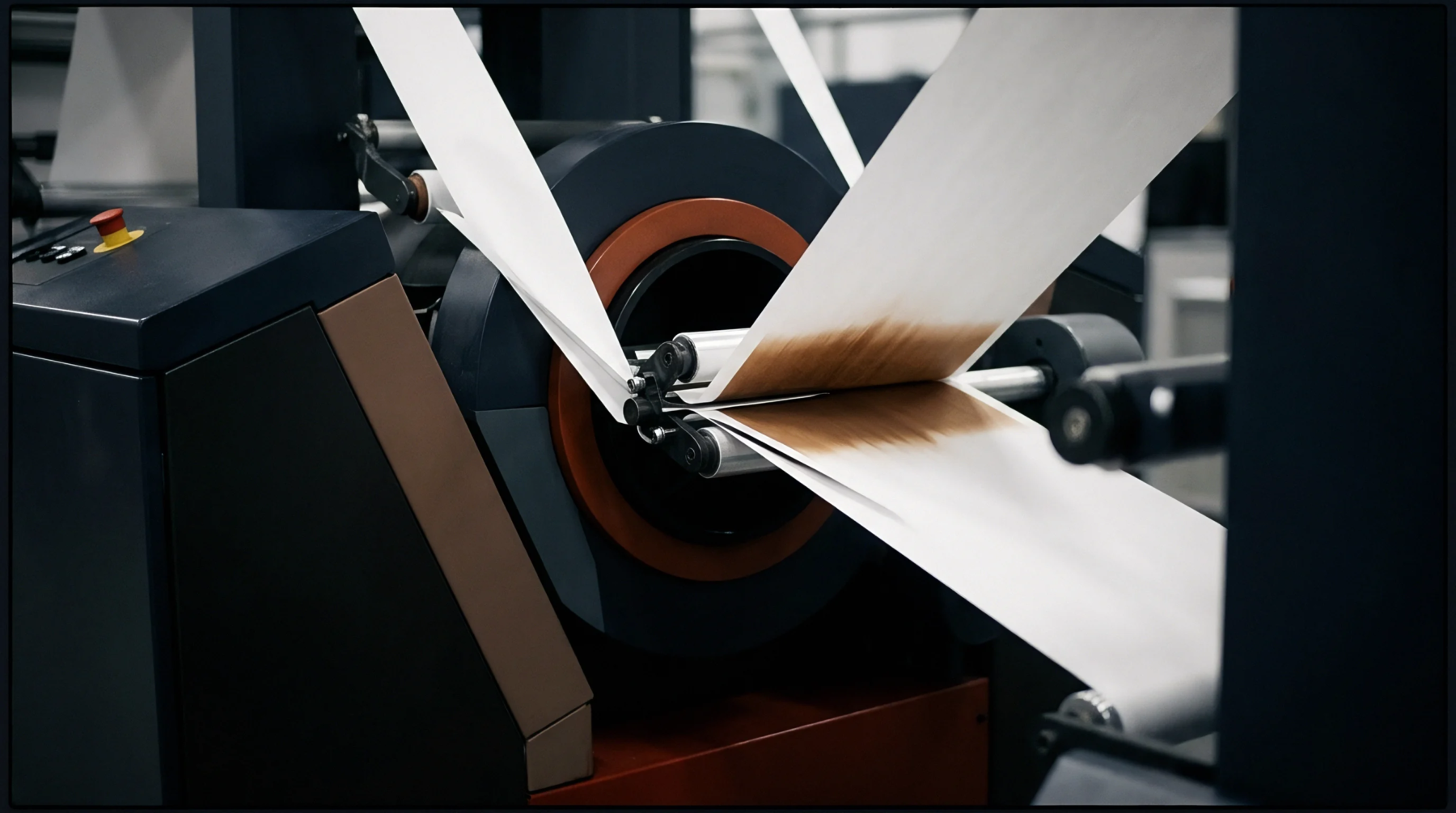
Quantitative variation in temperature per unit distance across or through a material governs the directional rate of conductive heat transfer. Inside paper manufacturing and converting operations, a thermal gradient develops primarily across the z-axis of the web, driven by intimate contact with heated dryer shells on one face and convective cooling from ambient air on the other. This differential controls the rate of internal sensible heating, moisture vaporization, and binder migration within liquid coatings.
Large gradients generate asymmetric thermal expansion and internal mechanical stresses between opposing faces of the sheet. Heat conduction across the paper plane slows significantly as density falls and internal air void fractions rise, establishing the paper caliper as a primary thermal resistor.
Heat Transfer Dynamics
Fourier’s law governs the conductive heat flux traveling through the porous fibrous matrix, establishing that heat transfer density remains proportional to the magnitude of the thermal gradient. Within multi-cylinder drying sections, the paperboard surface touching the cast iron cylinder approaches one hundred degrees Celsius, while the exposed sheet surface remains twenty to forty degrees cooler due to evaporative heat loss. This steep internal gradient establishes a coupled thermodynamic driving force that propels liquid water and vapor from the hot contact zone toward the cold open surface.
Rapid heatset drying of printed web substrates creates violent gradients, where the wet ink skin heats far faster than the base paperboard, risking ink bubbling if the thermal differential cannot equilibrate smoothly.
Converting Flatness
Web curl in solid bleached board or folding boxboard traces directly to unchecked differential heating during processing. An uncorrected thermal gradient between the felt side and wire side causes uneven drying rates, producing asymmetric shrinkage across individual cellulose fibers that warps the flat sheet. Lamination lines run into severe curling problems if hot polymer extrusions are applied to cold linerboards without adequate preheating of the base web.
Packaging convertors prevent post-cure warp by matching roll surface temperatures and adjusting steam showers to eliminate severe thermal differences across the caliper before winding.