Basic Recycled Pulp Moisture Measurement and Air Dry Weight Calculations
Air dry pulp calculations convert wet scale weight to a standard ninety percent dry fiber basis to prevent paying paper pulp rates for transported water.
Convention
Commercial transactions in the pulp trade separate the mass of water from the mass of cellulose. Papermakers purchase fiber to produce paper, board, and packaging materials. Water alters invoicing.
Water adds shipping deadweight and dilutes chemical slurries in the hydrapulper, yet fiber alone forms the web on the wire. When a mill receives a consignment of baled recycled pulp, paying against gross scale weight means purchasing moisture at fiber prices. International commerce therefore relies on a contractual baseline termed air dry weight.
International trade contracts governing pulp deliveries bind settlements to ISO 638 test results, forcing financial credit adjustments whenever delivered dryness deviates from contract baselines.
Commercial Weight versus Physical Mass
Invoiced totals reflect a standardized dry content rather than scale weight. Cellulosic fibers naturally seek hygroscopic equilibrium with the surrounding atmosphere. Bone dry pulp, possessing zero moisture, exists only inside laboratory drying ovens.
As soon as hot, dehydrated pulp contacts ambient air, fibers absorb ambient vapor. Transporting entirely water-free pulp across maritime routes remains physically impossible without airtight, hermetically sealed containment. The pulp industry resolved this physical reality by adopting an internationally harmonized definition for invoicing called standard air dry pulp.
Standard air dry pulp contains exactly ninety percent absolute oven dry fiber and ten percent water by mass. The commercial convention applies uniformly across virgin kraft, bleached chemical pulp, and recycled post-consumer fiber grades. When a supplier ships one metric ton of air dry pulp, the cargo contains 900 kilograms of bone dry fiber accompanied by 100 kilograms of structural moisture.
Invoiced tonnage rarely matches scale readouts at receiving docks. Moisture shifts line yield. Converting raw delivered weights into air dry figures protects both parties from the financial instability of fluctuating weather conditions, ocean transit humidity, and rain events during dock transfers.

International Baseline for Market Pulp
Technical committees codified the ninety percent dryness reference under ISO 638. The standard sets parity. Equivalent methods published by TAPPI under T 210 reinforce the identical mathematical multiplier across North American commercial contracts.
In European trade, EN ISO 638-1 governs the gravimetric determination of dry matter in paper, board, and pulp. These standards establish that the air dry weight of a pulp consignment equals the total mass of oven dry fiber divided by 0.90.
| Terminology | Nominal Moisture Content | Dry Matter Ratio | Commercial Weight Multiplier |
|---|---|---|---|
| Bone Dry (Oven Dry) | 0.0 percent | 1.00 | 1.111 |
| Air Dry (Commercial Pulp) | 10.0 percent | 0.90 | 1.000 |
| Wet Lap Recycled Bales | 45.0 to 55.0 percent | 0.45 to 0.55 | 0.500 to 0.611 |
| High-Density Wet Sheets | 15.0 to 25.0 percent | 0.75 to 0.85 | 0.833 to 0.944 |
Purchasers of recycled pulp encounter greater moisture variability than buyers of virgin chemical pulp. Virgin market pulp typically leaves modern drying lines at seven to ten percent moisture, remaining relatively stable during container transit. Deinked recycled pulp and post-consumer recovered grades often exit wet lap machines or flash driers with broad moisture distributions.
A bale exterior can measure twelve percent moisture while the dense core retains twenty-two percent moisture. Accurate financial settlement requires rigorous extraction procedures across entire bale shipments.
Pulp stored in unheated warehouses tracks seasonal humidity shifts through its exposed outer plies.


Wedge
Physical extraction of pulp samples from wrapped units demands strict geometry. Recycled pulp bales exhibit density gradients and non-uniform moisture dispersion. The exterior layers absorb atmospheric water during rainy transit or desiccate under solar exposure inside cargo containers.
Surface measurements fail completely to represent consignment averages. Standard sampling practices specify physical entry into the three-dimensional core of the bale to extract proportional representations of every moisture zone.
Core Boring versus Wedge Extraction
Field personnel choose between rotating augers and mechanical saws depending on bale compaction. ISO 7213 sets the global procedure for sampling pulp deliveries in bales or sheets. The two approved physical methods consist of cutting triangular wedges or extracting cylindrical cores through rotary power borers.
Mechanical core drills penetrate to the geometric midpoint of the unit. The core borer cuts deep. The rotating cutter retrieves a continuous cross-sectional cylinder of compressed fiber, spanning from exterior wrapper plies straight into the center.
Wedge cutting demands hand-operated circular or band saws. The technician cuts a triangular wedge from the corner toward the center, ensuring the sample cross-section widens proportionally as depth increases. A wedge accounts geometrically for the three-dimensional volumetric distribution of the bale.
The outer edge represents surface exposure, the mid-tier reflects transitional moisture zones, and the apex captures the dense, unexposed interior core. Discarding or disproportionately weighting any part of the triangular cross-section invalidates the resulting moisture assay.
- Gross consignment weighing records the total delivery mass before environmental moisture alters the load.
- Sample bale selection identifies representative units across varying stack heights, preventing bias from rain exposure or dry surface layers.
- Rapid core extraction retrieves pulp material from bale centers under fifty seconds to stop moisture loss to the ambient air.
- Vapor-tight enclosure seals test specimens into pre-weighed stainless canisters immediately, avoiding atmospheric moisture absorption.

Protection of Laboratory Samples
Exposure to warehouse air during cutting shifts sample weight within minutes. Rapid sealing prevents loss. Friction from mechanical coring generates localized thermal energy, which evaporates moisture into the surrounding room before technicians record specimen weights.
Experienced operators run boring tools at controlled rotational speeds, minimizing heat build-up. Tare weights drift quickly. The extracted fibers drop straight into tare-calibrated, hermetic vapor containers without manual handling.
Delays between extraction and gross sample weighing introduce non-systematic measurement error. A delay of twenty minutes on an open weighing table in a low-humidity receiving dock reduces measured moisture content by up to 0.5 percent, skewing subsequent invoicing calculations in favor of the seller. Standard operating discipline requires immediate balance registration of the wet gross sample mass to three decimal places.
The sealed specimen container travels directly from the receiving dock to the testing laboratory without opening.
The transport dispatch clerk stated that condensation on the trailer ceiling explained why the upper bales showed elevated moisture readings upon arrival.


Heat
Gravimetric moisture determination relies on drying specimens to constant weight at 105 degrees Celsius. Testing technicians place open containers inside ventilated electric drying ovens conforming to ISO 638-1 and TAPPI T 210. Forced convection circulates air across the cellulose fibers, sweeping desorbed water vapor out through exhaust dampers.
The sample remains inside the thermal zone until the mass difference between two consecutive weighings, separated by a specified heating interval, falls below 0.1 percent of the initial sample mass.
Deinked recycled pulp containing mineral fillers exhibits up to 0.4 percent non-aqueous mass loss when subjected to oven drying at 105 degrees Celsius.
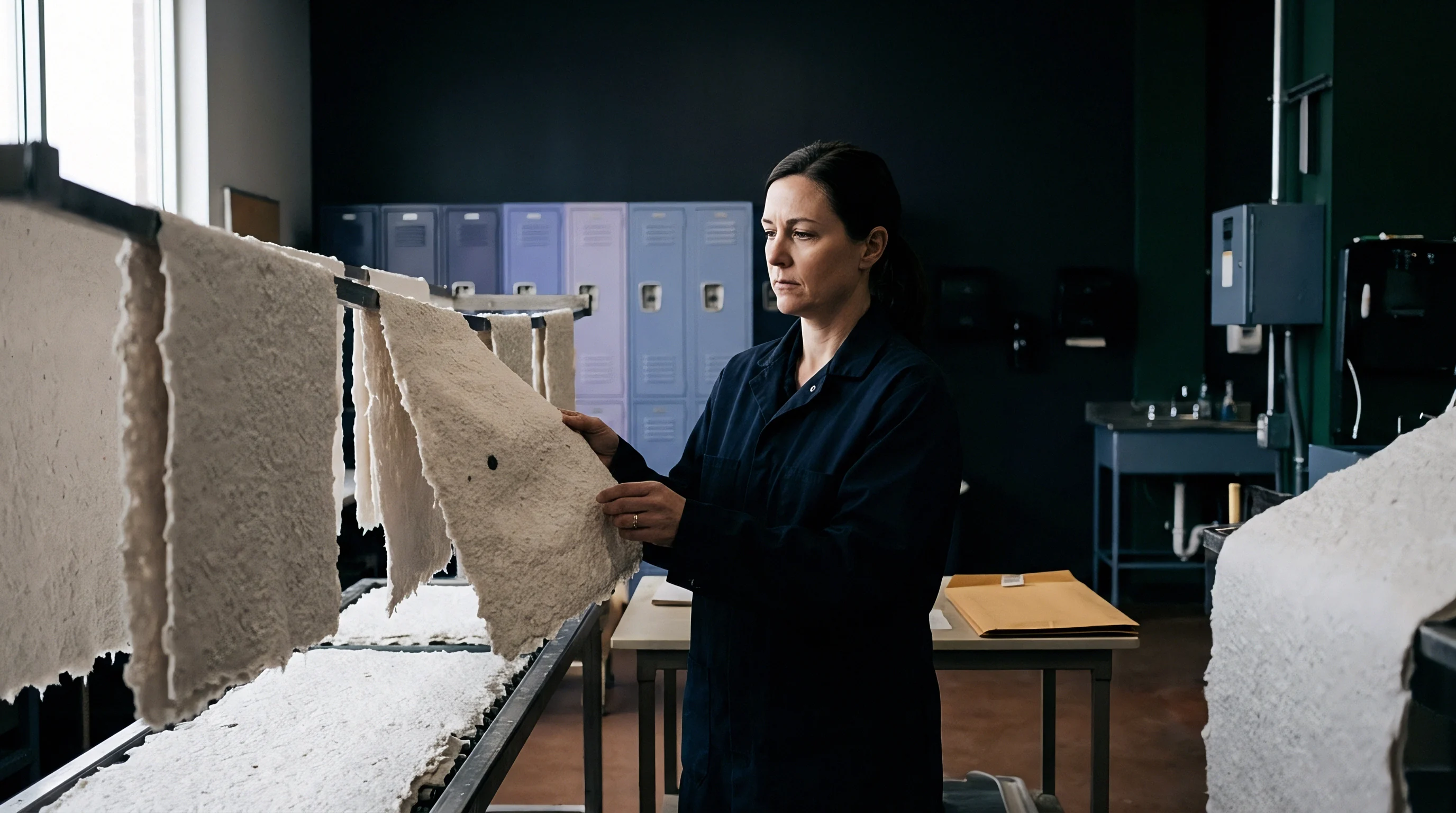
Thermal Desiccation in Laboratory Ovens
Laboratory test chambers circulate dry air across weighed specimen dishes. The temperature envelope stays tightly held at 105 degrees plus or minus 2 degrees. Elevated temperatures above 110 degrees initiate cellulose degradation, charring, and thermal pyrolysis, creating an artificial loss of dry mass that technicians mistake for evaporated moisture.
Temperatures below 103 degrees fail to drive out bound water trapped within the crystalline microfibrils of the fiber wall.
Cooling requires specialized desiccation chambers filled with active silica gel or anhydrous calcium sulfate. Transferring red-hot pulp samples directly to analytical balances induces convective draft currents inside balance chambers, disrupting precision readings. Cooling the sample in room air without a desiccator causes immediate reabsorption of ambient humidity by the dry fiber structure.
Technicians weigh the cooled dish inside an enclosed analytical balance accurate to 0.001 grams.
| Furnish Grade | Organic Filler Content | Mineral Ash Proportion | Apparent Volatile Bias |
|---|---|---|---|
| Virgin Bleached Kraft | Under 0.2 percent | Under 0.5 percent | 0.02 percent |
| Deinked Office Waste Pulp | 1.5 to 3.0 percent | 6.0 to 12.0 percent | 0.25 to 0.45 percent |
| Mixed OCC Secondary Fiber | 2.0 to 4.5 percent | 3.0 to 7.0 percent | 0.18 to 0.35 percent |
| Coated Broke Deinked Slurry | 3.0 to 6.0 percent | 10.0 to 18.0 percent | 0.30 to 0.55 percent |
| Test conditions per ISO 1762 incineration at 525 degrees Celsius and ISO 638-1 oven drying at 105 degrees Celsius. | |||

Recycled Furnish Volatilization Dynamics
Secondary fibers introduce chemical compounds absent in virgin wood pulp. Starches degrade under oven drying. Recovered papers contain residual surface sizes, wet strength resins, deinking collector chemicals, mineral oils, printing ink residues, and fatty acids.
When exposed to 105 degrees Celsius for four hours, low-boiling-point organics vaporize alongside liquid water. The analytical scale records total mass loss, attributing all departed grams exclusively to moisture.
Mineral fillers present in deinked recycled furnishes skew gravimetric measurements further. Calcium carbonate resists volatilization. However, hydrates associated with clay, gypsum, or calcium sulfate can release chemically bound crystal water at standard drying temperatures.
The resulting calculated moisture percentage registers higher than the physical water content of the pulp slurry. Mills handling high-filler deinked stocks verify mineral proportions through parallel ash tests at 525 degrees Celsius according to ISO 1762, correcting moisture readings for filler decomposition biases.
- Thermal carbohydrate pyrolysis degrades residual starch binders and cellulose chains during extended drying cycles, registering falsely as lost water.
- Volatile organic evaporation releases deinking surfactants and fatty acids into the oven airstream, artificially inflating calculated moisture values.
- Ambient vapor reabsorption occurs while moving hot crucibles to desiccators, reducing apparent moisture loss if technicians delay balance readings.
- Mineral filler dehydration alters crystal lattice water in clay or gypsum when temperatures exceed standard thresholds.
Whether chemical deinking surfactants accelerate mass loss at laboratory temperatures remains an open debate among commercial testing facilities.

Arithmetic
Calculating financial settlements begins with the ratio of dry cellulose to total delivered mass. Laboratory scales yield two fundamental values: wet sample mass before thermal desiccation and dry sample mass after cooling. Invoices demand exact math.
The primary operational output is the dry matter percentage, also designated the dryness factor. From this figure, engineers derive the air dry metric tonnage and reconcile discrepancies against supplier invoices.
Bales sampled from deep inside a shipping container retain their production moisture while perimeter bales equilibrate with oceanic air.
Moisture Ratio and Dry Content Equations
Conversion formulas translate raw oven data into commercially recognized figures. The mathematical derivation follows strict steps. Moisture content measures the proportion of water relative to wet sample weight.
The formula determines payment.
Moisture Content Percentage = ((Wet Mass – Dry Mass) / Wet Mass) 100
Dry Matter Percentage = (Dry Mass / Wet Mass) 100
Because commercial trade defines air dry pulp as ninety percent dry matter and ten percent water, the conversion from dry matter to air dry content uses a fixed 0.90 divisor:
Air Dry Content Percentage = Dry Matter Percentage / 0.90
Commercial Invoiced Weight = Gross Consignment Weight (Air Dry Content Percentage / 100)
Dry fiber defines value. When the air dry content percentage equals exactly 100 percent, the pulp consignment contains precisely ninety percent oven dry fiber. If the laboratory measures a dry matter percentage of 81 percent, the air dry content becomes 81 divided by 0.90, equaling 90.0 percent.
The commercial weight of the load is ninety percent of the scale weight on the delivery weighbridge. The buyer deducts ten percent from the gross billed tonnage.

Worked Reconciliation on Recycled Bale Lots
Evaluating a commercial consignment illustrates the exact financial stakes of water content. Assume a paperboard mill purchases a 100.00 metric ton delivery of baled deinked recycled pulp at a contracted price of $650.00 per Air Dry Metric Ton (ADMT). The delivery note claims an air dry content of 90.0 percent, corresponding to an invoiced delivery of 100.00 ADMT and an invoice total of $65,000.00.
Receiving inspection samples the lot using ISO 7213 wedge cuts across twenty bales. Laboratory drying under ISO 638-1 establishes that the average dry matter content is 78.50 percent instead of the anticipated 81.00 percent. The actual moisture content of the shipment stands at 21.50 percent.
Actual Air Dry Content Percentage = 78.50 / 0.90 = 87.222 percent
True Commercial Mass = 100.00 Metric Tons (87.222 / 100) = 87.222 ADMT
Payable Amount = 87.222 ADMT $650.00 = $56,694.30
Invoice Deduction Due = $65,000.00 – $56,694.30 = $8,305.70
The mill was billed for 12.778 metric tons of excess water disguised as market fiber. Without immediate gravimetric testing and air dry conversion math, the buyer forfeits over eight thousand dollars on a single truckload consignment.
| Received Wet Mass | Measured Moisture Content | Calculated Air Dry Tons | Invoiced Value at $650 per ADMT | Settlement Discrepancy |
|---|---|---|---|---|
| 100.00 MT | 9.0 percent | 101.11 ADMT | $65,721.50 | +$721.50 (Overage) |
| 100.00 MT | 10.0 percent | 100.00 ADMT | $65,000.00 | $0.00 (Parity) |
| 100.00 MT | 12.0 percent | 97.78 ADMT | $63,557.00 | -$1,443.00 (Shortage) |
| 100.00 MT | 15.0 percent | 94.44 ADMT | $61,386.00 | -$3,614.00 (Shortage) |
| 100.00 MT | 18.0 percent | 91.11 ADMT | $59,221.50 | -$5,778.50 (Shortage) |
| 100.00 MT | 21.5 percent | 87.22 ADMT | $56,693.00 | -$8,307.00 (Shortage) |

Documentation Requirements on Delivery Dockets
Clear paperwork prevents disputes before freight leaves the receiving apron. Sourcing desks verify that weight dockets, laboratory test certificates, and billing invoices tie back to identical lot numbers. Discrepancies between delivery tickets and laboratory receipts void commercial warranty claims.
- Certified gross intake weight proves the physical mass of the pulp delivery across certified weighbridge scales.
- Laboratory dry content percentage records the verified proportion of oven dry fibers established through standardized laboratory testing.
- Air dry metric tonnage specifies the payable commercial mass calculated directly against the ninety percent standard convention.
- Moisture deduction value states the financial deduction applied when measured water exceeds the contractual threshold.
The moisture adjustment clause in trade rules allows buyers to re-invoice entire consignments when measured dry content falls below contractual guarantees by more than one percent.


Ledger
Fibre tracking schemes demand that material accounting reflect true dry solids rather than gross cargo weight. Chain of custody verification under FSC-STD-40-004 and PEFC ST 2002 governs certified recycled packaging claims. When a mill credits its inventory ledger with incoming post-consumer pulp, input volumes convert to standard metric dry fiber.
Recording wet intake weight creates synthetic volume credits that distort the entire credit balance.
Fibre certification auditors reject mass balance ledgers that tally raw wet gate deliveries as certified dry input.

Chain of Custody Credit Mass Balancing
Certification auditors scrutinize volume credit balances to verify fiber input ratios. Credit balances require precision. Under the credit system, a packaging mill claims certified recycled content on outgoing folding cartons based on the proportion of certified recycled inputs entering the process.
If a facility books 1,000 metric tons of wet lap recycled pulp at 45 percent dry matter into its FSC credit bank without air dry conversion, the credit ledger inflates by 550 tons of water.
This accounting inflation leads directly to fraudulent certified product sales downstream. Auditors compare weighbridge records, laboratory moisture sheets, and hydrapulper charge logs during annual surveillance visits. The allowable credit volume equals the air dry metric tonnage of certified fiber, never the wet weight stamped on bill-of-lading wrappers.
If wet intake drifts unnoticed, the credit balance overstates output potential, triggering corrective action requests, certificate suspensions, and formal withdrawal of packaging claim approvals.
Border Valuation and Customs Classification
Import tariff codes apply duties strictly against legitimate cargo classifications. Customs inspectors penalize disparities. Baled recycled pulp crosses national frontiers under harmonized system code 4707 for recovered paper or paperboard, and code 4706 for pulps of other fibrous cellulosic material.
Customs duties, trade defense tariffs, and value-added tax assess against the invoiced transaction value. If an importer pays for 500 air dry metric tons based on unadjusted scale weights containing 15 percent excess water, the declared customs valuation overstates the taxable product value.
Tax authorities audit cross-border settlements against physical inventory intake. When a mill claims an after-the-fact financial rebate or credit note from a foreign supplier for excess water content, the transaction requires a formal customs declaration amendment. Neglecting to report post-settlement moisture rebates violates customs valuation rules, distorting the declared landed cost.
Importers who maintain automated cross-checks between laboratory moisture testing dockets and fiscal customs filings eliminate vulnerability to misdeclaration penalties during tax audits.
Mismatched dry mass figures between customs import entries and physical warehouse tallies expose importers to back-duty assessments and formal administrative penalties during post-clearance tax reviews.