Deriving Mathematical Diffusion Scaling Factors across High Speed Converting Mandrels
Deriving dynamic mathematical scaling factors converts static 10-day laboratory migration values into accurate millisecond dwell predictions for high-speed mandrel lines.


Mandrel
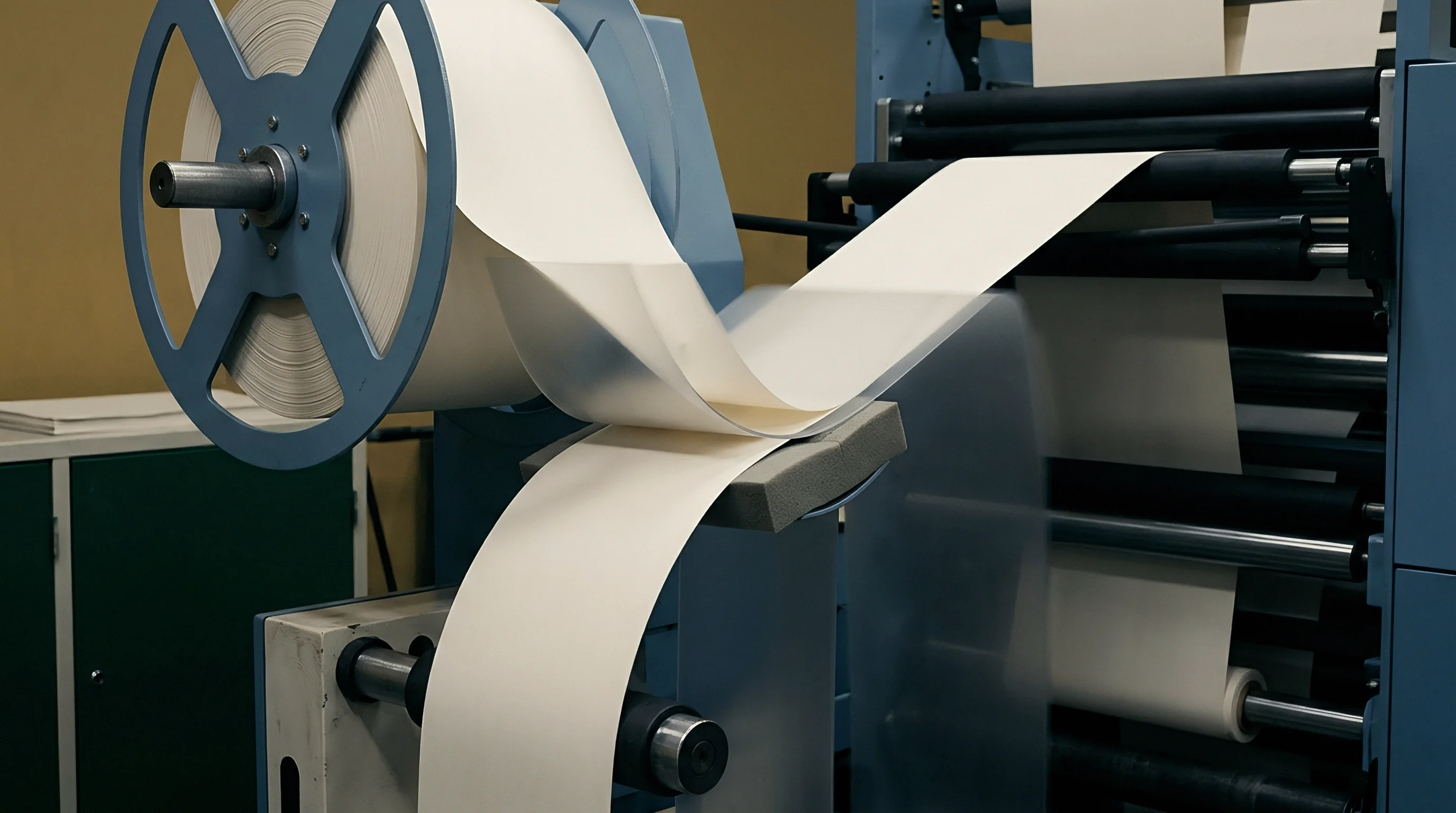
Steel core elements in rotary forming packaging equipment subject paperboard substrates to intense mechanical compression, sudden thermal transfers, and transient shear profiles over millisecond contact windows. At line speeds between 300 and 900 meters per minute, any given fiber segment touches the metal face for only 5 to 50 milliseconds. Across this brief window, functional additives, synthetic ester lubricants, silicone release fluids, and residual solvents undergo dynamic physical displacement across the interface.
During cylindrical shell forming, mechanical nip forces routinely exert 0.5 to 5.0 megapascals of compressive stress. This pressure collapses the board’s porous void network, altering internal capillaries and forcing volatile compounds and low-viscosity liquids directly into z-directional voids. Friction simultaneously heats the contact surface, producing temperature spikes 30 to 80 degrees Celsius above ambient plant baseline that alter fluid viscosity and gas phase energy, driving non-steady-state transport that static diffusion tests fail to capture.
Synthetic ester lubricant films on high-speed steel cores experience instantaneous hydraulic compression, driving fluid into board pores before bulk thermal equilibrium occurs.
Understanding transport physics at this boundary requires decoupling the mechanical compression phase from the thermal diffusion phase. Continuous industrial operation establishes distinct thermodynamic zones along the rotating element assembly, creating a complex gradient sequence:
- Initial Contact Zone where mechanical compaction drives bulk convective fluid flow into open surface pores of the board within the first 10 milliseconds.
- Thermal Peak Zone where localized frictional heating reduces chemical viscosity and increases the thermodynamic activity of volatile organic molecules.
- Decompression Zone where structural fiber relaxation generates negative internal pore pressure, drawing surface chemistry deeper into the paperboard core.
- Post-Forming Cooling Zone where ambient heat dissipation stabilizes fluid viscosity, locking chemical migrants into the internal pore network.
Ambient room temperatures render thermal expansion across core elements negligible during continuous runs.

Velocity
Web transport speeds across modern converting machinery shift chemical transport dynamics from classical Fickian diffusion to convection-dominated regimes. In steady-state laboratory setups, molecular mass transfer follows Fick’s first law, driven entirely by concentration gradients across a static barrier. High-speed processing invalidates static equilibrium assumptions as mechanical pressure compresses interstitial free volume and reduces radial migration times.
The dimensionless Peclet number defines the ratio of convective transport rate to molecular diffusion rate across the web boundary. When web line velocities exceed 5 meters per second, Peclet numbers within the open capillary channels of paperboard substrates rise above unity, indicating that fluid movement driven by mechanical pressure and web travel dominates over molecular diffusion. Determining effective chemical transfer across high-speed packaging machinery demands kinetic scaling factors calibrated against processing speeds.
| Line Velocity (m/min) | Contact Dwell (ms) | Nip Pressure (MPa) | Peclet Number Range | Dominant Transport Mechanism |
|---|---|---|---|---|
| 150 | 40.0 | 0.8 | 0.45 to 0.85 | Molecular Fickian Diffusion |
| 300 | 20.0 | 1.5 | 1.10 to 2.30 | Transient Mixed Convection |
| 600 | 10.0 | 3.0 | 3.50 to 6.80 | Pressure-Driven Capillary Flow |
| 900 | 5.0 | 4.5 | 8.20 to 14.50 | Hydrodynamic Advection |
Determining exact contact dwell times under operational production conditions follows a strict mathematical procedure using line monitoring equipment:
- Measure the effective circumferential arc length of the contact zone using high-speed optical positioning sensors across the primary nip area.
- Record the precise surface tangential velocity of the rotating core assembly using digital laser doppler velocimetry.
- Calculate baseline dwell time by dividing the measured contact arc length by the surface tangential velocity.
- Apply the dynamic web strain correction factor to account for elongation of the paperboard substrate under web tension.
- Verify actual liquid contact duration by measuring fluorescent tracer transfer across high-speed video capture footage.
Higher web tension compresses capillary pores before lubricant molecules achieve lateral penetration across paperboard structures.
Increased web tension restricts lateral fluid movement by flattening capillary pores before lubricant molecules can penetrate the paperboard structure.

Diffusivity
Quantifying chemical transport across compressed, heated paperboard requires modifying Fick’s second law to incorporate stress-strain relationships and anisotropic structural factors. Standard isotropic diffusion equations assume constant material density and spatial symmetry, but paperboard exhibits distinct transport properties along machine direction, cross direction, and z-direction thickness axes. Compressive strain decreases effective free volume while substrate density alters tortuosity ratios, causing barrier integrity to degrade under localized shear.
The generalized governing transient transport equation for anisotropic porous paperboard under dynamic mechanical deformation takes the following form:
∂C/∂t = ∇ · (D_eff ∇C) – v_conv · ∇C
The effective diffusion tensor D_eff integrates baseline molecular diffusivity D_0, activation energy E_a, thermodynamic gas constant R, absolute contact temperature T, substrate porosity ε_vol, structural tortuosity τ_tort, and the spatial anisotropy matrix I_aniso:
D_eff = D_0 exp(-E_a / (R T)) · (ε_vol / τ_tort) · I_aniso
Compressive strain ε_z along the z-axis alters fractional free volume and tortuosity simultaneously. Mechanical compaction reduces porosity according to the relationship ε_vol = 1 – (ρ_bulk / (ρ_fiber (1 – ε_z))), where ρ_bulk represents original board density and ρ_fiber represents solid cellulose density (1.54 grams per cubic centimeter). Structural tortuosity increases under compression following the power relation τ_tort = τ_0 (1 + β ε_z), where τ_0 is baseline uncompressed tortuosity and β is a empirical fiber compaction exponent typically ranging between 1.2 and 2.4.
| Compression Strain (ε_z) | Interface Temp (°C) | Porosity (ε_vol) | Tortuosity (τ_tort) | Scaling Factor (S_d) |
|---|---|---|---|---|
| 0.00 | 20 | 0.45 | 1.80 | 1.00 |
| 0.15 | 45 | 0.36 | 2.25 | 2.14 |
| 0.30 | 70 | 0.26 | 2.88 | 4.68 |
| 0.45 | 95 | 0.15 | 3.72 | 8.92 |
| Methods Note: Scaling Factor S_d defined as the ratio of dynamic effective diffusivity to baseline uncompressed room-temperature diffusivity. Test substrate: 230 g/m² solid bleached sulfate paperboard conditioned at 23°C and 50% relative humidity. | ||||
Calculating the dimensionless mathematical diffusion scaling factor S_d establishes a direct numerical bridge between static laboratory test reports and dynamic high-speed converting machinery performance:
S_d = D_effective_dynamic / D_static_baseline
When engineering mathematical scale factors for regulatory compliance dossiers, technicians evaluate four load-bearing parameters:
- Compressive Free Volume Ratio defining the structural loss of void space under peak mechanical load.
- Thermal Viscosity Reduction Index tracking the shift in chemical kinetic energy across thermal contact zones.
- Capillary Aspect Ratio Distortion measuring the physical flattening of internal pore channels under directional shear.
- Anisotropic Tensor Shift evaluating changes in preferred directional flow paths between surface coatings and internal fiber matrices.
A measured 30 percent compressive strain combined with a 50 degree Celsius thermal pulse increases effective volatile transport rates by a factor of 4.68 over static ambient conditions.
The exact transition boundary where mechanical shear breaks microencapsulated lubricant emulsions during high-speed rotary forming remains an active area of empirical debate.


Calibration
Which Simulant Conditions Accurately Mirror Millisecond Dwell Times?
Laboratory validation of chemical migration from converted paperboard packaging relies on standard food simulant exposures defined in European Commission Regulation 10/2011 and Council of Europe resolution guidelines for paper and board. Standard compliance testing subjects samples to total immersion or single-sided contact with simulants such as Tenax (modified polyphenylene oxide), 95 percent ethanol, or ISO-octane for 10 days at 40 degrees Celsius. Designed for long-term shelf storage equilibrium, these static tests overestimate total migrant yield, while solvent ingress degrades internal fiber bonding and demands strict temperature controls.
Directly applying 10-day migration test numbers to millisecond converting line contacts overstates chemical transfer volumes by orders of magnitude while missing pressure-induced surface ingress. High-speed gas chromatography with mass spectrometry (GC-MS) combined with thermal desorption sampling enables analytical laboratories to quantify short-dwell chemical mass transfer by matching liquid contact times on pilot converting rigs with subsequent automated solvent extraction.
| Chemical Compound Class | Tenax 10d at 40°C (mg/dm²) | Iso-Octane 1d at 20°C (mg/dm²) | Dynamic Core 20ms at 60°C (mg/dm²) | Extraction Yield Variance (%) |
|---|---|---|---|---|
| Synthetic Ester Lubricants (C16-C18) | 4.82 | 3.15 | 0.12 | -97.5 |
| Mineral Oil Hydrocarbons (MOSH C10-C25) | 12.40 | 9.80 | 0.84 | -93.2 |
| Photoinitiator Residuals (ITX/Benzophenone) | 1.15 | 0.92 | 0.08 | -93.0 |
| Fluorinated Functional Additives (PFAS) | 0.45 | 0.38 | 0.03 | -93.3 |
Analytical verification profiles establish that short-dwell line exposures predominantly transport low molecular weight volatile fractions under 300 Daltons. Heavy polymeric additives and long-chain mineral oil fractions remain largely trapped on the outer surface layer unless localized thermal peaks exceed 120 degrees Celsius. Correct calibration of kinetic scale models requires calibrating extraction values against empirical gas chromatography data collected directly from finished packaging samples taken off the converting line at full operating speed.
Standard 10-day Tenax simulant extractions at 40 degrees Celsius overestimate dynamic processing lubricant migration by more than twenty-fold.
Section 4 of the material safety specification assigns full financial responsibility to the converter whenever unlisted solvent fractions cross the food contact threshold during high-speed runs.

Enforcement
Customs authorities, market surveillance agencies, and food safety inspectors enforce compliance with Framework Regulation EC 1935/2004 Article 3 by examining technical compliance files behind converted paperboard packaging. Under European regulations, packaging materials must not transfer constituents to food in quantities that endanger human health or unacceptably alter food composition, meaning uncertified lubricants create immediate regulatory exposure and prompt border inspectors to hold non-compliant shipments.
When a regulatory authority questions chemical safety compliance on high-speed converted packaging, static material safety data sheets for raw paperboard or neat lubricants fail to satisfy documentation demands. Authorities demand proof that processing aids, lubricants, and thermal breakdown products transferred during high-speed forming stay below legal Specific Migration Limits (SML). Mathematical scale factors derived from validated kinetic models provide the technical rationale required to bridge the gap between static mill certificates and dynamic processing reality.
A comprehensive packaging compliance file for high-speed converted paperboard structures contains specific technical assets:
- Declaration of Compliance stating regulatory conformance under Regulation EC 1935/2004, Regulation EC 2023/2006 (Good Manufacturing Practice), and national laws.
- Substrate Baseline Certificate documenting FSC or PEFC chain of custody status alongside raw paperboard food contact safety profiles.
- Chemical Inventory Assessment listing all functional coatings, printing inks, mandrel lubricants, and hot-melt adhesives applied during converting.
- Mathematical Scaling Model Verification detailing the derivation of diffusion scale factors used to predict short-dwell chemical transfer during production.
- Analytical Simulant Extraction Report presenting GC-MS and HPLC validation data confirming that predicted migration levels remain below legal thresholds.
Miscalculating chemical migration rates on converting machinery leads directly to customs impoundment, complete lot destruction, and immediate delisting by primary European retail chains.