Resolving Analytical Limitations in Distinguishing Virgin and Recycled Cellulose Fibres across Packaging Supply Chains
Direct analytical testing cannot quantify recycled fiber ratios; buyers defend commercial packaging claims through chain of custody mass balance documentation.

Morphology
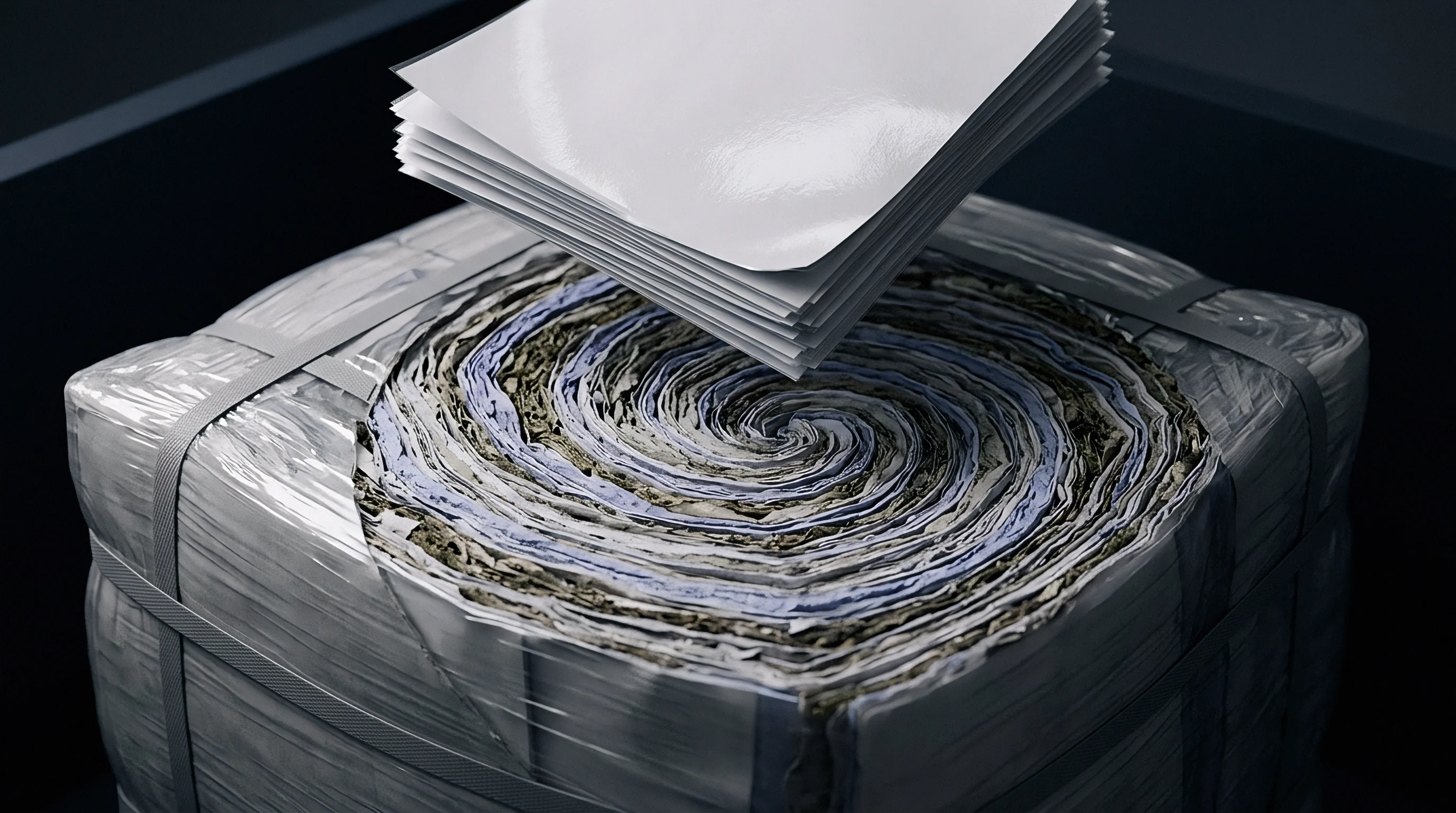
Polarized light microscopy at 100x magnification shows damaged cell lumens, sheared wall fibrils, and micro-compressions in a pulp sample. These structural features record mechanical stress, but they cannot quantify how much secondary furnish is in a paper blend. Industrial pulping subjects raw chemical wood pulp to intense shear, compression, and thermal drying.
As a result, virgin thermomechanical pulps and high-consistency refined chemical pulps show outer wall delamination and micro-kinks identical to those found in fibers recovered from post-consumer corrugated boxes. Fiber wall morphology reflects processing history, not raw material origin.
Analytical laboratories serving paper buyers often point to automated optical analyzers like the MorFi or Kajaani systems to validate recycled content declarations. These instruments quickly measure fiber length distribution, width, curl, and kink indices across tens of thousands of suspended fibers. Secondary fibers typically show shorter mean lengths and higher fines content from repeated mechanical cutting during repulping and deflaking.
Fibers shorten with each recycling loop as softwood tracheids break along longitudinal weak points and parenchyma cells fragment into microscopic debris, creating fines that skew automated optical counters.
A fiber analyzer reveals mechanical wall degradation while failing to quantify virgin furnish proportions.
Virgin hardwood pulps like eucalyptus or birch naturally have shorter fibers than recycled softwood kraft from old corrugated containers. A containerboard blend of seventy percent virgin unbleached softwood kraft and thirty percent recycled mixed paper can show an average weighted fiber length identical to a furnish made entirely of semi-chemical virgin hardwood and unrefined kraft. Secondary fines also create optical turbidity that throws off automated length-weighted calculations under ISO 16065-2.

Microfibril Disruption and Ultrastructural Collapse
Repeated refining and drying cycles strip the primary cell wall from softwood tracheids. As paper passes over steam-heated cylinders, the internal fiber structure shrinks irreversibly, causing S2 sub-layers within the secondary cell wall to collapse inward and pinch the central lumen shut. Under cross-sectional transmission electron microscopy, secondary kraft pulps display a flattened, ribbon-like geometry, whereas virgin chemical fibers hold elliptical or round lumens prior to wet pressing.
High-yield virgin mechanical processes like chemithermomechanical pulping cause severe external fibrillation and wall micro-fractures. Forcing wood chips between rotating refiner plates at 150 degrees Celsius shears and fractures outer cell walls. The resulting virgin fibers exhibit microfibril unraveling that mirrors the mechanical peel-off seen in repulped packaging waste.
Because of this overlap, using wall morphology to differentiate virgin mechanical pulps from recycled chemical pulps is statistically invalid in mixed furnishes.
- Microfibril angle deviation shifts under longitudinal tensile loading as paper dries, altering the native helical orientation of cellulose fibrils relative to the fiber axis.
- Fiber curl index increases during high-consistency repulping, creating curved geometries indistinguishable from the curvature caused by virgin pulp discharge blow valves.
- Kink frequency tracks impact zones along the fiber wall, accumulating whenever processing equipment subjects the fiber to localized bending beyond cell wall yield strength.
- Lumen collapse ratio quantifies radial flattening from capillary forces during wet pressing, which leaves recycled fibers and heavily pressed virgin fibers structurally equivalent.
Packaging shipments face customs impoundment and reclassification penalties whenever border authorities reject an unsubstantiated fiber analysis report.

Swell
Centrifuging a wet pulp mat at 3,000 g under ISO 23714 isolates water held within cell wall pores to measure Water Retention Value, expressed as grams of water retained per gram of dry pulp. This figure directly reflects the swelling capacity of cellulose and hemicellulose chains. Unbleached virgin softwood kraft exhibits high swelling capacity because amorphous hemicelluloses remain fully hydrated, keeping the internal pore network within the lamellar cell wall open.
Once sub-microscopic pores close during drying, they resist chemical rehydration. When cellulose fibers dry below the fiber saturation point during packaging manufacturing, hydrogen bonds form between adjacent microfibrils in a process called hornification that permanently closes pores within the cell wall. Subsequent re-slushing in water fails to break these supramolecular hydrogen bonds, leaving secondary fibers with lower Water Retention Values than virgin stock.
In fact, the swelling capacity of bleached softwood chemical pulp drops by twenty to forty percent after a single industrial drying cycle.
Water retention under ISO 23714 drops from 1.35 grams per gram in virgin unbleached softwood kraft to 0.88 grams per gram after three drying cycles at 105 degrees Celsius.
The 1.10 g/g water retention value baseline for unbleached softwood kraft pulp under ISO 23714 was established at 23 degrees Celsius and 50 percent relative humidity in 2021. That value moves upward if a mill alters chemical charge during pulping, or downward if wet pressing pressure exceeds 450 kPa. Packaging mills running recycled furnish regularly use chemical swelling agents, light refining, and enzymatic treatments to restore paper machine drainage and sheet formation.
For example, sodium hydroxide treatments expand hornified cell walls, boosting water retention back to levels typical of unrefined virgin pulp.
Reclaimed fibers stiffen during flash drying, while starch additions mask the accompanying drop in drainage. Mills introduce cationic wet-end starches, carboxymethyl cellulose, and synthetic dry-strength resins to offset lost fiber-to-fiber bonding in secondary furnish. These hydrophilic polymers coat fiber surfaces and fill collapsed lumens, artificially inflating the Water Retention Value of recycled stock.
Solute exclusion tests with dextran polymers show that while hornification keeps internal micro-pore volume restricted, surface-adsorbed additives hold bulk water and defeat gravimetric swelling analysis.
| Furnish Grade | Water Retention Value (g/g) | Schopper-Riegler (°SR) | Zero-Span Tensile (N/cm) | Mean Fiber Length (mm) |
|---|---|---|---|---|
| Virgin Bleached Softwood Kraft | 1.42 | 18 | 142 | 2.65 |
| Once-Dried Softwood Kraft | 1.08 | 24 | 136 | 2.48 |
| Triple-Dried Softwood Kraft | 0.86 | 31 | 118 | 2.15 |
| Virgin Unbleached Hardwood Kraft | 1.25 | 22 | 110 | 0.95 |
| Repulped Old Corrugated Container | 0.92 | 42 | 102 | 1.62 |
| Enzyme-Treated Recycled Testliner | 1.15 | 36 | 112 | 1.58 |
| Methods note: Water Retention Value tested under ISO 23714 at 3000 g for 30 minutes; Zero-Span Tensile measured dry under ISO 15361 after conditioning at 23°C and 50% RH. | ||||
Drainage resistance, measured on the Schopper-Riegler scale under ISO 5267-1 or Canadian Standard Freeness under ISO 5267-2, tracks mechanical fines alongside cell wall flexibilization. Virgin pulp refined aggressively for smooth luxury packaging can reach forty Schopper-Riegler degrees. Low-grade recycled testliner often hits the exact same reading, though driven entirely by fiber fragments and inorganic fillers rather than fibrillated cell walls.
A pulp furnish that drains rapidly on the wire while losing wet web consolidation indicates advanced hornification rather than virgin stock selection.


Spectroscopy
Attenuated total reflectance infrared beams penetrate only two micrometers into paper, capturing sizing agents, binders, and surface coatings. Fourier transform infrared spectroscopy tracks molecular functional groups through vibrational bond absorption, showing strong bands in virgin chemical cellulose at 3330 cm-1 for hydroxyl stretching, 2895 cm-1 for carbon-hydrogen stretching, and 1030 cm-1 for carbon-oxygen pyranose ring vibration. Unprinted virgin packaging boards yield clean baseline spectra that reflect only native cellulose, hemicellulose, and residual lignin.
Secondary fibers recovered from commercial streams bring heavy chemical noise. Packaging papers accumulate styrene-butadiene latexes from barrier coatings, polyvinyl alcohol from seam adhesives, polyamidoamine-epichlorohydrin wet-strength additives, and copper phthalocyanine pigments from flexographic inks. Even after chemical deinking strips primary pigments, residual traces remain lodged in lumen voids and surface fibrils, creating irregular absorption bands at 1720 cm-1 for ester carbonyl groups and 1600 cm-1 for aromatic skeletal vibrations.
Do Spectral Baselines Differentiate Secondary Pulps?
The 0.85 carbonyl-to-methylene absorbance ratio at 1710 cm-1 and 2900 cm-1 on FTIR was established under 4 cm-1 resolution in 2022. That baseline collapses if virgin pulp contains natural fatty acid extractives or if recycled furnish contains peroxide-bleached mechanical pulp. Resin acids, abietic derivatives, and fatty esters in virgin softwood kraft produce carbonyl peaks identical to residual inks and synthetic sizing agents.
While extracting samples with dichloromethane under ISO 653 removes soluble resins, it also strips out the synthetic contaminants testing labs rely on as forensic markers for secondary furnish.
The 15 percent recycled furnish threshold that analytical laboratories claim to detect via automated image analysis remains widely contested across the testing sector. This detection limit is unreliable in practice, with trial data fluctuating between 8 percent and 28 percent depending on furnish origin, refining energy, and filler contamination. Buyers managing cross-border risk treat such analytical claims as non-actionable, relying instead on audited Chain of Custody reconciliation back to pulper feed logs.
Counterfeit detection in pharmaceuticals faces a similar spectroscopic hurdle when excipients obscure active ingredients, and cellulose chemistry presents the same matrix interference. The bulk of the cellulose-hemicellulose carbohydrate matrix easily swamps the faint chemical signatures of earlier consumer lifecycles. Pyrolysis-gas chromatography-mass spectrometry breaks samples down at 600 degrees Celsius to separate molecular fragments.
While thermal degradation of recycled paper yields traces of phthalate plasticizers, hydrocarbon waxes, and resin acid breakdown products, virgin pine kraft from fire-prone regions yields levoglucosan, alkylated benzenes, and phenanthrene derivatives from past forest exposure that overlap with those same pyrolytic markers.
- Spectroscopic peak overlapping occurs across the 1600 cm-1 to 1750 cm-1 region, where oxidized cellulose carbonyl groups mask synthetic acrylic coating residues.
- Extraction solvent interference occurs during matrix dissolution, stripping diagnostic contaminants along with native wood extractives.
- Mineral filler background scatter dominates diffuse reflectance spectra, swamping weak polymer signals under strong calcium carbonate and kaolin absorption bands.
- Sizing agent re-adsorption redistributes alkyl ketene dimer and alkenyl succinic anhydride across fiber walls, blurring chemical differences between virgin and secondary surfaces.
While wet-strength resins impede fiber separation and surface sizing distorts infrared spectra, X-ray photoelectron spectroscopy probes the elemental composition of the outer ten nanometers of the fiber surface to calculate oxygen-to-carbon ratios. Pure cellulose carries a theoretical ratio of 0.83. Industrial virgin unbleached kraft shows lower values, typically between 0.45 and 0.65, owing to surface-migrated lignin and fatty extractives.
Recycled fibers produce nearly identical ratios between 0.40 and 0.60 due to redispersed silicone lubricants, defoamers, and synthetic sizing agents applied during conversion.
| Analytical Method | Primary Target Parameter | Lower Detection Boundary | Primary Chemical Interferent |
|---|---|---|---|
| Polarized Light Microscopy | Fibrillar wall shearing | 20% secondary furnish | High-consistency virgin mechanical pulp |
| Centrifugal Swelling (WRV) | Pore volume loss (hornification) | 25% secondary furnish | Hydrophilic surface starch, alkaline swelling agents |
| ATR-FTIR Spectroscopy | Polymer adhesive residues | 10% contaminated furnish | Native resin acids, cellulose oxidation products |
| Pyrolysis-GC-MS | Volatile organic contaminants | 5% secondary furnish | Natural wood terpenes, fatty extractives |
| X-Ray Photoelectron Spectroscopy | Surface oxygen-to-carbon ratio | 30% secondary furnish | Synthetic processing aids, internal sizing agents |
| Carbon-14 Radioisotope Dating | Biogenic versus fossil carbon | Not applicable to cellulose | Purely separates bio-based fiber from petro-coatings |
Whether emerging isotope ratio mass spectrometry can isolate regional virgin timber signatures from mixed post-consumer municipal pulp remains unproven in commercial containerboard production.


Custody
A purchase order that matches delivery notes to an unbroken certificate registration code forms the legal baseline for recycled content claims. Physical lab testing cannot determine the exact proportion of secondary fiber in a shipped corrugated carton. Regulatory authorities enforcing packaging claims evaluate administrative chain-of-custody documentation instead of bench test reports.
In the European Union, the Packaging and Packaging Waste Regulation penalizes unverified post-consumer claims by referencing harmonized CEN standards rather than microscopic fiber counts.
Forest management frameworks such as the Forest Stewardship Council and the Programme for the Endorsement of Forest Certification set clear documentation paths for virgin and reclaimed fiber. Scheme rules separate inputs into distinct categories: FSC Pure, FSC Mixed, FSC Recycled, PEFC Certified, and PEFC Controlled Sources. When a converter produces corrugated packaging with a sixty percent recycled claim, that statement relies on mass balance accounting conducted at both the converting plant and the supplying containerboard mill under FSC-STD-40-004 or PEFC ST 2002.
Is Custody Documentation Legally Superior to Fiber Morphology?
Mass balance accounting lets mills balance input volumes of certified virgin pulp and recovered paper bales against outgoing product over fixed auditing windows, typically thirty days. Transfer rules, percentage calculations, and volume credit accounts determine how claims attach to specific production batches. Under a volume credit model, a mill running fifty tonnes of recycled pulp and fifty tonnes of virgin kraft through a common blend system can assign a one hundred percent recycled claim to half its reels while tagging the rest as zero percent.
Subsequent laboratory testing on the reels invoiced as one hundred percent recycled will yield fiber morphology, water retention, and chemical spectra identical to those declared as zero percent.
Clause 5.1 of ISO 14021 invalidates recycled content packaging claims lacking audited batch reconciliation records.
Because credit transfers obscure raw inputs and lab tools cannot isolate recycled ratios, a customs officer inspecting containerboard at a port of entry cannot rely on physical sheet testing to disprove a fraudulent recycled claim. Customs clearance requires a complete documentary audit trail connecting every production run back to verified bill of lading manifests for raw paper waste bales.
- Confirm the certificate code against public registers, verifying that the product scope covers the specific packaging grade and grammage.
- Audit mass balance records across the supplier’s thirty-day accounting window to reconcile raw material receipts with finished board deliveries.
- Cross-check pulper input logs against bill of lading bale descriptions to confirm the physical charging of EN 643 recovered paper grades.
- Examine conversion yield factors in production equations to ensure industrial shrinkage and fiber rejects are deducted from credit allocations.
Audited paper trails protect buyers at border crossings where commercial lab reports leave tariffs exposed. When a twenty-five percent post-consumer recycled claim is made to meet sustainability targets or avoid packaging taxes, a lab report pointing to broken fibers offers no defense during an audit. Tax authorities require mass balance ledgers, delivery notes specifying EN 643 recovered paper grades, and formal Chain of Custody certificate scopes covering the converted stock.
Incorporating PEFC ST 2002 Clause 6.3 into supply agreements shifts financial liability for non-conforming content declarations directly onto the converting mill.

Warranty
Commercial dispute mechanisms reallocate financial risk between mills, converters, and brand owners when post-consumer recycled claims fail regulatory scrutiny. When customs officials or environmental agencies challenge a claim, defense relies entirely on contractual warranties built into supply agreements. Standard specifications defining board only by basis weight, burst strength, and Cobb absorption leave buyers exposed to administrative penalties, regardless of whether virgin fibers retain open lumens or secondary furnish pricing fluctuates around tax thresholds.
A rigorous procurement contract translates regulatory rules into binding operational warranties, specifying that every delivered reel or box lot carry an unbroken chain-of-custody claim on certified invoice lines. The agreement obligates the supplying mill to provide auditable raw material reconciliations within forty-eight hours of a request. Should authorities assess extended producer responsibility penalties or plastic packaging taxes over an unverified claim, the indemnity clause requires the supplier to cover the full tax liability along with legal fees.
Without auditable paper trails, buyers absorb unhedged regulatory fines. Mills resisting warranty terms often try to offer laboratory certificates of analysis showing recycled fiber morphology in place of audited chain-of-custody certification. Accepting a microscopy report shifts verification risk back to the buyer, but technical testing cannot defend an uncertified claim when compliance rests on contract language.
Variations in regional wood species are frequently cited to explain collapsed pore volume and elevated fines in containerboard.