Validating Physical Recycled Content in Packaging Materials
Physical recycled packaging validation requires combining ISO 17025 accredited laboratory assays with batch-level EN 15343 physical segregation custody dossiers.


Tariff
Customs authorities in northern European ports examine incoming polymer consignments against declared post-consumer waste fractions under aggressive financial penalty codes. The European Union Packaging and Packaging Waste Regulation sets mandatory minimum recycled content quotas for 2030, establishing a 35 percent threshold for non-contact sensitive plastics and a 10 percent threshold for contact-sensitive formats. Importers assume full fiscal liability.
Under the United Kingdom Plastic Packaging Tax, any plastic packaging component containing less than 30 percent verified recycled plastic incurs a flat levy of 217.85 pounds sterling per metric tonne. A shipping container carrying twenty metric tonnes of packaging film faces an immediate tax exposure of 4,357 pounds sterling the moment clearance documentation fails inspection. The administrative assumption defaults to virgin material unless positive proof satisfies the investigating revenue officer.

Statutory Thresholds and Financial Penalties
National fiscal regimes diverge sharply on what evidence proves a declared percentage. Revenue authorities in Spain enforce a non-reusable plastic packaging excise of 0.45 euros per kilogram, demanding accredited third-party certification under UNE-EN 15343:2008. The Italian plastic levy imposes a charge of 0.45 euros per kilogram on single-use items, exempting only certified recycled materials.
These border controls expose an unbridgeable rift between commercial declarations and tax enforcement: fiscal courts reject corporate mass balance certificates where secondary materials are allocated on paper to premium product runs while the physical container holds unblended fossil resin.
| Jurisdiction | Statutory Minimum | Applicable Material | Evidentiary Standard at Clearance | Direct Duty or Surcharge |
|---|---|---|---|---|
| United Kingdom | 30 percent by weight | Rigid and flexible plastics | Due diligence dossier with batch mass balance | 217.85 GBP per metric tonne |
| Spain | Variable by claim | Non-reusable plastics | EN 15343 accredited third-party certification | 0.45 EUR per kilogram virgin content |
| Italy | Variable by claim | Single-use plastic packaging | Accredited certification of recycled origin | 0.45 EUR per kilogram virgin content |
| European Union | 35 percent by 2030 | Non-contact sensitive polymers | Harmonised verification under PPWR secondary legislation | Market restriction and administrative fines |
A packaging declaration must survive four sequential documentary tests before clearance officers release goods without assigning punitive tariff codes.
- Supplier origin declarations trace the physical waste stream back to licensed sorting facilities and municipal recycling facilities.
- Batch processing logs record the exact mass balance ratio of raw scrap inputs to finished pellet extrusion outputs.
- Accredited testing certificates verify mechanical and chemical markers from an ISO/IEC 17025 accredited laboratory facility.
- Transport shipping documentation links every unique production lot number directly to the container seal number listed on the customs manifest.
Tax authorities penalize unverified credit swaps. When a clearing agent submits documentation claiming forty percent recycled content based on an annual corporate allocation credit rather than a physical batch run, auditors invalidate the exemption. The importer pays the back taxes, standard interest penalties, and an administrative fine that routinely reaches three times the unpaid duty figure.


Pulp
Recovered paper furnish reveals its true lineage under polarized optical microscopy. Recycled cellulose fibres undergo structural collapse during repetitive drying and wetting cycles, leaving unmistakable physical traces along the cell walls. Tracheids from virgin softwood exhibit smooth surfaces, patent lumina, and intact bordered pits.
Secondary fibres display longitudinal micro-cracks, collapsed central voids, and fibrillar delamination along their outer layers. Optical automated fibre analyzers quantify these micro-structural phenomena, measuring mean fibre length distributions that distinguish virgin Scandinavian kraft from multiply processed testliner.
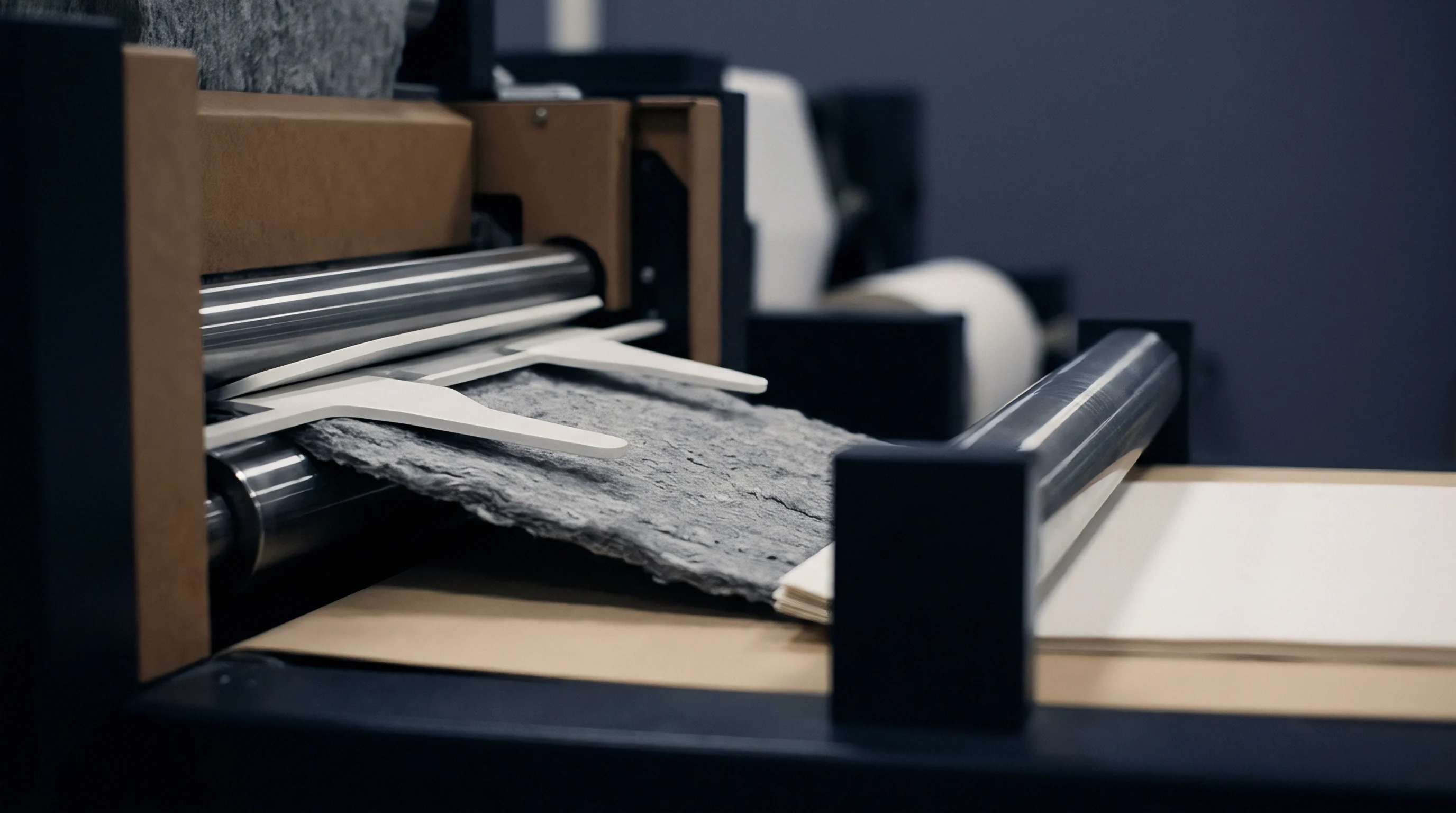
Morphological Identification of Secondary Fibres
Laboratory technicians prepare fibre suspensions according to ISO 9184 standards, using selective chemical stains to differentiate mechanical, semi-chemical, and chemical treatment histories. The Graff C-stain reacts with residual surface hemicelluloses and lignin, yielding pale violet hues on bleached chemical fibres, bright yellow on unbleached groundwood, and distinct wine-red shades on highly refined secondary pulps. Mean fibre length serves as a direct indicator of recycling intensity: northern bleached softwood kraft averages 2.8 millimetres in virgin state, dropping to 1.9 millimetres after three processing cycles and falling below 1.2 millimetres after six repulping cycles.
Secondary fibres drink water faster.
Under controlled laboratory disintegration at 23 degrees Celsius, secondary softwood fibres exhibit a 42 percent reduction in wet zero-span tensile strength compared to virgin furnish processed under identical freeness conditions.
Paperboard loses stiffness with repulping. As recycled fibre fractions increase within corrugated fluting, internal bonding strength decays predictably, compelling converters to add synthetic dry-strength agents to meet minimum ring crush specifications.

Chemical Markers and Residual Ash Fractions
Combustion testing under ISO 1762 isolates non-combustible inorganic fillers that accumulate throughout recovered paper streams. Virgin unbleached kraftliner maintains an ash content below 1.5 percent by weight, composed primarily of naturally occurring wood salts. In contrast, testliner and fluting produced from mixed recovered paper regularly demonstrate ash contents between 8.0 percent and 16.0 percent.
Calcium carbonate from alkaline papermaking coatings, kaolin clay from graphic sheet coatings, and titanium dioxide pigments persist through repulping operations. Gas chromatography coupled with mass spectrometry identifies secondary contaminants: diisopropylnaphthalenes from carbonless copy papers, phthalate plasticizers from water-based adhesives, and mineral oil saturated hydrocarbons derived from historical offset printing inks.
| Furnish Parameter | Virgin Bleached Kraft | Virgin Semi-Chemical | 100 Percent Recycled Testliner | Test Protocol |
|---|---|---|---|---|
| Mean Weighted Fibre Length | 2.4 to 3.0 mm | 1.4 to 1.8 mm | 0.9 to 1.4 mm | ISO 16065-1 Optical Projection |
| Water Retention Value | 1.10 to 1.25 g/g | 1.30 to 1.50 g/g | 0.75 to 0.95 g/g | ISO 23714 Centrifugal Dewatering |
| Inorganic Ash Content at 525 C | 0.4 to 1.2 percent | 0.8 to 2.0 percent | 8.5 to 15.5 percent | ISO 1762 Gravimetric Combustion |
| Mineral Oil Hydrocarbons MOSH | Below 2.0 mg/kg | Below 2.0 mg/kg | 25.0 to 120.0 mg/kg | EN 16995 Online HPLC-GC-FID |
| Lignin Content by Kappa Number | Below 5 Kappa | 55 to 75 Kappa | 28 to 45 Kappa | ISO 302 Potassium Permanganate |
A rigorous examination of secondary furnish relies on four laboratory quantification stages executed in strict sequence.
- Suspension freeness measurement establishes the Schopper-Riegler drainage resistance of the de-inked stock.
- Automated optical projection records the arithmetic and length-weighted fibre length distribution across fifty thousand individual particles.
- Solvent Soxhlet extraction isolates dichloromethane-soluble adhesive stickies and silicone residues from paper conversion processes.
- Gas chromatography detection measures accumulated mineral oil fractions to confirm post-consumer packaging exposure.
The material supplier defends the discrepancy by claiming that high mineral filler content and depressed fibre length stem entirely from aggressive machine refining of premium virgin broadleaf pulps.


Isotope
Carbon dating delivers definitive boundaries for bio-based materials while highlighting the steep challenges of synthetic polymer validation. Standard test method ASTM D6866 and European standard EN 16640 measure the ratio of carbon-14 to carbon-12 isotopes within a sample. Living organic matter maintains a stable equilibrium with atmospheric radiocarbon, yielding a bio-based carbon signature of 100 percent.
Fossil-derived petroleum feedstocks have rested underground for millions of years, allowing all radiocarbon to decay to absolute zero. This analytical mechanism proves whether a polymer derives from sugarcane ethanol or petrochemical cracking. It cannot, however, separate a virgin fossil polymer from a mechanically recycled fossil polymer.
Where Does Chemical Tracing Fall Short?
Modern analytical instrumentation encounters strict physical limits when evaluating polyolefins. Both virgin low-density polyethylene and post-consumer recycled polyethylene contain zero radiocarbon. Pyrolysis gas chromatography-mass spectrometry scans for polymer degradation artifacts to infer thermal processing history.
Virgin polyethylene resin displays a clean, periodic triplet pattern of alpha-olefins, n-alkanes, and alpha,omega-dienes. Reprocessed resins reveal irregular secondary oxidation products: long-chain branched ketones, carboxylic acids, and volatilized degradation products of phenolic antioxidants like Irganox 1010 and tris-nonylphenyl phosphite.
Trace markers introduced at compounding must withstand twin-screw extrusion temperatures exceeding 240 degrees Celsius without decomposing or altering matrix polymer mechanical properties.
Tracer markers degrade during extrusion. When converters introduce synthetic optical, elemental, or encapsulated DNA tracers into virgin masterbatches, the marker concentration dilutes in direct proportion to secondary material addition. A targeted marker reading of 500 parts per billion indicates an unblended stream, whereas a reading of 250 parts per billion indicates a one-to-one blend with un-traced recycled stock.
These forensic tracers require supply-chain-wide commercial adoption, an operational prerequisite that commodity recyclers rarely support.
Spectroscopic and Thermal Degradation Fingerprints
Differential scanning calorimetry identifies recycled fractions in supposedly virgin polyethylene terephthalate and polypropylene packaging. Post-consumer recycled polyethylene terephthalate contains residual traces of isophthalic acid and diethylene glycol modifiers along with minute fractions of immiscible polyolefin caps that fail flake washing. The melting curve reflects these impurities: virgin bottle-grade polyethylene terephthalate demonstrates a sharp endothermic peak at 248 degrees Celsius with an intrinsic viscosity between 0.78 and 0.84 decilitres per gram.
Recycled flakes show broadened melting profiles, lower peak temperatures near 242 degrees Celsius, and depressed intrinsic viscosity between 0.68 and 0.74 decilitres per gram unless upgraded through prolonged solid-state polycondensation.
| Testing Technology | Targeted Measurand | Detection Boundary | Applicable Substrates |
|---|---|---|---|
| ASTM D6866 Radiocarbon Dating | Carbon-14 isotope fraction | Plus or minus 1.0 percent bio-carbon | Bio-based polymers and natural fibre composites |
| Pyrolysis GC-MS Analysis | Degradation VOCs and stabilizers | 10 to 50 mg/kg volatile fragments | Polyolefins, styrenics, and polyamides |
| Differential Scanning Calorimetry | Melting enthalpy and crystallization peaks | 0.5 percent polymer contaminant blend | Polyethylene terephthalate, polyethylene, and polypropylene |
| Fluorescent or Rare-Earth Tracers | Inorganic or molecular tracer concentration | 10 parts per billion marker dilution | Engineered masterbatches and rigid barrier containers |
A persistent commercial uncertainty centers on whether upcoming market regulations will approve chemical pyrolysis mass-balance allocations as physical recycled content or restrict financial relief exclusively to mechanically isolated secondary polymers verified by direct lab markers.
Route
Material custody frameworks bridge the physical verification gap across industrial supply chains. Standard ISO 22095:2020 defines five distinct custody tracking models: identity preservation, physical segregation, controlled blending, mass balance percentage, and mass balance credit bookkeeping. Regulators and tax authorities increasingly reject credit bookkeeping systems for fiscal relief.
The Spanish excise tax authority permits only physical segregation and controlled blending models verified under UNE-EN 15343:2008. If a manufacturing plant inputs twenty metric tonnes of post-consumer resin and eighty metric tonnes of virgin resin into a common hopper, the output packaging units may declare exactly twenty percent recycled content under controlled blending, but the manufacturer cannot legally sell one unit carrying a one-hundred percent claim while selling four units as virgin.

Is Physical Allocation Defensible under Border Scrutiny?
Revenue investigators cross-reference plant floor yield data against third-party custody claims. Forest management and recovered paper schemes operate under similar tensions. Standard FSC-STD-40-004 V3-1 governs chain of custody validation, defining the FSC Recycled claim for products containing a minimum of 70 percent post-consumer reclaimed fibre, with the remainder composed of pre-consumer reclaimed material.
FSC-STD-40-007 details the mandatory vetting procedures for reclaimed material suppliers, mandating on-site supplier audits for any uncertified post-consumer paper merchant delivering more than twenty tonnes of recovered fibre per calendar year.
Under Clause 5.3 of EN 15343, converters must maintain continuous mass balance records linking every outgoing production batch directly to incoming certified recycling delivery notes with matching chemical identification codes.
Mass balance permits unallocated volume. Where a mill uses a credit system, secondary fibre credits accumulate in an accounting ledger valid for twelve calendar months. A packaging buyer purchasing cartons under a credit ledger invoice receives paperboard that physically contains zero recycled fibres, because the physical secondary furnish was processed weeks earlier into heavy corrugated fluting destined for local industrial applications.
Border authorities inspecting shipments against physical recycled content declarations reject these credit certificates when physical testing proves the sheet consists purely of virgin chemical softwood.
Documentary Verification under Recycling Standards
A bulletproof qualification dossier demands direct physical linkage through every processing phase. The Chain-of-Custody Examiner demands four specific documentary anchors before approving an environmental content declaration for commercial packaging print.
- Supplier audit certifications confirm that reclaiming facilities hold current, unannounced annual verification credentials from accredited inspection bodies.
- Batch-specific delivery manifests state the exact net weight of secondary flakes or recovered bales assigned to that specific order.
- Converting floor run records document machine extruder hopper settings and blend valve ratios during the packaging production run.
- Reconciled sales invoices declare the verified physical percentage claim matching the physical batch delivery manifest numbers.
General purchasing terms establish that if a regulatory audit rejects an environmental claim due to unsupported custody documentation, the primary packaging converter reimburses the buyer for all levied import taxes and packaging register surcharges.


Caliper
Converting machinery reveals the functional limits of secondary fibre through mechanical performance degradation. When papermakers increase recycled content percentages, sheet thickness and bulk decline under equal calender nip pressures. Fibre hornification explains this loss: during initial papermaking and subsequent drying passes, internal hydrogen bonds within the cellulose amorphous zones pull the cell wall structure inward.
The pore structure shrinks irreversibly. When repulped, hornified fibres fail to swell to their original virgin volume. The Water Retention Value measured under ISO 23714 drops from 1.20 grams of water per gram of virgin pulp down to 0.85 grams for recycled furnish.
The laboratory rejects unconditioned swatches.

Mechanical Degradation and Fibre Hornification
Tensile and compression metrics decline sharply across repulping cycles. Consider a standard 175 gram per square metre linerboard running through a rotary corrugator. Virgin kraftliner manufactured from unbleached northern softwood kraft achieves a Short-span Compression Test value of 3.85 kilonewtons per metre and an internal Scott Bond strength of 210 joules per square metre under standard conditioning at 23 degrees Celsius and 50 percent relative humidity under ISO 187.
When furnish switches to 100 percent recycled testliner of identical 175 gram basis weight, the compression value falls to 2.45 kilonewtons per metre, and Scott Bond drops to 140 joules per square metre.
| Processing Cycle | Tensile Index (Nm/g) | Burst Index (kPa m2/g) | Short-Span SCT (kN/m) | Tear Index (mN m2/g) |
|---|---|---|---|---|
| Virgin Sheet (Cycle 0) | 84.5 | 6.20 | 3.85 | 14.8 |
| Cycle 1 Repulped | 71.2 | 4.95 | 3.30 | 12.1 |
| Cycle 2 Repulped | 62.8 | 4.10 | 2.85 | 10.4 |
| Cycle 3 Repulped | 54.0 | 3.45 | 2.50 | 8.9 |
| Cycle 4 Repulped | 48.2 | 2.90 | 2.25 | 7.6 |
| Laboratory sheets conditioned according to ISO 187 at 23 degrees Celsius and 50 percent relative humidity; testing conducted per ISO 1924-2, ISO 2758, ISO 9895, and ISO 1974. | ||||
Corrugating lines push paper webs through high-pressure corrugating rolls heated to 180 degrees Celsius. Virgin medium tolerates severe mechanical stretching along flute tips without tearing. Recycled medium, compromised by hornified fibres and inorganic ash fillers, cracks along flute crests when web speed exceeds 250 metres per minute.
Slower machine runnability elevates operational production costs, directly counteracting the raw material savings achieved by sourcing recovered paper.

Converting Runnability and Structural Integrity Limits
Box compression calculation models demonstrate how recycled content fractions alter structural packaging efficiency. The McKee formula calculates top-to-bottom box compression strength using sheet caliper, flexural stiffness, and edgewise compression test values. Assume an enterprise ships palletized goods requiring a minimum box compression strength of 4,200 Newtons.
A corrugated container manufactured from virgin kraftliner outer plies achieves this rating using a 140 gram kraftliner married to a 120 gram semi-chemical fluting. If regulatory mandates force the specification to 100 percent recycled testliner, achieving that identical 4,200 Newton compression threshold demands upgrading the outer liners to 185 grams per square metre and the recycled fluting to 150 grams per square metre.
Bond strength drops across recycles. The total packaging mass expands by 26 percent simply to compensate for the mechanical deficits of the recycled cellulose network, generating an unintended paradox where higher recycled content percentages inflate total material tonnage, pallet weight, and freight transport emissions. Fold creasing presents another physical barrier.
Heavy virgin folding boxboard bends smoothly across creasing matrices without delaminating. When secondary fibre exceeds sixty percent of the furnish, the exterior coated liner ruptures along score lines during 180-degree pre-folding on automated carton gluers.
Experienced line operators know that when high-recycled fluting splits during humid morning shifts, increasing steam shower pressure softens the sheet just enough to preserve the box shape.