Basic Fiber Orientation Effects on Paper Web Deformation
Controlling the jet-to-wire speed ratio limits fiber orientation anisotropy, preventing catastrophic cross-direction curl, register drift, and twist deformation.
Alignment
A sheet entering the die-cutter with two millimeters of lateral register drift usually points to fluid dynamics at the wet end slice. When wood fibers suspend in water at consistencies below one percent, their spatial distribution remains chaotic until physical acceleration imposes directionality. The headbox delivers stock to the forming fabric through an adjustable opening where the relationship between jet velocity and wire speed dictates how individual cellulose filaments settle.
Adjusting that speed differential changes the ratio of fibers aligned in the machine direction compared to the cross direction, establishing the physical foundation for every dimensional change the sheet experiences during converting passes. A converter who ignores this structural reality pays for it through unexpected skew during coating, foil stamping, and multi-pass printing.
Slice Geometry and Stock Delivery
Headbox pond heights and jet angles establish the initial velocity differential across the forming table. As the stock suspension discharges from the slice lip, shear forces generated at the boundary between the moving fluid and the forming fabric exert rotational torque on suspended fibers. Cellulose fibers possess aspect ratios ranging from twenty to over sixty, meaning length substantially exceeds width.
Under pure extensional flow, elongated particles naturally rotate until their major axes parallel the primary velocity vectors of the slurry stream.
Altering the slice opening across the width of the headbox corrects local basis weight deviations, yet local adjustments simultaneously distort cross-flow velocities. Cross flows rotate fibers away from the true machine direction, creating localized orientation skew. When the angle of average alignment deviates even two degrees from the machine path, the finished web develops an asymmetrical response to mechanical pull and ambient humidity.
Packaging converters encounter this issue when sheets cut from the front side of a wide jumbo roll curl along a completely different axis than sheets converted from the drive side.
How Jet Wire Speed Ratios Alter Hygroexpansion?
Differential speeds between the discharged suspension and the moving fabric force cellulose filaments to rotate toward the machine direction. Running the stock jet slightly faster than the fabric produces a drag condition, while running the fabric faster than the jet creates a rush condition. Both modes increase the machine-direction orientation relative to the cross direction.
Perfect synchronization between the jet and the fabric yields the lowest achievable orientation ratio, producing an isotropic sheet structure where physical properties remain relatively balanced in all planar directions.
Commercial forming units rarely run at true unity because isotropic webs exhibit lower tensile strength along the machine path, limiting paper machine running speeds. Mills typically run with a minor rush or drag to optimize drainage and web consolidation. High machine-direction orientation reduces hygroexpansion along the processing length while magnifying dimensional movement across the width.
Packaging converters applying water-based adhesives or barrier coatings observe immediate cross-direction swelling because the transverse expansion coefficient of individual cellulose fibers exceeds longitudinal expansion by an order of magnitude. Cellulose expands across its width. Uneven tension ruins foil adhesion.
Paperboard processed with balanced planar alignment exhibits minimal diagonal curl when exposed to unilateral coating applications.
Stable sheet performance in multi-pass finishing operations depends entirely on maintaining low directional divergence from the nominal manufacturing axes across the entire parent roll. As a practical shop floor guideline, maintaining consistent orientation symmetry across the sheet width prevents diagonal distortion far more reliably than attempting to correct web tension at the feeder.

Wire
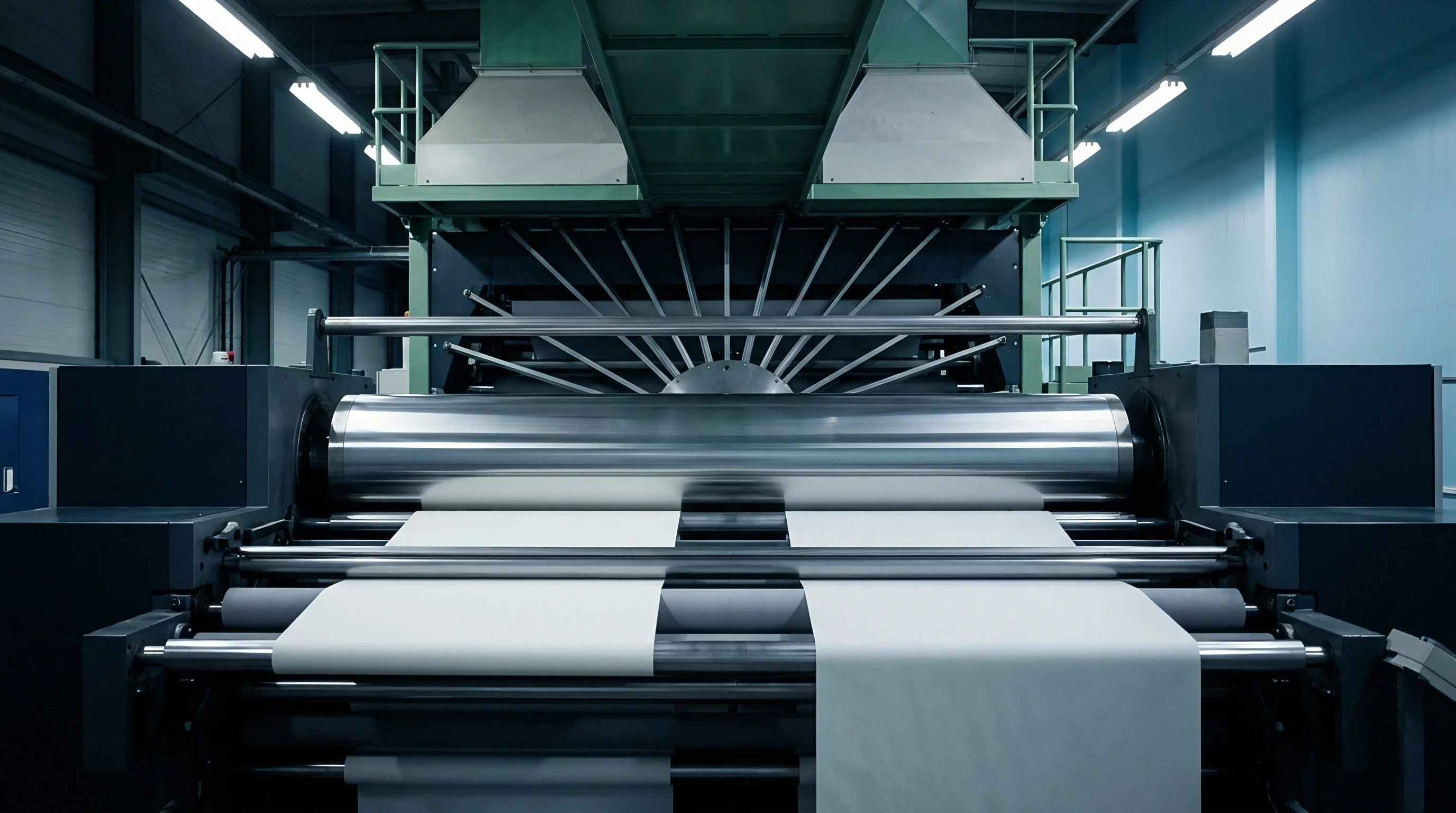
Drainage forces on the fourdrinier table lock suspended solids into a stratified spatial network. Once the slurry contacts the traveling mesh, gravity and vacuum elements extract water downward through the forming fabric. This rapid extraction freezes the lower layer of fibers in position almost instantaneously, preserving the high orientation created by the slice discharge shear.
The upper layer of the suspension retains fluidity longer, allowing turbulence to randomize fiber angles before drainage consolidates the top surface.
Dewatering Gradients through Web Thickness
Vacuum foils pull liquid downward, creating structural disparity between the bottom surface and the top side. In single-wire fourdrinier machines, the wire side consistently displays higher machine-direction fiber alignment than the felt side. Modern gap formers inject stock between two converging fabrics, dewatering the suspension symmetrically from both surfaces toward the center.
This twin-wire drainage generates symmetrical orientation profiles through the thickness of the board, which proves critical for sheets intended for two-sided lamination or double-sided aqueous varnishing.
The forming table configuration dictates five fundamental web properties that directly govern stability during converting:
- Z-directional orientation disparity generates differential expansion coefficients between the top and bottom plies, resulting in structural face curl whenever ambient relative humidity shifts.
- Hydrodynamic drag intensity aligns surface fibers more tightly along the machine axis than internal core fibers. Register loss compounds rapidly.
- Localized drainage turbulence disrupts orientation uniformity across sheet zones, generating erratic cockling during heated drying stages.
- Fibers resist pull along length under mechanical tension. This resistance prevents machine-direction stretch while allowing wide transverse elongation.
- Forming fabric mesh topology imprints microscopic wire marks that bias surface wetting angles and coating penetration rates along specific planar vectors.
Multi-ply folding boxboard structures compound this mechanical complexity by combining separate plies produced on distinct forming units. A typical solid bleached sulfate or folding boxboard grade features outer layers formed on fourdrinier or gap units to optimize smoothness and print fidelity, sandwiching a bulky middle ply produced from mechanical or semi-chemical pulp. If the jet-to-wire speed ratio on the back-ply headbox drifts away from the top-ply setting, the two surfaces will expand at different rates during moisture absorption.
The nip sets the curl. Packaging converters running high-speed carton lines frequently experience carton panel bowing that resists die-creasing correction.
According to ISO 187 conditioning protocols at twenty-three degrees Celsius and fifty percent relative humidity, fourdrinier paperboards routinely demonstrate cross-direction moisture expansion rates five to eight times greater than machine-direction rates.
When converters challenge paper mills regarding excessive edge curl following high-coverage gravure varnishing, paper mills counter that the converting plant applied excessive coating weights without providing adequate infrared web conditioning between print units.

Anisotropy
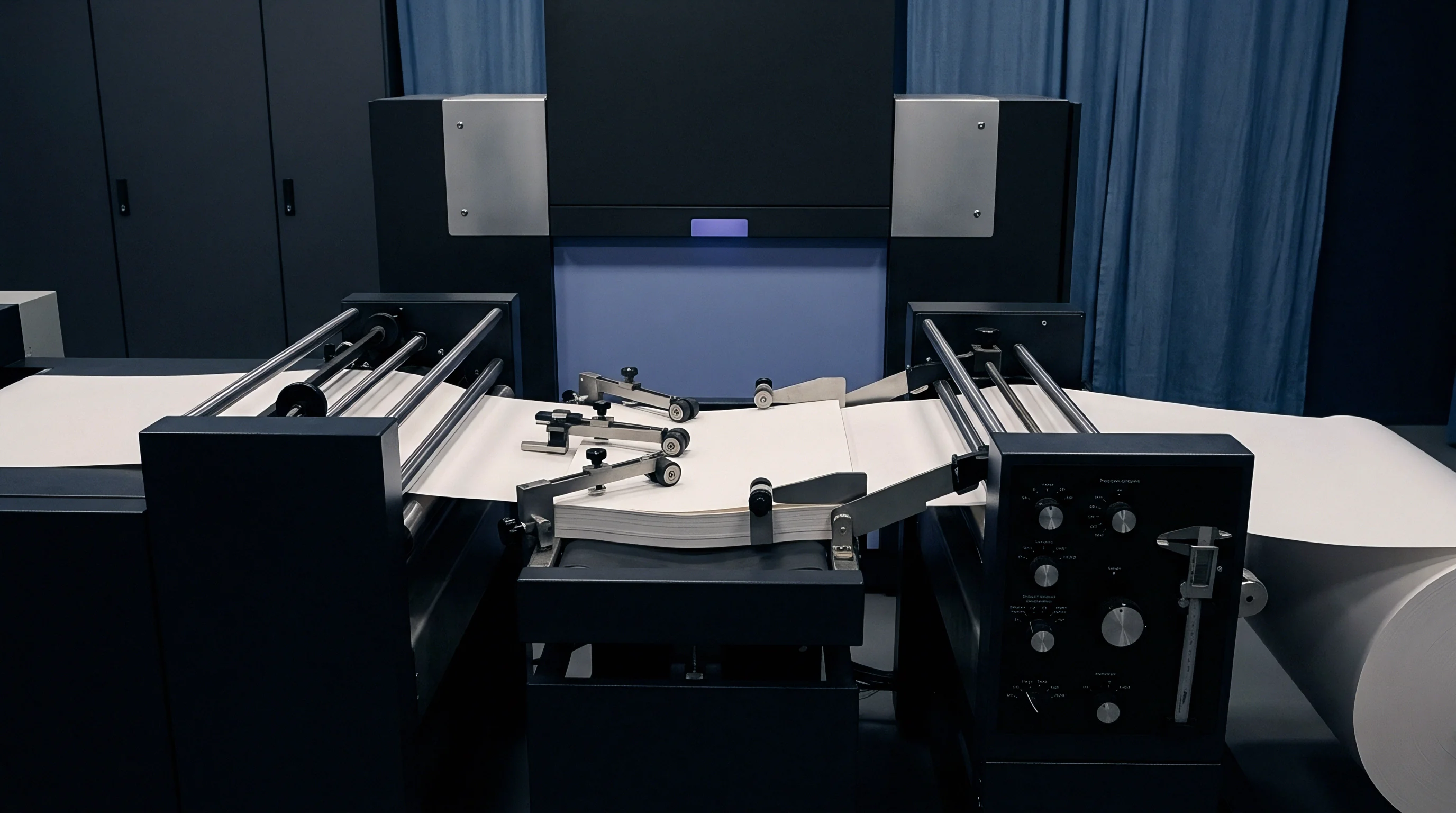
Tensile stiffness index measurements across orthogonal axes show ratios ranging from 1.5 to nearly 4.0 in commercial paperboards. This physical directional disparity defines mechanical anisotropy. The structural cause traces directly to the molecular organization of wood fibers.
Cellulose microfibrils wind helically around the fiber axis at relatively steep angles within the S2 cell wall layer. When dried under axial restraint on the paper machine, individual fibers exhibit exceptional elastic modulus and negligible hygroexpansion along their longitudinal axis. Transverse to the fiber axis, amorphous hemicellulose and lignin swell freely when exposed to moisture vapor or liquid water.
Mechanical Asymmetry along Principal Axes
Wood pulp fibers expand up to twenty times more across their diameter than along their longitudinal axis when absorbing ambient water. In an oriented paper web where sixty to eighty percent of fibers align within thirty degrees of the machine axis, macroscopic expansion reflects this microscopic bias. Cross-direction hygroexpansion coefficients routinely range from 0.025 to 0.035 percent per one percent change in sheet moisture content, whereas machine-direction hygroexpansion remains between 0.004 and 0.008 percent across the same moisture range.
Moisture drives the dimensional drift.
| Forming Section Technology | Tensile Stiffness Ratio (MD:CD) | Elastic Modulus MD (GPa) | Elastic Modulus CD (GPa) | Hygroexpansion Ratio (CD:MD) | Planar Shear Modulus (GPa) |
|---|---|---|---|---|---|
| Conventional Fourdrinier | 3.45 | 8.60 | 2.49 | 6.80 | 1.45 |
| Fourdrinier with Top Former | 2.60 | 7.20 | 2.77 | 4.90 | 1.58 |
| Symmetric Gap Former | 1.85 | 6.10 | 3.30 | 3.20 | 1.72 |
| Laboratory Sheet Former | 1.05 | 4.80 | 4.57 | 1.15 | 1.85 |
Converting operations subjecting the web to aqueous inks, barrier emulsions, or starch pastes introduce substantial moisture into the paper matrix. When liquid penetrates the network, hydrogen bonds between fibers release, permitting the internal micro-strains locked during papermaking drying to relax. The sheet expands rapidly across its width while maintaining dimensional stability along its length.
Sheet waste climbs immediately. In multi-color flexographic or gravure presses lacking dynamic lateral register controls, this asymmetric transverse expansion causes color misregistration exceeding 0.3 millimeters across a one-meter web width.
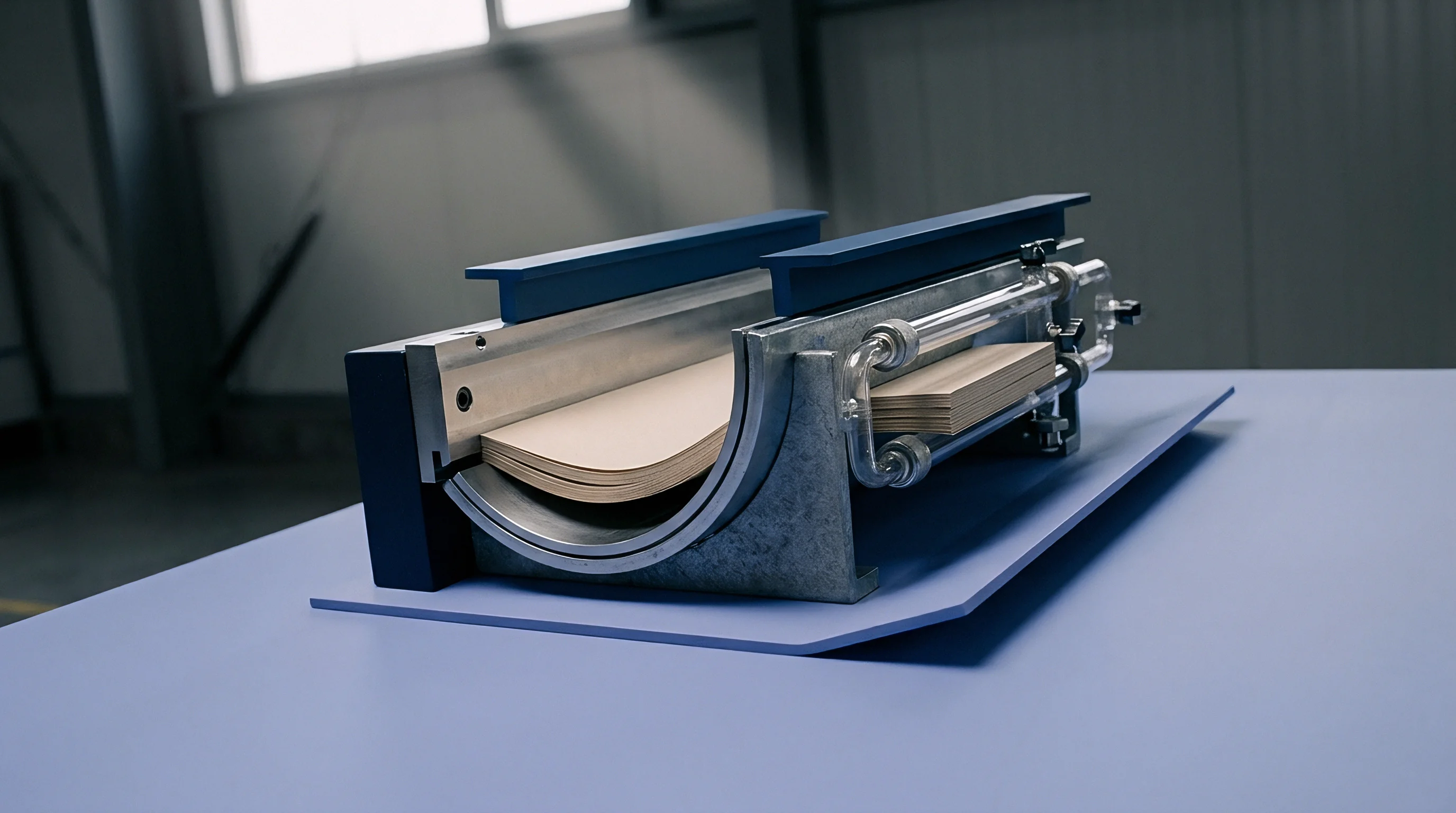
Where off Axis Stresses Trigger Diagonal Web Twist?
Misalignment of the principal orientation angle from the machine direction converts simple tensile pull into in-plane shear. In ideal webs, the principal axis of fiber alignment coincides exactly with the physical running direction of the paper roll. Papermaking headboxes with cross-flow velocity gradients, however, generate a skewed orientation profile where the primary axis tilts by two to seven degrees away from the running direction.
Off axis angles produce skew. This structural tilt induces cross-coupling between normal tensile forces and shear deformation.
- Aqueous coating application introduces moisture uniformly across the top surface of the moving web, breaking inter-fiber hydrogen bonds within the outer layer.
- Asymmetric relaxation occurs along the tilted fiber orientation axis rather than parallel to the machine centerline. Diagonal stress forces sheet curl.
- Web tension in the drying tunnel pulls strictly along the mechanical processing path, fighting the skewed contraction forces of the re-drying fibers.
- Residual internal shear stresses freeze into the web structure as moisture falls below five percent under heated air impingement.
- Rotary sheeting or die-cutting releases external boundary restraints, prompting individual sheets to deform into out-of-plane helical twist that jams carton packing equipment.
Twist warp represents the most damaging form of dimensional failure in folding carton production. Unlike simple cylindrical curl, which packaging machinery handles through feed-hopper pressure bars or scoring adjustments, twist deformation creates non-developable surfaces that refuse to lie flat against feed conveyors. Thin films exaggerate cross expansion.
When folded into pharmaceutical or cosmetic cartons, blanks cut from webs with skewed orientation form parallelogram profiles instead of square rectangles, preventing automated cartoning machinery from closing tuck flaps at rated line speeds.
Cross-coupling between machine-direction web tension and skewed fiber alignment angles generates internal shear strain that manifests as incurable sheet twist upon rotary sheeting.
The exact mathematical threshold where headbox cross-flow angles transition from generating acceptable planar camber to producing unrunnable three-dimensional carton twist remains unresolved across differing pulp furnish blends and refining degrees.

Distortion
Printed paper stocks react to moisture changes by warping out of their manufactured plane. Paper deformation during finishing passes stems from localized variations in fiber orientation interacting with non-uniform moisture and temperature profiles. Standard commercial converting processes apply heat, fluid coatings, polymeric films, and extreme mechanical pressures to paperboard surfaces.
If fiber distribution remains uniform throughout the web, dimensional expansion occurs predictably along rectangular coordinates. When fiber distribution fluctuates, deformation produces localized buckling, cockling, and edge fluting that render sheets unprintable.
Hygroexpansive Instability under Surface Heat
Thermal platens drive moisture out of cellulose bonds within fractions of a second during hot foil stamping passes. At platen temperatures between 110 and 140 degrees Celsius, water vapor flashes out of the paper surface directly beneath the stamping die. As moisture drops from eight percent to under three percent locally, the cellulose matrix contracts sharply.
High-speed lines reject warp. In areas with high machine-direction fiber alignment, this localized thermal shock generates extreme cross-direction shrinkage while longitudinal dimensions remain locked by fiber microfibrils.
| Finishing Pass | Applied Energy or Chemistry | Governing Fiber Mechanism | Primary Out-of-Plane Deformation | Typical Dimensional Displacement |
|---|---|---|---|---|
| Thermal Film Lamination | Heated nip (105°C), OPP/PET film | Transverse thermal contraction against non-shrinking polymer film | Cylindrical cross-direction curl toward film side | 8 to 22 mm lift at sheet corners |
| Aqueous Flood Coating | Water-based acrylic varnish (4 g/m²) | Inter-fiber bond breakage followed by rapid transverse swelling | Wavy edges and transverse fluting along roll edges | 3 to 7 mm wave amplitude |
| Hot Foil Stamping | Metallic foil, heated die (125°C) | Localized desorption shrinkage constrained by surrounding cold matrix | Localized puckering and draw around stamped image | 0.5 to 1.5 mm vertical dimpling |
| UV Gloss Screen Varnish | Radical photoinitiators, UV radiation | Polymerization shrinkage of coating over asymmetric porous surface | Diagonal corner lift and board embrittlement | 4 to 12 mm corner deflection |
| Measurements recorded on 280 g/m² folding boxboard conditioned to 23°C and 50% relative humidity, measured after 24 hours open storage. | ||||
Laminating plastic films to paperboard surfaces creates a bimaterial strip subject to intense hygro-mechanical strain. Polypropylene and polyester films possess low thermal expansion coefficients and zero moisture sensitivity, whereas paperboard changes dimensions continuously with relative humidity. When a single-sided thermal film bonds to a board possessing an orientation ratio exceeding 3.0, the composite structure remains stable only at the precise moisture content present during the laminating nip pass.
Uniformity across the web matters. As ambient humidity falls, the cross-direction of the board shrinks dramatically while the film remains dimensionally static, curling the sheet tightly toward the board side. As ambient humidity rises, the cross-direction of the board expands against the inert film, forcing the sheet to curl toward the plastic face.
Packaging engineers managing multi-ply board converting must evaluate four distinct failure criteria during specification design:
- Structural flute alignment in microflute corrugated packaging demands that linerboard machine direction runs perpendicular to flute tips to maximize flat crush resistance.
- Crease rupture thresholds dictate that score lines indented parallel to fiber direction crack at significantly lower folding angles than scores made across the fiber axis. The die splits unyielding board.
- Window patch distortion occurs when clear film glued over carton apertures contracts against high-cross-expansion boxboard, pinching carton display openings out of shape.
- Embossing depth retention degrades rapidly over time if high-relief male dies fracture fibers oriented across the draw direction, permitting stress relaxation under humid storage.
Ignoring fiber orientation during layout planning produces massive economic waste on printing and converting floors. When carton packaging graphics force carton creases to align improperly with fiber direction to optimize sheet nesting yield, the resulting cartons crack at the fold during automated gluing, or fail under top-load compression in palletized transit, resulting in entire truckload rejections by retail brand owners.

Tolerance
Converters purchasing high-grammage board write mechanical ratio limits into procurement technical dockets to avoid press downtime. While paper mills market consistency based on basis weight, caliper, and Taber stiffness, high-speed converting machinery requires tight constraints on elastic anisotropy and orientation angles. Modern quality assurance laboratories utilize ultrasonic tensile stiffness testers to scan cross-web profiles rapidly.
The ultrasonic velocity through a paper sheet correlates directly with its specific elastic modulus along the acoustic propagation path, providing non-destructive maps of fiber orientation ratios and alignment skew within minutes of reel turnup.
Technical Procurement Boundaries and Rejection Thresholds
Purchase orders specifying ultrasonic stiffness testing isolate problematic material before pallets reach print stations. A comprehensive mill specification must define both the mean stiffness ratio and the permissible variation across the deckle width. Material displaying a tensile stiffness index ratio between 1.8 and 2.3 generally provides the best compromise between machine-direction runnability on high-speed web presses and cross-direction dimensional stability during multi-pass sheet-fed conversions.
Any parent roll displaying a principal orientation angle deviation greater than three degrees from the web centerline carries an unacceptably high probability of out-of-plane twist failure during rotary die-cutting.
Ultrasonic testing per ISO 12625-4 establishes non-destructive tensile stiffness orientation maps that expose cross-web angle drift before printed sheets enter laminating nips.
Commercial contracts governing prime packaging grades incorporate rigorous physical standards to allocate financial liability for defective board runs. When procurement agreements incorporate explicit boundaries on orientation skew and hygroexpansive ratios under standardized conditioning methods, converting plants hold legal authority to reject rolls that drift outside operational limits. Standard supply agreements incorporating strict technical appendices enforce that paperboard exhibiting an ultrasonic orientation angle deviation exceeding plus or minus two degrees from the machine axis across more than five percent of the roll width constitutes non-conforming stock, releasing the buyer from processing obligations and shifting all direct freight and material replacement liabilities back to the manufacturing mill.