In Plane Sound Velocity Profiling for Fiber Orientation Analysis
In-plane ultrasonic velocity profiling maps fiber orientation angles and stiffness anisotropy non-destructively to prevent carton curling and die-cutting failure.


Pulse
Ultrasonic wave propagation through paper webs provides a non-destructive method for measuring elastic constants. High-frequency acoustic waves travel through the cellulosic sheet at speeds dictated by the specific elastic modulus of the fiber network. Transducers operating between 50 kHz and 1 MHz emit compressional or shear waves across the sheet plane, registering transit time over a defined displacement distance.
Sound travels faster along fibers than across bonded joints between them. Taking measurements across multiple angles reveals the mechanical orientation distribution created during wet-end sheet formation.
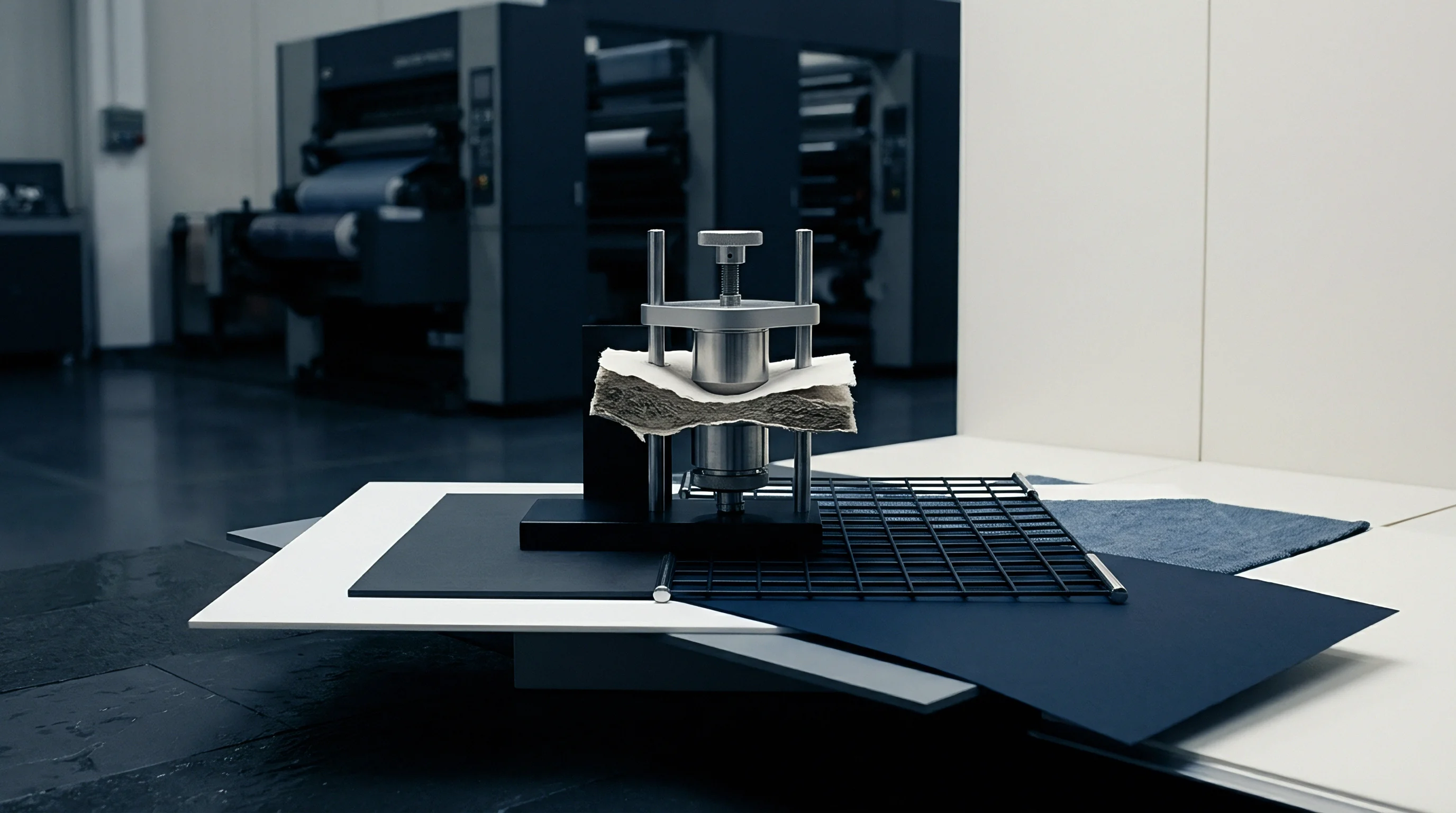
Dry-contact ultrasonic transducers clamped against a paper specimen measure the time required for an acoustic wave packet to pass between two piezoceramic elements. Phase velocity calculations depend directly on substrate density, following the relation where specific acoustic stiffness equals the square of the sound velocity. High acoustic velocity indicates aligned cellulose chains and dense inter-fiber bonding, whereas low acoustic velocity reveals transverse alignment or loose spatial packing.
An acoustic velocity ratio of 1.65 between machine and cross directions rests on dry-contact transducer measurements at 23 degrees Celsius and 50 percent relative humidity under ISO 187; shifting ambient humidity to 80 percent drops this velocity by 11 percent due to moisture-induced plasticization of cell wall hemicellulose.
Because off-axis stiffness causes skew, laboratory profiling instruments use rotating transducer pairs or multi-channel fixed arrays to measure phase delay at 15-degree angular increments. Evaluating sound velocity at discrete angles yields a complete polar map of acoustic stiffness. The resulting distribution maps directly to tensile stiffness index values, allowing converters to evaluate sheet symmetry prior to subjecting raw stock to lamination or hot-foil stamping.
| Paperboard Grade | Grammage (g/m²) | MD Velocity (km/s) | CD Velocity (km/s) | Specific Modulus Ratio (MD/CD) |
|---|---|---|---|---|
| Solid Bleached Sulfate (SBS) | 280 | 4.15 | 2.45 | 2.87 |
| Folding Boxboard (FBB) | 310 | 3.85 | 2.10 | 3.36 |
| Coated Recycled Board (CRB) | 350 | 3.40 | 2.25 | 2.28 |
| Unbleached Kraft Kraftliner | 175 | 4.60 | 2.30 | 4.00 |
When acoustic propagation timing varies across consecutive reel samples, the cause traces back to wet-end stock flow instabilities on the paper machine. Transducers operating in non-contact air-coupled modes allow continuous web tracking at mill running speeds, though temperature fluctuations in the air gap require active barometric compensation. Accurate velocity profiling isolates sheet structural variance before web tension converts density gradients into registration errors on multi-pass converting equipment.
High sound velocity along the principal machine axis correlates with reduced ultimate elongation, setting clear boundaries for scoring and embossing depth.
Polarity
Anisotropic distribution of structural stiffness dictates how a paper web responds to directional stress during die-cutting and folding passes. Mapping acoustic velocity continuously across 360 degrees generates an elliptical profile whose primary axis identifies the true mechanical orientation of the sheet. On Fourdrinier paper machines, fiber alignment rarely matches the physical machine axis perfectly, routinely exhibiting an angular deviation between two and seven degrees.
This misalignment introduces diagonal stress vectors during drying cycles and surface finishing operations.
The polar stiffness ellipse defines two key parameters: the anisotropy ratio, calculated as maximum sound velocity divided by minimum sound velocity, and the alignment angle offset. A symmetrical ellipse indicates balanced directional properties, whereas an elongated profile demonstrates pronounced machine-direction bias. When a converter applies high-heat film lamination to stock with a broad anisotropy ratio, differential contraction occurs along the off-axis stiffness vector.
Measuring acoustic attenuation alongside phase velocity provides secondary data on fiber-to-fiber bond integrity, showing where die blades might crush misaligned edges or lamination could trap residual stress. High attenuation coupled with low acoustic speed flags internal micro-voids or inadequate starch pick-up at the size press. Converters processing heavy-grammage folding boxboard use these polar metrics to adjust crease rule depth relative to the measured fiber angle rather than relying on nominal mill reel orientation.
Matching crease rule depth to the measured fiber axis prevents linerboard splitting on high-speed folder-gluers.
Fiber orientation patterns govern convertibility across multiple downstream processes:
- Crease Crack Susceptibility increases when score lines run parallel to the true acoustic stiffness axis, causing outer liner fibers to fracture under tension.
- Register Shift in Foil Stamping occurs when web tension stretches an asymmetrical sheet unevenly across the machine width during high-temperature dwell passes.
- Laminate Curl Instability manifests when moisture movement across an off-axis stiffness profile creates diagonal twist rather than simple axial bowing.
- Flute Crush Resistance Loss results when corrugating medium exhibits low cross-direction acoustic velocity, reducing vertical compression performance under load.
Off-axis fiber alignment creates complex physical interactions during high-speed converting. Does the measured acoustic axis remain stable through the paper thickness, or does top-layer stock skew independently of the middle ply during former dewatering?


Draft
Hydrodynamic forces within the paper machine headbox determine the spatial distribution of suspended cellulose fibers as stock flows onto the forming wire. The speed ratio between the jet of stock exiting the slice lip and the moving wire controls the drag or rush experienced by the fiber slurry. When jet speed matches wire speed, fibers land randomly, yielding low polar anisotropy.
Elevating jet speed relative to wire speed stretches the slurry, aligning fibers along the machine axis and sharpening the acoustic stiffness profile.

Which Hydrodynamic Controls Shift Specific Acoustic Elasticity?
Slice lip adjustment screws alter local flow geometry across the machine width, modifying velocity vectors and fiber alignment angles. Micro-turbulence generators inside the headbox disrupt fiber flocculation, but excessive turbulence introduces local velocity variations that distort acoustic symmetry. Fiber alignment angle offset limit of 2.5 degrees rests on headbox laser-doppler speed audits from 1200-millimeter wide Fourdrinier lines; changing stock consistency by 0.1 percent or altering slice lip temperature shifts the hydrodynamic shear field and moves this angle by up to 1.8 degrees.
Dewatering forces on twin-wire formers fix orientation quickly, locking in polar anisotropy before the web enters the press section.
Calibrating an in-line ultrasonic sensor array on a continuous converting line requires systematic steps:
- Mount the ultrasonic transducer ring across the web path, ensuring non-contact air-gap spacing remains fixed at 2.0 millimeters plus or minus 0.05 millimeters across the full bar width.
- Purge the sensor measurement zone with dry compressed air to clear surface cellulose dust and stabilize ambient acoustic temperature gradients.
- Execute a static zero-delay calibration using a standard polyester reference film of known acoustic velocity and uniform thickness.
- Initiate web movement and record baseline acoustic transit times across twelve discrete angular channels at zero line tension.
- Apply operational running tension and record phase shift variances to isolate tension-induced elastic stretch from structural fiber orientation anisotropy.
- Generate a real-time polar acoustic map and compute the directional alignment offset relative to the mechanical centerline of the reel.
Consider a folding boxboard plant running 350 g/m² board with a nominal MD/CD acoustic stiffness ratio of 3.2. A baseline machine run of 50,000 sheets operated at a jet-to-wire speed ratio of 1.08, yielding a fiber angle deviation of 1.5 degrees off machine centerline. Spoilage at the folder-gluer due to score line cracking held at 0.4 percent of the run.
On a subsequent lot, headbox dilution flow drifted, shifting jet-to-wire ratio to 1.14 and increasing fiber angle deviation to 4.2 degrees off centerline. Score line cracking spoilage rose to 2.8 percent because creasing rules were positioned assuming true axial alignment.
| Jet-to-Wire Speed Ratio | Fiber Angle Deviation (Degrees) | Acoustic Velocity Ratio (MD/CD) | Score Cracking Waste (%) | Laminate Twist Scrap (%) |
|---|---|---|---|---|
| 0.98 (Drag) | 3.8 | 2.10 | 1.9 | 2.4 |
| 1.02 (Near-Match) | 1.1 | 1.65 | 0.3 | 0.5 |
| 1.08 (Moderate Rush) | 1.5 | 2.85 | 0.4 | 0.8 |
| 1.15 (High Rush) | 4.5 | 3.60 | 3.1 | 4.2 |
When mill certificates report standard machine-direction tensile strength without off-axis acoustic profiling, paper mills present web uniformity as fully optimized despite undetected off-axis orientation drift across the reel width.

Distortion
Hygroexpansion behavior in paper products couples tightly to directional stiffness patterns established during wet-end sheet formation. Cellulose fibers expand significantly in diameter upon absorbing moisture, while their longitudinal dimensions remain relatively stable. Consequently, a sheet with strong cross-direction fiber alignment undergoes pronounced dimensional expansion perpendicular to the fiber axis when exposed to humidity shifts.
When polymer films or barrier coatings are laminated to paperboard with uneven polar elasticity, differential expansion creates severe structural instability.
Because wet expansion forces diagonal twist and film tension compounds paper anisotropy, applying a heat-sealed polypropylene film to paperboard exhibiting a five-degree acoustic axis offset causes the finished laminate to curl along a diagonal axis rather than along the sheet edges. Diagonal twist prevents reliable feeder pickup on automatic packaging lines and causes jam-ups in high-speed cartoning equipment.
Standard ISO 1924-3 test protocols define tensile stiffness index procedures, but require supplementary off-axis acoustic profiling to predict multi-pass film lamination curl.
Converters evaluate sheet stability prior to film lamination using structured checks:
- Verify Polar Symmetry Ratio ensuring the ratio between principal acoustic stiffness and transverse stiffness does not exceed the maximum allowable threshold for the specific lamination film gauge.
- Measure Off-Axis Angle Offset confirming that the acoustic velocity peak aligns within two degrees of the intended web machine axis.
- Audit Cross-Web Stiffness Profile checking that sonic velocity readings taken at the drive side, center, and tend side of the reel vary by less than three percent.
- Evaluate Moisture Gradient Sensitivity comparing acoustic velocity values at 50 percent relative humidity against values recorded after conditioning under ISO 187 elevated moisture environments.
Score lines executed perpendicular to an unaligned fiber network suffer from uneven stress concentration during folding passes. The outer linerboard splits along the true fiber axis rather than along the indented score groove, exposing raw internal fibers and compromising structural integrity. Dropping sheet moisture content prior to converting stiffens the matrix temporarily, but ambient humidity regain reinstates the underlying orientation bias, causing finished cartons to warp in warehouse storage.

Dossier
Integrating non-destructive ultrasonic acoustic profiling into raw material acceptance criteria changes how paperboard is specified and verified. Traditional tensile tests require destructive sample preparation and fail to capture angular stiffness variations across the full 360-degree plane. Ultrasonic profiling provides rapid, complete polar maps that link directly to commercial line performance, tooling wear rates, and converting scrap allowances.
Buying paperboard based solely on basic weight and machine-direction burst strength exposes packaging operations to unforeseen converting failures.
A target value of 0.82 for acoustic polar symmetry ratio remains difficult to defend across varied recycled furnish streams due to batch-to-batch variation in recovered pulp stiffness; a buyer protects the converting pass by specifying an off-axis sonic velocity variance limit of plus or minus 3.5 percent in the purchase agreement rather than relying on mill averages. Setting tight polar stiffness tolerances reduces line stoppages on automated cartoning equipment. Rejection rates double on bad runs, and tooling dies fail on misaligned board.
| Tolerance Class | Acoustic Angle Offset Limit | MD/CD Velocity Ratio Range | Make-Ready Waste per 100k (Sht) | Net Added Board Premium ($/Ton) |
|---|---|---|---|---|
| Strict Precision | ± 1.5° | 1.8 – 2.2 | 800 | 45.00 |
| Standard Commercial | ± 3.0° | 1.6 – 2.8 | 2,100 | 0.00 |
| Relaxed Utility | ± 6.0° | 1.4 – 3.5 | 5,400 | -25.00 |
Mill certificates omitting off-axis figures leave converting plants vulnerable to unexpected material behavior. Scrap rates during high-speed film lamination directly reflect off-axis velocity variance. High-density fiber networks with balanced acoustic polarity maintain dimensional stability through multiple coating, printing, and drying passes.
Incorporating ultrasonic polar profile requirements into procurement documentation shifts the burden of dimensional stability verification back to the paper mill.
Quality assurance documentation for high-value packaging runs must capture distinct ultrasonic metrics:
- Absolute Mean Sonic Velocity along the primary axis, recorded in kilometers per second under ISO 187 standard atmosphere.
- Maximum Fiber Alignment Deviation Angle expressed relative to the physical reel edge.
- Polar Stiffness Anisotropy Index calculated as the ratio of maximum to minimum specific acoustic modulus.
- Cross-Web Stiffness Uniformity Index quantifying property variance across drive side, center, and tend side samples.
Off-axis sonic velocity mapping provides non-destructive proof of fiber orientation stability prior to high-speed die-cutting and lamination passes.
Under standard packaging procurement contracts, an off-axis fiber orientation deviation exceeding 3.5 degrees from the specified machine axis invalidates nominal tensile strength compliance and entitles the buyer to reject the delivered lot without paying mill return penalties.