Mass Balance Arithmetic and Yield Loss Factors in Fiber Ledgers
Applying uncorrected gross weights or inflated yield factors into mass balance ledgers creates over-allocated credit accounts that trigger customs seizures.


Intake
Mass balance accounting begins at the weighbridge. Incoming dry fiber weight governs every downstream certified claim, yet pulp bales, recovered paper bundles, and roundwood arrive at the yard with unpredictable moisture levels. FSC-STD-40-004 Clause 5.1 and PEFC ST 2002 Clause 6.1 require input figures in company ledgers to match actual certified physical volumes.
Commercial bills of lading, however, give gross weights including ambient water, wire strapping, and wrapper stock. Logging invoice weights without moisture adjustments effectively credits uncertified water into certified fiber pools.
For chemical market pulp, the standard commercial baseline is set at 10 percent moisture content ~ classified as 90 percent air-dry pulp under ISO 638-1 testing. Recovered paper bought under EN 643 specifications shows wider swings, anywhere from 8 to 18 percent moisture depending on weather exposure, yard storage, and bale density. Booking 1,000 metric tons of recovered paper at 16 percent moisture against a standard 10 percent baseline without correction injects 60 metric tons of phantom fiber mass into the credit ledger.
Under ISO 638-1 oven-dry testing at 105 degrees Celsius, moisture content exceeding the 10 percent commercial air-dry baseline forces a mandatory physical mass deduction in credit ledger entries.
Certification schemes treat that excess as an over-allocation of certified volume. Once pulp hits the hydrapulper, water weight dissolves into process slurry, leaving actual fiber yields below what the books reflect. Auditors cross-reference moisture logs against receiving tickets to ensure conversion factors draw from measured bone-dry tonnage rather than gross scale weights.
Managing fiber ledgers demands clear separation between physical delivery weights and accounting credits. Mills establish conversion factors by measuring dry fiber mass for each distinct raw material. Groundwood mechanical pulp, unbleached kraft, and deinked secondary fibers show very different yield losses during initial stock preparation.
| Input Material Grade | Standard Purchase Basis | Process Water Fraction | Slurry Retention Rate | Ledger Entry Factor |
|---|---|---|---|---|
| Bleached Kraft Pulp Sheets | 90/10 Air-Dry Metric Ton | 0.100 | 0.985 | 0.886 |
| EN 643 Grade 1.02 Old Corrugated | Gross As-Received Weight | 0.142 | 0.812 | 0.697 |
| EN 643 Grade 3.02 Deinked Pulp Substrate | Gross Baled Weight | 0.118 | 0.745 | 0.657 |
| Thermo-Mechanical Pulp Slush | Bone-Dry Equivalent Ton | 0.000 | 0.962 | 0.962 |
Bale core moisture determination follows ISO 638-1, oven-drying core samples at 105 degrees Celsius to constant weight. Plants running batch pulpers record moisture for each delivery lot, while continuous operations rely on automated microwave or near-infrared sensors mounted above intake conveyors. These sensors measure real-time absorption lines calibrated against TAPPI T 412 om-16 oven-dry reference methods.
Those measurements determine the certified ledger entry. A delivery note for 500 metric tons of FSC Mix Credit virgin kraft fiber actually supplies 450 metric tons of dry cellulose when sampled at 10 percent moisture. Conversion factors that overestimate yield build phantom credit surpluses that trigger suspensions during surveillance audits.
Including explicit ISO 638-1 testing protocols in purchase contracts avoids vendor disputes by rejecting gross-weight delivery tickets right at the gate.
Press
Dewatering mechanics drive most of the physical fiber lost along forming fabrics and wet felts. Machine forming sections flush fine cellulose particles, starch, mineral fillers, and sizing into the white water tray. Flotation save-alls and disc filters catch most suspended solids, but short fibers and broken fibrils pass through the filter mesh and head toward wastewater treatment.
Modern twin-wire formers running virgin bleached softwood kraft keep white water solids consistency between 0.015 percent and 0.035 percent, which translates to a forming yield loss around 1.5 percent.
Recycled testliner mills running 100 percent secondary fiber face considerably higher forming losses. Repeated repulping shortens recycled fibers significantly, leaving furnish loaded with hornified fines and non-cellulosic debris that cannot bridge the forming fabric. Shear forces inside suction couch rolls and press nips dislodge these fragile fiber fragments, flushing them directly into felt wash effluent.
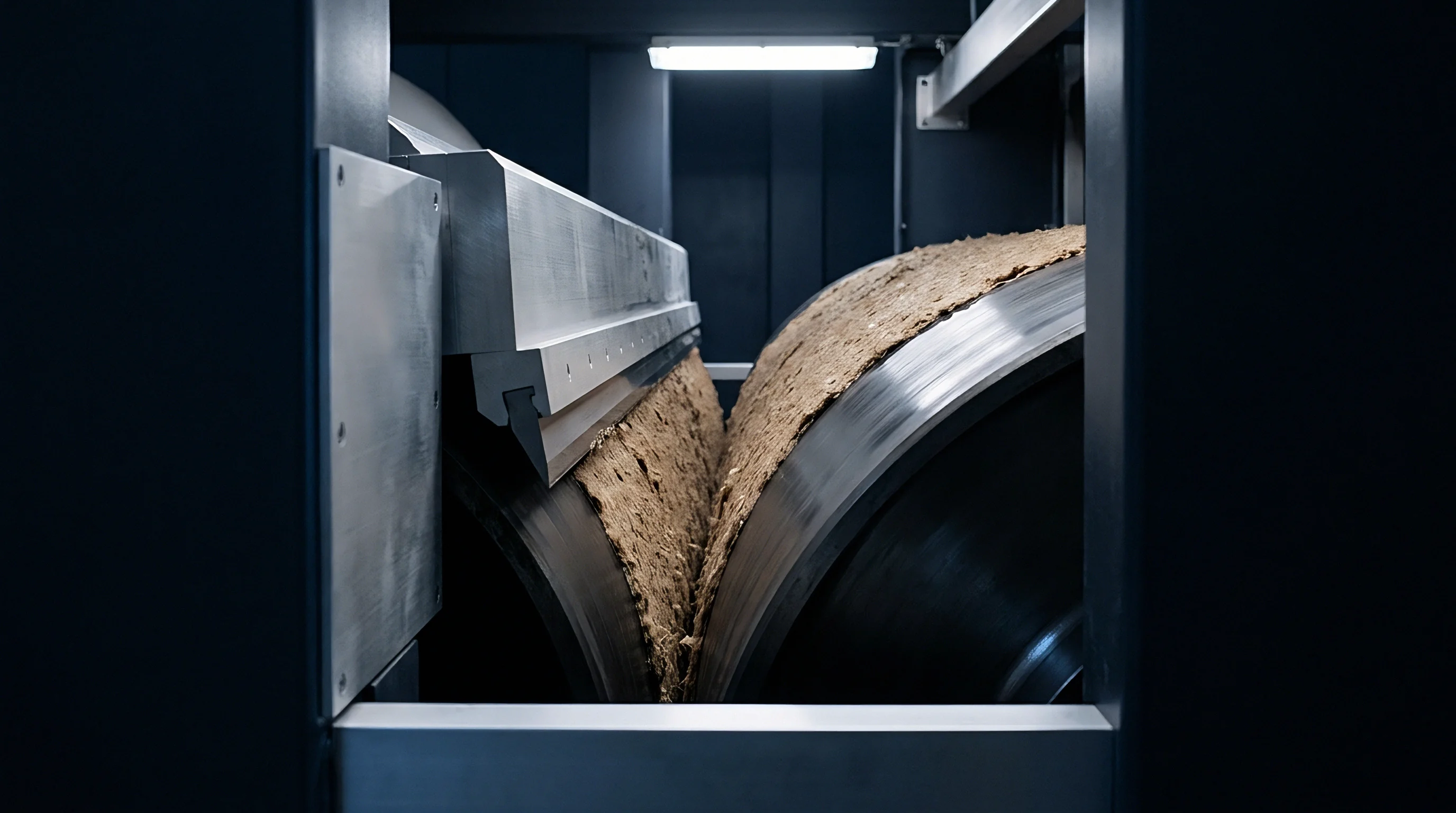
Press nip mechanical stress consolidates the web while knocking loose fine debris. Linear nip loads up to 1,200 kilonewtons per meter force free water from the sheet, flattening tubular fibers and expressing colloidal material. Oscillating needle showers condition wet felts at 2.5 to 3.5 megapascals to avoid felt compaction and sheet rewetting, but the continuous spray washes away high-freeness fines that bypass recovery systems entirely.
Furnish solids escaping the press section into primary wastewater sumps permanently forfeit their claim allocation in certified ledgers.
Certification standards treat unrecovered fines as permanent process losses. The moment an unrecovered effluent stream leaves the closed system, ledger balances must drop accordingly. Establishing accurate press-section yield factors requires sampling wastewater streams strictly under ISO 4119 pulping suspension protocols.
- Primary wire pit sampling measures total suspended solids in white water at the forming table drain pan under steady-state operating speeds.
- Save-all clear filtrate analysis isolates fine solids passing through vacuum disc filter poly-filament cloths under TAPPI T 656 standards.
- Press section felt purge measurement quantifies fine fiber fragments dislodged by high-pressure oscillating conditioning showers and discharged directly to sewer trenches.
- Couch pit overflow monitoring identifies fiber surges dumped during wet-end sheet breaks before vacuum couch transfer points.
Web transfer into the dryer section marks the boundary of liquid mechanical losses. Any fiber remaining in the sheet past this point stays bound in the paper matrix. Engineers account for press-section losses in machine balances using continuous effluent flow meters paired with dry-weight sample evaporators.
A machine losing 22 kilograms of dry solids per metric ton of linerboard, for example, operates at a press yield factor of 0.978. Any unrecovered solids lost from the white water loop cancel out corresponding ledger claims, physical inventory notwithstanding.

Shrinkage
Thermal drying, calender friction, and slitting cause further mass loss downstream. Water evaporates in the dryer section until paper moisture stabilizes between 5 and 8 percent under TAPPI T 402 parameters. Shrinkage creates sheet tension that causes edge flutter and micro-tearing along deckle margins; wet trim cutters trim these rough edges and send the slurry straight back to the machine chest.
Converting at the dry end generates additional waste. Flying splices on slitter-rewinders strip off outer wraps and core remnants. Calender rolls crush sheet surface defects under heat and pressure, producing fine dust that vacuum hoods draw away.
Off-spec reels produced during weight or grade changes are removed from main production ledgers as internal broke, then repulped on site to return certified fiber into the furnish stream.
Both FSC and PEFC enforce strict accounting on repulped broke. Clean broke retains certified status only if kept within the same product group and reprocessed in the same mill. Mixing certified and non-certified runs destroys the balance chain.
When switching from an uncertified run to certified kraftliner, operators must thoroughly flush blending chests, excluding the purge from certified credit tallies.
| Processing Node | Observed Mass Loss Range | Recovery Mechanism | Ledger Deductible Status | Accounting Treatment |
|---|---|---|---|---|
| Deckle Wet Trim | 2.5% to 4.5% | Direct Hydrapulper Return | Non-Deductible | Internal Closed Loop |
| Rewinder Slitter Trim | 1.2% to 2.8% | Pneumatic Blower to Dry Broke Chest | Non-Deductible | Certified Stock Re-entry |
| Reel Core Remnants | 0.5% to 1.1% | Off-line Batch Repulping | Conditional | Deductible if Mixed |
| Calender Dust Exhaust | 0.1% to 0.3% | Cyclonic Baghouse Filtration | Deductible | Definitive Landfill Loss |
| Grade Transition Broke | 3.0% to 7.5% | Broke Storage Silo Buffer | Conditional | Downgraded Allocation |
Yield calculations must account for physical degradation during repulping. Secondary fibers lose bonding capacity and break down under high-consistency rotor blades. ISO 16063 optical image analysis shows hardwood fibers shortening from an average 0.95 millimeters down to 0.72 millimeters during broke repulping.
These finer fractions slip through recovery screens when reintroduced, compounding shrinkage losses.
Fibers repulped across grade transitions lose their original certification pedigree whenever mixed-origin broke silos accept input from non-certified base runs.
Tracking yield depends on mass flow meters measuring broke stock density and flow rates into mixing chests, with microwave attenuation transmitters checking slurry consistency. When mass flow calculations do not match reel scale weights, audit discrepancies surface. Mills often trace these variances to unmeasured retention changes during broke additions.
Deduction
Credit ledgers follow strict math. Certified claims pass downstream only when backed by dedicated credit accounts set up under FSC-STD-40-004 Clause 9 or PEFC ST 2002 Clause 6.3. Under mass balance rules, a mill can intake certified fiber, mix it with controlled or non-certified virgin furnish, and sell a calculated share of finished output with a certified claim.
That claim volume cannot exceed incoming certified tonnage multiplied by the verified yield factor of the process.
The formula for calculating certified output enforces this conversion factor:
Certified Output Quantity = Certified Raw Material Input Quantity multiplied by Verified Processing Yield Factor
Take a mill producing 10,000 metric tons of folding boxboard. It buys 4,000 air-dry metric tons of FSC Mix Credit bleached chemical pulp and blends it with 6,000 metric tons of non-certified thermo-mechanical pulp and mineral coating pigments. Actual yield across the run is measured at 0.880 after accounting for pulping rejects, edge trim, coating splices, and wastewater fines.
The usable certified credit equals 4,000 multiplied by 0.880 ~ yielding 3,520 metric tons of FSC Mix Credit boxboard. The remaining 6,480 metric tons must be sold without certification claims. If accounting records the raw 4,000 metric tons directly without applying the 0.880 yield factor, the mill over-claims by 480 metric tons.
Auditors treat this as a major non-conformity, leading to formal corrective action demands or immediate certificate suspension.
- Credit validity expiration voids unused credit balances past PEFC’s 24-month rolling limit or FSC’s 12-month cap.
- Product group segregation failure merges ledger pools from incompatible lines, invalidating claims for both product groups.
- Coating pigment inclusion errors count inorganic mineral slips like calcium carbonate and kaolin clay as certified fiber input.
- Multi-site pooling breaches transfer credits between facilities in different jurisdictions without physical logistics links or shared group certification scope.
Inorganic coatings carry heavy compliance risks. On coated paperboards like solid bleached sulfate or coated duplex, mineral coatings make up 15 to 30 percent of total dry sheet weight. Calcium carbonate, titanium dioxide, latex binders, and starch contain no wood fiber.
FSC-STD-40-004 Clause 5.3 explicitly restricts certified claims to the substrate’s fiber content. Adding 250 metric tons of mineral slurry to 1,000 metric tons of certified pulp to produce 1,250 metric tons of coated board does not yield 1,250 metric tons of certified product. The claim remains tied strictly to the 1,000 metric tons of fiber times the fiber-line yield factor.
What specific test boundary separates recoverable organic process broke from non-reclaimable chemical sludge when closed-loop clarifiers recycle deinked fiber back into stock preparation chests?

Clearance
Finished goods face tight regulatory scrutiny at international ports. When shipments arrive at customs checkpoints in the European Union, the United States, or other regulated markets, inspectors cross-check import filings, commercial invoices, and packing lists against provenance records. Under the EU Deforestation Regulation (EUDR) and the Packaging and Packaging Waste Regulation (PPWR), mass balance declarations carry legal force rather than marketing weight.
Shipments with invalid claims face immediate quarantine.
Customs authorities require clear document trails linking physical containers directly to mill credit ledgers. Any container declared as FSC Mix Credit or PEFC Certified must carry invoice-level claims with the supplier’s chain-of-custody code. Border agents use public FSC and PEFC databases to verify certificate validity, scope, and covered product lines on the spot.
| Regulatory Instrument | Target Verification Item | Documentary Instrument | Enforcement Authority | Commercial Exposure |
|---|---|---|---|---|
| EU Deforestation Regulation | Geolocation of Harvest Plots | Due Diligence Statement | National Customs Service | 4% Annual EU Turnover Fine |
| Packaging & Waste Regulation | Recycled Content Percentage | Conformity Declaration | Market Surveillance Agencies | Administrative Sales Ban |
| Lacey Act Amendments | Timber Species and Origin | PPQ Form 505 Declaration | US Fish and Wildlife Service | Civil Forfeiture and Penalties |
| Green Claims Directive | Mass Balance Credibility | Third-Party Verifier Dossier | Consumer Protection Bodies | Unfair Competition Litigation |
Discrepancies between shipping paperwork and ledger deductions expose buyers directly to legal liability. If a converter runs a job claiming a 0.950 yield factor when machine logs show an actual yield of 0.820, the imported packaging carries an unsubstantiated green claim. If customs audits catch the discrepancy, authorities will seize inventory, strip duty exemptions, and levy secondary penalties against the importer of record.
Supply contracts need to pass compliance exposure back to converters using indemnification clauses. Experienced buyers turn down supplier claims that lack audited yield documentation. Sourcing terms should require mills to provide annual third-party audit reports confirming that ledger yield factors match physical figures measured by calibrated flow meters, broke scales, and effluent monitoring.
Ignoring processing losses in mass balance accounting risks impounded freight, canceled customer accounts, and heavy fines at the port of entry.