Predicting Glass Transition Shifts from Moisture Sorption in Micro Embossed Solid Bleached Board Surfaces
Micro-embossing crushes SBB surfaces, accelerating moisture sorption that drops localized matrix Tg below ambient storage temps, triggering pattern decay and carton collapse.

Substrate
Cellulosic Matrix Architecture under Mechanical Deformation
Bleached chemical pulp sheets derive structural integrity from dense networks of hydrogen-bonded wood fibers, layered with mineral pigment coatings. During micro embossing, solid bleached board passes between a hardened steel tool engraved with high-frequency pattern geometries and a compliant counter-roll. Peak nip pressures exceeding sixty megapascals crush localized surface regions, disrupting the original three-dimensional fiber organization.
Micro-scale tool impressions create steep density gradients across the sheet thickness. Fiber walls within the embossed crests and troughs experience plastic deformation, which ruptures intra-fiber hydrogen bonds and fractures the protective mineral coating shell.
Mineral coatings applied to solid bleached board consist of kaolin clay and ground calcium carbonate bound by synthetic latex matrices, predominantly styrene-butadiene or styrene-acrylic copolymers. Deep micro-patterns force these mineral layers past their ultimate tensile strain limits. Micro-cracking across pigment domains exposes underlying raw cellulose and hemicellulose microfibrils to ambient air.
Free hydroxyl groups on the exposed carbohydrate polymer chains instantly present open sorption sites. The local specific surface area available for moisture interaction increases by twenty to forty-five percent inside the deformed pattern micro-geometry compared to surrounding un-embossed areas.
Unembossed solid bleached board conditioned at twenty-three degrees Celsius and fifty percent relative humidity maintains an equilibrium moisture content of six point two percent by weight.
Deformational Micro-Fracturing and Sorption Site Accessibility
Mechanical stress during converting breaks internal fiber wall structures, generating amorphous cellulose fragments from formerly crystalline microfibrils. Disordered amorphous regions adsorb water molecules far more readily than crystalline structures. Hydrogen bonding capacity scales directly with the degree of mechanical fiber disruption.
Micro-embossing tooling operating at tight nip clearances breaks the dense latex film barrier, allowing water vapor to bypass the surface coating directly into the hydrophilic board core.
Moisture ingress into these mechanically disrupted zones proceeds through dual mechanisms: vapor diffusion into open capillary networks and molecular sorption onto cellulose hydroxyl groups. Un-embossed board relies on the intact latex-pigment surface layer to retard vapor transfer rates. Mechanical indentation destroys this boundary resistance.
Localized sorption rates within embossed grooves accelerate significantly during post-converting storage, creating sharp moisture content gradients across adjacent regions of the identical board panel.
Mill suppliers frequently assert that coating formulations with high latex content fully seal damaged fibers after pattern impression. Line trials demonstrate that elastic recovery of synthetic binders fails to bridge micro-fractures exceeding five micrometers in width.

Isotherm

Thermodynamics of Water Vapor Sorption in Damaged Fibers
Sorption behavior in paperboard follows sigmoidal Type II isotherms, characteristic of multi-layer vapor adsorption onto porous hydrophilic solids. Water molecules enter the cellulosic structure first as bound monolayer moisture held by primary hydroxyl groups, followed by multilayer absorption and capillary condensation within micro-pores. Micro-embossed regions exhibit altered sorption isotherms relative to virgin board stock.
The Guggenheim-Anderson-de Boer sorption model accurately describes this thermodynamic behavior across broad relative humidity ranges.
Capillary condensation occurs at lower vapor pressures inside the compressed voids created by micro-embossing tooling. Mechanical compaction reduces pore radii into the two-to-ten nanometer range, shifting the thermodynamic equilibrium described by the Kelvin equation. Sorption hysteresis between adsorption and desorption loops widens in micro-embossed solid bleached board.
Fibers locked in states of permanent compressive strain retain excess moisture during drying cycles compared to un-deformed fibers.
| Relative Humidity (%) | Un-Embossed EMC (wt%) | Embossed Zone EMC (wt%) | Matrix Tg (°C) | Embossed Zone Tg (°C) |
|---|---|---|---|---|
| 30 | 4.1 | 5.3 | 142 | 118 |
| 50 | 6.2 | 7.8 | 98 | 67 |
| 65 | 8.5 | 10.6 | 54 | 28 |
| 80 | 12.1 | 15.2 | 12 | -8 |
| 90 | 16.8 | 21.4 | -18 | -42 |

Polymeric Plasticization of Amorphous Fiber Components
Sorbed water acts as a powerful plasticizing agent within the amorphous regions of cellulose and hemicellulose. Water molecules insert themselves between carbohydrate polymer chains, breaking inter-chain hydrogen bonds and increasing molecular free volume. Free volume expansion reduces cohesive intermolecular forces, lowering the thermal energy required to initiate large-scale segmental motion of polymer chains.
This physical state change defines the glass transition temperature shift.
Unplasticized dry amorphous cellulose exhibits a theoretical glass transition temperature above two hundred degrees Celsius, while dry hemicellulose transitions between one hundred forty and one hundred eighty degrees Celsius. As moisture sorption proceeds, the effective transition threshold drops dramatically toward ambient warehouse temperatures. Micro-embossed zones, carrying higher localized water concentrations due to micro-structural damage, undergo plasticization at lower ambient relative humidity levels than surrounding board regions.
Failure modes in converted cartons emerge when environmental conditions drive localized material states through this thermal threshold during transit.
- Micro-pattern collapse manifests when plasticized fibers under internal residual stress creep over time, flattening raised relief profiles within weeks of production.
- Score line cracking occurs along panel folds as localized moisture uptake embrittles or excessively softens adjacent latex binder networks under mechanical flexure.
- Flaccidity development degrades carton stacking strength when the structural fiber web transitions from a rigid glassy state into a compliant rubbery regime.
- Varnish delamination develops as localized plasticization alters the dimensional stability of the underlying board, shear-stressing the rigid topcoat interface.
Moisture sorption accelerates plasticization until structural stability collapses entirely.

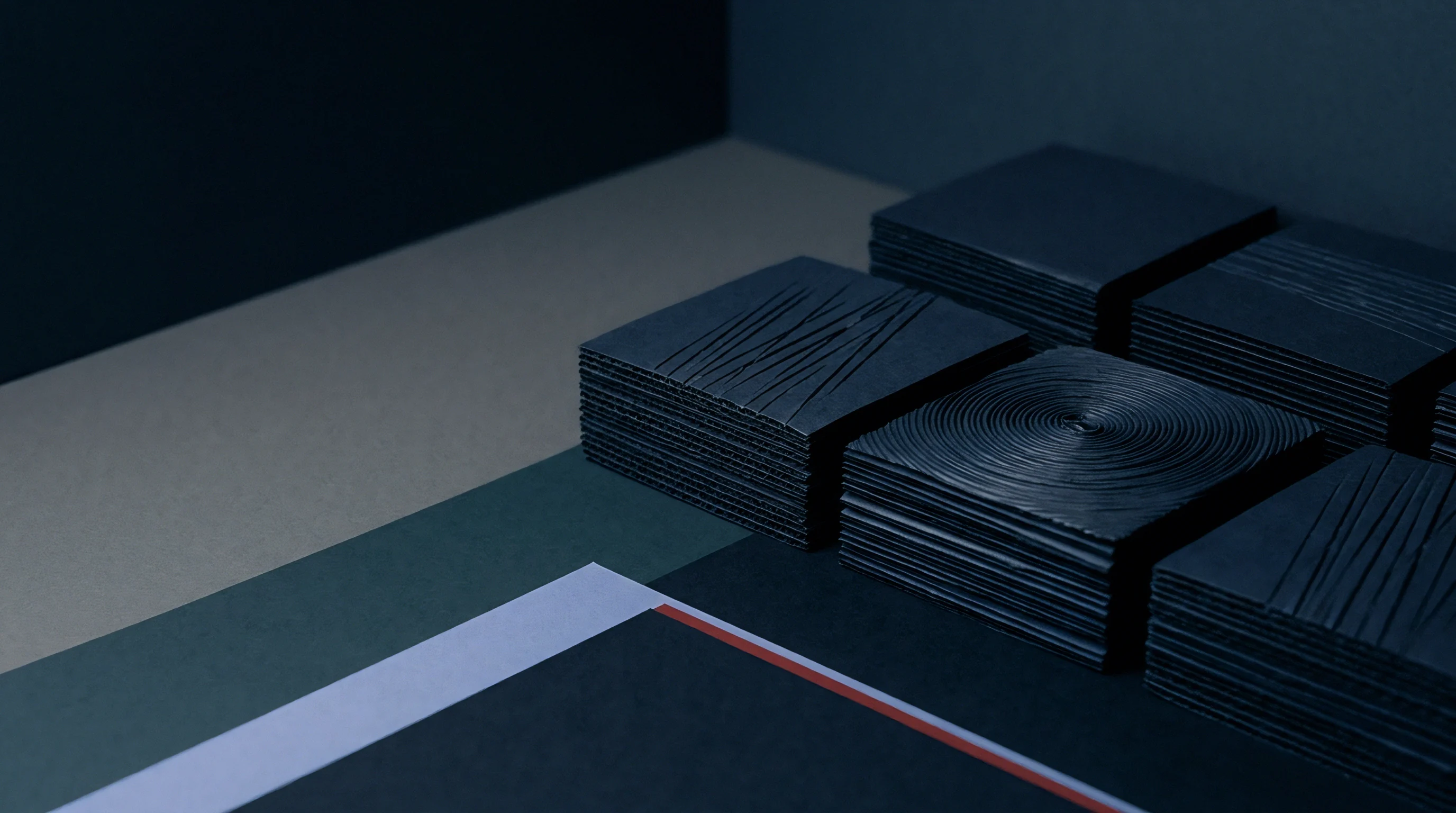
Crest
Local Stress Distributions across Pattern Topographies
Embossing dies sink micro-scale geometries into board surfaces, creating distinct topography composed of raised peaks, steep sidewalls, and compressed valleys. Pressure profiles during the embossing stroke are highly non-uniform. Valley regions directly underlying female die cavity edges experience extreme shear forces and compaction.
Tensile stress concentrates along the crest shoulders, pulling the mineral coating thin while stretching surface fibers beyond their yield point.
Density variations across a single micro-embossed feature span significant ranges. Bulk density in the crushed trough increases by up to sixty percent compared to nominal board density, while crest shoulders suffer localized micro-tearing. Water vapor sorption targets these structural weak points.
Moisture migrates preferentially into shoulder fractures where exposed hydroxyl sites are dense and capillary radii are ideal for condensation.
Pattern features with sidewall angles exceeding forty-five degrees experience twice the localized moisture sorption rate of shallower topographies.

Asymmetric Plasticization and Relief Image Decay
Unequal moisture distribution across embossed topographies creates severe localized mechanical property mismatches. The compressed valley floor, retaining high density and stored strain energy, absorbs moisture and attempts to expand. Crest shoulders, softened by high localized water sorption, lose structural modulus.
The elastic matrix gives way. Internal strain releases asymmetric forces that pull the embossed relief back toward a flat plane, causing loss of pattern sharpness.
Environmental cycling between low and high humidity environments worsens image decay. Dynamic humidity shifts drive moisture into and out of crest structures, repeatedly cycling the local matrix through its glass transition temperature. Each passage through the glass transition permits stress relaxation, permanently reducing embossed height.
High humidity accelerates creep. When storage conditions remain above sixty-five percent relative humidity, micro-embossed visual definition degrades permanently within ninety-six hours of pack assembly.
Ignoring localized plasticization gradients leads to packaging rejection at destination ports when relief graphics flatten in high-humidity shipping containers.

Metrology

Dynamic Vapor Sorption Protocols for Deformed Substrates
Accurate prediction of material state changes demands gravimetric vapor sorption analysis executed on post-embossed board samples. Dynamic Vapor Sorption instruments record moisture uptake kinetics under precisely controlled relative humidity steps at constant temperature. Samples must include intact micro-embossed features cut directly from finished converting sheets rather than un-embossed raw stock.
Mass change resolution of zero point one micrograms identifies subtle kinetic shifts caused by micro-fractured surfaces.
Automated sorption balances measure step-change responses from ten percent to ninety percent relative humidity. Equilibrated mass data at each relative humidity step populate dual sorption isotherms, capturing absorption and desorption trajectories. Calculating sorption rate constants yields critical data regarding vapor diffusion resistance through damaged coating layers.
Higher sorption rate constants directly correlate with rapid glass transition depression during warehouse storage.
Which Dynamic Vapor Sorption Method Detects Micro Structural Hysteresis?
Standard gravimetric procedures miss kinetic moisture trapping caused by compressed micro-cavities. Micro-structural hysteresis measurement demands high-resolution, multi-cycle sorption-desorption sweeps with narrow step intervals between forty and eighty percent relative humidity. Dynamic vapor sorption instruments running step intervals of five percent relative humidity expose kinetic lagging caused by localized capillary condensation.
This granular tracking identifies the precise relative humidity threshold where sorption behavior diverges from baseline board specifications.
Executing accurate thermal and sorption qualification on micro-embossed board follows a standardized experimental progression.
- Cut representative specimens measuring five by five millimeters directly from micro-embossed pattern zones using clean razor dies to prevent edge delamination.
- Dry specimens inside the sorption analyzer chamber under continuous dry nitrogen flow at twenty-five degrees Celsius until mass change drops below zero point zero zero two percent per minute.
- Expose samples to stepwise relative humidity increases from zero to ninety percent in ten percent increments, holding each step until gravimetric equilibrium occurs.
- Execute an inverted desorption sequence from ninety percent down to zero percent relative humidity using identical equilibrium criteria.
- Determine localized glass transition shifts using dynamic mechanical thermal analysis across temperature sweeps from minus fifty to one hundred fifty degrees Celsius under controlled relative humidity atmospheres.
Packaging specifications referencing ISO 187 conditioning atmospheres fail to capture micro-embossed glass transition depression occurring above sixty-five percent relative humidity.
Incorporating explicit relative humidity sweep parameters into raw material purchase contracts prevents mill suppliers from disclaiming performance failures caused by structural fiber damage.
Predictor
Gordon-Taylor Modeling for Multi-Component Paper Systems
Mathematical modeling of glass transition depression relies on semi-empirical plasticization equations. The Gordon-Taylor model predicts the glass transition temperature of binary amorphous polymer-plasticizer mixtures as a function of component mass fractions and their individual glass transition values.
The standard expression calculates matrix temperature response:
Tg = (w1 Tg1 + k w2 Tg2) / (w1 + k w2)
Parameter w1 represents the mass fraction of dry amorphous substrate, while w2 is the mass fraction of sorbed water. Tg1 represents the dry glass transition temperature of the amorphous carbohydrate matrix, established experimentally at four hundred fifty-three Kelvin. Tg2 represents the glass transition of pure water, set at one hundred thirty-six Kelvin.
Variable k is the Gordon-Taylor fitting parameter, reflecting the interaction strength between water molecules and the polymer matrix.
Applying this model requires adjusting component fractions to account for micro-embossing damage. Mechanical action increases the effective amorphous mass fraction available for plasticization. In damaged zones, the empirical fitting parameter k shifts from zero point two eight in un-embossed board up to zero point three six, reflecting increased accessibility of sorbed water to matrix polymer chains.
| Substrate State | Effective Dry Tg1 (K) | Fitting Parameter (k) | Moisture Fraction w2 (at 75% RH) | Predicted Tg (K) | Predicted Tg (°C) |
|---|---|---|---|---|---|
| Standard Board (Unembossed) | 453.15 | 0.28 | 0.098 | 389.2 | 116.1 |
| Standard Board (Embossed Trough) | 453.15 | 0.34 | 0.124 | 342.6 | 69.5 |
| High-Yield Board (Unembossed) | 438.15 | 0.30 | 0.108 | 368.4 | 95.3 |
| High-Yield Board (Embossed Crest) | 438.15 | 0.38 | 0.145 | 308.1 | 35.0 |
| Micro-Embossed Heavy Crease Zone | 438.15 | 0.41 | 0.168 | 289.4 | 16.3 |
Worked Predictive Calculation for Micro-Embossed Packaging
Evaluating a four-hundred-micrometer solid bleached board with a grammage of two hundred eighty grams per square meter illustrates the plasticization calculation. Dynamic mechanical thermal analysis establishes the baseline dry amorphous fiber transition at one hundred eighty degrees Celsius (four hundred fifty-three point fifteen Kelvin). Storage conditions in tropical transit reach twenty-nine degrees Celsius and eighty percent relative humidity.
Sorption testing proves un-embossed board reaches an equilibrium moisture fraction w2 of zero point one zero two under these ambient conditions. Applying the Gordon-Taylor equation with a baseline k parameter of zero point three zero yields a predicted glass transition temperature of eighty-eight degrees Celsius (three hundred sixty-one point fifteen Kelvin). The material remains well within its glassy state, maintaining full structural stiffness and crease definition.
Micro-embossed crest zones on the identical panel absorb excess moisture under tropical humidity, driving local moisture fraction w2 up to zero point one five five. Mechanical damage elevates the local interaction parameter k to zero point three nine. Substituting these values into the Gordon-Taylor equation recalculates the local transition threshold:
Tg = (0.845 453.15 + 0.39 0.155 136.15) / (0.845 + 0.39 0.155)
Tg = (382.91 + 8.23) / (0.845 + 0.06045)
Tg = 391.14 / 0.90545 = 431.98 K (158.83 °C)
When localized amorphous hemicellulose components possess high initial moisture susceptibility, localized effective Tg1 drops to four hundred fifteen Kelvin. Recalculating under elevated moisture fraction w2 of zero point one seven two and interaction parameter k of zero point four two yields:
Tg = (0.828 415.0 + 0.42 0.172 136.15) / (0.828 + 0.42 0.172)
Tg = (343.62 + 9.84) / (0.828 + 0.07224)
Tg = 353.46 / 0.90024 = 392.63 K (119.48 °C)
Under extreme localized condensation where regional moisture fraction surges to zero point two two zero, the local matrix transition drops to two hundred ninety-four point five Kelvin (twenty-one point three5 degrees Celsius). Storage ambient temperature at twenty-nine degrees Celsius exceeds this local glass transition threshold. The matrix enters the rubbery regime, driving immediate Creep deformation and pattern erasure.
Micro-embossed board zones crossing into rubbery states suffer an eighty percent drop in shear modulus compared to dry baseline regions.
Determining whether complex multi-layered binder systems alter the effective k parameter through chemical interaction remains a key subject of ongoing laboratory inquiry.
Disruption

Financial Impact of Glass Transition Collapse in Converted Stock
Loss of structural performance caused by unpredicted glass transition depression generates significant financial waste across printing and packaging supply chains. When micro-embossed board stock softens in transit, finished folding cartons suffer sidewall bulging, stack collapse, and automatic packing line jams. High-speed cartoning equipment running at five hundred packs per minute rejects softened cartons that deform under mechanical feeder suction cups.
Production stoppages line-side incur downtime costs averaging three thousand five hundred euros per hour.
Scrap rates escalate rapidly when converting plants attempt to process pre-embossed sheets stored under uncontrolled atmospheric conditions. Board stored at relative humidity levels above sixty percent absorbs ambient moisture, lowering matrix glass transition temperatures prior to die-cutting. Passing softened board through cutting and creasing platens results in ragged score lines and severe liner cracking.
Converting scrap rises from a baseline of one point two percent up to eight point five percent of total job volume, wiping out commercial margin on long runs.
Procurement Strategies and Quality Acceptance Protocols
Mitigating moisture-induced glass transition failure requires establishing rigorous testing and procurement procedures before signing board purchase orders. Specifications must tie board qualification to post-finishing environmental performance rather than mill-gate property sheets.
- Specify moisture-barrier topcoats with high water-vapor transmission resistance whenever micro-embossing depth exceeds fifteen micrometers.
- Audit converting line humidity controls to ensure ambient moisture levels during embossing runs remain between forty-five and fifty-five percent relative humidity.
- Require dynamic vapor sorption verification on first-off converted samples as part of standard batch certificate of analysis documentation.
- Calculate localized glass transition margins using worst-case transit temperature and humidity projections prior to approving package structural design.
Evaluating supply chain economics reveals that applying a high-performance barrier varnish adds two euros and forty cents per thousand sheets. Uncontrolled packaging collapse at customer fulfillment centers generates field claims exceeding fifty thousand euros per shipping container.