In-Plane Shear Deformation Modes in Multi Layer Paperboard
In-plane shear deformation in multi-layer paperboard operates via core matrix yield and inter-ply slippage, requiring core stiffness control to prevent splay.
Kinematics

Constitutive Mechanics of Multi-Ply Shearing
Paperboard exhibits pronounced orthotropic symmetry driven by machine-direction alignment during wet-end deposition. Loading the sheet off its principal material axes produces in-plane shear deformation through combined intra-ply matrix distortion and inter-ply boundary slipping. Pure shear stress in the machine-cross plane generates an angular strain that alters the right angle between machine- and cross-direction fibres.
Because thick paperboards are formed by laminating discrete layers during forming or pressing, the shear modulus varies internally across the thickness profile.
The overall elastic response depends on the shear modulus of each individual ply. Outer softwood kraft layers provide higher initial in-plane shear stiffness than bulky mechanical core plies. Because density and fibre alignment vary from ply to ply, stress distribution across the thickness is non-uniform.
Initial loading produces a linear angular deflection as individual cellulose filaments twist and bend within the starch matrix.
Plies with low density undergo matrix displacement long before outer kraft layers reach their elastic limit.
As stress rises past the linear elastic limit, plastic deformation begins in localized micro-yield zones. Hydrogen bonds between adjacent fibres disassociate, letting filaments slip past each other in the inter-ply regions. In multi-layer structures, this manifests as cumulative micro-cracking within the starch adhesives and mechanical pulp cores.
Recoverable elastic strain gives way to permanent set, shifting the sheet geometry well before surface fracture becomes visible.

Yield Boundaries and Fibre Network Slippage
Plastic flow within the sheet plane follows a yield envelope dictated by combined axial and shear stresses. When loaded in pure in-plane shear, multi-ply paperboard develops principal tensile stresses oriented at forty-five degrees to the shear plane. Failure occurs once internal network tensile capacity along these diagonal planes drops below the applied stress state.
Slippage within the fibre network concentrates where volumetric density is lowest. Groundwood and thermomechanical pulp plies contain short, rigid fibre fragments that yield easily under shear, while bleached softwood kraft plies continue transferring stress across wider strain increments. The lower density of middle layers reduces active inter-fibre contacts per unit volume, forming weak shear planes inside the board’s core.
Displaced fibres briefly align with principal tensile stress vectors, causing short-lived strain hardening. Ongoing shear disrupts this temporary stability and triggers shear band localization. As density drops inside the localized band, the sheet’s effective load-bearing area shrinks.
In heavy packaging grades, this localization shows up as panel bowing during box erection.
Microscopic examination of shear zones shows fibre pull-out occurring alongside inter-ply delamination. Printable outer plies hold the structure together until the inner layers fail completely. While higher sizing levels delay moisture-driven breakdown of the shear envelope, they do not change the dry fibre network’s underlying yield criterion.
Predicting the exact transition from diffuse micro-yielding to a concentrated shear band under changing moisture levels remains difficult from standard tensile metrics alone.

Architecture

Furnish Distribution across Layer Profiles
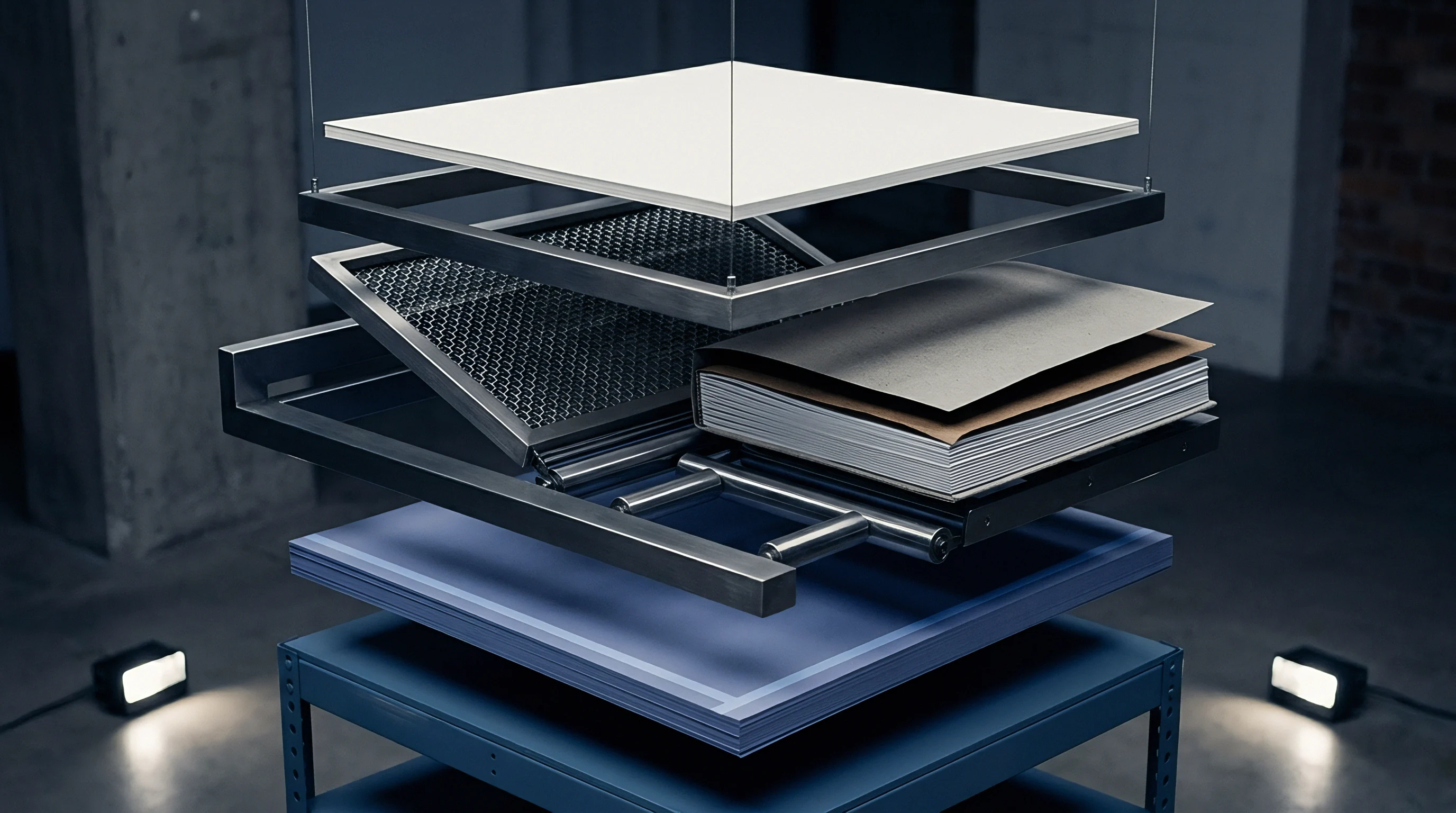
Layering strategy dictates how multi-ply paperboard responds to in-plane shear. Modern multiply boxboard machines deposit separate furnishes through dedicated headboxes to set specific density and stiffness profiles across the sheet. Outer plies rely on long-fibre bleached kraft pulp for high tensile and shear resistance, whereas inner plies use high-yield mechanical pulps or recycled fibres to gain caliper at minimum weight cost.
Mechanical contrast across layers creates complex stress concentrations. Under standard test conditions, bleached softwood kraft outer plies reach an in-plane shear modulus of three gigapascals, while mechanical middle plies often fall below eight hundred megapascals. Under planar shear loading, this steep gradient develops high inter-ply shear stress at the interface between the stiff liner and the compliant core.
Conditioned samples tested at twenty-three degrees Celsius and fifty percent relative humidity display a thirty percent drop in core shear modulus when relative humidity increases to eighty percent.
Refining intensity controls inter-fibre bonding in each ply. Higher Schopper-Riegler degrees in outer plies increase internal bond strength to resist intra-ply shear failure. These dense outer layers redirect shear deformation into the weaker core, where mechanical pulps with low specific bond areas yield early under torsional or planar shear loads.
Interface Bonding and Starch Matrix Dynamics
Ply coupling relies on chemical bonding at the wet interface and wet-end starches. Inter-ply bond strength dictates whether multi-layer paperboard behaves like a unified composite or a loosely stacked set of thin sheets. Strong interfacial bonding forces shear strain into the bulk of the plies, increasing energy absorption before ultimate failure.
A weak interface shifts the dominant deformation mode from diffuse matrix shear to discrete slip along ply boundaries. Sizing formulations containing cationic starch improve resistance to interfacial shear. Conversely, excessive filler content near layer interfaces weakens hydrogen bonding between plies and lowers the critical in-plane shear yield stress.
Moisture content acts as a primary lever over shear deformation. Water molecules disrupt inter-fibre hydrogen bonds, softening amorphous cellulose within the fibre walls. Higher moisture reduces the in-plane shear modulus while extending overall strain to failure.
In high humidity, shear-induced panel creep accelerates, compromising the stacking stability of folded cartons.
Symmetric furnish distribution maintains structural balance under multi-axis loading. Unbalanced layering creates internal shear coupling during simple bending, warping converted carton panels. Solid bleached board offers a uniform shear response through its thickness, whereas folding boxboard shows step-change property shifts at each interface.
Operators balance furnish cost against structural performance by adjusting the starch spray rate at the couch roll.
Core thickness governs the geometric contribution to effective shear rigidity. Increasing middle-ply caliper raises the cross-sectional moment of inertia, but lowers volumetric shear capacity if density drops excessively.
Fibre orientation within each ply sets the directional bias of the shear response. A high machine-to-cross-direction ratio concentrates shear resistance along specific diagonal vectors, while low anisotropy delivers balanced shear performance in non-aligned packaging formats.


Metrology

Planar Shear Test Configurations
Measuring in-plane shear properties in paperboard demands specialized fixture geometries to avoid premature edge buckling. Standard tensile tests cannot capture pure shear because of edge stress concentrations and uniaxial necking. Reliable shear characterization requires methods that isolate pure shear stress within a controlled gauge region.
The off-axis tensile test applies uniaxial tension to specimens cut at deliberate angles to the machine direction. Cutting samples at forty-five degrees induces combined normal and shear stresses along principal fibre axes. Mathematical transformation extracts the pure shear response, though non-uniform strain near clamped edges degrades precision.
Test protocols require exact specimen alignment in mechanical jaws to avoid spurious bending moments.
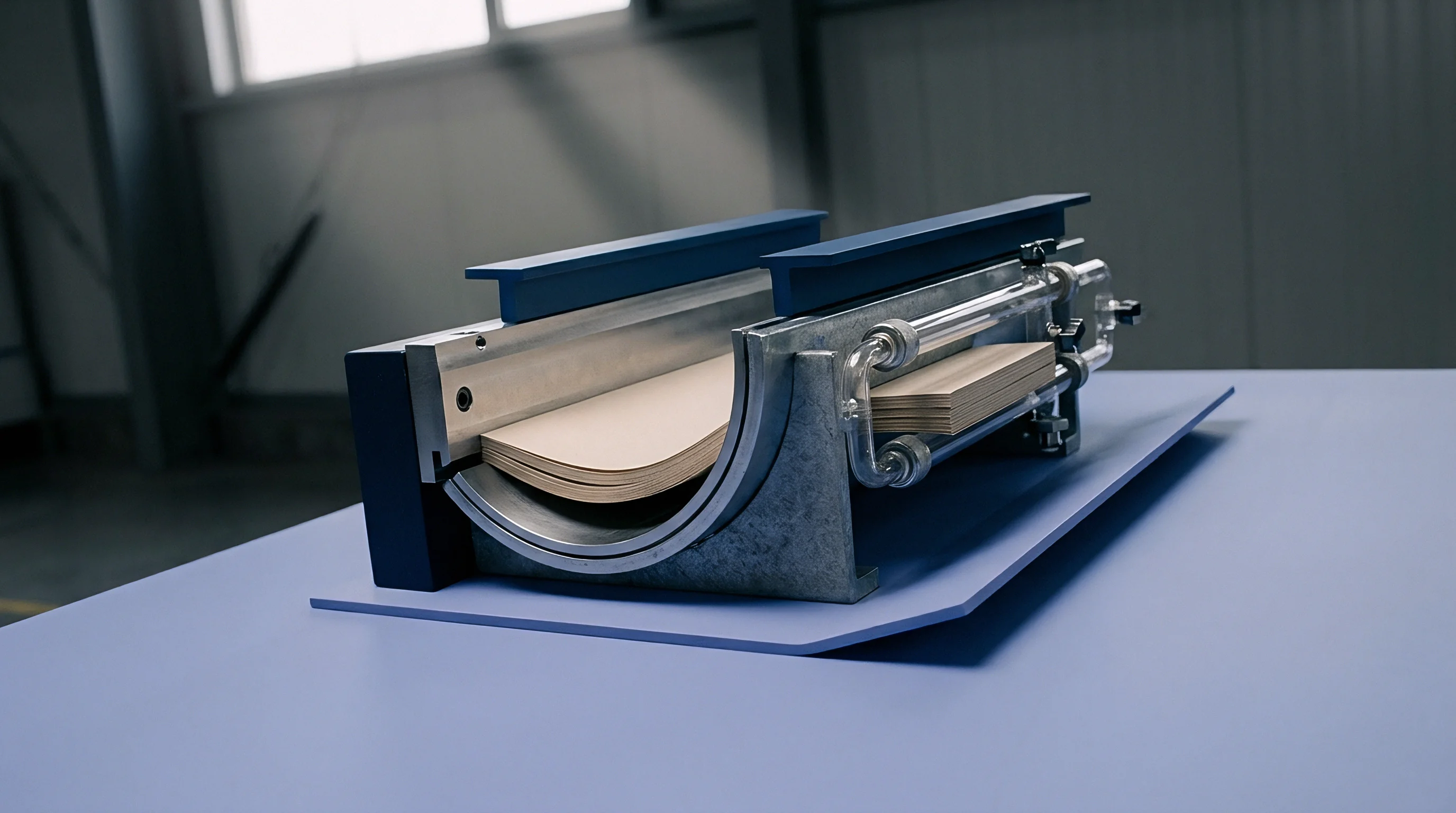
The V-notched rail shear test uses rectangular specimens clamped between rigid parallel rails. Notches on opposite edges concentrate strain in a central gauge section. This produces a uniform shear stress distribution across the gauge line, generating dependable stress-strain curves up to failure.
Specimen thickness dictates maximum load capacity before out-of-plane buckling distorts results.
Arcan fixtures use circular or semi-circular frames that allow variable loading angles relative to specimen axes. Pin-loaded perimeter holes permit pure shear loading when force acts parallel to the notched centerline. Advanced setups incorporate three-dimensional digital image correlation to track localized strain fields in real time.
| Test Methodology | Primary Standard | Specimen Geometry | Stress State Uniformity | Dominant Failure Mode |
|---|---|---|---|---|
| Off-Axis Tensile (45 Deg) | ISO 1924-3 (Modified) | 15 mm x 100 mm Strip | Moderate (Edge Distortions) | Combined Tensile and Shear Slip |
| V-Notched Rail Shear | ASTM D5379 (Adapted) | 76 mm x 56 mm Notched | High (Central Gauge) | Pure In-Plane Matrix Shear |
| Arcan Planar Shear | ASTM E143 (Modified) | Custom Butterfly Specimen | Very High (Centered Zone) | Core Delamination and Shear Yield |
| Torsion of Hollow Cylinders | ISO 11093-9 (Related) | Rolled Paperboard Tube | Uniform (No Edges) | Pure Torsional In-Plane Shear |
Strain Field Mapping and Worked Mechanics
Digital image correlation (DIC) provides non-contact, full-field strain measurements across specimen surfaces during shear tests. Painted high-contrast speckle patterns allow movement tracking across sub-pixel resolution blocks. DIC captures non-linear strain localization well before load cells register mechanical failure.
Evaluating the effective in-plane shear modulus from a forty-five degree off-axis tensile trial on three hundred gram per square metre folding boxboard illustrates the worked mechanics. Assume a sheet caliper of four hundred micrometres, an initial gauge width of fifteen millimetres, and a gauge length of fifty millimetres, with an applied axial load increment of fifty newtons in the linear elastic regime.
Applied axial stress is load divided by cross-sectional area. Multiplying fifteen millimetres width by zero point four millimetres caliper yields an area of six square millimetres, giving an axial stress of eight point three three megapascals. At a forty-five degree orientation, in-plane shear stress is half the axial stress, or four point one six megapascals.
Optical strain tracking records zero point three5 percent axial strain and negative zero point one five percent transverse contraction strain. Shear strain along material axes equals the difference between axial and transverse strains, producing zero point five zero percent strain. Dividing four point one six megapascals by zero point zero zero five strain yields an in-plane shear modulus of eight hundred and thirty-two megapascals.
Standard mill quality control documentation must report conditioned relative humidity alongside measured shear values to establish compliance with contract tolerances.
Replicating this calculation across multiple orientations determines the full orthotropic shear compliance matrix. Because variations in basis weight or thickness alter calculated cross-sectional stress directly, strict caliper control during sample preparation is essential.
Torsional testing on rolled hollow paperboard cylinders eliminates edge effects entirely by applying uniform tangential shear stress, establishing a benchmark calibration for planar fixtures. Because setup complexity limits cylindrical testing to laboratory research, rail and Arcan fixtures remain the practical choices for routine quality control. Technical data sheets specify these in-plane shear tolerances to protect downstream converting performance.
Under standard commercial paperboard supply contracts, delivered stock that fails specified minimum in-plane shear modulus values by more than eight percent across five consecutive reels triggers formal batch re-testing under ISO 187 reference conditioning protocols.

Distortion
Converting Operations and Fold Line Shear Kinematics
Converting exposes paperboard to severe combinations of bending, compression, and in-plane shear. Rotary die-cutting, high-speed folder-gluers, and press-forming generate localized shear forces that test internal layer integrity. As blanks pass through folding rails, differential belt speeds introduce torsional forces that induce planar shear across carton panels.
Creasing creates localized damage zones that act as flexible hinges. Proper creases reduce bending stiffness along the fold line while preserving inter-ply shear strength in neighboring flat panels. If female die channels are sized imprecisely, male rule penetration forces severe shear stress into the core, causing premature delamination beyond the crease zone.
High-speed folding propagates transient strain waves across score lines. When core furnish lacks adequate shear compliance, the board fractures along the outer kraft liner rather than yielding smoothly through middle layers. Excessive shear stiffness causes panel rollover, bulging carton sides outward instead of forming crisp perpendicular corners.
Why Do Corner Joints Splay under High Torsional Load?
Corner joints on side-seam glued cartons undergo concentrated multi-axial stresses during packing-line handling and pallet stacking. Torsional loads on top of a carton generate diagonal shear forces across side panels that transmit straight into the glue-lap joint, subjecting the adhesive line and adjacent plies to severe shear and peel forces.
Splay occurs when internal paperboard plies yield under shear before the adhesive bond fails. Core mechanical plies shear apart horizontally, letting the outer liner rotate away from the inner flap. High cross-direction shear compliance encourages structural skewing, causing square cartons to collapse into rhomboids during transit.
| Paperboard Grade Standard | Nominal Grammage (g/m²) | Typical Caliper (µm) | In-Plane Shear Modulus G12 (MPa) | In-Plane Shear Yield Stress (MPa) |
|---|---|---|---|---|
| Solid Bleached Board (SBS) | 280 | 350 | 1150 | 14.2 |
| Folding Boxboard (FBB) | 300 | 450 | 780 | 8.5 |
| White Lined Chipboard (WLC) | 350 | 480 | 620 | 6.1 |
| Solid Unbleached Board (SUB) | 310 | 400 | 1020 | 12.8 |
Press-forming and deep-drawing paperboard trays induce severe in-plane shear deformations. As flat blanks enter forming dies, circumferential compression forces the material to buckle at micro-scale network levels or shear smoothly in-plane. Insufficient shear compliance generates macro-wrinkling along tray rims, compromising heat-sealing integrity.
Macro-wrinkling along tray rims damages barrier coatings and exposes raw edge fibres to liquid absorption.
Industrial packaging conversion demands balanced shear properties to survive high-speed erect-fill-seal equipment. Incompatible friction coefficients on machinery amplify surface shear stresses, causing ink rub-off and edge scuffing. Line operators adjust blank orientation relative to machine direction to align shear resistance with primary load paths.
Diagnostic inspection of failed paperboard structures reveals characteristic material signatures:
- Inter-layer delamination occurs when internal shear stress exceeds interface bond strength, splitting middle plies into discrete, unbonded sheets.
- Diagonal panel creasing develops when shear-induced principal compressive stress causes localized micro-buckling across unreinforced panel spans.
- Score line rupture manifests when low core shear strain capacity transfers excessive tensile load directly to outer printable liners during rapid ninety-degree folding.
- Corner joint displacement arises when internal shear yielding lets bonded lap joints rotate out of vertical alignment under top-load compression.
Ignoring in-plane shear dynamics during blank design leads to packaging line jams, high spoilage at the gluer, and compromised pallet integrity during transit.
Outlay
Yield Arithmetic and Down-Sheet Optimisation
Specifying paperboard requires balancing structural shear needs against total landed material costs. Mills sell paperboard by metric tonnage, but converters consume it by surface area as individual blanks. For high-volume packaging, maximizing surface area yield per tonne drives overall cost effectiveness.
Selecting bulky folding boxboard over solid bleached board improves yield through better caliper-to-grammage efficiency. A three hundred gram folding boxboard matches the bending stiffness of a three hundred and forty gram solid bleached board. However, the lower core shear modulus in folding boxboard requires careful joint geometry design to prevent corner splay under load.
Substrate choice impacts overall converting efficiency. Stock with inconsistent in-plane shear properties creates register variations on folder-gluers, forcing lower line speeds to avoid jams. On lines running at four hundred metres per minute, micro-mechanical defects quickly escalate into full stops.
Evaluating candidate grade substitutions relies on structured technical verification:
- Furnish composition audit verifies the ratio of long-fibre softwood kraft to mechanical or recycled pulps across all plies.
- Conditioned laboratory testing establishes baseline in-plane shear modulus and internal bond values using standardized fixtures.
- Press-room converting trial measures score line cracking, folding torque, and blank squareness across a minimum five-thousand-sheet test run.
- End-of-life stream classification confirms that chemical additives do not penalize paperboard recyclability grading.

Goods-in Inspection and Batch Qualification
Receiving inspections verify incoming pallet lots against engineering specifications before releasing stock to the print floor. Systematic sampling isolates non-compliant material before conversion begins.
- Extract ten full-size sample sheets across three separate pallets per mill roll batch upon arrival at the unconditioned receiving staging area.
- Condition test specimens at twenty-three degrees Celsius and fifty percent relative humidity for a minimum of twenty-four hours in accordance with standard atmospheric protocols.
- Perform caliper and basis weight checks across five points per sheet to establish structural density profile consistency.
- Conduct directional Z-direction tensile and in-plane shear tests using calibrated V-notched rail or off-axis test fixtures to confirm matrix stiffness standards.
- Log measured shear yield data into statistical process control software to identify batch-to-batch drift away from nominal mill certificates.
Sourcing practice mitigates performance disputes by embedding explicit mechanical properties, including minimum in-plane shear modulus and internal bond thresholds, directly into substrate purchasing contracts. Substrate specifications establish clear legal boundaries for batch acceptance and pricing adjustments.