Interlaminar Shear Deformation Mechanics in Multilayer Paperboard Converting
Interlaminar shear mechanics govern multilayer paperboard creasing, where controlled internal delamination reduces score stiffness to prevent outer ply cracking.

Core
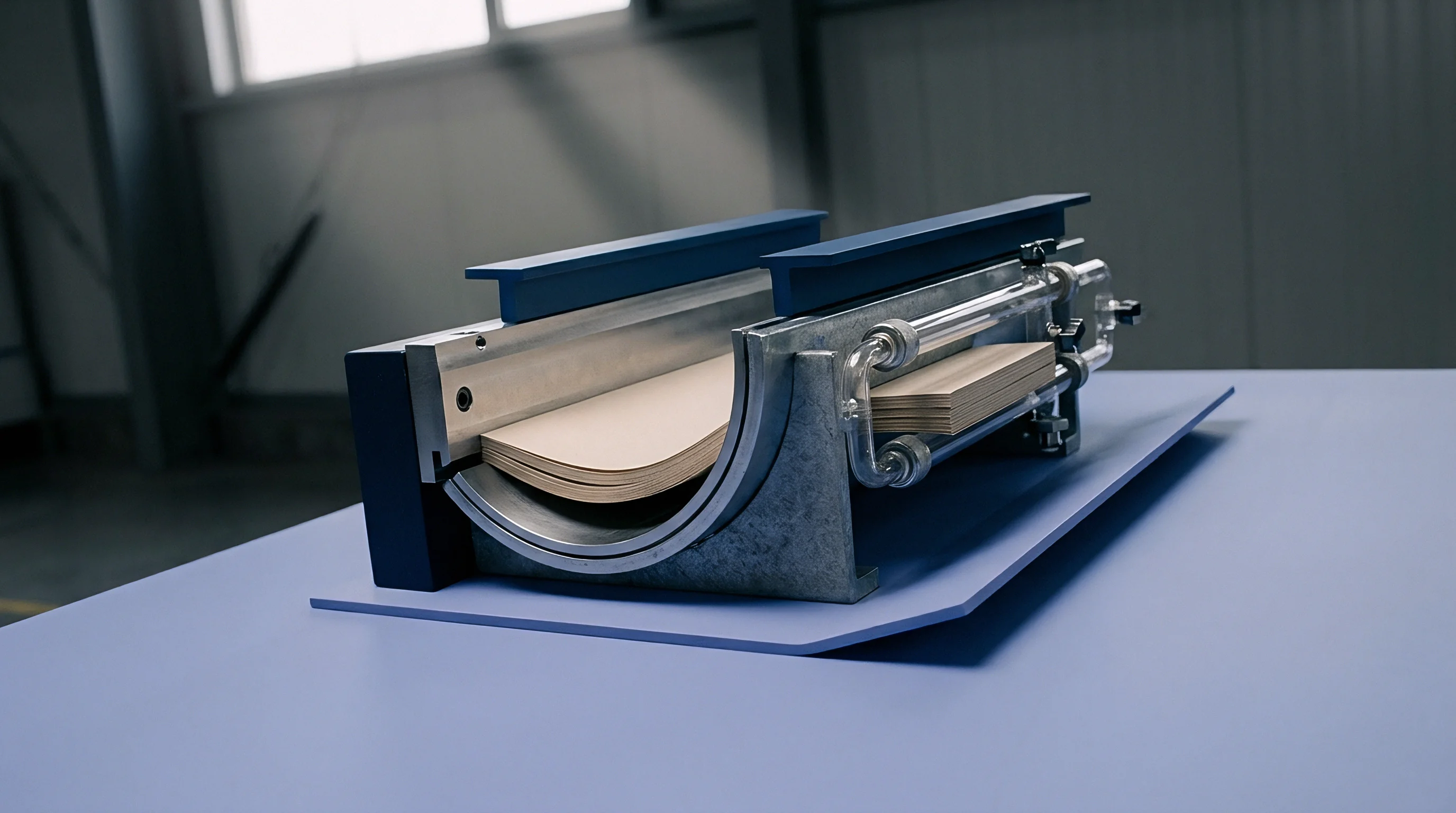
Multilayer paperboard achieves flexural stiffness through an engineered distribution of furnish density across its cross-section. High-density bleached or unbleached chemical pulp fibres form the outer plies, while middle layers integrate low-density mechanical pulps such as BCTMP or recycled fibres. Mechanically, this structure functions like an I-beam: high-modulus surface plies bear bending stresses, while the bulky core maintains distance between the tension and compression faces.
Out-of-plane material properties govern how paperboard behaves during sharp-radius bending. Whether a sheet folds cleanly or ruptures during converting depends on its Z-direction elastic modulus and in-plane shear moduli. Elastic modulus along the thickness axis typically runs two orders of magnitude lower than in-plane values: standard machine-direction modulus ranges from 4.0 GPa to 9.0 GPa, whereas Z-direction modulus sits between 0.01 GPa and 0.05 GPa.
This structural anisotropy dictates internal force distribution during high-speed scoring.
| Grade Architecture | Top Ply Density (g/cm3) | Center Ply Type | Center Density (g/cm3) | Out-of-Plane Shear Modulus Gxz (MPa) |
|---|---|---|---|---|
| Folding Boxboard (FBB) | 0.95 to 1.10 | Mechanical BCTMP | 0.35 to 0.45 | 12 to 22 |
| Solid Bleached Board (SBS) | 0.80 to 0.90 | Bleached Hardwood/Softwood Kraft | 0.75 to 0.85 | 35 to 55 |
| Coated Recycled Board (CRB) | 0.85 to 0.95 | Deinked mixed waste kraft/news | 0.65 to 0.75 | 18 to 28 |
| Coated Unbleached Kraft (CUK) | 0.90 to 1.05 | Unbleached Softwood Kraft | 0.70 to 0.80 | 30 to 45 |
Fibre alignment inside the core dictates directional yield behavior under stress. Dynamic orientation during wet-end formation aligns fibres predominantly in the machine direction, reducing cross-direction shear resistance because fewer inter-fibre bonds form perpendicular to the machine axis. In folding boxboard, mechanical pulp fibres create a porous matrix with high bulk; their short, stiff morphology offers fewer hydrogen bonding sites per unit volume than refined softwood kraft pulps.
Ply adhesion relies on inter-ply hydrogen bonding, starch spray applications, or wet-press consolidation. Starch applied between plies during multi-wire forming creates discrete bonding planes. Incomplete starch gelatinization or uneven moisture removal produces weak interfaces across the sheet profile, establishing where micro-delamination occurs under deformation forces.
A low density center layer maintains structural sheet thickness while reducing total fibre mass per unit area.
Moisture content controls viscoelastic behavior within each layer. Standard ambient conditioning at 50 percent relative humidity keeps water content between 6.0 and 7.5 percent by weight, acting as an internal plasticizer in the amorphous cellulose and hemicellulose matrices. Dropping moisture below 5.0 percent elevates the elastic modulus and reduces failure strain under out-of-plane shear loading.
Conversely, moisture above 8.5 percent softens inter-fibre bonds, lowering ultimate shear strength and causing compression collapse under creasing dies.
Manufacturing targets require tight control of ply basis weight ratios. Outer plies represent approximately 20 to 30 percent of total basis weight in classic folding boxboard, with middle layers accounting for the remaining 40 to 60 percent. Altering this balance shifts the neutral axis under flexural loading, changing how shear forces accumulate across the sheet thickness during high-speed scoring.
Cellulose plies respond differently depending on strain rate. High converting speeds generate shear strain rates exceeding 1000 per second, where internal polymer chains cannot relax through viscous dissipation. Peak stress levels rise as a result, so specifying multi-ply board without testing high-rate strain limits risks unexpected field performance failures.
Fibre stiffness dictates middle-layer deformation. Refining intensity in the kraft plies controls bonding surface area: over-refining increases density and ruins bulk efficiency, while under-refining leaves large voids that concentrate shear stress. Reaching an optimum stiffness-to-weight ratio requires precise refining targets at the pulp mill.
Delamination must remain internal to preserve structural integrity. The top coated surface must maintain a continuous film during folding, and the bottom liner must handle localized compression without tearing. Balancing outer-layer tensile capacity against core delamination thresholds forms the central challenge of paperboard design.
Mechanical pulps yield high bulk at the expense of inter-ply fracture energy, whereas softwood chemical pulps provide high tear resistance and absorb energy via plastic fibre pull-out. Blending these pulps across distinct plies optimizes total carton performance, provided structural equilibrium is maintained under die-cutting forces.
A thick board requires lower middle-layer shear resistance than a thin board to achieve identical folding moments without outer ply fracture.
Shear
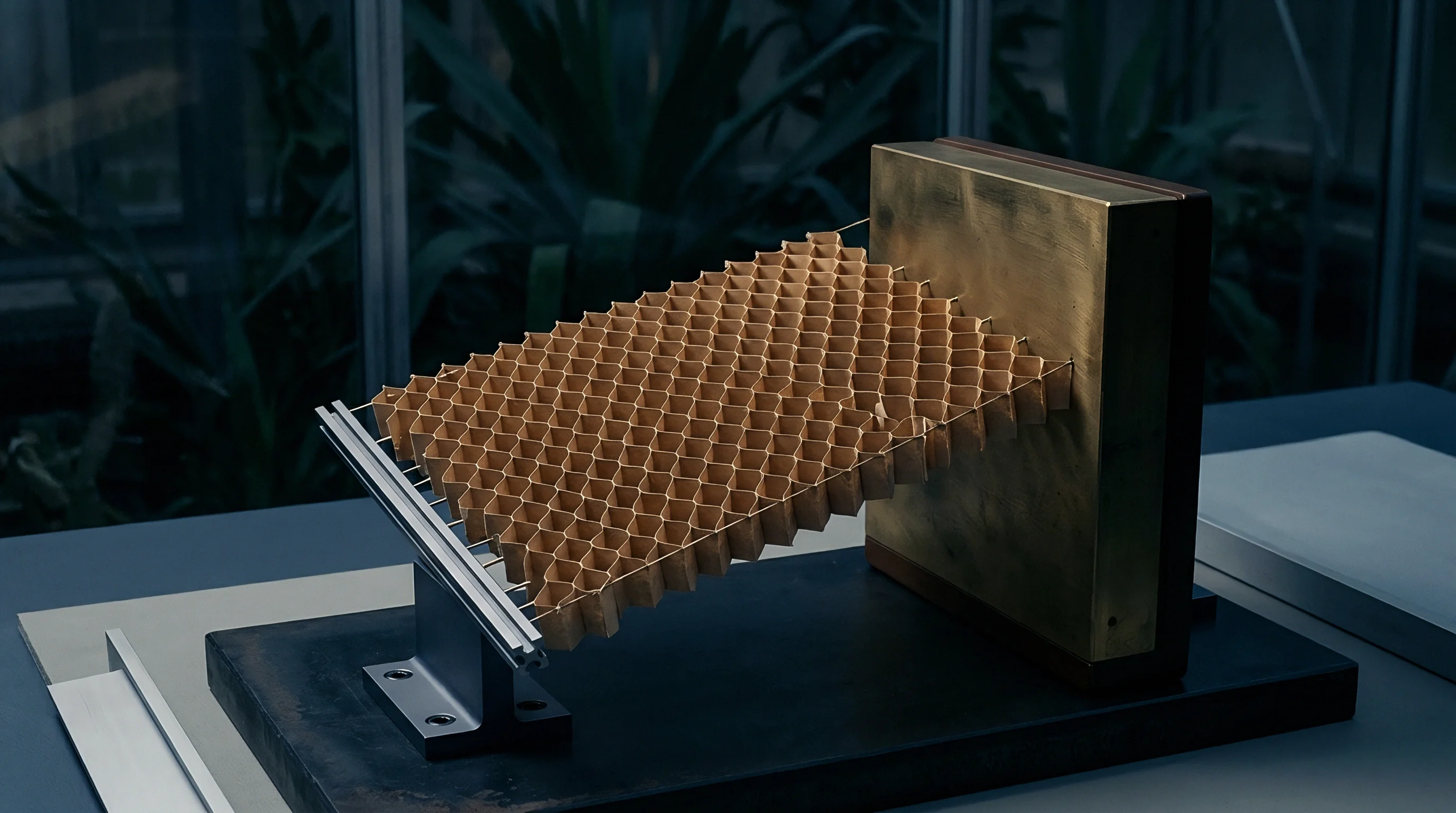
Scoring forces paperboard into an asymmetric three-point bending state over a female channel die. As the male creasing rule drives the sheet into the matrix opening, intense out-of-plane stresses develop through the board thickness: compression directly beneath the rule tip, tensile strain across the bottom liner spanning the channel shoulders, and transverse forces driving interlaminar displacement between adjacent plies.
Controlled internal cleavage is the primary objective of scoring. Heavy out-of-plane forces split weak middle plies into multiple thin, unbonded sub-layers, changing local sheet stiffness across the score line from a single thick board to a stack of independent laminates. Bending resistance at the score drops by 60 to 80 percent relative to uncreased board stiffness.
Internal delamination prevents high tensile stress from concentrating in outer printable coatings during 90-degree or 180-degree carton folding. When middle layers fail to split, the outer liner absorbs the full flexural strain; exceeding the 2.5 percent yield limit of coated mineral layers results in visible surface cracking. Controlled internal micro-buckling lets inner plies collapse inward into the carton interior without rupturing the exterior print face.
Failure Modes from Imbalanced Interlaminar Resistance
Substrate structural failures during folding trace back directly to out-of-plane mechanical properties:
- Surface Liner Rupture takes place when middle-layer internal bond strength exceeds the tensile failure limit of the top coated ply. The core fails to delaminate, forcing the outer ply to bear extreme tensile extension until the mineral coating fractures along the score line.
- Flange Roll-Up occurs when out-of-plane resistance drops below acceptable limits across broad zones. The board collapses laterally inside the channel, losing score definition and distorting panel geometry.
- Delamination Extension develops when shear fracture propagates sideways beyond the scoring channel width. The damaged zone spreads into the flat panel area, reducing column strength and causing panels to bulge under stack loads.
- Inner Liner Rupture results from severe compressive buckling concentration in high-density recycled furnish plies. The interior liner bursts inward, exposing raw fibre threads and degrading liquid barrier coatings.
Modeling transverse displacement across paperboard thickness relies on orthotropic elasticity models, as plane stress assumptions break down within the scoring zone due to localized force application. Shear stress reaches its maximum along the neutral axis of the sheet profile, governed by creasing force, local sheet caliper, and female die channel geometry.
Maximum out-of-plane shear stress can be calculated using the following continuous mechanical relation:
Tau_xz = (3 V_z) / (2 b_eff t)
Where V_z represents the vertical creasing force per unit score length, b_eff defines the effective width of the localized deformation zone, and t represents the total board thickness. Shear strain accumulates rapidly as the male rule penetrates past 30 percent of the original sheet caliper. Yielding initiates at inter-ply interfaces where local shear strength drops below the calculated stress value.
| Paperboard Grade | Caliper (mm) | Out-of-Plane Tensile Strength (kPa) | Internal Delamination Threshold Tau_xz (MPa) | Score Stiffness Ratio (S_crease / S_raw) |
|---|---|---|---|---|
| FBB 250 g/m2 | 0.38 to 0.42 | 220 to 310 | 1.8 to 2.4 | 0.18 to 0.25 |
| FBB 350 g/m2 | 0.56 to 0.62 | 190 to 260 | 1.4 to 2.0 | 0.15 to 0.22 |
| SBS 300 g/m2 | 0.36 to 0.40 | 450 to 650 | 3.5 to 5.0 | 0.30 to 0.40 |
| CRB 400 g/m2 | 0.50 to 0.55 | 250 to 380 | 2.1 to 3.0 | 0.25 to 0.35 |
The score stiffness ratio measures converting performance. Low values between 0.15 and 0.25 indicate effective internal delamination without surface damage. Ratios above 0.40 signify insufficient internal splitting, forcing packaging machinery to exert excessive force during carton erection and risking jams and downtime.
Cross-direction scoring demands higher penetration force than machine-direction scoring. Fibres aligned parallel to the crease line offer less mechanical resistance to out-of-plane displacement, whereas cross-direction creases force the tool to deform fibres along their transverse axis. This structural difference requires separate channel geometry selection based on web orientation.
Standard ISO 187 conditioning guarantees that board mechanical tests reflect performance at 23 degrees C and 50 percent relative humidity.
High-speed die-cutting introduces dynamic wave mechanics into the shear zone. Modern platen presses operating up to 9,000 sheets per hour produce impact times under 15 milliseconds. This high speed limits time for plastic deformation, increasing peak tensile stress by 20 to 35 percent relative to static bench measurements and requiring tooling setup that accounts for dynamic strain hardening.
Internal moisture levels significantly alter the delamination threshold. Dry stock generates abrupt fracture propagation across large areas, while moist stock exhibits broad plastic deformation zones with poor score definition. Maintaining warehouse humidity equilibrium prevents these runnability failures on converted stock.
Selecting incorrect channel widths forces paperboard into pure compression instead of controlled shear bending. A matrix channel that is too narrow prevents the sheet from entering the cavity, crushing the core without creating the multi-laminate split required for low bending moments. This leads directly to surface cracking, damaged print finishes, and high scrap rates on high-speed gluers.

Bench
Evaluating interlaminar strength requires specific laboratory equipment designed for out-of-plane testing, as in-plane tensile instruments cannot measure the Z-axis properties governing converting performance. Standard testing relies on two main methods: internal bond energy testing and Z-direction tensile strength evaluation, each capturing distinct aspects of multi-ply cohesion.
The Scott Bond test (TAPPI T 569) uses dynamic impact to measure the energy absorbed when a pendulum strikes a metal angle double-taped to the board surface. Results express energy absorption per unit area in Joules per square meter, ranging from 100 J/m2 for low-density FBB to 400 J/m2 for dense SBS grades. High energy values indicate strong ply adhesion but can signal resistance to necessary scoring delamination.
Z-direction tensile testing follows ISO 15754 and TAPPI T 541 protocols. Double-sided tape secures a square board specimen between two rigid metal platen blocks, which a testing machine pulls apart at 2.5 mm/min until failure. Recording peak tensile stress in kilopascals isolates true normal bond strength without the shear components inherent to pendulum tests.
Direct out-of-plane shear testing is complicated by edge effects and clamping difficulties. Specialized fixtures like the Minnesota out-of-plane shear apparatus apply pure shear stress parallel to the board plies to measure shear strength and shear modulus (Gxz). Obtaining accurate modulus data requires optical or laser extensometers, with standard test values showing shear moduli between 10 MPa and 60 MPa across commercial grades.
An internal bond rating above 350 J/m2 frequently requires widened matrix tooling to force internal ply failure during high-speed scoring.

Analytical Protocol for Board Qualification
Qualifying a new substrate before commercial press runs requires a systematic laboratory routine:
- Acquire representative sample sheets across the full web width to capture cross-machine density and moisture profiles.
- Equilibrate test specimens in a controlled atmosphere at 23 degrees C and 50 percent relative humidity for 24 hours per ISO 187.
- Measure sheet thickness using a dead-weight micrometer applying 100 kPa pressure over a 2.0 cm2 anvil area under ISO 534.
- Perform six replicate Scott Bond impacts per direction to establish mean internal bond energy and standard deviation.
- Conduct five Z-tensile pull tests under ISO 15754 to verify ultimate normal fracture limits across the consignment.
- Execute bench-scale scoring trials using controlled male rule penetration depths to generate crease stiffness curves.
Laboratory data often shows discrepancies between Scott Bond energy and Z-direction tensile strength. Scott Bond tests combine tensile displacement, shear deformation, and tape backing elasticity; consequently, stock showing a high Scott Bond rating of 300 J/m2 may still fail at a low Z-tensile value of 180 kPa if the middle layer contains unbonded voids. Relying on a single test method creates unnecessary risk during qualification.
Bench testing must account for adhesive tape compliance. Standard high-tack acrylic tapes deform under tension, inflating measured strain values. Laboratories must subtract tape displacement from total crosshead motion to calculate accurate Z-direction elastic moduli; uncorrected measurements yield moduli up to 40 percent lower than true material values.
| Test Protocol | Governing Standard | Measured Mechanical Parameter | Output Units | Sensitivity to Converting Behavior |
|---|---|---|---|---|
| Scott Internal Bond | TAPPI T 569 / ISO 16260 | Dynamic Fracture Energy Impact | J/m2 | Moderate; reflects overall internal toughness |
| Z-Direction Tensile | ISO 15754 / TAPPI T 541 | Static Out-of-Plane Normal Strength | kPa | High; predicts liner peel resistance |
| Crease Bending Test | ISO 2493-2 / TAPPI T 829 | Post-score Bending Moment | mN m | Direct; measures actual score line stiffness |
| Out-of-Plane Shear | ASTM D5379 (Modified) | Direct Interlaminar Shear Modulus | MPa | Critical; provides true engineering input data |
Ultrasonic pulse propagation provides a non-destructive method for evaluating out-of-plane elastic constants. High-frequency transducers pass sound waves through the sheet caliper, deriving the stiffness tensor C33 from acoustic velocity. Because sound speed correlates directly with internal bonding density, mills use online ultrasonic sensors to track web uniformity at full production speeds.
Bench evaluation of creased samples relies on automated bending testers. The instrument clamps the unscored board segment and folds the creased section through 90 degrees over 15 seconds. Peak bending moment recorded during folding defines crease resistance; comparing this to the uncreased sheet’s resistance yields the score stiffness ratio.
Target ratios for high-speed folding equipment remain below 0.25.
Cross-sectional micro-tomography tracks internal crack propagation during bench creasing trials, revealing the precise spatial location of delamination planes relative to the male rule. Images show whether the core split cleanly along a single middle ply interface or branched into outer liner structures, providing empirical validation for finite element carton design models.

Tooling
Converting machinery uses steel rule dies and female matrix channels to transform sheets into folded carton blanks. Die geometry must match substrate caliper and out-of-plane shear properties. Selecting proper matrix width, channel depth, and creasing rule thickness creates the precise stress state necessary to split internal plies while leaving outer liners intact.
Channel width selection follows standard geometrical calculations, where matrix channel width W is defined as:
W = 1.6 t + b
Where t represents total board thickness and b equals male rule width. For 0.45 mm FBB board scored with a 0.71 mm (2-Point) male rule, the calculated channel width equals 1.43 mm. Using a narrower 1.20 mm matrix increases vertical compression and risks surface cracking, while using a wider 1.80 mm matrix reduces localized shear stress, resulting in incomplete delamination and high bending resistance.
Channel depth selection relies on board thickness and compressed density limits. Matrix depth usually equals board thickness t or one standard gauge size smaller. Penetration of the male rule into the matrix must reach 50 to 70 percent of initial board thickness to drive maximum shear strain into the middle plies.
Insufficient penetration fails to exceed the interlaminar yield limit, leaving the middle matrix intact.
What Tooling Adjustments Prevent Flaking?
Flaking occurs when surface coatings detach along the crease line during high-speed folding. Resolving coating detachment requires systematic adjustments to die geometry and press setup:
- Increase Matrix Width to widen the shear deformation zone. A broader channel distributes bending strain across a larger area, lowering peak tensile forces on the top mineral coat.
- Reduce Rule Penetration Depth by shimming the male rule base. Decreasing rule penetration limits excessive vertical compression directly underneath the rule tip.
- Select Round-Profile Rules featuring a smooth crown radius rather than standard flat-faced profiles. Rounded tips eliminate sharp stress concentration points along the crease centerline.
- Adjust Counter-Matrix Material from standard phenolic resin to flexible creasing matrix channels. Polymeric channel walls yield slightly under load, softening impact forces on brittle surface coatings.
Male creasing rule selection uses standard point sizes: 2-Point rules measure 0.71 mm thick, and 3-Point rules measure 1.05 mm thick. Thin 1.5-Point rules (0.53 mm) apply concentrated line loads ideal for thin paperboard under 0.30 mm caliper, whereas heavy boards above 0.60 mm demand 3-Point or 4-Point rules to distribute displacement forces and prevent liner pinch fracture.
Counter-matrix materials range from creasing matrix strips to milled steel plates. Phenolic channels offer durability for production runs exceeding 500,000 impressions, while milled steel counters provide exact dimensional stability across high-volume runs. Preserving channel edge sharpness is essential: worn channel shoulders lose clear geometry, lowering effective shear force and producing ill-defined score lines.
| Board Caliper (mm) | Male Rule Width b (mm / pt) | Calculated Channel Width W (mm) | Matrix Channel Depth (mm) | Target Penetration Depth (mm) |
|---|---|---|---|---|
| 0.30 to 0.35 | 0.53 / 1.5 Pt | 1.00 to 1.10 | 0.35 | 0.18 to 0.22 |
| 0.40 to 0.45 | 0.71 / 2.0 Pt | 1.35 to 1.45 | 0.45 | 0.25 to 0.30 |
| 0.50 to 0.55 | 0.71 / 2.0 Pt | 1.55 to 1.65 | 0.55 | 0.32 to 0.38 |
| 0.60 to 0.70 | 1.05 / 3.0 Pt | 2.05 to 2.20 | 0.70 | 0.40 to 0.48 |
Platen press impression pressure requires precise setup. Excessive tonnage crushes flat panel areas, destroying caliper and flexural stiffness. Insufficient tonnage produces shallow score penetration and inconsistent folding angles.
Technicians set press tonnage to achieve clean matrix impression definition without burnishing the board.
Dynamic press speeds alter tooling interactions. Running at 8,500 sheets per hour reduces contact dwell time to under 10 milliseconds, limiting viscous flow within the sheet structure. The board behaves stiffer than static bench predictions suggest; operators often increase male rule height by 0.03 mm to 0.05 mm to compensate for speed-induced strain hardening.
Rubbering around creasing rules controls sheet ejection and holds the board flat against matrix channels during scoring. Hard elastomer rubbers (60 to 70 Shore A) placed close to creasing rules restrain lateral board movement, concentrating deformation within the channel for clean internal delamination. Soft rubbers permit sheet lift, inducing unwanted lateral tension and outer liner cracking.
Score line cracking often stems from board moisture dropping below specified contract limits or degraded mill pulp quality. Sourcing personnel verify environmental logs and conduct bench moisture tests before approving tooling modifications.
Outturn
Substrate selection balances unit material cost against converting line yield. Solid bleached sulphate boards deliver uniform out-of-plane strength and wide converting windows, but high raw material costs increase total packaging spend. Folding boxboard offers yield advantages by delivering high caliper at lower basis weight, where low core density reduces purchased weight while maintaining flexural stiffness.
Yield arithmetic highlights the economic advantage of bulky multilayer substrates. A 350 g/m2 FBB achieves a caliper of 0.58 mm, whereas SBS board requires a basis weight of 430 g/m2 to reach that same 0.58 mm caliper. Purchasing 100 metric tonnes of 350 g/m2 FBB yields 285,714 square meters of stock, compared to 232,558 square meters for 100 metric tonnes of 430 g/m2 SBS ~ a 22.8 percent gain in usable surface area per metric tonne.
Capturing this yield efficiency requires tight management of converting tolerances. Because FBB middle plies contain mechanical pulp with lower shear strength than refined chemical pulp, the allowable tooling window narrows. Channel width tolerances must stay within plus or minus 0.05 mm of optimal calculations; running FBB on uncalibrated tooling increases score-cracking scrap and quickly erodes material savings.
High-speed folder-gluers amplify these material differences. Operating at speeds up to 100,000 cartons per hour (500 meters per minute), high score bending resistance causes blanks to fold out of square. Misaligned folds lead to packing line jams and downtime that can cost upwards of 2,500 USD per hour in lost output.
| Substrate Grade | Landed Cost per Tonne (USD) | Yield per Tonne at 0.50 mm Caliper (m2) | Tooling Window Tolerance (mm) | Waste Rate on High-Speed Lines (%) | Landed Net Cost per 1,000 Cartons (USD) |
|---|---|---|---|---|---|
| Folding Boxboard (FBB) | 1,250 | 3,225 | +/- 0.05 | 1.5 to 2.5 | 42.50 |
| Solid Bleached Board (SBS) | 1,550 | 2,500 | +/- 0.12 | 0.3 to 0.8 | 62.80 |
| Coated Recycled Board (CRB) | 980 | 2,700 | +/- 0.04 | 3.0 to 5.0 | 38.90 |
| Coated Unbleached Kraft (CUK) | 1,400 | 2,850 | +/- 0.08 | 0.8 to 1.2 | 50.10 |
Downgauging programs must evaluate out-of-plane failure limits alongside weight reduction. Dropping board basis weight by 10 percent cuts raw material spend but lowers caliper, shifting the neutral axis and requiring narrower scoring matrices. Without tooling adjustments, downgauged stock exhibits incomplete delamination and elevated score stiffness, causing carton failure on automated lines.
Scrap calculations govern job profitability. On a 500,000-carton run using 0.45 mm FBB (baseline material cost of 20,000 USD), unoptimized matrix tooling generating a 3.5 percent reject rate adds 700 USD in direct material loss and 1,200 USD in downtime penalties. Re-tooling with custom counter-matrices reduces the waste rate to 0.5 percent, saving 1,620 USD on the run.
Recycled fiber content alters long-term cost tradeoffs. While coated recycled board offers low landed material costs, repeated recycling shortens cellulose fibers and reduces inter-fiber hydrogen bonding capacity. Out-of-plane shear strength varies considerably between mill batches, forcing converters to run presses at lower speeds to prevent score rupture and increasing processing costs per thousand sheets.
Verification clauses in procurement contracts protect buyers against substandard interlaminar performance. Technical specifications should set explicit boundaries for out-of-plane bond strength, Z-direction tensile capacity, and moisture content upon initial delivery unwrap.
Commercial Specification Clauses for Board Procurement
Buyers embed explicit mechanical guarantees into formal substrate supply agreements:
- Z-Direction Tensile Guarantee binds the mill to supply stock maintaining out-of-plane strength within specified ranges (e.g. 200 to 320 kPa per ISO 15754) across every delivered reel batch.
- Moisture Tolerance Limits establish that delivered board reels must maintain 6.5 percent +/- 0.8 percent water weight under ISO 187 sampling, preventing dry-stock cracking liability.
- Crease Stiffness Ratio Target mandates that converted sample blanks must achieve score stiffness ratios below 0.25 when creased using standard ISO tooling guidelines.
- Batch Traceability Mandate requires mills to provide certified MTR documentation linking individual roll numbers to bench test records for Scott Bond energy and caliper uniformity.
Standard supply agreements specify that delivered stock exhibiting Z-direction tensile values below 180 kPa or Scott Bond ratings outside agreed tolerance bands triggers lot rejection at the converter’s dock, assigning freight, re-stocking, and downtime costs back to the mill.