Dynamic Mechanical Core Shear Delamination in High-Speed Board Converting
Dynamic core shear delamination occurs when converting nip acceleration outpaces the viscoelastic relaxation rate and internal bond strength of multi-ply paperboard.


Velocity
Modern rotary converting presses run folding boxboard at web speeds exceeding 350 meters per minute. Operating at these speeds subjects multi-ply board structures to severe transverse kinetic impulses during rotary die cutting and creasing. Peak compressive forces occur within four to eight milliseconds of the board entering the tooling nip.
This rapid displacement drives mechanical stress through the central interfaces of the sheet, causing interlayer shear delamination whenever kinetic stresses exceed the internal cohesion of the multi-ply fibrous structure.
Line speed amplifies mechanical nip shear, driving the strain rate applied to the substrate up by orders of magnitude as converting speeds rise. Because paperboard is viscoelastic, its mechanical response depends directly on deformation rate. In slow laboratory tests, internal polymer chains and cellulose microfibrils have time to flex and redistribute stress across neighboring fiber networks.
At industrial converting speeds, tool impact is too brief to allow structural relaxation. Kinetic energy concentrates along the plane of minimum shear resistance instead, triggering immediate bond separation.
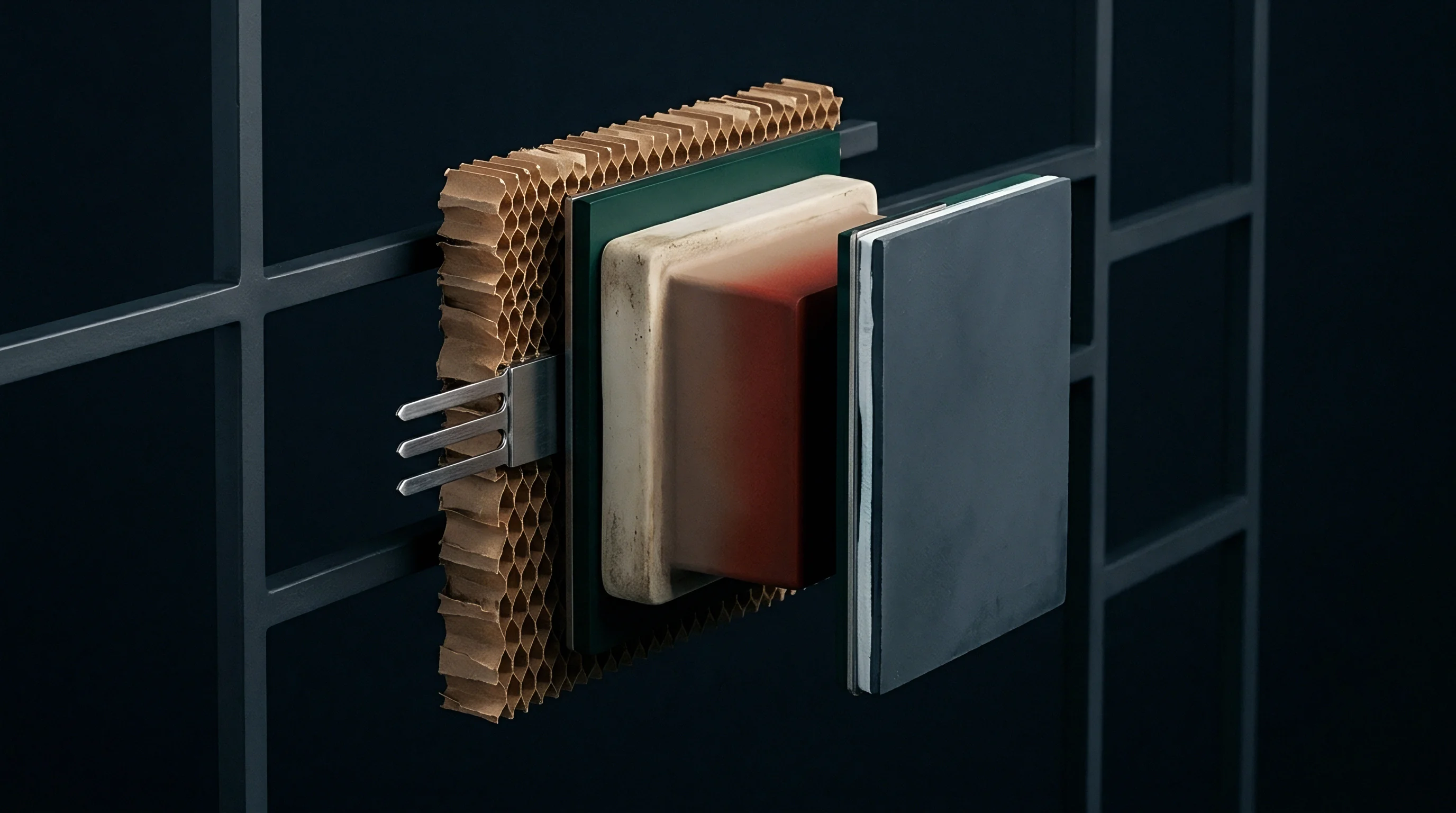
Transient Kinetic Shear across Converting Nips
Entering the nip generates an asymmetric stress field through the sheet thickness. The top liner hits the male creasing rule as the bottom liner presses into the counter-matrix groove, subjecting outer plies to localized bending and compressive strain. Central plies absorb the resulting differential displacement through in-plane shear deformation; high-speed video analysis confirms that they undergo severe angular distortion before the crease groove fully forms.
High converting speeds quickly expose internal furnish voids. Mills build the middle plies of multi-ply folding boxboard (FBB) and coated recycled board (CRB) with high-bulk mechanical pulps, such as chemithermomechanical pulp (CTMP) or recycled mixed paper fibers, to secure high flexural rigidity at lower basis weights. But mechanical pulps offer far less fiber-to-fiber bonding area than chemical kraft liners.
When the converting nip strikes, this low-density central network yields to shear displacement long before the outer liners reach their tensile yield points.
Pulp fibers aligned in the machine direction slip past cross-linked starch networks whenever converting line acceleration outpaces polymer relaxation.
Rotational Acceleration and Web Separation Forces
Cylinder diameter determines the angular acceleration imparted to paperboard traversing rotary scoring and cutting units. Smaller cylinders create steeper nip entry angles and tighter deformation radii ~ a 250-millimeter rotary cylinder exerts higher peak shear force than an 800-millimeter flatbed platen die running at the same linear throughput. This geometric difference is why substrates that behave acceptably on flatbed presses can fail rapidly on high-speed rotary lines.
Web tension determines how stably paperboard enters the cutting tools. Fluctuations in unwind brake torque cause transient tension spikes across the web, while high baseline tension pre-stresses the sheet along the machine direction. When a transverse creasing rule strikes paperboard already under pre-stress, combined multiaxial stress vectors lower the critical shear threshold at internal fiber interfaces.
- Crease matrix misalignment shifts transverse loads onto unsupported liner sections, creating asymmetric internal cleavage planes.
- Excessive web tension pre-strains outer plies, driving instantaneous shear failure into the unreinforced center layers during die contact.
- Tooling radius degradation rounds sharp rule edges, broadening the compression contact zone and elevating total displacement energy.
- Moisture profile variance destabilizes hemicellulose hydrogen bonds, cutting the shear resistance of middle plies during rapid converting strikes.
Failing to match machine velocity to substrate shear capacity leads to extensive delamination blistering along blank scores. The resulting cartons collapse under the pressure of automated side-seam gluers, triggering full pallet rejections at downstream filling plants.
Anvil
Tooling geometry dictates how shear stresses distribute across the paperboard cross section. In high-speed flatbed and rotary converting, the creasing rule descends into a calibrated counter-channel mounted on the anvil plate. The interaction between steel rule tip and matrix shoulder creates the primary shear zone, where penetration depth, rule thickness, and channel width determine whether internal plies experience controlled delamination or catastrophic planar rupture.
Controlled delamination is the intended mechanical outcome of creasing. A proper crease introduces internal shear separation within the center ply to form a hinge, allowing the board to fold without cracking its outer liner. Uncontrolled dynamic shear delamination happens when fractures spread laterally past the score shoulders into the flat carton panels, destroying structural panel stiffness.
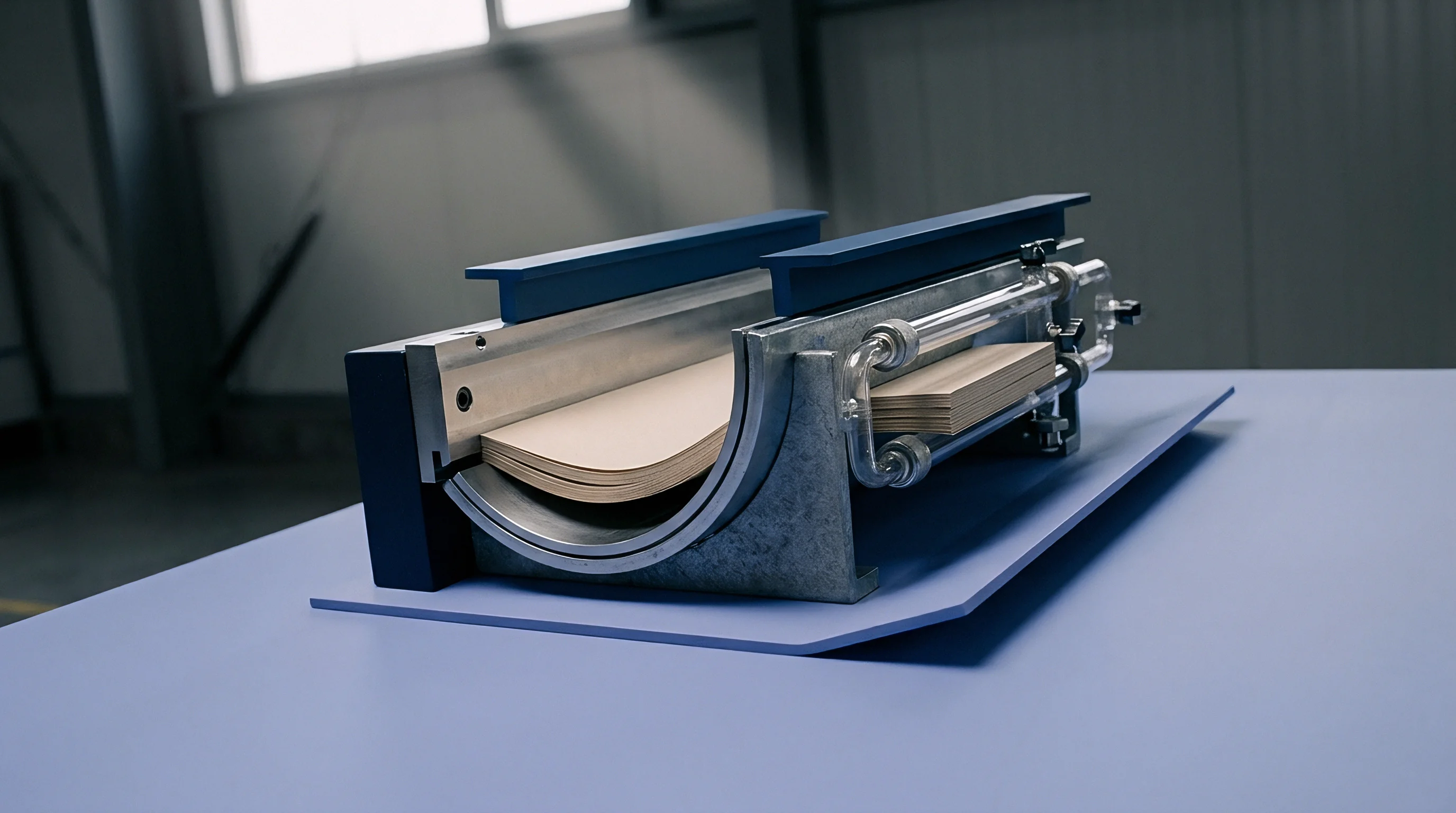
Counter Channel Geometry and Crease Penetration Depth
Sizing a counter-channel requires empirical formulas that match board caliper to rule thickness. Typically, channel width equals rule thickness plus 1.5 to 1.7 times board caliper. If the channel is cut too narrow, the anvil shoulders pinch the sheet as the tool penetrates; this pinching multiplies localized transverse shear forces and shears the middle plies immediately.
Matrix clearance directly governs shear stress distribution. Widening the channel past optimal dimensions weakens clamping force at the crease shoulders, so the board pulls into the groove without sufficient internal shear deformation. Instead of forming an internal hinge, the sheet bends like an intact solid beam, creating excessive outer liner strain that cracks the surface during folding.
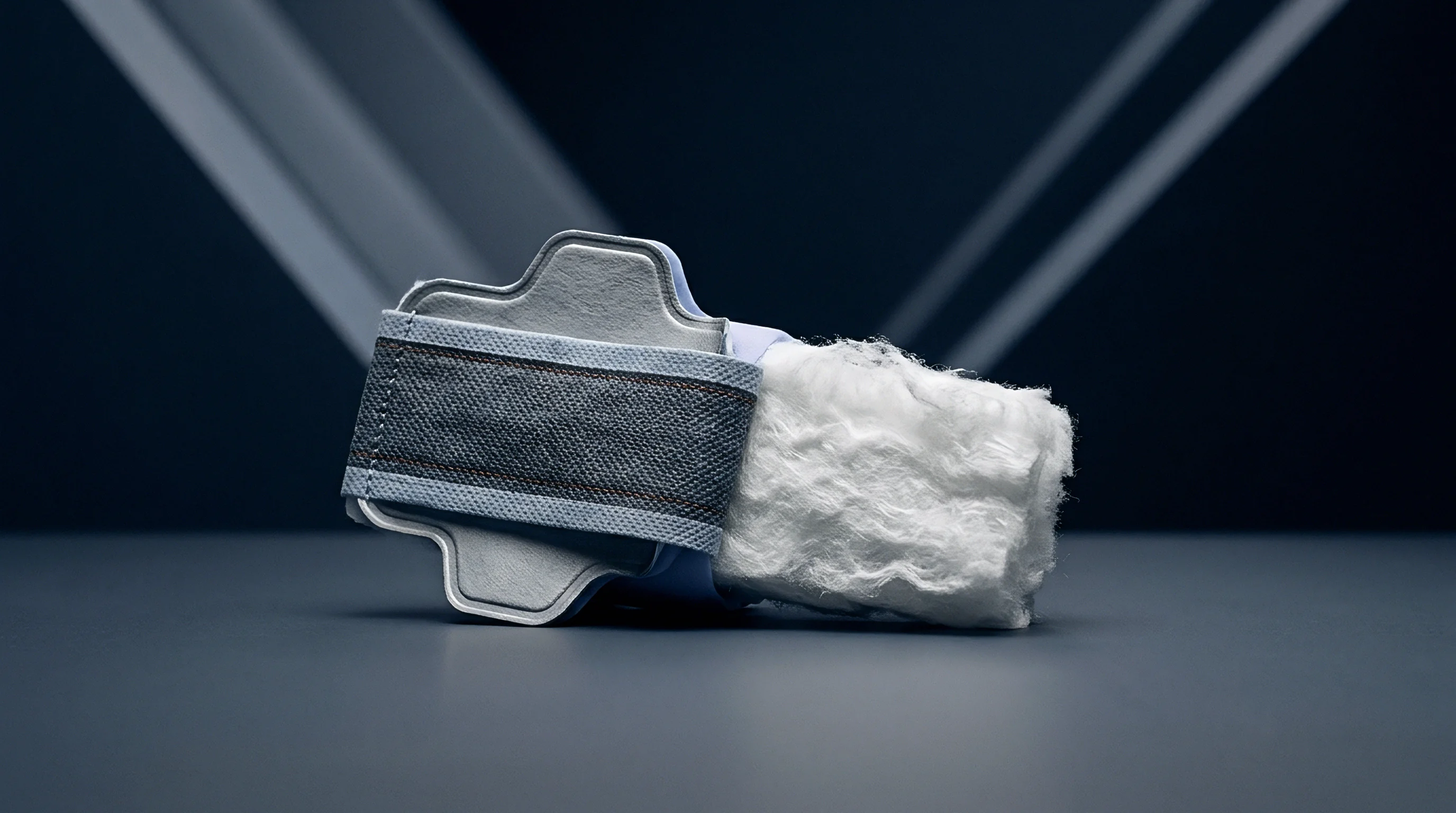
Will Dynamic Shear Overwhelm Ply Bond Strengths?
The rate of rule penetration changes how fiber networks inside the groove respond mechanically. At high press speeds, the rule edge strikes the board at over two meters per second. This impulse delivers heavy kinetic energy to the top liner, driving the load straight through the thickness toward the anvil plate.
Tool wear accelerates this shear damage. As steel rules wear, their tip profile shifts from a clean radius to a flattened, burred shape that concentrates force along outer edges instead of across the crown. The resulting stress spikes start internal tears that propagate through the middle plies under minimal folding force.
| Board Grade | Caliper (µm) | Rule Thickness (pt) | Channel Width (mm) | Penetration Depth (mm) | Internal Shear Risk |
|---|---|---|---|---|---|
| Solid Bleached Sulfate (SBS) | 350 | 2.0 (0.71 mm) | 1.25 | 0.28 | Low |
| Folding Boxboard (FBB) | 350 | 2.0 (0.71 mm) | 1.30 | 0.26 | Moderate |
| Coated Recycled Board (CRB) | 350 | 2.0 (0.71 mm) | 1.35 | 0.24 | High |
| Folding Boxboard (FBB) | 500 | 3.0 (1.05 mm) | 1.85 | 0.38 | Moderate |
| Coated Recycled Board (CRB) | 500 | 3.0 (1.05 mm) | 1.95 | 0.35 | Severe |
Mid-plane rupture stems from worn counter-matrices and excessive press penetration rather than inconsistent furnish sizing.

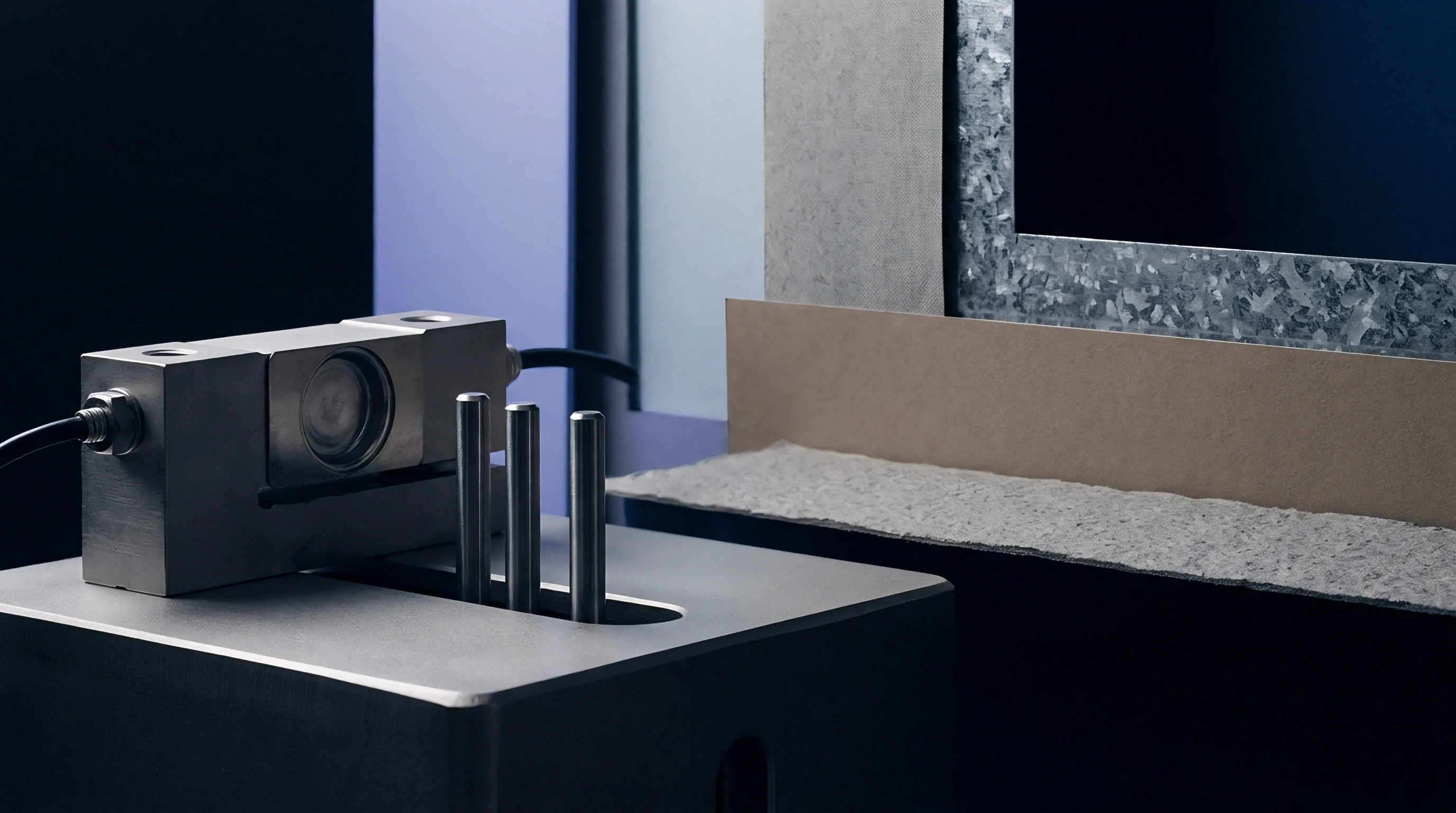
Cleavage
Interlaminar separation follows the path of least resistance through the fibrous sandwich. In multi-layer board, this plane sits either at the interface between different pulp furnishes or within the center of the mechanical pulp core. Chemical kraft liners provide high tensile strength and burst resistance, while center layers composed of groundwood, thermo-mechanical pulp, or recycled fibers possess lower internal cohesion.
Cleavage cracks start at micro-defects and propagate through shear-induced fiber pullout.
When tensile forces exceed fiber network cohesion, the sheet separates into decoupled laminates. During rotary converting, the rapid withdrawal of the male rule and immediate web redirection produce localized out-of-plane peel stresses. Combined with residual in-plane shear, these peeling forces tear the weakened middle plies apart.

Fiber Network Cohesion across Multi-Ply Boundaries
Starch applied at the wet end bridges individual fiber layers on the board machine. Spray starch gelatinizes during drying to form physical and chemical anchor points across wet-laid plies. If starch distribution is uneven or cooking is incomplete, weak zones form where interlaminar bonding drops below critical thresholds; mechanical shear then fractures these unbonded interfaces during high-speed converting with minimal energy expenditure.
Mechanical pulps lack long fibrillar bonds. Groundwood and CTMP fibers are rigid, short, and heavily lignified compared to flexible chemical pulp fibers, with lignin blocking close molecular contact between cellulose microfibrils and reducing hydrogen bonding density. Although mechanical fibers add bulk and bending stiffness, their resistance to dynamic shear cleavage remains low under rapid loading.
Solid bleached sulfate conditioned under ISO 187 retains an internal bond strength of 210 Joules per square meter when measured according to TAPPI T 569.
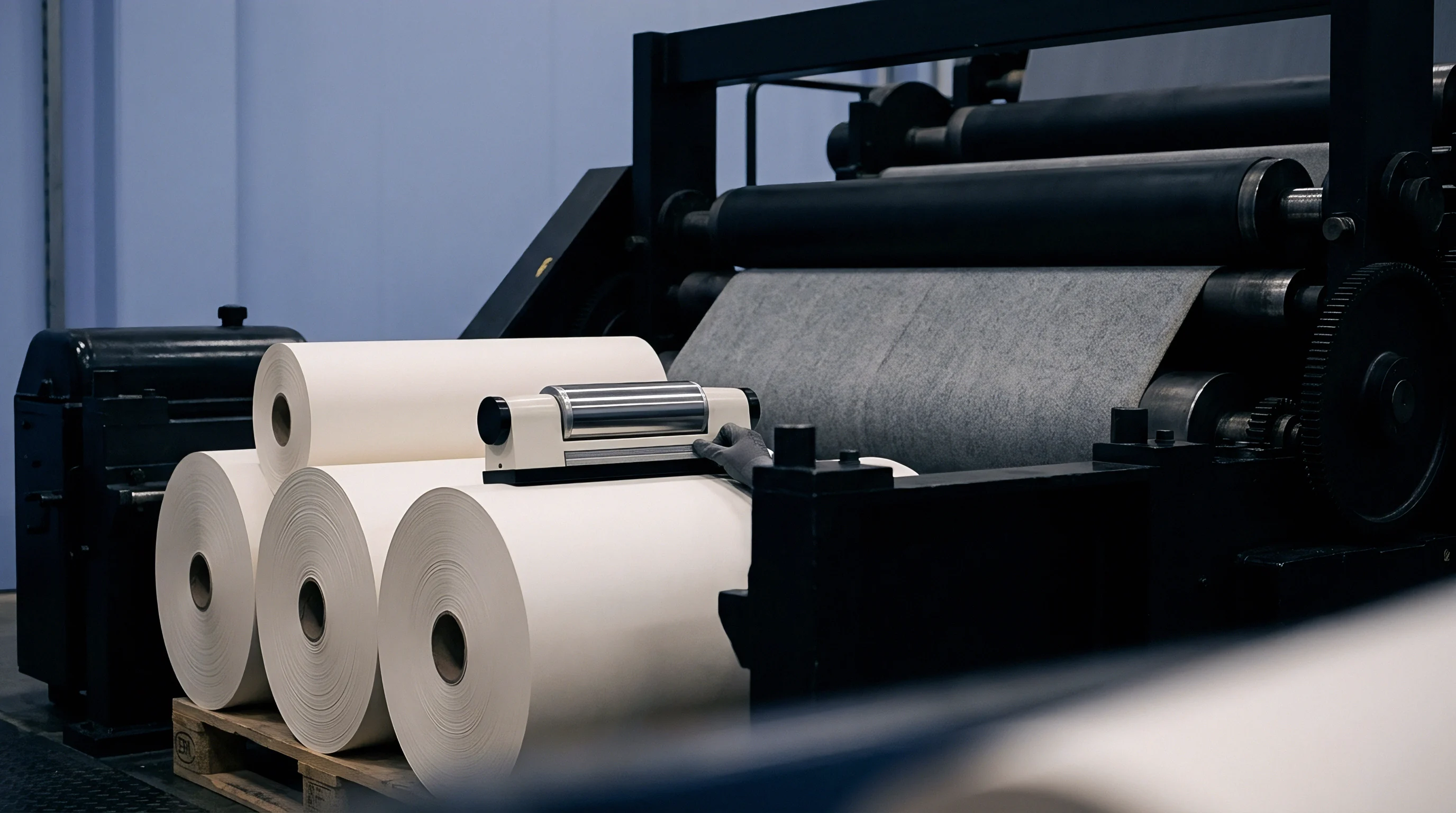
Are Z Direction Tensile Tests Truly Predictive?
Converting operations require testing protocols that reliably predict line performance. Standard z-direction tensile (ZDT) testing measures static tensile strength normal to the sheet surface under slow crosshead displacement, missing shear stress components and rate-dependent viscoelastic behavior. Substrates with acceptable static ZDT values frequently suffer massive internal delamination on high-speed rotary presses because the static test ignores kinetic shear loading.
Ultrasonic stiffness testing offers clearer insight into internal board cohesion by measuring out-of-plane velocity to reveal three-dimensional elastic stiffness constants. The out-of-plane shear modulus reflects how well the internal fiber network resists rapid displacement. Boards with low shear moduli exhibit extensive cleavage during converting, regardless of static tensile ratings.
- Impact from the upper creasing rule drives compressive deformation through the top chemical liner.
- Localized shear displacement develops along the boundary between the top liner and mechanical middle plies.
- Hydrogen bonds fracture within the middle ply matrix as shear strain exceeds fiber network elastic elongation limits.
- Micro-voids coalesce into continuous planar cleavage cracks running parallel to the converting web direction.
- Subsequent folding sequences force detached layers to buckle independently, causing structural wall collapse.
| Substrate Classification | Basis Weight (g/m²) | Caliper (µm) | Internal Bond (J/m²) | ZD Tensile (kPa) | Max Converting Velocity (m/min) |
|---|---|---|---|---|---|
| Solid Bleached Sulfate (SBS) | 280 | 370 | 225 | 440 | 450 |
| Folding Boxboard (FBB) – Pure Virgin | 250 | 400 | 170 | 310 | 380 |
| Folding Boxboard (FBB) – Blended Core | 270 | 430 | 140 | 260 | 310 |
| Coated Recycled Board (CRB) | 320 | 450 | 110 | 210 | 240 |
| White Lined Chipboard (WLC) | 350 | 480 | 95 | 180 | 200 |
| Data measured according to TAPPI T 569 for internal bond strength and ISO 15754 for z-direction tensile strength under standard atmospheric conditions. | |||||
The exact correlation between starch penetration depth across the CTMP interface and dynamic crack propagation velocity under millisecond nip contact remains an open operational question across modern boxboard plants.
Appraisal
Evaluating multi-ply board stock requires test methods that isolate dynamic mechanical properties from static structural strength. Standard mill certificates specify caliper, basis weight, bending stiffness, and Scott Bond values. Scott Bond testing, standardized under TAPPI T 569, uses a swinging pendulum to delaminate a paperboard specimen clamped between metal plates with double-sided adhesive tape.
Though widely adopted, this method shows substantial variance when applied to high-bulk, multi-ply structures.
Pendulum velocity during Scott Bond testing reaches about two meters per second at impact. That impulse speed approaches actual converting velocities, making Scott Bond far more indicative than static tensile tests. However, double-sided adhesive tape penetration can distort the measured strength of thin specimens: if low-viscosity acrylic adhesive migrates into porous outer liners, it artificially reinforces internal fiber networks and yields inflated bond values that fail to reflect press performance.

Laboratory Scott Bond against High Speed Strain Rates
High-speed converting presses subject board to complex stress states combining compression, shear, and tension. Because Scott Bond measures cleavage rupture energy under pure peel and shear impact, it misses the compressive confinement present inside a creasing nip. Under compressive confinement, friction between fiber surfaces temporarily impedes sliding, altering the apparent shear resistance of the substrate.
Moisture loss reduces fiber wall flexibility. When paperboard dries below six percent moisture content, individual cellulose fibers turn brittle and stiff, fracturing under shear instead of slipping and lowering the dynamic energy absorption of the central plies. Maintaining plant humidity between 45 and 55 percent relative humidity prevents premature embrittlement of the internal network.
DIN 53121 establishes the three-point bending stiffness parameters that dictate whether a scoring matrix causes outer liner stretching or uncontained internal ply rupture.
Worked Calculation for Converting Nip Shear Work
Consider a standard 350-micrometer folding boxboard running through a rotary die at 300 meters per minute, or five meters per second linear web speed. Assuming a rotary creasing nip with an effective contact width of two millimeters, tool contact duration equals 0.002 meters divided by 5.0 meters per second, yielding an interaction time of 0.0004 seconds, or 400 microseconds.
During this 400-microsecond contact window, the male creasing rule penetrates 0.25 millimeters into the board thickness at an average vertical displacement rate of 0.625 meters per second. With a nominal creasing force of 600 Newtons per linear meter of rule, mechanical work applied per meter equals 600 Newtons multiplied by 0.00025 meters, or 0.15 Joules per meter of rule. For a carton blank carrying 1.8 meters of creasing rule, total instantaneous mechanical energy input equals 0.27 Joules.
If the internal fiber bond energy measured via TAPPI T 569 is 130 Joules per square meter, delaminating a 1.5-millimeter wide shear band along 1.8 meters of crease requires 130 Joules multiplied by 0.0027 square meters, totaling 0.351 Joules. Increasing tool penetration by just 0.05 millimeters pushes applied work up to 0.324 Joules, dangerously close to the critical cohesion threshold of the substrate. At that point, any localized deficit in starch content drops the material threshold below applied mechanical energy, initiating uncontained core shear delamination.
- Scott Bond energy threshold must equal or exceed 150 Joules per square meter under TAPPI T 569 to survive 300 meter per minute rotary converting speeds.
- Equilibrium moisture content must register between 6.5 and 7.5 percent under ISO 287 to prevent dry fiber embrittlement during die strike.
- Out of plane tensile strength must exceed 280 kilopascals under ISO 15754 to ensure resistance against web pullout stresses.
- Caliper consistency must hold within plus or minus three percent of nominal mill specification across the entire parent reel width.
Thicker calipers demand wider counter-matrix channels regardless of high laboratory bond test ratings.
Settlement
Procurement agreements for multi-ply folding boxboard need strict mechanical performance tolerances alongside basic basis weight and thickness criteria. When dynamic delamination occurs, converters face immediate press shutdowns, elevated tooling replacement costs, and lost production capacity. Mills frequently contest delamination claims, attributing failures to improper press setup, incorrect counter-matrix selection, or dull cutting rules.
Establishing objective technical baselines within supply contracts protects buyers from absorbing these operational losses.
Incoming inspection protocols must include routine internal bond testing. Relying entirely on mill-issued quality certificates exposes converters to off-spec material, as mills test composite laboratory samples taken from reel ends that rarely capture cross-web variation or transient moisture loss during unconditioned warehouse transit. Verifying internal bond values on pallet samples before releasing board to the press floor prevents processing defective stock.
Commercial Tolerance Specifications in Supply Contracts
Purchase contracts should tie pricing and acceptance criteria directly to standardized mechanical properties. Specifying minimum Scott Bond thresholds alongside maximum allowable caliper drift prevents mills from delivering excessively bulky, under-refined board. While high bulk saves raw material costs for the papermaker, it strips the substrate of the internal shear strength required by high-speed automated packaging lines.
Downtime costs quickly outpace raw material savings. Running lower-grade coated recycled board saves twenty percent on initial substrate costs relative to virgin folding boxboard, but a five percent delamination defect rate on a high-speed gluer erases that margin entirely through machine downtime, carton sorting labor, and discarded blanks.
Converted blanks displaying delaminated creases foul automated cartoning lines long before optical inspection cameras flag visual surface blisters.
Downtime Yield Losses and Material Rejection Thresholds
High-speed gluing and erecting machinery demands cartons with predictable crease resistance. When delaminated blanks enter the folding section, damaged scores bow unpredictably and trigger feed jams. A modern packing line running at 600 cartons per minute halts within seconds of encountering an improperly creased blank, losing valuable operational time while operators clear jams and reset feeder sensors.
Technical supply agreements must define the specific test conditions under which rejection thresholds apply. If moisture content drops during transit because of non-compliant packaging barriers, the contract must establish whether liability falls on the freight carrier or the substrate manufacturer. Detailed logging of warehouse environmental conditions provides the evidence needed to settle quality disputes without litigation.
Section 8.4 of the standard European Carton Makers Association technical specification binds mills to replace uncreaseable tonnage whenever internal shear values deviate by ten percent from agreed baseline parameters.