Multi Tier Corrugated Substrate Verification under High Humidity Export Conditions
Multi-tier corrugated export survival demands virgin kraftliners, ketone-crosslinked wet starch, and safety factors adjusted for twenty-percent moisture uptake.

Vapour
At ninety percent relative humidity and thirty-eight degrees Celsius, unbleached kraftliner absorbs water until its equilibrium content reaches twenty-two percent by weight. The intake of moisture plasticizes the amorphous regions of cellulose, forcing apart the hemicellulose matrix that binds adjacent microfibrils. Hydrogen bonding between adjacent cellulose chains releases to accommodate free water molecules.
Water breaks internal hydrogen links. When these bonds dissociate, the cross-directional compressive stiffness of the linerboard drops precipitously, eroding the structural column strength that keeps stacked corrugated shipping containers upright in ocean transit.
Export packaging engineered for temperate climates relies on five to eight percent sheet moisture content measured under standard testing conditions of twenty-three degrees Celsius and fifty percent relative humidity. Shipping lanes traversing the Malacca Strait or docking in Santos subject cargo holds to extended periods of thirty to forty degrees Celsius with relative humidity exceeding eighty-five percent. As relative humidity increases from fifty percent to ninety percent, the compressive strength of standard corrugated board drops by roughly fifty to sixty percent, regardless of initial dry burst metrics.
Packaging engineers tracking container desiccant failures routinely discover saturated linerboards exhibiting severe loss of vertical load capacity.
Unbleached virgin kraftliner surrenders forty-eight percent of its dry cross-direction ring crush resistance when conditioned from fifty percent up to ninety percent relative humidity under ISO 187 parameters.
Testing protocols established under laboratory equilibrium often fail to account for the rate of vapour penetration through outer carton plies. Porosity, surface sizing, and resin chemistry dictate whether a board reaches moisture saturation in forty-eight hours or twelve days. Virgin softwood fibers hold longer.
A dense, highly refined northern bleached softwood kraft sheet retards vapour transmission through mechanical tortuosity, whereas an open, recycled testliner allows ambient water vapour to reach interior fluting within hours of container door closure.
Sorption Mechanics and Fibre Swelling
Cellulose fibres expand diametrically by up to twenty percent as they absorb moisture, while their longitudinal elongation remains below two percent. This anisotropic swelling distorts the planar geometry of the corrugated board, generating shear stresses across the adhesive interface connecting the linerboard to the fluted medium. Recycled furnish swells unevenly.
Shorter, heavily hornified secondary fibres possess disrupted cell walls that take up moisture erratically compared to intact virgin pine tracheids.
The Cobb test, executed according to ISO 535, measures liquid water absorption over a specified interval, typically sixty or eighteen hundred seconds. Liquid absorption rates do not correlate directly with water vapour sorption isotherms. A fluorochemical or surface wax treatment can yield an exceptional thirty-minute liquid Cobb value below twenty grams per square metre, yet permit gaseous water molecules to migrate into the sheet matrix unimpeded under steady vapor pressure gradients.
Sizing treatments that repel droplets do nothing to prevent vapour phase sorption during four-week marine voyages.
Equilibrium Isotherms across Recycled Fractions
Hysteresis curves govern the absorption and desorption of water in lignocellulosic materials. A substrate adsorbing moisture from a dry state reaches a lower equilibrium moisture content than a substrate desorbing from a saturated state at the identical relative humidity. In export corridors, shipping containers undergo diurnal temperature cycling.
Sunlight warms container roofs to fifty-five degrees Celsius during daylight, driving water out of upper carton tiers, which then condenses into hanging droplets that rain onto lower tiers when night brings rapid cooling to twenty-four degrees Celsius.
Recycled testliner grades demonstrate higher moisture uptake at elevated humidity levels than virgin kraft papers because residual fines, starches, and inorganic fillers attract moisture. Calcium carbonate fillers in recycled furnish absorb water, accelerating the softening of the fibre network. The ring crush test, conducted per ISO 12192, registers steep performance losses in high-recycled-content linerboards exposed to tropical moisture chambers, showing yield collapses that make baseline room-temperature test certificates meaningless for maritime route design.
| Substrate Grade | Grammage (g/m²) | Furnish Type | Moisture Content at 50% RH (%) | Moisture Content at 90% RH (%) | Cross-Direction Ring Crush Loss (%) |
|---|---|---|---|---|---|
| Virgin Kraftliner | 175 | Unbleached Softwood Kraft | 7.2 | 18.4 | 46.5 |
| Semi-Chemical Fluting | 140 | Virgin Hardwood NSSC | 6.8 | 17.1 | 41.2 |
| Testliner 2 | 170 | 100% Recycled OCC Fines | 8.1 | 22.8 | 61.4 |
| Recycled Fluting (Wellstoff) | 135 | 100% Mixed Waste Paper | 8.5 | 24.3 | 68.9 |
| High-Performance Kraftliner | 200 | Wet-Strength Virgin Pine | 7.0 | 16.5 | 38.0 |
| Data measured following 72-hour pre-conditioning at 23°C/50% RH followed by 96-hour chamber exposure at 38°C/90% RH in accordance with ISO 187 conditioning guidelines. | |||||
Mills frequently claim that internal sizing agents provide adequate moisture defense for transoceanic voyages, insisting that liquid water repellency guarantees container performance.
Flute
Cross-directional compression failure begins where corrugated geometry meets condensed moisture along the glue line. The fluted medium acts as a continuous series of structural arches maintaining the separation between facing sheets. When ambient humidity softens these arches, the flexural stiffness of the combined board structure declines.
Linerboards peel under sheer weight. Without adequate flute caliper, the moment of inertia falls, prompting immediate sidewall buckling under top-load pallet weights.
Different flute profiles behave dissimilarly under prolonged tropical exposure. An A-flute construction provides substantial vertical top-to-bottom compression resistance when dry, owing to its greater height of roughly 4.8 millimetres. That same tall arch geometry makes it vulnerable to lateral rolling under shear displacement when high moisture content softens the paper web.
A B-flute construction, measuring approximately 2.4 millimetres in height, delivers superior flat crush resistance and resists moisture-induced racking, though it sacrifices absolute stacking strength. Double-wall combinations such as BC-flute balance these mechanical demands, provided the individual medium grammages are chosen specifically for humid export stresses.
Condensation dripping from container ceilings causes localized top-flute softening long before bulk air reaches moisture saturation.
Vibrational transit motions accelerate buckling. Ocean swells induce cyclic vertical accelerations between 0.2g and 0.8g across freight holds. Saturated corrugated media undergoing cyclic loading display accelerated creep behaviour.
Under static loads in dry conditions, paper deformation eventually stabilizes, whereas in environments exceeding eighty percent relative humidity, paper fibers undergo continuous mechanical drift. The rate of deformation increases until the structural arch collapses entirely.
Where Does Equilibrium Moisture Settle across Transits?
Internal carton air spaces stabilize around ninety-two percent relative humidity within seventy-two hours of entering equatorial sea corridors. Sensor logs placed inside corrugated cargo units show that moisture does not distribute evenly through the stack. Pallet corners and top tiers absorb incoming water vapor first, followed by bottom tiers that absorb container floor moisture generated by wooden pallets damp from timber treatment kilns.
Corrugated boards built with semi-chemical fluting resist this creep deformation far better than fluting manufactured from recycled wastepaper. Neutral Sulphite Semi-Chemical mediums contain native lignin that has been modified without complete extraction. The preserved cross-linked lignin structure behaves as a rigid binder around hardwood fibres, providing natural wet stiffness that synthetic sizing additives applied to recycled mediums fail to replicate over long exposure windows.

Flat Crush Retention under Severe Exposure
Evaluating fluting performance requires direct testing of flat crush resistance per ISO 3035 and corrugated medium test values per ISO 7263. When exposed to tropical chambers, standard recycled fluting loses up to seventy percent of its dry flat crush strength. Loss of flute height leads directly to carton creasing along horizontal scorelines.
Moisture distribution across multi-wall constructions generates specific physical breakdowns during transit:
- Asymmetric Arch Shear develops when the outer facing absorbs damp ocean air faster than the inner liner, twisting the flute profile sideways and reducing vertical box compression strength by up to thirty-five percent.
- Scoreline Delamination occurs along factory creasing zones where bending has fractured outer surface fibres, allowing moisture direct access to untreated interior plies.
- Glue Line Cavitation appears when softening adhesive allows the flute tip to slide across the linerboard under dynamic freight vibration, breaking structural bonds without visible paper tear.
- Flute Flattening manifests in bottom pallet layers where sustained static pressure combined with twenty-percent sheet moisture crushes the medium to less than half its manufactured caliper.
Underestimating the rate of moisture-induced flute flattening produces crushed bottom layers, collapsed pallet arrays, and damaged interior merchandise across entire container consignments.
Starch
Adhesive bonds prepared with standard pearl maize dissolve when ocean freight containers cycle through tropical dew points. Corrugating adhesive relies on an alkaline gelled starch suspension to hold raw starch granules in suspension until heat from the corrugator plates gelatinizes them inside the paper flute interface. Standard unmodified cornstarch creates brittle, hydrophilic bonds.
Water molecules infiltrate the dried starch film, breaking the physical anchor points between the adhesive and paper fibers.
Alkaline starch requires synthetic crosslinkers. Ketone-aldehyde, resorcinol, or urea-formaldehyde resins introduced into the corrugator glue pan create covalent cross-links across starch polymer chains during the brief heat exposure on the corrugator double-facer. These covalent chemical bonds resist hydrolysis when exposed to liquid water and high humidity.
Uncrosslinked starch softens rapidly, causing the liners to delaminate from the fluting even if the paper plies remain intact.
Wet-strength resin additions retain corrugated bond integrity under water exposure but slow machine speeds across the corrugator hot plate section.
Applying wet-strength resins alters the rheology of the starch paste. Corrugator operators monitor adhesive viscosity using the Stein-Hall cup, targeting thirty-five to fifty seconds at forty-three degrees Celsius. Adding excessive resin crosslinkers can cause premature thickening in circulating supply loops, creating adhesive starvation at the glue rolls.
Puddle starch migration ruins caliper. Correct starch film thickness must measure between 0.15 and 0.25 millimetres across the flute tip to guarantee fiber tear without drenching the substrate in excess water.
Resin Crosslinking Chemistry in Wet Environments
Ketone-formaldehyde resins react with the hydroxyl groups of amylose and amylopectin molecules under alkaline conditions, forming water-insoluble methylene bridge networks. This reaction requires precise corrugator hot-plate temperature profiles, exceeding one hundred and sixty-five degrees Celsius, to complete curing before the combined web is wound into reels or cut into sheets. If corrugator line speeds outpace heat transfer, the resin leaves the heating section partially uncured, yielding bonds that fail during subsequent ocean exposure.
Testing adhesive water resistance involves soaking board samples in water baths according to standards such as FEFCO Testing Method No. 9. Samples submerged in water at twenty degrees Celsius must sustain full fiber tear across the flute line when pulled apart manually after twenty-four hours of immersion. Packaging converters running high-speed lines occasionally dial back resin dosing to prevent machine fouling, producing corrugated boards that pass dry flat crush tests but disintegrate after six days in tropical sea cargo holds.

Should Virgin Kraft Replace High Semi Chemical Mediums?
Substituting virgin unbleached kraftliner for semi-chemical medium improves tear strength but reduces overall board stiffness under humid conditions. Semi-chemical hardwood fluting provides an optimal balance of stiffness and cost under high humidity because short hardwood fibers interlock densely, resisting lateral buckling. Virgin softwood kraft offers high tensile properties along the machine direction, but its longer, flexible fibers provide less compressive arch support when moisture levels rise above fifteen percent.
Evaluating wet-strength chemical integration across converting runs demands rigorous factory-floor checks:
- Pot Life Verification monitors resin reactivity inside holding tanks to prevent gelation before adhesive reaches the doctor rolls.
- Stein-Hall Viscosity Tracking confirms that adhesive flow rates remain within five seconds of targeted machine specifications throughout the production run.
- Immersion Fiber Tear Audits verify that submerged bond lines pull paper substrate rather than separating cleanly at the glue boundary.
- Hot Plate Temperature Logging ensures continuous heat delivery above one hundred and sixty degrees Celsius across all corrugator heating shoes.
Bonds engineered with crosslinked wet-strength resins hold firm through tropical moisture shifts so long as heat input on the corrugating line fully cures the chemical network.
Inspection
Receiving docks verify incoming multi-tier corrugated consignments against pre-shipment conditioning data using calibrated balance chambers. Relying on supplier mill certificates without running independent moisture-chamber verification introduces severe financial exposure. Mill test certificates document physical values obtained immediately after manufacture under standard twenty-three degrees Celsius and fifty percent relative humidity conditions.
These static baseline figures provide zero indication of how the delivered board will hold compression when exposed to tropical transit.
Moisture meters require daily calibration. Handheld dielectric pin meters deliver fast estimates on the plant floor, yet their readings fluctuate based on paper density, recycled ash content, and chemical additives. Accurate determination demands the gravimetric oven-dry method specified in ISO 287, drying specimens at one hundred and five degrees Celsius until consecutive weighings agree within 0.1 percent.
Gravimetric measurements establish the true baseline moisture content of paper reels before converting commences.
Acceptance agreements enforcing TAPPI T 843 require edge crush retesting within sixty seconds of removal from tropical chamber conditioning to avoid rapid sample drying.
Physical paper properties vary across the machine web. Cross-machine moisture profiles and basis-weight variations create localized weak spots that fail prematurely under compression. A laboratory evaluating multi-tier corrugated boards measures properties across five distinct reels from a delivery batch, running edge crush, burst, and ring crush tests under both standard and tropical atmospheres.
Bench Conditioning under ISO Standard Atmospheres
ISO 187 governs conditioning environments for paper and board testing. Standard conditioning specifies twenty-three degrees Celsius and fifty percent relative humidity, while the tropical conditioning atmosphere dictates thirty-eight degrees Celsius and ninety percent relative humidity. Substrates must remain in the tropical chamber for a minimum of seventy-two hours to ensure moisture equilibrium across all plies before mechanical crushing loads are applied.
Carrying specimens from the conditioning chamber to the testing rig introduces environmental error. A moist paper sheet exposed to dry, air-conditioned laboratory air loses surface moisture within ninety seconds, artificially elevating measured compressive metrics. Edge crush test fixtures must sit immediately adjacent to chamber doors, or tests must occur inside environmental control chambers to avoid testing artifacts that misrepresent field performance.
Edge Crush Deficits and Grip Tolerances
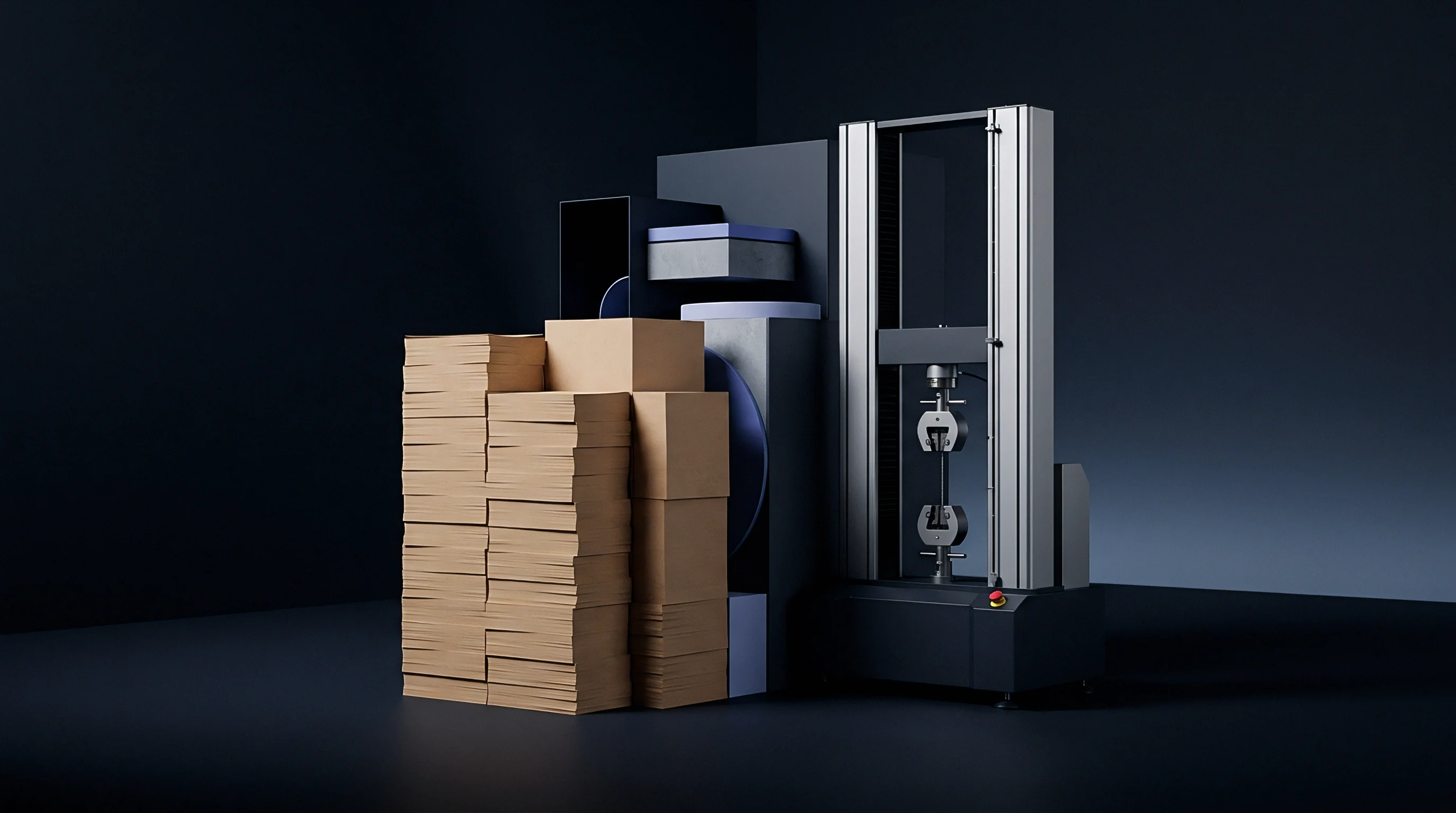
Edge crush testing conducted under ISO 3037 or TAPPI T 811 measures the direct vertical compressive force a corrugated board specimen withstands before buckling. For heavy-duty multi-tier constructions, test specimens must feature clean, parallel cut edges cut with diamond-wheel saws or precision twin-blade cutters. Crushed edges created by dull utility knives yield artificial test reductions of up to twenty-five percent.
The desk cannot fully defend the accuracy of standard McKee formula calculations when board moisture exceeds sixteen percent, because the formula assumes linear elastic board behaviour that disappears under moisture plasticization. Packaging engineers face genuine uncertainty when translating high-moisture edge crush values into actual top-load pallet limits. Under these conditions, careful buyers mandate direct dynamic compression testing on filled packaging assemblies inside environmental chambers rather than relying on mathematical calculations.
| Test Parameter | Standard Designation | Standard Atmosphere | Tropical Atmosphere | Minimum Conditioning Time | Primary Failure Mode Monitored |
|---|---|---|---|---|---|
| Edge Crush Resistance | ISO 3037 / TAPPI T 811 | 23°C / 50% RH | 38°C / 90% RH | 72 Hours | Vertical flute wall buckling |
| Ring Crush Resistance | ISO 12192 / TAPPI T 822 | 23°C / 50% RH | 38°C / 90% RH | 48 Hours | Internal laminate shear failure |
| Flat Crush Resistance | ISO 3035 / TAPPI T 825 | 23°C / 50% RH | 38°C / 90% RH | 48 Hours | Flute tip flattening |
| Water Absorptiveness | ISO 535 (Cobb Method) | 23°C / 50% RH | Not Applicable | 24 Hours | Surface sizing failure |
| Puncture Resistance | ISO 3036 / ASTM D781 | 23°C / 50% RH | 38°C / 90% RH | 72 Hours | Combined tensile-shear tearing |
| Adhesive Water Resistance | FEFCO Testing Method 9 | Water Immersion | 20°C Water Bath | 24 Hours Immersion | Flute delamination without fiber tear |
A rigorous receiving verification sequence isolates defective substrate batches before they enter production lines:
- Cut twenty representative samples from the inner plies of delivered reels, avoiding outer protective wraps.
- Place test specimens immediately into hermetically sealed containers to preserve as-delivered moisture states.
- Execute oven-dry moisture determination according to ISO 287 on five random samples to establish baseline water content.
- Condition remaining test specimens in a climatic chamber at thirty-eight degrees Celsius and ninety percent relative humidity for seventy-two hours.
- Perform edge crush testing per ISO 3037 within forty-five seconds of extraction from the environmental chamber.
- Reject any substrate batch showing a drop in edge crush strength greater than fifty percent compared to dry baseline metrics.
Purchase contracts stipulating that delivered corrugated packaging must satisfy minimum ISO 3037 edge crush values after ninety-six hours of continuous exposure to thirty-eight degrees Celsius and ninety percent relative humidity shift liability for maritime transit damage back to the packaging converter.
Outlay
Virgin kraftliner costs roughly four hundred dollars more per metric tonne than mixed waste testliner in international markets. For high-volume exporters shipping heavy industrial machinery, fresh produce, or electronics, the commercial decision hinges on total delivered cost rather than raw material price per square metre. Recycled containers fail in tropical transit corridors, causing damaged contents, insurance deductibles, customer chargebacks, and emergency air freight shipments that dwarf initial substrate savings.
Pulp index shifts move invoices. Converting facilities operating under tight margins often attempt subtle grade downgrading, swapping high-performance virgin liners for recycled testliners with identical nominal basis weights. A multi-tier carton manufactured with a 200 g/m² recycled liner exhibits dry Mullen burst strength comparable to a 175 g/m² virgin kraftliner, yet it loses twice as much compressive strength once relative humidity surpasses eighty percent.
Buying paper based purely on dry grammage guarantees poor field performance.
Yield Losses from Overpack Margin Additions
Overpacking wastes valuable payload tonnage. Engineers lacking confidence in substrate moisture stability routinely compensate by adding redundant plies, selecting triple-wall corrugated board where an optimized double-wall construction would suffice. A triple-wall box adds roughly thirty-five percent more tare weight per pallet, directly increasing ocean freight charges and road haulage fees calculated against gross shipment mass.
Consider a typical commercial scenario involving forty metric tonnes of high-volume export packaging. An unoptimized specification utilizing 250 g/m² testliner outer facings, 150 g/m² recycled mediums, and standard starch adhesive requires heavy double-wall board to achieve the necessary stacking safety factor. By transitioning to 175 g/m² virgin northern pine kraftliner facings, 140 g/m² semi-chemical mediums, and ketone-crosslinked water-resistant adhesive, the converter reduces total board grammage by twenty-two percent while improving wet edge crush retention by thirty-eight percent.
The net substrate yield increases from four thousand cartons per tonne of paper to five thousand one hundred cartons per tonne, offsetting the higher cost per metric tonne of virgin fiber.
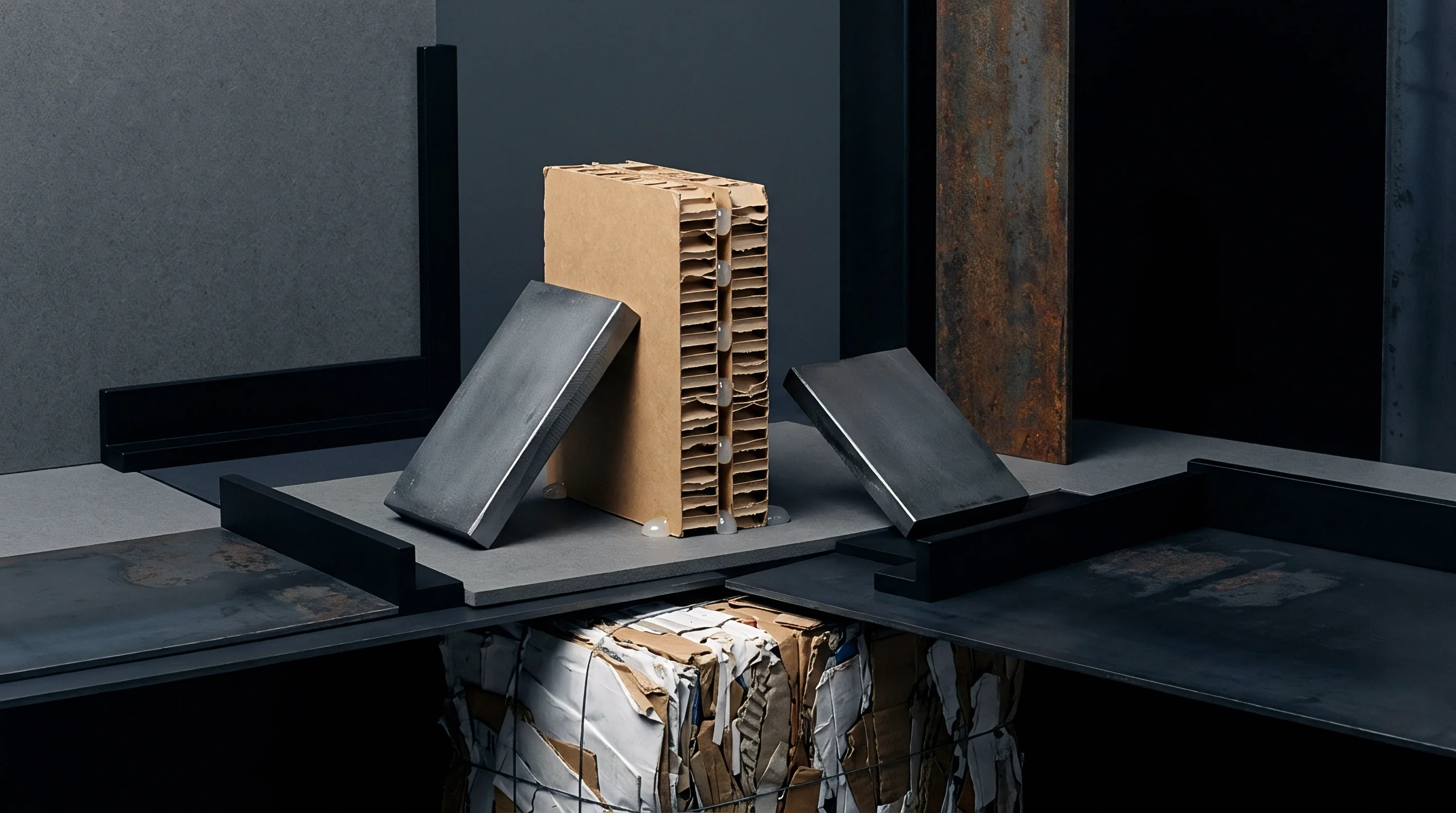
Commercial Ledger of Grade Upgrades
Financial exposure extends beyond the invoice price of paperboard reels. In maritime shipping, modern container vessels carry upwards of twenty thousand twenty-foot equivalent units, stacking containers up to nine tiers high inside cargo holds. The structural integrity of individual cartons inside each container determines whether bottom pallets hold their profile or collapse into adjacent shipping lanes.
International cargo insurance underwriters increasingly inspect packaging specifications before settling moisture-damage claims.
Export containers create microclimates. Marine air cycling through vent grates introduces salt-laden moisture that accelerates fibre degradation. Corrugated cartons that collapse during voyage generate salvage costs, disposal expenses at destination ports, and replacement production runs.
Calculating the economic return of an advanced packaging specification demands a holistic balance sheet assessing material purchase prices, reel yields, container space utilization, and catastrophic transit loss probabilities.
| Cost Component | Baseline Recycled Specification | Optimized Virgin Kraft Specification | Variance per 1,000 Boxes |
|---|---|---|---|
| Substrate Reel Cost per Metric Tonne | $620 | $1,020 | +$400/tonne (+64.5%) |
| Total Combined Board Grammage (g/m²) | 1,050 (Heavy Double-Wall) | 820 (Engineered Double-Wall) | -230 g/m² (-21.9%) |
| Blank Area per Finished Carton (m²) | 2.40 | 2.40 | 0.00 m² (0.0%) |
| Delivered Substrate Cost per 1,000 Cartons | $1,562 | $2,007 | +$445 (+28.5%) |
| Adhesive Resin Chemistry Additive Cost | $12 | $48 | +$36 (+300.0%) |
| Tare Weight per Finished Pallet (kg) | 52.8 | 41.2 | -11.6 kg (-22.0%) |
| Average Historical Transit Failure Rate (%) | 4.2% | 0.1% | -4.1% absolute |
| Cargo Loss Reserve and Claims Cost | $680 | $16 | -$664 (-97.6%) |
| Net Landed Packaging Expense per 1,000 Units | $2,254 | $2,071 | -$183 (-8.1%) |
Whether future global recycling regulations will penalize the disposal of synthetic wet-strength resin additives heavily enough to erase the economic advantage of high-yield virgin kraft packaging remains an open commercial question.