Paperboard Substrate Moisture Content Effects on Scoring Line Strain Distribution
Substrate moisture content directly governs z-direction shear yield and strain distribution during paperboard creasing, dictating outer liner cracking limits.
Regain
Atmospheric moisture plasticizes amorphous cellulose and hemicellulose, directly altering the viscoelastic behavior of paperboard. Within multi-ply structures, moisture levels dictate yield strength, elastic modulus, and ultimate strain capacity ply by ply. As the board takes on ambient water vapor, hydrogen bonds between fibrils break and reform across wider spacing, increasing polymer mobility in the fibre wall and softening the overall sheet matrix.
Hygroexpansion Dynamics and Fibre Network Equilibrium
Water entering the cell wall breaks down inter-fibre hydrogen bonds, reducing network bond strength. Equilibrium moisture content reflects the balance between ambient relative humidity and internal water mass ~ a relationship shaped by sorption hysteresis. At fifty percent relative humidity, paperboard typically carries between six point five and seven point five percent moisture by weight, depending on furnish and sizing.
Below five percent moisture, the fibre network stiffens sharply, limiting plastic strain deformation during mechanical creasing.
The mechanical response of cellulose shifts across moisture levels. When dry, paperboard displays high tensile modulus with almost no elongation before fracture, leaving unplasticized fibers prone to cracking under rapid bending. Adding moisture reduces z-direction tensile strength and raises out-of-plane shear compliance.
That compliance allows internal plies to deform plastically under a scoring rule, sparing the outer liner from tensile rupture while sheet caliper thickens under regain.
Solid bleached sulfate board conditioned to seven percent moisture content exhibits an out of plane shear modulus twenty two percent lower than the same sheet tested at five percent relative equilibrium.
Sorption Isotherms across Solid Bleached and Recycled Furnishes
Paperboard sorption exhibits pronounced hysteresis: desorption curves sit consistently above adsorption curves at matching relative humidity. Solid Bleached Sulfate, made from virgin chemical pulp, absorbs water uniformly thanks to uniform pore geometry and an absence of residual lignin. By contrast, Folding Boxboard plies containing mechanical pulp hold more bound water in their rigid lignin networks, producing markedly different sorption behavior than purely chemical sheets.
Recycled boards made from post-consumer fibers show flatter sorption isotherms. Repeated recycling shortens individual fibers and limits internal swelling, altering how water partitions between voids and cell walls. Sizing, ash fillers, and surface starch treatments also slow moisture diffusion into the core plies.
As a result, recycled grades surrender their strain-dissipation capacity much faster than virgin boards once exposed to dry plant air.
Scoreline rupture stems from ambient warehouse relative humidity drops during transit rather than variation in mill sizing formulations.
Shear
Scoring turns flat paperboard into a functional hinge by driving localized out-of-plane deformation. Strain distribution through the crease determines whether the blank folds cleanly or splits its outer liner. As male scoring rules force the sheet into a female channel, they create a complex multi-axial stress field combining in-plane tension, z-direction compression, and out-of-plane shear.
Z-Directional Strain Partitioning during Rule Penetration
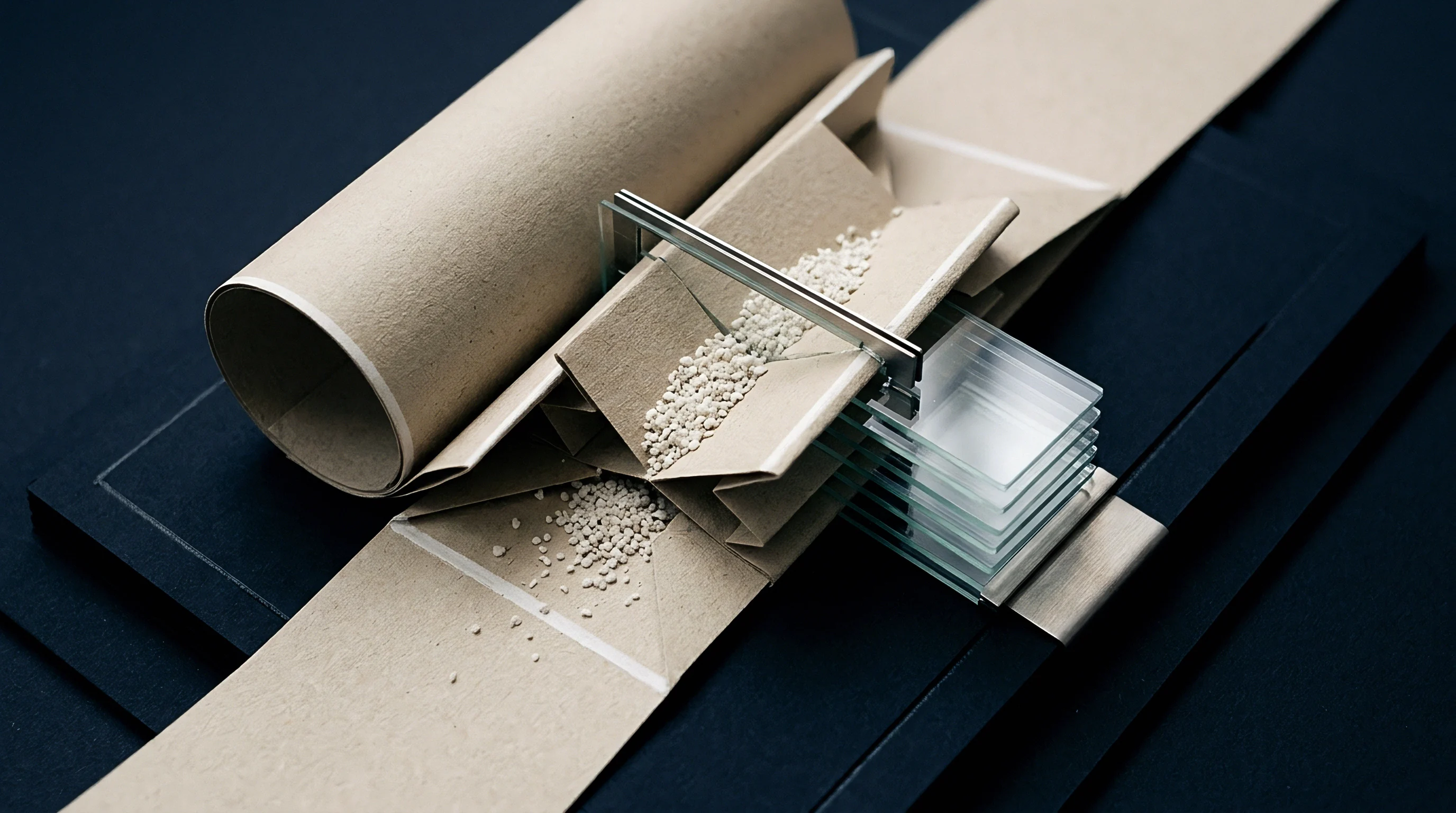
Tool indentation establishes distinct stress profiles across the thickness of the sheet. Compression dominates the upper surface near the female channel shoulders, while peak tensile strain builds along the bottom liner under the male rule tip. At adequate moisture levels, central plies yield under out-of-plane shear stress τxz, forming controlled delamination zones that relieve bending stress.
Internal delamination acts as the primary strain-relief mechanism during carton erection. Splitting the caliper into independent thin lamellae lowers bending resistance and spreads flexural strain. When low moisture drives up internal shear strength, plies cannot release along their interfaces.
Denied that internal slip, tensile strain concentrates on the outer liner during ninety-degree folding, tearing the printed surface.
Fibre swelling alters ply stiffness and matrix shear capacity. When internal shear yield develops cleanly, outer liner strain stays safely below fracture thresholds; if moisture climbs too high, plies lose cohesion and delaminate uncontrollably.
Outer liner tension governs crease integrity, and dry operating conditions consistently accelerate shear failure along the scoreline.
ISO 187 mandates testing after pre-conditioning below thirty percent relative humidity to ensure adsorption equilibrium during physical strain measurements.
Digital Image Correlation Mapping of Out-of-Plane Deformations
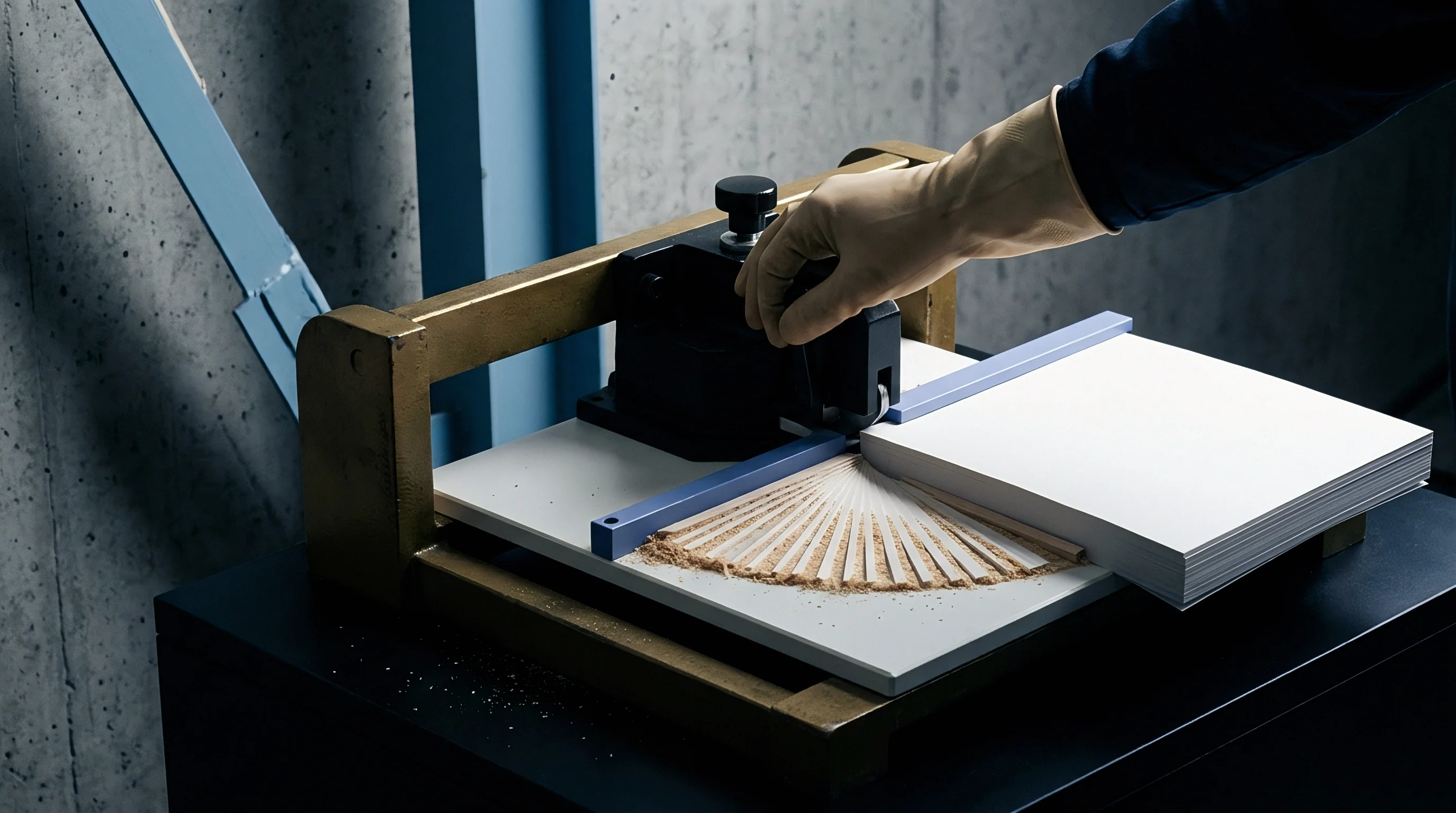
Optical displacement measurements map the deformation fields that form through the board’s cross-section. By tracking speckle patterns applied to strip edges, digital image correlation captures strain gradients throughout tool penetration. Higher moisture broadens the plastic strain envelope around the crease, distributing mechanical work over a wider volume.
Low moisture contracts that zone, producing severe gradients focused directly over the male rule.
Optical strain mapping shows that peak tensile strain on the outer liner falls markedly when board moisture rises from four point five percent to seven point five percent. That redistribution pulls strain energy away from surface fibers, substantially lowering the peak bending moments encountered during rapid carton folding.
| Substrate Grade | Conditioning RH (%) | Board Moisture (%) | Z-Shear Strength (kPa) | Outer Liner Strain at Rupture (%) | Delamination Mode |
|---|---|---|---|---|---|
| Solid Bleached Sulfate (300 gsm) | 30% RH | 4.8% | 410 | 2.1% | Brittle / Concentrated |
| Solid Bleached Sulfate (300 gsm) | 50% RH | 7.1% | 315 | 3.8% | Ductile / Distributed |
| Solid Bleached Sulfate (300 gsm) | 70% RH | 9.4% | 220 | 4.9% | Excessive / Structural Softening |
| Folding Boxboard (350 gsm) | 30% RH | 5.1% | 360 | 1.8% | Top Liner Splitting |
| Folding Boxboard (350 gsm) | 50% RH | 7.4% | 270 | 3.2% | Controlled Mid-Ply Shear |
| Coated Recycled Board (320 gsm) | 30% RH | 4.4% | 440 | 1.4% | Severe Surface Micro-Cracking |
| Coated Recycled Board (320 gsm) | 50% RH | 6.8% | 330 | 2.6% | Moderate Delamination Zone |
- Outer liner cracking develops when moisture falls below five percent, reducing ultimate elongation and focusing tensile stresses along the crease line.
- Delamination failure sets in above nine percent moisture, where weak internal ply bonding leads to complete structural collapse during erection.
- Rolling shear displacement occurs in bulky folding boxboards as plasticization of the mechanical core produces asymmetrical crease profiles.
- Crease stiffness rebound worsens in stock below six percent moisture, where strong elastic recovery hampers automated folding at speed.
Skipping inbound moisture checks routinely produces tens of thousands of split cartons when brittle creases hit high-speed cartoning lines.
Matrix
Female channel dimensions determine how cleanly board draws into the matrix without splitting the outer liner. Tooling geometry has to match both substrate caliper and its immediate moisture state. While matrix selection typically relies on baseline caliper tb and male rule width tr, hygroexpansive swelling continuously alters operational clearances.
Male Rule Penetration and Channel Width Tolerances
Tooling standards link rule penetration depth directly to matrix width, conventionally calculated as:
W = 1.5 · tr + 1.4 · tb
Here W represents matrix channel width, tr rule thickness, and tb caliper, with rule height setting penetration depth. As board takes on moisture, z-direction swelling expands tb. A sheet measuring zero point four zero millimeters at five percent moisture, for example, swells to zero point four three millimeters at eight percent, cutting into matrix side clearance.
Pinched clearance intensifies shear along the matrix shoulders. If channel width is fixed while the board swells, the shoulders slice outer fibers rather than encouraging internal plies to slip. Conversely, running an oversized channel on dry board leaves broad, ill-defined creases that retain too much folding resistance.
| Caliper at 50% RH (mm) | Target Moisture (%) | Swollen Caliper (mm) | Male Rule Width (mm) | Nominal Channel Width (mm) | Adjusted Channel Width (mm) |
|---|---|---|---|---|---|
| 0.35 | 4.5% | 0.34 | 0.71 | 1.56 | 1.50 |
| 0.35 | 7.0% | 0.35 | 0.71 | 1.56 | 1.56 |
| 0.35 | 9.0% | 0.37 | 0.71 | 1.56 | 1.62 |
| 0.50 | 4.5% | 0.48 | 1.05 | 2.28 | 2.20 |
| 0.50 | 7.0% | 0.50 | 1.05 | 2.28 | 2.28 |
| 0.50 | 9.0% | 0.53 | 1.05 | 2.28 | 2.35 |
| Adjusted channel width accounts for out-of-plane hygroexpansion to maintain constant clearance ratios across press runs. | |||||

Where Does Delamination Initiate across Low Equilibrium Moisture Content?
Cross-sectional strain mapping shows internal shear cracks initiating near the male rule shoulder whenever relative humidity falls below thirty percent. Lacking the moisture required for fibers to slip, dry core plies resist steady shear yield. Instead of delaminating smoothly through the center, the sheet develops abrupt micro-fractures along the boundary between the top liner and the core.
As moisture increases, the shear zone migrates inward toward the core. Delamination begins earlier in the stroke, lowering peak rule loads and shielding printed surface coatings from extreme strain spikes.
- Measure core pallet moisture upon receipt using a calibrated microwave attenuation gauge.
- Size female channel widths to measured sheet thickness rather than nominal mill certificate caliper.
- Set rule penetration depth to seventy-five percent of total swollen board thickness.
- Examine cross-sectioned creases under fifty-times magnification to confirm balanced internal ply delamination.
Female matrix channel width scales directly with moisture-swollen board thickness to prevent shear cutting of the bottom liner.
For high-yield bleached chemical-thermomechanical pulps, testing has yet to determine the precise threshold where cross-direction fibre orientation overrides moisture-driven strain relaxation in multi-axis scoring.

Anvil
High-speed converting lines subject carton creases to violent, transient mechanical loads. Dynamic strain rates in modern die-cutters exceed static bench tests by orders of magnitude. When unwrapped pallets sit exposed on an unconditioned press floor, rapid surface drying sharply increases the risk of outer liner failure during the run.

High-Speed Platen Strain Dynamics and Moisture Decay Rates
Running a platen press above seven thousand sheets per hour compresses scoring deformation into milliseconds. Such rapid loading leaves little time for viscoelastic stress relaxation along the crease. If the board is dry, polymer networks cannot reorient fast enough to absorb the energy, and the fibers fracture in tension.
While pallet logs confirm initial delivery moisture, exposed sheet perimeters dry out quickly in low ambient humidity. This edge desiccation sets up moisture gradients across the stack, causing identical scores to behave differently depending on whether a blank sits at the center or the rim of the chase.
Substrate desiccation elevates converting line micro-cracking and directly increases the landed unit cost per thousand acceptable finished cartons.

Worked Unit Economics of Moisture-Modulated Spoilage Rates
Take a fifty-tonne run of three hundred fifty gram per square meter folding boxboard. At one thousand four hundred fifty dollars per tonne, raw material costs seventy-two thousand five hundred dollars, yielding two hundred four thousand eighty-one parent sheets at zero point seven square meters per sheet.
In Case A, conditioned storage maintains stock at seven point two percent moisture. Crease-cracking waste stays at zero point eight percent, scrapping one thousand six hundred thirty-three sheets and delivering two hundred two thousand four hundred forty-eight finished blanks. Net substrate cost comes to three hundred fifty-eight dollars and twelve cents per thousand good sheets.
In Case B, dry winter air pulls board moisture down to four point eight percent. Reduced strain capacity drives crease failures up to six point two percent, wasting twelve thousand six hundred fifty-three sheets. To contain splitting, operators slow press speed from eight thousand to five thousand five hundred sheets per hour.
Total run time stretches from twenty-five point five hours to thirty-seven point one hours, racking up eleven point six extra hours at two hundred twenty dollars per hour.
Direct board costs climb to three hundred seventy-eight dollars and seventy-three cents per thousand net sheets, while lost press time adds two thousand five hundred fifty-two dollars in overhead. The total financial penalty across the fifty-tonne lot is six thousand four hundred ninety-seven dollars ~ an eight point nine six percent increase in unit manufacturing cost.
- Ambient pressroom relative humidity controls stop pallet surfaces from drying out over long production runs.
- Scoring rule height offset tables allow rapid tooling adjustments when running dry board in unconditioned facilities.
- Edge-to-core moisture differential thresholds set strict limits on cross-sheet moisture variation before press approval.
- Real-time optoelectronic score monitoring catches micro-fissures at the die-cutter before ruined blanks jam folder-gluers downstream.
Writing DIN 55437 creasing stiffness criteria into purchase agreements gives converters a clear contractual basis for rejecting delivered lots that fail bending tests under standard atmospheric conditions.
Dossier
Purchase contracts require explicit moisture boundaries to protect downstream converting performance. Procurement teams bind suppliers to tight equilibrium bands so delivered stock conforms to certified properties, rather than accepting wide mill tolerances that conceal scoring problems.
Specifying Moisture Bands in Mill Supply Contracts
Supply contracts must establish enforceable moisture limits at dispatch. While standard mill terms target six point five to seven point five percent moisture with a tolerance of plus or minus zero point five percent, board that arrives below five point five percent regularly drives up scrap during winter conversions.
Specifications should mandate pallet wrapping in low-transmission polyethylene film to block moisture loss during transit and unconditioned storage. Contracts also need explicit rejection clauses when goods-inward dielectric probe readings fall outside agreed limits.
Goods-Inward Quality Assurance and Certificate Audit Mechanics
Receiving bays must log core moisture before pallets leave the staging area. Using calibrated microwave resonance or radiofrequency dielectric meters, quality teams measure interior readings through the protective wrap to separate transit damage from mill defects.
Mill certificates cite average moisture measured by online paper machine scanners, which routinely masks dry edges and web profiles. Inbound verification relies on physical oven-dry tests under TAPPI T 412 or ISO 287 at one hundred five degrees Celsius, establishing an absolute gravimetric reference against supplier paperwork.
| Paperboard Grade | Target Moisture (%) | Acceptable Range (%) | Test Standard | Non-Conformance Penalty |
|---|---|---|---|---|
| Solid Bleached Sulfate (SBS) | 7.0% | 6.5% – 7.5% | ISO 287 / TAPPI T 412 | Credit for excess press spoilage |
| Folding Boxboard (FBB) | 7.5% | 7.0% – 8.0% | ISO 287 / TAPPI T 412 | Rejection of out-of-spec lot |
| Coated Recycled Board (CRB) | 6.5% | 5.8% – 7.2% | ISO 287 / TAPPI T 412 | Supplier re-wrapping / conditioning fee |
| Solid Unbleached Sulfate (SUS) | 7.2% | 6.5% – 8.0% | ISO 287 / TAPPI T 412 | Full lot replacement at mill cost |
Rigorous inbound moisture checks prevent brittle board from reaching the die-cutter, heading off scoreline cracking and the press downtime that follows.
Protective wrap stays sealed until pallets reach full temperature equilibrium with the pressroom floor.