Folding Boxboard Scoring Parameters for Uncoated Board Conversion
Uncoated FBB requires matrix channels 1.5 to 1.7 times board caliper plus rule width and strict 45-55% relative humidity to prevent liner cracking.

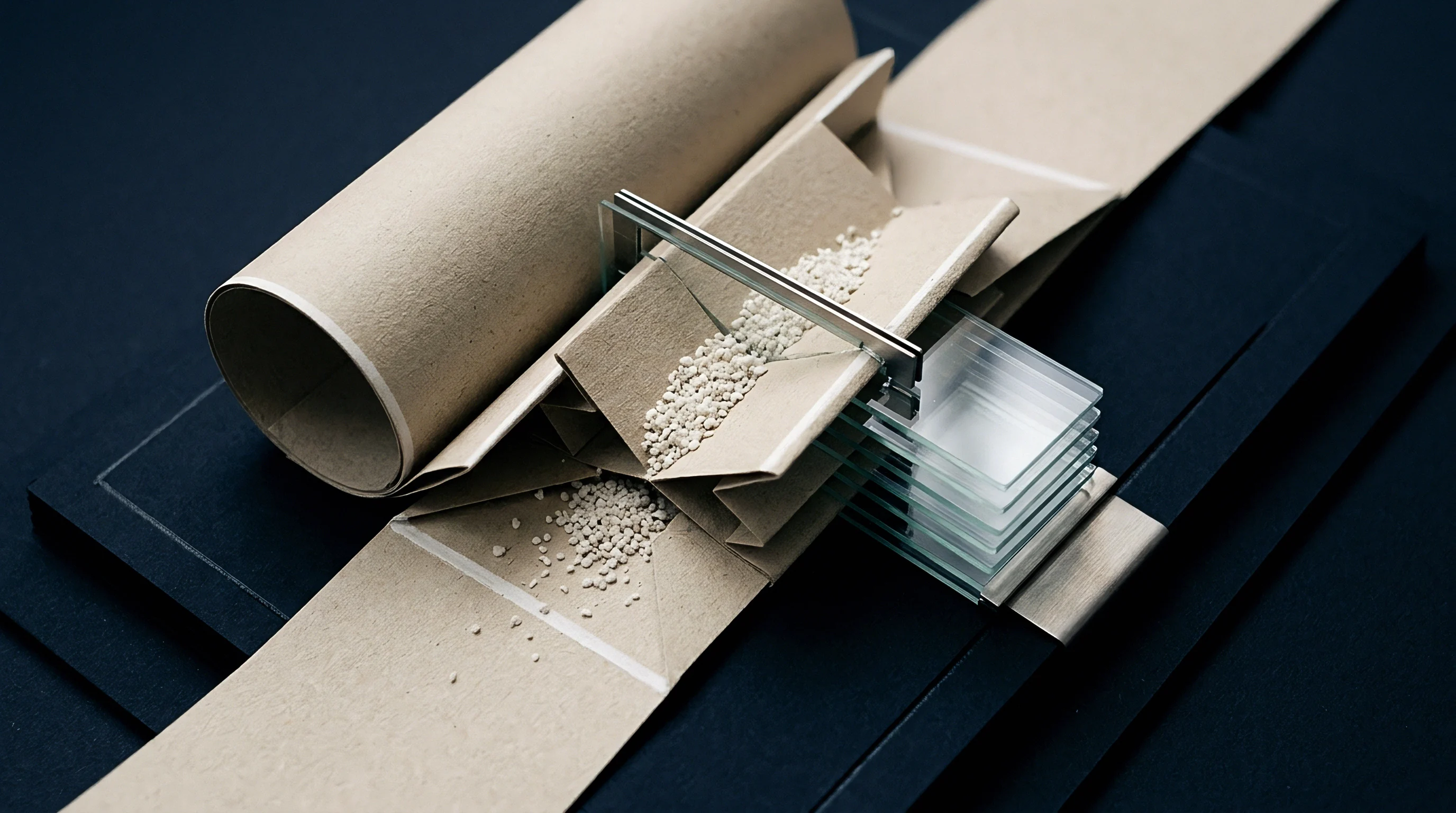
Matrix
Female groove calculations on a platen die-cutter require precise alignment between the steel rule height and the counter channel base. When converting uncoated folding boxboard, the absence of a plasticized surface latex coating fundamentally alters how the board reacts to compressive displacement. The material relies entirely on the internal delamination of its mechanical pulp core to form a clean bending hinge without tearing the outer chemical pulp faces.
Determining the correct channel width relies on a mathematical ratio tied to board caliper and fiber orientation. For standard folding boxboard with a chemi-thermomechanical pulp core, the channel width formula accounts for the board thickness multiplied by a material shear factor, added to the width of the male creasing rule. For machine-direction scoring, where fibers lie parallel to the crease line, the shear factor multiplier is set at 1.5.
Across the grain, where stiff cross-oriented fibers exert higher resistance against displacement, the shear factor multiplier increases to 1.7.
The channel depth calculation matches the nominal board caliper, though uncoated grades frequently require an added depth clearance of 0.05 millimeters. This additional depth accommodates the springback behavior of uncompressed mechanical pulp fibers that have not been locked into place by a top surface coating layer.
| Caliper Range (mm) | Rule Thickness (pt / mm) | Grain Direction | Calculated Matrix Width (mm) | Recommended Channel Depth (mm) |
|---|---|---|---|---|
| 0.35 – 0.40 | 2-pt / 0.71 mm | Machine Direction (MD) | 1.24 – 1.31 | 0.40 |
| 0.35 – 0.40 | 2-pt / 0.71 mm | Cross Direction (CD) | 1.31 – 1.39 | 0.40 |
| 0.45 – 0.50 | 2-pt / 0.71 mm | Machine Direction (MD) | 1.39 – 1.46 | 0.50 |
| 0.45 – 0.50 | 2-pt / 0.71 mm | Cross Direction (CD) | 1.48 – 1.56 | 0.50 |
| 0.55 – 0.60 | 3-pt / 1.05 mm | Machine Direction (MD) | 1.88 – 1.95 | 0.60 |
| 0.55 – 0.60 | 3-pt / 1.05 mm | Cross Direction (CD) | 1.99 – 2.07 | 0.65 |
Selection of counter-die materials dictates channel durability over extended press runs. Phenolic resin matrix strips provide adequate performance for short production batches under fifty thousand impressions. Continuous steel counter-plates milled directly via computer numerical control maintain precise shoulder geometry across multi-million impression packaging runs.
Channel sidewall wear expands the effective groove width over time, which reduces the double-ply shear definition and introduces score roll during high-speed carton assembly.
Matrix suppliers frequently claim their off-the-shelf polymer channels function identically across coated and uncoated substrates of matching caliper, ignoring the higher coefficient of friction and lower surface compressibility of raw chemical pulp plies.

Substrate
Uncoated folding boxboard relies on a multi-ply sheet architecture combining outer chemical kraft layers with a bulky mechanical pulp core. The top liner consists of bleached chemical pulp, providing high tensile strength and high brightness without a mineral pigment coating. The middle plies contain chemi-thermomechanical pulp, which yields high bulk and flexural stiffness at a lower basis weight than solid bleached sulphate sheets.
During the creasing impression, the physical structure of the board undergoes controlled internal destruction. As the male creasing rule forces the board down into the female channel, high shear forces develop between the internal fiber plies. The mechanical pulp fibers in the center plies separate from each other, creating internal shear delamination.
Dry board cracks under shear.
Uncoated board requires precise internal ply separation to prevent outer tensile fracture during high-speed folding.
The absence of a surface coating layer significantly changes how bending stress distributes across the top liner. Pigmented coatings containing latex or starch binders act as a semi-flexible surface membrane that helps distribute localized tensile strain over a broader area. On an uncoated board, the raw chemical pulp fibers directly absorb the peak tensile load at the outer apex of the fold.
If the internal mechanical core fails to delaminate cleanly due to excessive ply bond strength or improper channel clearance, the tensile stress on the outer liner exceeds the elongation limit of the kraft fibers, causing a visible crack along the score line.
Standard quality agreements for packaging board specify that scoring performance complies with DIN 55437 testing protocols, measuring crease stiffness and resistance to score line rupture across specified relative humidity ranges.

Crease
Male rule selection governs the initial displacement of fibers during the platen impression stroke. Steel rule thickness is measured in points, where one point equals 0.71 millimeters. For uncoated boxboard calipers below 0.45 millimeters, a 2-point rule with a rounded crown profile is standard.
Substrates exceeding 0.45 millimeters caliper require a 3-point rule to displace sufficient material into the female matrix without piercing the top liner.
Rule penetration depth controls the degree of deformation imparted to the board structure. Excessive penetration crushes the mechanical core completely, destroying the structural bead that formed inside the folded corner. Insufficient penetration fails to initiate internal ply delamination, forcing the board to behave as a solid monolithic sheet when folded.

Platen Setup Protocol for Uncoated Conversion
- Mount the cutting and creasing die into the press chase and lock it securely after verifying rule height uniformity across the die face.
- Clean the steel counter-plate surface with an fast-evaporating solvent to remove oil residues prior to positioning the counter-matrix strips.
- Transfer the self-adhesive creasing matrix channels onto the counter-plate by aligning them over the creasing rules and executing a low-pressure impression stroke.
- Peel away the matrix locator carrier strips and inspect each channel edge for complete adhesion against the counter-plate base.
- Adjust the platen impression tonnage incrementally using press make-ready tissue until the score lines display clean internal bead formation without cutting the top kraft liner.
- Fold initial press samples 180 degrees along both machine-direction and cross-direction score lines to verify that zero liner fracturing occurs.
The tip radius of the male creasing rule plays an essential role in preventing fiber cutting. Standard creasing rules feature a full-round radius equal to half the rule thickness. For delicate uncoated boards prone to surface flaking, a slightly flattened profile with smooth, polished shoulder radii prevents sharp point contact from breaking surface fibers during impact.
Delivery of specified crease stiffness values depends on maintaining counter-channel width within a three percent tolerance across the die plate.
Liner stiffness varies by grain. Machine-direction scores encounter lower bending resistance because the fibers flex along their long axis. Cross-direction scores push against aligned fiber bundles, requiring higher impression force and wider matrix channels to achieve equivalent folding torque without tearing.
Proper creasing rule height selection always maintains a fixed structural differential below the adjacent cutting rule height to prevent excessive board pinching at the crease shoulders.
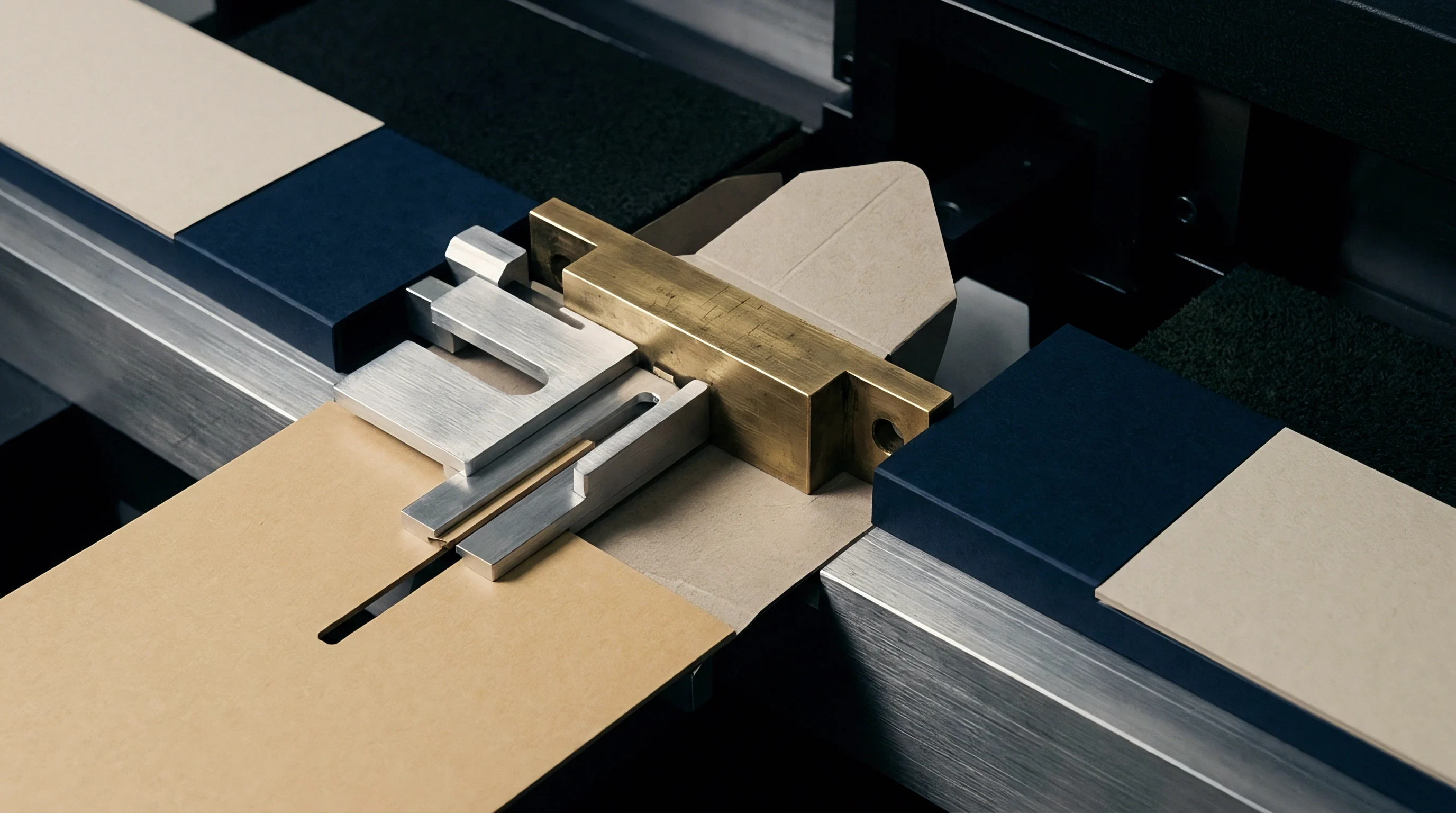
Moisture
Relative humidity equilibrium within the converting plant dictates the elastic strain limit of raw paperboard plies. Uncoated folding boxboard absorbs and desorbs atmospheric moisture far more rapidly than coated board grades because it lacks a mineral coating barrier. When stored in low-humidity environments, raw chemical pulp outer fibers rapidly lose bound water, turning brittle and prone to fracturing under tensile strain.
What Moisture Range Prevents Liner Splitting?
Board storage rooms maintaining 45 to 55 percent relative humidity preserve the intrinsic elongation property of uncoated kraft fibers. At this environmental equilibrium, uncoated board holds an internal moisture content between 6.5 and 7.5 percent by weight. If board moisture drops below 5.5 percent, tensile strain to failure decreases by up to 30 percent, causing catastrophic outer liner splitting during creasing.
Platen die-cutting executed at 50 percent relative humidity achieves a 6.8 percent board moisture content that eliminates outer kraft liner cracking.
Pass-attached finishing steps add thermal stress that pulls moisture out of the sheet. Hot foil stamping passes run at die temperatures between 110°C and 140°C, baking the board and lowering local moisture content near the stamped area. Heavy drying passes on sheet-fed offset presses running infrared emitters similarly desiccate the top liner.
When die-cutting occurs immediately following an offline thermal pass, the board must pass through an environmental conditioning rest period to reabsorb ambient moisture before hitting the creasing rules.
Moisture loss reduces tensile strain. Thermal drying cycles without intermediate re-humidification create localized stress points where the score line intersects printed or hot-foiled areas, forcing converting engineers to alter tooling clearances to prevent board splitting.
What atmospheric moisture recovery duration allows post-stamped uncoated sheets to regain sufficient fiber flexibility before enter the die-cutting press?

Rupture
Outer liner splitting occurs when tensile elongation along the outer bend face exceeds the ultimate strain capacity of the bleached kraft pulp. This failure mode appears as fine hair-line cracks or open gaps along the outer ridge of the score line after 90-degree or 180-degree folding. Uncoated fibers lack synthetic binding.
The lack of latex binders means the fiber network relies purely on inter-fiber hydrogen bonding, which breaks cleanly under sharp peak stress.
| Observed Failure Mode | Primary Physical Mechanism | Root Cause in Parameters | Corrective Action |
|---|---|---|---|
| Outer Liner Splitting | Tensile fracture of top kraft fibers during folding | Matrix channel too narrow or insufficient board moisture | Widen matrix channel by 0.10 mm or increase plant relative humidity |
| Inner Liner Bursting | Compressive failure of bottom liner into the groove | Male rule penetration depth too deep or rule profile too sharp | Reduce male rule height or install a wider radius creasing rule |
| Score Rolling / Asymmetry | Fold line wanders away from score center | Matrix channel too wide or loose counter-die register | Nodular channel width reduction or re-align counter-plate register |
| Delamination Flaking | Inter-ply separation extending outside crease zone | Excessive impression tonnage on dry CTMP core | Reduce platen pressure and optimize internal ply bond specification |
Inner liner bursting represents the inverse failure mode, where the male rule punches directly through the back layer of the board into the female groove. This occurs when rule penetration depth is excessive or when the channel width is too narrow, creating high shear cutting forces instead of controlled bending deformation.
Quality Audit Verification Steps
- Crease Stiffness Evaluation ~ Measure bending moment at a 15-degree angle using a two-point bending tester to ensure score resistance falls below 50 percent of uncut board stiffness.
- Visual Rupture Inspection ~ Inspect folded score lines under 10x optical magnification to detect micro-cracks in the outer chemical pulp liner before committing to full production runs.
- Bead Geometry Audit ~ Section a folded score sample with a razor to verify that the internal CTMP core forms a symmetrical, uniform internal bead without board shearing.
- Fold Torque Uniformity ~ Measure score resistance along the entire length of major carton flaps to confirm balanced impression pressure across the platen die face.
Tooling adjustments directly dictate conversion waste arithmetic. Consider a high-speed carton converting job running an uncoated 450-micrometer FBB substrate across 100,000 sheets. Selecting a standard coated-board channel matrix formula (1.4 t + g) yields a channel width of 1.34 millimeters.
On an uncoated sheet, this narrow channel creates excessive tension, generating a 4 percent carton scrap rate due to score line cracking during automated high-speed gluing. Widening the channel to the correct uncoated formula (1.7 t + g) produces a 1.48-millimeter channel width, dropping carton rejection rates to 0.1 percent and saving 3,900 ruined cartons per shift.
Selecting incorrect scoring matrix dimensions for uncoated board leads directly to high scrap rates, gluers jamming during automated filling, and complete rejection of finished packaging lots by automated packing facilities.
Spoilage
Commercial run efficiency drops sharply when defective creasing causes high-speed carton folder-gluers to misfeed or jam. Uncoated folding boxboard exhibits a higher surface coefficient of friction than coated grades, meaning score lines must fold cleanly with low resistance torque to prevent carton blank twisting inside the folding belts. A stiff, improperly delaminated crease forces the folder-gluer to apply uneven pressure, leading to skewed glued joints and out-of-square carton geometries.
Tooling wear alters channel clearance. Over long press runs, abrasive uncoated fibers gradually wear down the shoulders of phenolic creasing matrices. A channel that opens up by just 0.08 millimeters across a hundred thousand impressions causes the score bead to loosen, introducing fold position variation that ruins high-speed automated packing operations.
Fibers snap under excess tension. Platen press pressure demands balance. Improper depth destroys internal delamination.
Score width controls fold resistance. Thin boards require narrow channels. Core ply failure ruins box geometry.
Gluer downtime inflates conversion cost.
Converting line spoilage costs escalate rapidly when material defect issues reach automated product filling lines. A single split score line on a heavy retail carton can burst open under stacking loads in warehousing logistics, exposing packed goods to damage and triggering customer chargeback penalties against the converter. Establishing substrate-specific creasing protocols during initial press make-ready secures structural integrity, protects run margins, and locks in predictable production throughput across every converting batch.