Short Span Compression Strength Decay in Recycled Containerboard Transport Cycles
Short span compression strength in recycled containerboard drops over 35 percent under ambient moisture shifts, requiring higher safety factors in box design.
Physics
A standard 140 g/m² recycled containerboard liner clamped at 0.70 MPa clamping force inside an ISO 9895 short span compression tester yields an ultimate compression strength of 2.15 kN/m under TAPPI T 402 standard conditioning at 23 degrees Celsius and 50 percent relative humidity. That figure represents the baseline resistance of individual wood fibers to localized micro-axial crushing before panel-level instability occurs. When recycled paperboard enters long-distance supply chains, static laboratory numbers decay rapidly under physical dynamic stress.
Recycled fibers possess shorter mean fiber lengths and elevated micro-fracture density compared to virgin kraft pulps. These structural deficiencies lower the structural threshold where elastic deformation transitions into irreversible cell wall collapse.
Microscopic Cell Wall Buckling under Compression
When axial load acts upon a paperboard web, individual wood fibers experience localized micro-compressive failure prior to gross sheet deflection. Virgin softwood fibers resist axial strain through intact secondary cell wall layers, specifically the dense S2 fibrillar region. Recycled containerboard furnish undergoes repeated mechanical repulping cycles that strip external fibrillar fines and introduce micro-delamination within the cell wall layers.
Fibre bonds fail first. Under compressive loads, these pre-damaged fiber walls buckle internally at load levels far below theoretical tensile limits. Short span compression testing evaluates a narrow 0.70 millimeter span to isolate this exact failure mode, preventing sheet buckling while exposing pure fiber-to-fiber compressive resistance.
Fibre-level shear dislocations propagate along the S2 layer microfibrils when load transfers across the sheet. In recycled containerboard, high mineral filler fractions including calcium carbonate reduce fiber-to-fiber contact area. The presence of non-cellulosic contaminants and hornified fiber fragments creates stress concentration points within the sheet matrix.
Under continuous transport vibration, these points initiate localized fiber buckling long before the box structure manifests visible exterior deformation.
Fibre Length Degradation across Recycling Loops
Repeated repulping shortens cellulose polymers and strips external fibrillar fines from the furnish matrix. A typical recycled testliner contains fibers that have passed through four to seven repulping loops, yielding a weighted average fiber length often below 1.2 millimeters compared to 2.8 millimeters for unbleached softwood kraft. Shorter fibers reduce the number of inter-fiber bonds spanning the 0.70 millimeter short span test gap.
Consequently, the load transfer efficiency across the fiber network declines, accelerating strength decay under external mechanical forces.
Micro-buckling within recycled cellulose fibers occurs long before visible creasing or structural box collapse appears in transit.
Fibre hornification during repeated papermaking dry cycles irreversibly collapses internal pore structures within the cell wall. Hornified fibers exhibit decreased flexibility, preventing tight mechanical conformability during sheet pressing and drying on the paper machine. The resulting containerboard web displays lower apparent density and reduced inter-fiber bond strength per unit grammage.
When subjected to transit compression cycles, sheets manufactured from heavily recycled furnish experience accelerated micro-mechanical degradation.
Ignoring micro-structural compression failure leads directly to catastrophic lower-tier carton crushing in high-humidity transit routes.

Stack
In multi-tier palletizing, corrugated shipping containers carry vertical loads for extended transit durations. The mechanical integrity of the bottom-tier box relies directly on the short span compression strength of both the outer liners and the internal corrugating medium. Static compression strength measured in laboratory settings drops substantially when containers endure dynamic stacking forces inside road trailers, rail cars, or ocean vessels.
Dynamic shock loads during transport amplify static payload weights by factors between 1.2 and 1.8, causing progressive structural fatigue across the recycled paperboard matrix.
Dynamic Creep and Pallet Interlocking Mechanics
Continuous deadweight on bottom-tier packaging causes viscoelastic deformation of the corrugated fluting walls. Recycled containerboard exhibits pronounced creep behavior under sustained compressive load, expanding laterally while losing vertical caliper over time. Creep accelerates box collapse.
When pallets sit stacked two-high or three-high inside distribution centers, the bottom container liner experiences steady material flow at the molecular level. Hydrogen bonds between cellulose chains continuously break and reform in lower-energy configurations, causing gradual height reduction and eventual corner-post failure.
Pallets tilt under shear. Interlocked stacking patterns reduce overall box compression strength by 20 to 40 percent compared to column-stacked arrangements. Column stacking aligns the structural corners of each box directly over the corners below, maximizing vertical load transfer through the stiffest structural zones.
Interlocked patterns place box corners directly over the unsupported panel spans of lower boxes, converting vertical compression loads into bending moments that accelerate short span compression failure in recycled liners.
- Flute Creep Indentations localized physical crushing along flute tips where linerboard meets corrugated medium under static compression loads.
- Panel Out-Of-Plane Bulging lateral deflection of vertical box walls caused by viscoelastic yield of recycled fibers under prolonged deadweight loading.
- Corner Post Crushing irreversible failure at vertical box corners where short span compression thresholds fall below peak dynamic stacking forces.
- Interlocking Shear Fatigue diagonal micro-tearing along liner surfaces resulting from non-uniform weight distribution in column-misaligned pallet patterns.
Vibrational Shear during Multi Modal Transit
Standard sea-freight containers encounter low-frequency vertical accelerations between 0.2 g and 1.5 g during ocean movement. Road transport introduces continuous random vibration across the 2 Hz to 200 Hz frequency spectrum. These mechanical vibrations generate cyclical shear stresses within the corrugated board paper matrix.
Because recycled fibers hold lower bond energy, continuous vibrational cycling loosens inter-fiber bonding, lowering short span compression strength progressively over long-distance routes.
Freight movement across rough road networks introduces harmonic resonances that match the natural frequency of filled corrugated containers. When resonance occurs, internal dynamic forces multiply, driving rapid localized short span strength decay. Board caliper drops under weight.
The combination of dynamic vibration and vertical compression leads to progressive loss of structural stiffness, resulting in creased box panels and compromised load support.
Paper mills frequently assert that pallet deformation stems from improper container stacking patterns rather than moisture-induced strength degradation.
Climate
Ambient atmospheric changes trigger rapid moisture equilibration within the porous paper network. Recycled containerboard contains high concentrations of hydrophilic hemicellulose and residual papermaking chemicals that accelerate moisture absorption from surrounding air. Paper absorbs moisture quickly.
Relative humidity drives decay. As moisture content within the sheet rises, liquid water molecules insert into the amorphous regions between cellulose microfibrils, breaking inter-fiber hydrogen bonds and softening the structural matrix.
Relative Humidity Spikes and Sorption Hysteresis
Exposing containerboard to an 85 percent relative humidity environment increases sheet moisture content from 6 percent to roughly 12 percent by weight. Moisture uptake weakens the cellulose structure dramatically, reducing short span compression resistance by up to 40 percent compared to standard laboratory baseline conditions. Hysteresis locks in water.
When paperboard absorbs moisture during humid transit legs and subsequently dries, the initial compression strength is never fully recovered due to permanent fiber network restructuring.
Sorption hysteresis dictates that a containerboard sheet reaching equilibrium from a wetting path holds higher moisture content than a sheet reaching equilibrium from a drying path at the exact same relative humidity level. Sourcing managers relying on static laboratory tables fail to anticipate this increased moisture retention during tropical shipping legs. The retained water maintains the cellulose fiber network in a permanently softened state, lowering short span compression performance continuously throughout the voyage.
| Relative Humidity Percent | Equilibrium Moisture Content Percent | Short Span Compression Value kN/m | Strength Retention Rate Percent |
|---|---|---|---|
| 50 RH Standard | 6.5 | 2.20 | 100.0 |
| 65 RH Elevated | 8.2 | 1.85 | 84.1 |
| 80 RH High Transit | 11.4 | 1.48 | 67.2 |
| 90 RH Extreme Tropical | 14.8 | 1.18 | 53.6 |

Lignin Matrix Softening at High Moisture Equilibrium
Water molecules act as plasticizers within amorphous carbohydrate regions, lowering the glass transition temperature of residual polymers. In recycled containerboard grades containing unbleached kraft pulps or semi-chemical fluting, residual lignin acts as a hydrophobic binder at low moisture levels. Once internal moisture content exceeds 10 percent, water disrupts the lignin-carbohydrate complex, allowing individual cellulose microfibrils to slip past one another under lower compressive loads.
Conditioned recycled containerboard at 85 percent relative humidity exhibits up to 38 percent decay in short span compression strength compared to standard testing at 50 percent relative humidity.
Dry paper restores strength partially, but physical transit damage sustained while softened remains permanent. Structural micro-creasing that occurs during high-humidity transit legs impairs box performance permanently even if the containerboard subsequently dries in an air-conditioned warehouse.
- Moisture Barrier Sizing Verification testing surface Cobb values according to ISO 535 to ensure liquid water absorption remains below specified transit limits.
- Equilibrium Moisture Audit measuring board moisture content at loading docks using calibrated high-frequency dielectric meters prior to container stuffing.
- Sorption Isotherm Profiling mapping specific recycled furnish strength loss curves across expected transport relative humidity ranges.
- Synthetic Binder Integrity Check evaluating internal strength additive retention rates under prolonged saturated atmospheric conditions.
A containerboard batch that maintains structural stiffness through rapid humidity shifts consistently outperforms heavier sheets that lack hydrophobic surface sizing.
Bench
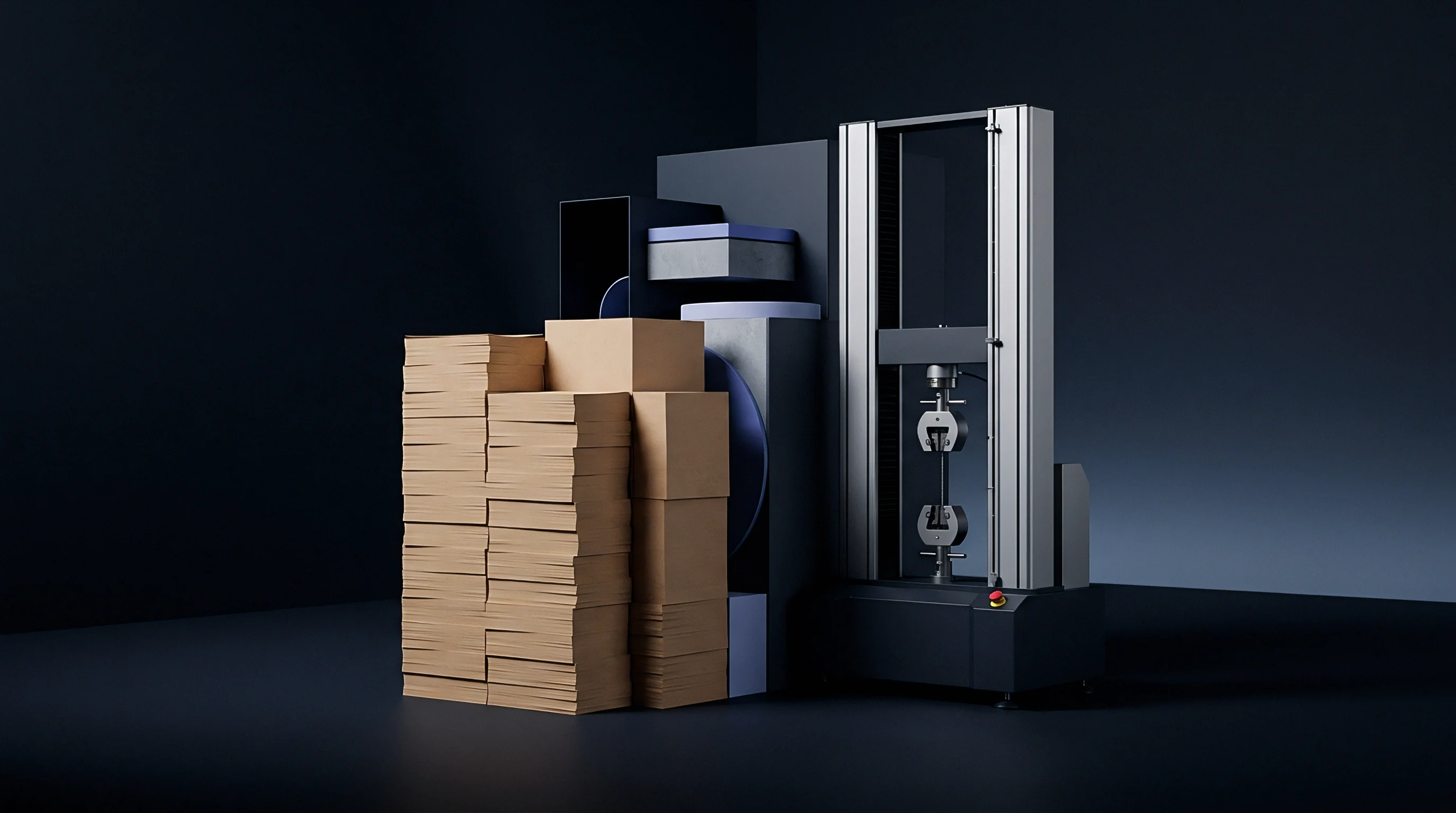
Measuring short span compression strength requires precise alignment of opposing pneumatic jaws separated by a 0.70 millimeter gap. Standard test method ISO 9895 defines the mechanical apparatus, requiring a specimen width of 15.0 millimeters and a constant clamping force between 2300 N and 2800 N. Clamp pressure alters results. Test span width remains fixed.
If clamping pressure drops below standard specifications, specimen slippage occurs inside the jaws, recording artificially low strength values. Conversely, excessive clamping pressure crushes the paperboard profile, initiating premature fiber wall failure prior to testing.
Why Does Short Span Compression Strength Fail First?
The short span measurement isolates pure compressive wall strength without allowing global panel buckling. Older compressive testing methodologies, such as the Ring Crush Test (RCT) per ISO 12192, allow long speciment strips to buckle during testing, introducing structural bending physics into a test intended to measure intrinsic fiber compression. Ring crush results reflect sheet stiffness and thickness heavily rather than pure fiber wall strength.
Recycled containerboard exhibits rapid short span decay because short span testing specifically measures fiber-to-fiber bond strength and cell wall integrity, both of which are directly degraded by repulping loops and moisture uptake.
| Test Parameter | Short Span Compression ISO 9895 | Short Span Compression TAPPI T 826 | Ring Crush Test ISO 12192 |
|---|---|---|---|
| Specimen Span Gap | 0.70 mm | 0.70 mm | 12.7 mm gauge groove |
| Specimen Width | 15.0 mm | 15.0 mm | 12.7 mm |
| Primary Failure Mode | Pure Micro Wall Compression | Pure Micro Wall Compression | Combined Buckling and Compression |
| Sensitivity to Moisture | High Fiber Bond Dependency | High Fiber Bond Dependency | Moderate Stiffness Dependency |
| Clamping Mechanism | Pneumatic Parallel Jaws | Pneumatic Parallel Jaws | Unclamped Guide Slot |
Laboratory Conditioning Protocols and Discrepancies
Pre-conditioning paper specimens at 20 percent relative humidity before final stabilization at standard 50 percent relative humidity removes historical moisture memory. Standard TAPPI T 402 protocols require pre-conditioning at low humidity to approach standard testing equilibrium strictly from a wetting path. Laboratory technicians who skip pre-conditioning or test specimens directly from unconditioned warehouse environments produce flawed test reports that overestimate field performance.
Sourcing errors compound rapidly.
Standard supply contracts referencing TAPPI T 826 compel mills to guarantee minimum clamping pressure precision during short span measurements.
Quality checks must adhere to strict pre-conditioning sequences to ensure laboratory reproducibility. Testing paperboard immediately after taking samples from hot, humid converting floors yields short span compression figures up to 25 percent lower than true conditioned standards. Converting buyers auditing mill certificates must verify that reported metrics reflect fully conditioned samples rather than quick dry-end mill-gate checks.
- Cut representative containerboard specimens exactly 15.0 millimeters wide using a dual-blade precision cutter to prevent edge-burr deformation.
- Place specimens inside a pre-conditioning atmosphere held between 10 and 35 percent relative humidity for a minimum of four hours.
- Transfer specimens into the standard conditioning room held at 23 degrees Celsius and 50 percent relative humidity for twenty-four hours per ISO 187.
- Set the short span test apparatus clamping force to exactly 2300 N ensuring parallel jaw alignment across the 0.70 millimeter gap.
- Insert the conditioned strip into the pneumatic jaws and initiate compressive loading at a constant compression rate of 3.0 millimeters per minute.
- Record ultimate peak compressive load in kilonewtons per meter across ten machine-direction and ten cross-direction test strips.
The question remains whether dynamic cyclic compression testing can replace static laboratory short span measurements in standard international purchasing agreements.
Clause
Commercial supply contracts for containerboard grades frequently specify minimum nominal short span values based on mill-gate testing. These specifications establish baseline material acceptances at the point of manufacture. Paper mills test freshly produced rolls at the reel end under optimal dry conditions, recording peak short span values on the official Mill Test Report (MTR).
By the time rolls arrive at overseas converting plants, ambient moisture pickup and transport vibration have reduced real compression capability below contract minimums.

Mill Test Report Certificate Discrepancies
Quality assurances provided on paper mill quality sheets routinely reflect pristine, reel-end samples taken prior to storage or maritime shipping. Mill certificates report average values across production runs, concealing wide basis weight and moisture variances across the web. A batch certified at 2.10 kN/m short span strength at the paper mill gate may deliver only 1.65 kN/m at goods-in inspection after multi-week transit in unconditioned shipping containers.
Sourcing engineers must insert environmental derivative clauses into supply contracts to account for expected transport decay.
Verifying certificates requires cross-referencing batch timestamps with ambient transit tracking logs. Unsized recycled testliner absorbs moisture aggressively through roll edges during transit. Outer layers of delivered paper reels often exhibit severe edge-softening, resulting in converted board fluting that fails short span standards along container margins while passing center-web sampling checks.

Grade Substitution Risks across Cross Border Corrugators
Converting facilities struggling with supply shortages sometimes replace semi-chemical virgin medium with recycled testliner. Recycled fluting loses stiffness. Corrugator operators adjust machine speeds and starch application rates to compensate for lower raw material stiffness, but thermo-mechanical processing cannot overcome fundamental short span compression deficits inherent in heavily recycled fibers.
- Guaranteed Minimum Short Span Thresholds contract terms defining absolute minimum compression values acceptable at destination goods-in inspection.
- Conditioning Protocol Standard Enforcement mandatory inclusion of ISO 187 pre-conditioning requirements within all supplier quality agreement documentation.
- Moisture Variance Penalty Scales financial deduction schedules triggered when roll moisture content exceeds standard contract upper bounds upon delivery.
- Batch Traceability Certificate Binding legal clauses linking specific roll serial numbers directly to certified reel-end physical test MTR datasheets.
Inserting standard purchase clause FEFCO-2024-B shifts financial liability for short span strength loss during maritime transit directly to the substrate supplier when moisture uptake exceeds contract thresholds.
Cost
Financial losses stemming from transit packaging collapse stem primarily from box compression strength overestimation. Box Compression Test (BCT) calculations traditionally rely on McKee formula derivatives that combine liner short span values and medium compression performance. Sourcing teams calculating target box strength using pristine laboratory short span metrics select undersized paper grammages.
When the converted boxes encounter real-world transit humidity, short span compression values decay, causes lower-tier box crushing, product damage, and supply chain insurance claims.
Box Compression Strength Safety Factor Financial Worked Example
Calculating target box compression strength requires applying the McKee formula using liner short span compression values alongside corrugating medium ring crush data. McKee empirical relationship establishes that box compression strength scales directly with the square root of short span compression strength multiplied by board flexural stiffness. When short span values drop by 30 percent during humid ocean transit, total box compression strength falls by approximately 18 to 22 percent depending on box perimeter dimensions.
Assume a high-volume export packaging program shipping 1,000,000 corrugated boxes annually for export electronics. Standard design calls for a 150 g/m² Recycled Testliner outer liner paired with a 120 g/m² Recycled Fluting medium. The baseline laboratory short span value of the liner is certified at 2.20 kN/m, producing a theoretical Box Compression Strength of 3.80 kN.
During a 30-day maritime shipping cycle through humid ocean lanes, real short span compression decays to 1.45 kN/m, reducing effective Box Compression Strength to 2.95 kN. This drops the safety factor from a target 2.2 down to 1.7, initiating lower-tier pallet crushing in transit.
| Sourcing Option & Substrate Strategy | Paper Tonnage Cost per Metric Ton | Design Safety Factor Baseline | Transit Strength Decay Percent | Landed Cost per 1,000 Delivered Boxes |
|---|---|---|---|---|
| Option A Standard Recycled Liner 140g | $620 | 1.80 | 35.0 | $1,240 |
| Option B Heavy Recycled Liner 170g | $610 | 2.25 | 32.0 | $1,480 |
| Option C High Performance Sized Recycled 140g | $710 | 2.10 | 12.0 | $1,310 |
Freight Volume Penalties and Grammage Downgauging Limits
Increasing liner basis weight compensates for moisture-induced strength loss but adds dead weight to container shipments. Sourcing 170 g/m² recycled liner instead of 140 g/m² liner raises material purchase costs per box while adding up to 600 kilograms of tare weight per 40-foot sea shipping container. Freight costs escalate fast.
Yield losses offset paper savings. Downgauging basis weight without specifying hydrophobic surface sizing or high-performance chemical bonding agents creates massive financial exposure to transit claims.
Optimizing landed cost per unit requires evaluating substrate selection through total cost per thousand undamaged delivered boxes rather than mill-gate paper price per ton. Investing in hydrophobically sized, high-performance recycled liners adds roughly $90 per metric ton in raw material cost while eliminating transit collapse risk entirely. Balancing basis weight selections against verified regional transport humidity profiles protects total margin across high-volume containerboard shipping contracts.