Z-Directional Density Gradient Modeling in High Impulse Multi-Ply Paperboard Dewatering
High impulse shoe pressing increases surface density and preserves bulk in multi-ply board, maximizing Taber stiffness while reducing grammage.

Strain
Deformation of a wet fibre network during press section passage follows complex non-linear mechanics. As liquid water moves through the saturated matrix, momentum transfer between the solid cellulose phase and the pore fluid generates localized internal stresses. Higher machine operating speeds elevate fluid drag forces exponentially.
This dynamic interaction alters local void fractions continuously from the entering nip zone to the exit boundary, dictating the ultimate spatial arrangement of dry fibre mass through the thickness of the paperboard.

Hydraulic Pressure Generation in Wet Web Compression
Fluid forced through microscopic channels creates resistive drag against the collapsing cellulosic matrix. During the initial phase of pressing, applied mechanical load converts into intra-web fluid pressure. This hydraulic pressure gradient pushes free pore water toward the felt surfaces, initiating steady dewatering.
In multi-ply structures, each layer exhibits distinct drainage resistance based on mean pore radius, fiber surface area, and chemical refining levels. When incoming web moisture exceeds critical saturation thresholds, total hydraulic pressure rises sharply, reducing the effective compressive stress acting on the fibre skeleton.
Dewatering capacity depends directly on maintaining an adequate effective stress level across all plies. The solid phase compresses only when effective stress exceeds the structural yield point of the wet web. High impulse press configurations extend the duration of applied pressure, permitting fluid dissipation without generating excessive hydraulic peaks.
Conversely, steep hydraulic gradients collapse fine pores prematurely near the felt interface, forming a dense boundary skin that inhibits subsequent water removal from the central core plies.
Viscoelastic Fiber Network Response under Peak Nip Loading
Fibre walls act as elastic springs filled with bound water. Under sudden compressive loads, individual wood fibres exhibit immediate elastic deformation followed by time-dependent viscous creep. High impulse pressing alters this viscoelastic spectrum by extending the duration of peak mechanical stress.
Extended compression times allow hydrogen-bonded networks within wet fibres to slip and reorient into denser configurations, permanently reducing inter-fibre distance. Warm web temperatures reduce liquid viscosity while lower temperatures increase it, accelerating fluid evacuation while lowering the dynamic yield strength of wet cellulose.
Mathematical modeling of this process links Darcy fluid flow with non-linear porous media mechanics. The constitutive equation balancing fluid pressure and matrix deformation relies on empirical permeability functions derived under compressive strain:
K(e) = K_0 exp(M e)
In this relationship, K represents directional permeability, e is the local void ratio, K_0 defines unstrained mat permeability, and M is an empirical compressibility exponent. For bleached hardwood kraft plies, M ranges between 4.2 and 6.1, whereas mechanical pulp plies carrying high fines fractions yield M values exceeding 9.5. This difference explains why mechanical core plies build immense hydraulic resistance under rapid compression, limiting dewatering efficiency unless pressing impulse profiles are carefully tailored.
The fundamental challenge remaining in dynamic strain modeling involves determining whether localized pore collapse under brief hydraulic surges is entirely reversible during web expansion at the nip exit.

Zone
Extended nip machinery alters the time domain of liquid removal. Traditional roll presses deliver sharp, short-duration pressure pulses that frequently exceed the structural capacity of wet webs. Shoe pressing replaces roll contacts with concave stationary shoes matched to mating flexible belts, extending the nip zone length from 50 millimetres to over 250 millimetres.
This geometry spreads mechanical energy over longer durations, maintaining peak hydraulic pressure below critical web rupture thresholds while maximizing total fluid flow.

Extended Dwell Times and Extended Nip Geometry
Shoe press configurations expand the pressing window from five milliseconds to over forty milliseconds at standard production speeds. Long dwell times shift the predominant dewatering mechanism from flow-limited hydraulics to stress-limited matrix consolidation. Under extended loading, pore fluid has sufficient time to escape dense central plies without developing destructive internal pressure peaks.
Peak press pressure can thus be optimized for surface smooth consolidation or interior bulk retention depending on the target paperboard grade.
Double-felted shoe press arrangements allow symmetrical bi-directional drainage, reducing total fluid travel distance by half. Moisture removal efficiency increases substantially when water exits through top and bottom surfaces simultaneously. Single-felted arrangements force all pore fluid through the un-felted side toward the single receiving fabric, increasing internal hydraulic gradient severity.
For multi-ply packaging grades above 220 grams per square metre, double-felted geometry prevents internal structural ply shift and minimizes Z-directional density asymmetry.
Felt Topography and Interface Hydraulic Impedance
Press fabric architecture governs surface void volume and local pressure distribution. Woven monofilament structures with coarse batt layer surfaces create non-uniform pressure points that imprint into the soft wet web, establishing localized high-density micro-zones. Fine non-woven surface felts distribute mechanical load evenly, producing a uniform z-directional compaction profile.
Hydraulic impedance at the felt-web interface remains a primary determinant of rewetting as the sheet exits the pressing zone.
| Nip Configuration | Dwell Time (ms) | Peak Pressure (MPa) | Press Impulse (kPa·s) | Exit Dryness (% Solid) | Z-Gradient Index |
|---|---|---|---|---|---|
| Single-Felted Roll Press | 4.2 | 6.5 | 14.1 | 41.2 | 1.85 |
| Double-Felted Roll Press | 5.1 | 5.8 | 15.2 | 43.5 | 1.62 |
| Single-Felted Shoe Press | 28.5 | 3.2 | 45.6 | 48.1 | 1.41 |
| Double-Felted Shoe Press | 32.0 | 3.8 | 60.8 | 52.4 | 1.18 |
Maximum water removal without density collapse occurs when pressing duration increases while peak nip pressure remains below the structural crush threshold of the furnish.
Felt design must match the specific hydraulic capacity requirements of the target web basis weight.
Profile
Cross-sectional density variations emerge directly from the balance between fluid drag and structural resistance. In multi-ply paperboard, achieving an ideal z-directional density distribution is essential for maximizing bending stiffness per unit mass. Placing dense, highly consolidated plies at the outer surfaces while preserving a thick, low-density bulk structure in the central core plies optimizes the structural moment of inertia.
High impulse dewatering allows papermakers to engineer this density profile with precision.

Density Distribution across Multi-Ply Board Strata
Outer plies experience the highest solid fraction due to rapid initial dewatering at the felt faces. High surface compaction creates dense outer skins with elevated elastic modulus. Central plies, shielded from extreme peak mechanical pressures by fluid cushioning effects, maintain high specific volume.
Modern multi-ply board machines utilize distinct furnish blends in top, middle, and bottom plies to capitalize on this structural phenomenon.
Uncontrolled z-directional compaction degrades structural efficiency. If peak press pressure is applied too rapidly, core plies collapse, losing bulk without contributing significantly to outer skin strength. Conversely, insufficient surface pressing leaves top and bottom plies porous, lowering tensile strength, surface smoothness, and printing ink holdout.
Precise modeling of the z-density profile enables predictable optimization of mechanical strength properties.
- Surface Layer Consolidation High peak pressure near felt interfaces increases local density above 950 kilograms per cubic metre, enhancing surface tensile strength and smoothness.
- Core Bulk Retention Extended dwell pressing preserves central ply bulk below 550 kilograms per cubic metre, maximizing total sheet thickness per gram of raw fibre.
- Permeability Matching Micro-refining top plies while keeping core plies free-draining prevents steep hydraulic pressure accumulation at ply boundaries.
- Interface Void Minimization Uniform compaction across ply junctions prevents air void accumulation that weakens internal bond integrity under converting shear forces.
Substrate thickness measured under ISO 534 conditioning at 23 °C and 50 percent relative humidity drops by eight percent when shoe press peak pressure increases from 3.0 to 5.0 MPa.
Failing to control the z-directional density gradient leads directly to deficient Taber bending stiffness, forcing converters to increase total sheet basis weight to satisfy box compression requirements.
Mass
Raw material selection dictates the hydraulic permeability and viscoelastic relaxation rate of each individual layer. Fully bleached chemical pulps deform easily under compressive loads, forming tightly bonded, dense networks. Mechanical pulps, such as Bleached Chemithermomechanical Pulp (BCTMP), contain stiff, lignin-rich fibres that resist permanent compaction.
Integrating BCTMP into central board plies provides structural resilience, maintaining core bulk even under intense pressing impulses.
Mechanical Pulp Fines Retention and Flow Resistance
Microscopic cellulosic fragments accumulate within web interstices during rapid dewatering. Fines migrate toward felt surfaces along fluid flow streamlines, creating localized zones of low permeability. This phenomenon increases flow resistance dynamically during press passage.
High fines levels in recycled fiber furnishes aggravate internal hydraulic pressure, limiting the maximum permissible press impulse before wet web crushing occurs.
Chemical additives assist in maintaining matrix permeability under press loads. Retention aids aggregate fine particles onto larger coarse fibres, preventing their movement into narrow pore necks. Deaeration chemicals remove micro-bubbles from stock suspensions, reducing fluid compressibility and stabilizing hydraulic pressure transmission through the web.
Proper wet-end chemistry management stabilizes the dewatering process, allowing higher press impulses without compromising internal drainage channels.
| Layer Position | Furnish Type | Specific Volume (cm³/g) | Permeability (10⁻¹³ m²) | Compressive Modulus (MPa) |
|---|---|---|---|---|
| Top Ply | 100% Bleached Hardwood Kraft | 1.15 | 1.2 | 14.5 |
| Upper Middle | 100% BCTMP (Aspen) | 2.45 | 8.5 | 3.2 |
| Lower Middle | 100% BCTMP (Spruce) | 2.60 | 11.2 | 2.8 |
| Bottom Ply | 100% Unbleached Softwood Kraft | 1.30 | 3.4 | 11.0 |
Spring Back Phenominology and Web Rewetting
As the paperboard leaves the nip exit, compressed fibres expand elastically. This physical relaxation creates internal vacuum forces inside the expanding pore network. Liquid held within receiving felts is drawn back into the paperboard surface unless fabric separation occurs cleanly at the precise instant of expansion.
High felt moisture content accelerates water re-absorption, reducing net dry content by up to four percentage points.
Paperboard flexural properties evaluated under ISO 2493 guidelines require stiffness variations across production batches to remain within a plus or minus five percent tolerance band.
High shoe press roll temperatures reduce web rewetting by altering water surface tension at the felt boundary.
Split
Internal web delamination occurs when outward hydraulic forces exceed the inter-ply cohesion strength. During press nip exit, rapid mechanical decompression coincides with residual fluid pressure trapped in dense core layers. If internal fluid pressure exceeds Z-directional tensile strength at any plane, the multi-ply structure separates internally, causing catastrophic strength loss during subsequent converting and folding operations.

Hydraulic Shear at Weak Inter-Ply Boundaries
Fluid pressure gradient peaks near the ply interfaces where basis weight and furnish changes create permeability mismatches. Water flowing laterally along high-permeability boundaries generates shear stresses that weaken inter-fiber bonding. High speed web movement accelerates these hydro-dynamic shear forces.
Proper couch pressure and starch application between plies before wet pressing bolster interface shear resistance, ensuring structural integrity during high impulse compression.
Scott Bond test procedures quantify this internal structural strength by measuring energy absorption during rapid out-of-plane fracture. Low Scott Bond values correlate directly with high peak hydraulic pressure experienced in the second press position. Optimizing the pressing impulse curve spreads dewatering work across multiple press nips, maintaining internal hydraulic pressure below the dynamic Scott Bond strength envelope of the wet web.
- Verify incoming sheet dryness into the shoe press section exceeds thirty-eight percent solid content using high-speed microwave moisture sensors.
- Adjust shoe pressure profile tilt to shift peak pressure location toward the final five millimetres of the shoe zone.
- Regulate felt vacuum dewatering boxes to keep press fabric moisture below three hundred and fifty grams of water per square metre of felt.
- Monitor post-press Scott Bond values continuously to detect micro-delamination before structural failure appears on converting lines.
Inter-ply strength drops rapidly when fluid flow velocities parallel to the web surface exceed critical laminar limits.
Standard supply contracts specify that internal bond values measured under TAPPI T 569 must exceed one hundred and sixty Joules per square metre to withstand high-speed rotary die-cutting stresses.


Arithmetic
Financial returns on press section modernization stem from basis weight reduction while maintaining target bending rigidity. Modernizing wet pressing allows paperboard manufacturers to engineer sharp z-directional density gradients, concentrating high-density, high-modulus fibers in outer plies while preserving bulky mechanical pulps in central core plies. This structural arrangement maximizes bending stiffness per unit mass, enabling significant downgauging without sacrificing box compression performance.
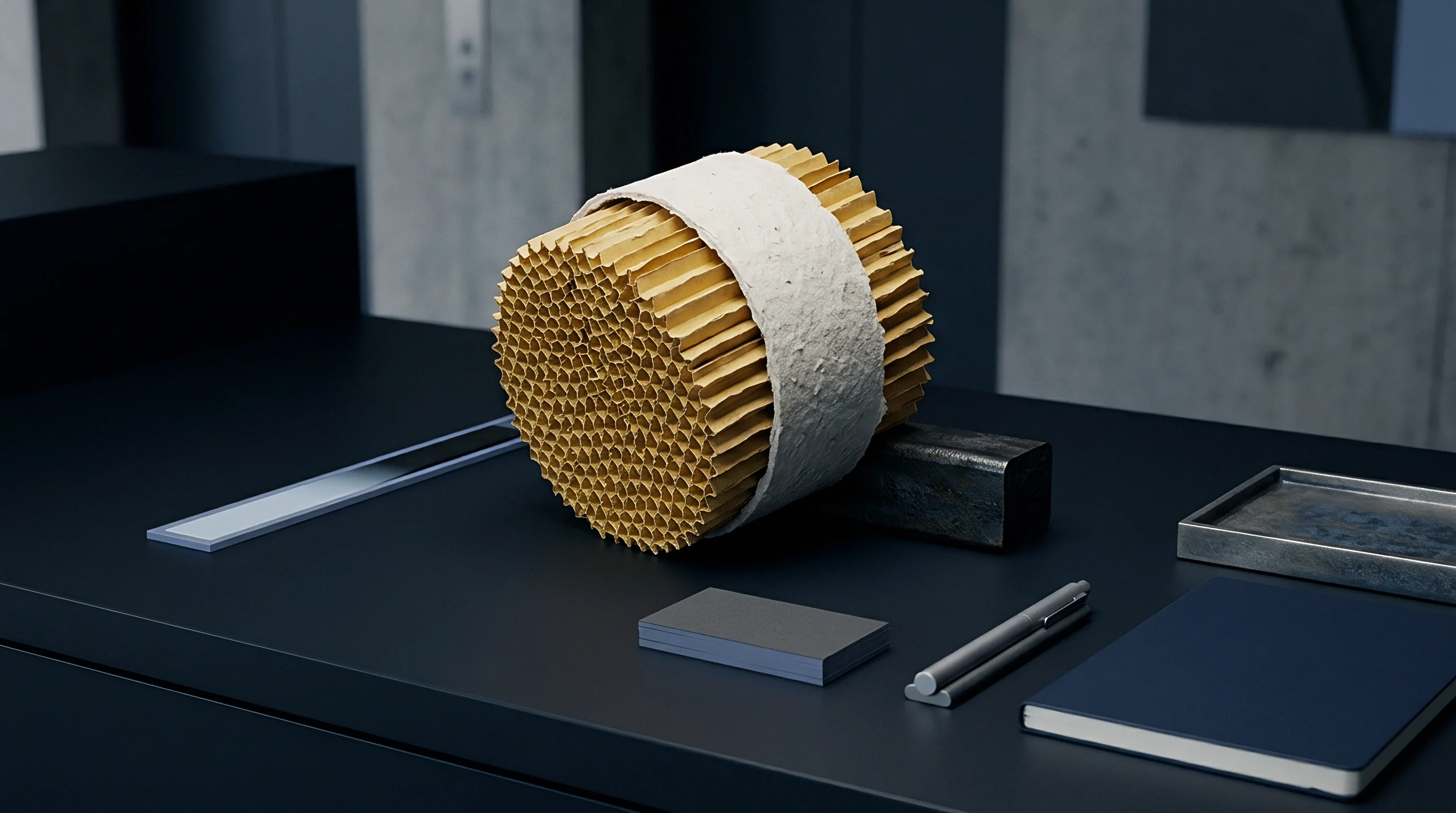
Core Furnish Savings via Z-Density Profile Control
Replacing virgin bleached sulphate pulp in middle plies with high-yield thermo-mechanical pulp lowers material expenditure. Consider a target specification requiring 15.0 milliNewton-metres of Taber 15-degree bending stiffness in a 300 gram per square metre paperboard structure. Under conventional roll pressing, achieving this stiffness requires a bulk of 1.30 cubic centimetres per gram, demanding high proportions of expensive softwood kraft fibre throughout the sheet cross section.
Implementation of an optimized double-felted shoe press alters this economic balance. By compressing top and bottom plies to a density of 980 kilograms per cubic metre while preserving core ply bulk at 2.50 cubic centimetres per gram, total sheet thickness increases at equivalent basis weight, or basis weight decreases at equivalent thickness. The mathematical relationship governing bending stiffness (E I) illustrates this operational advantage:
S_b = Integral( E(z) z² dz )
Where S_b is total bending stiffness, E(z) represents the elastic modulus as a function of z-directional position, and z is distance from the neutral axis. Concentrating high-modulus material at maximum z values increases stiffness exponentially due to the squared term.
Consider a practical downgauging scenario converting a conventional 300 gsm multi-ply board line to an optimized high-impulse press configuration. Assume an annual production volume of 100,000 metric tonnes, raw fibre costs averaging 750 USD per tonne for chemical pulps and 480 USD per tonne for high-yield mechanical pulps, and fixed conversion overheads. The calculations assume a constant Taber 15-degree bending stiffness target of 15.0 mNm across both manufacturing routes.
| Parameter | Conventional Roll Pressing | High Impulse Shoe Pressing | Delta / Benefit |
|---|---|---|---|
| Basis Weight (gsm) | 300.0 | 270.0 | -30.0 gsm (-10.0%) |
| Total Sheet Thickness (µm) | 390.0 | 391.5 | +1.5 µm (+0.4%) |
| Top Ply Density (kg/m³) | 780.0 | 980.0 | +200.0 kg/m³ (+25.6%) |
| Core Ply Density (kg/m³) | 680.0 | 400.0 | -280.0 kg/m³ (-41.2%) |
| Bottom Ply Density (kg/m³) | 820.0 | 990.0 | +170.0 kg/m³ (+20.7%) |
| Chemical Fibre Share (%) | 65.0 | 45.0 | -20.0 percentage points |
| Mechanical Fibre Share (%) | 35.0 | 55.0 | +20.0 percentage points |
| Fibre Cost per Tonne (USD) | 655.50 | 601.50 | -54.00 USD/tonne (-8.2%) |
| Annual Fibre Consumption (t) | 100,000 | 90,000 | -10,000 tonnes (-10.0%) |
| Total Annual Fibre Cost (USD) | 65,550,000 | 54,135,000 | -11,415,000 USD/year |
The resulting financial gain comprises two distinct mechanisms: raw material mass reduction through basis weight downgauging, and lower unit fibre blend cost achieved by substituting chemical pulp with high-yield mechanical pulp in the core layer.
Downgauging Strategy for High-Impulse Multi-Ply Board
Engineers achieve significant paperboard weight reductions by optimizing the z-directional elastic modulus profile. Lowering total web weight by ten percent while maintaining flexural performance reduces transportation costs, lowers EPR eco-tax liabilities, and increases paper machine productivity in dryer-limited operations. Higher post-press dryness accelerates production speeds, reducing steam consumption per tonne of water evaporated.
- Furnish Distribution Review Allocate long softwood kraft fibres exclusively to outer plies to maximize surface tensile modulus, replacing core chemical pulp with stiff mechanical fibres.
- Impulse Profile Calibration Adjust shoe press pressure curves to deliver high peak mechanical strain at outer surfaces while keeping core fluid pressure below crushing thresholds.
- Clothing Optimization Implement high-void-volume, non-marking press felts engineered to absorb rapid fluid pulses without inducing surface rewetting at high machine speeds.
- Goods-In Stiffness Checks Validate delivered paperboard lots using Taber stiffness testing combined with cross-sectional micro-density profiling to confirm structural compliance.
Calculated savings alter pulp selection. Reduced fibre volume requirements allow paperboard mills to reinvest capital into advanced press clothing and automated profile controls. Lower basis weight packaging sheets satisfy stringent environmental sustainability requirements without compromising structural protective performance across demanding supply chain environments.