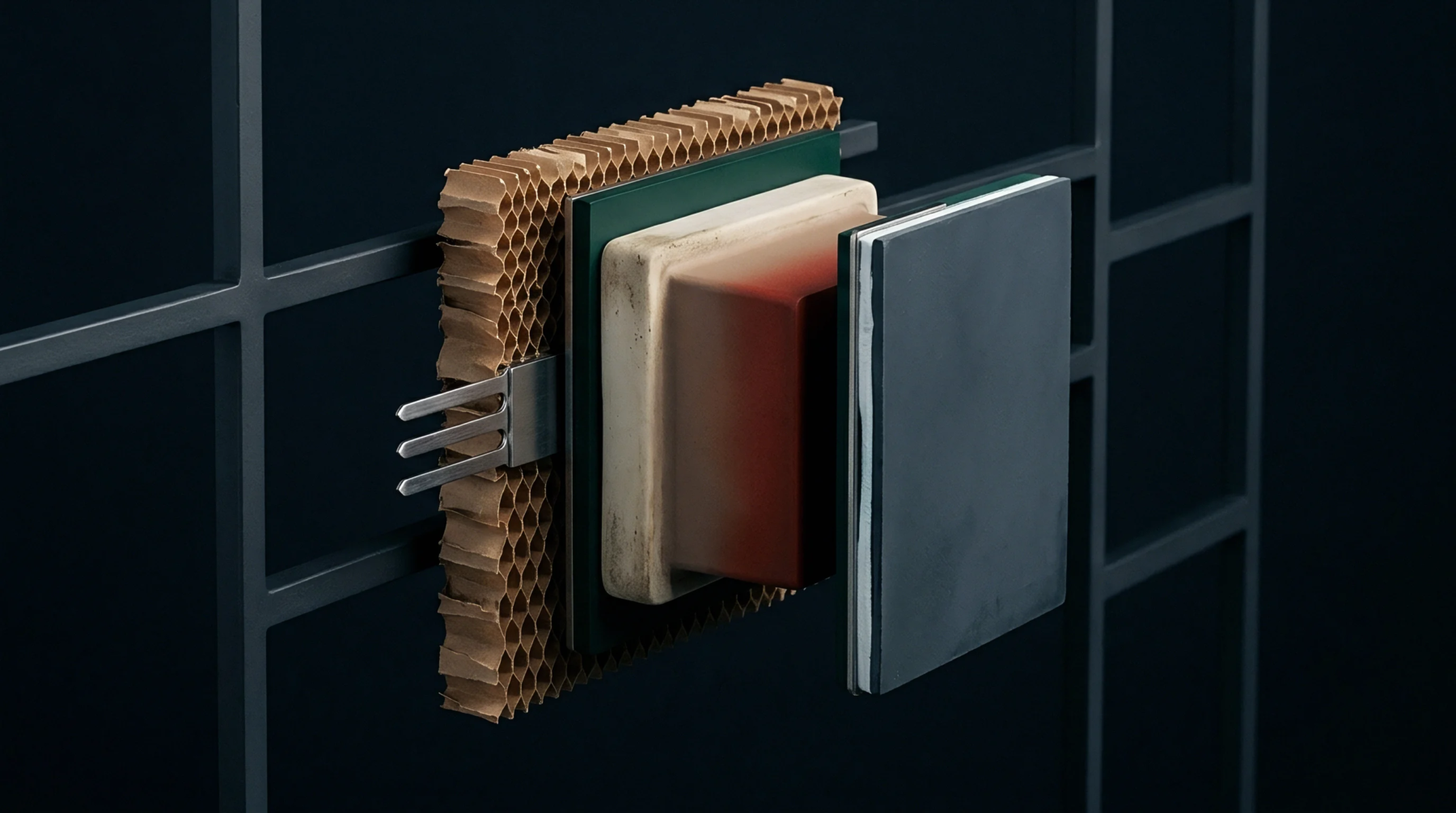
Structural Deformation
Mechanical pre-conditioning creates localized channels in paperboard sheets to facilitate precise folding along predefined hinge lines without cracking the top liner or coating. The mechanical action of scoreline creasing forces creasing rules into underlying matrix channels, causing controlled internal delamination within the board structure. Delamination reduces bending stiffness along the creased line, allowing ninety-degree and one-hundred-eighty-degree folds to form cleanly.
This converting operation applies to folding boxboard and solid bleached board grades, but does not apply to lightweight printing papers.
Tooling Configuration
Creasing performance depends on precise matching between creasing rule thickness and matrix channel width relative to paperboard caliper. Proper scoreline creasing requires matrix depth to equal board thickness while matrix width equals twice board thickness plus rule width. Incorrect matrix sizing causes surface cracking or uneven fold angles on high-speed carton erecting machines.
Converting plants select steel creasing rules and calibrated counter-plates to maintain uniform groove geometry across die-cutting plates.
Folding Reliability
Well-formed scorelines reduce bending resistance, enabling high-speed automatic packaging lines to erect and fill folding cartons without machine jams. Inadequate scoreline creasing leaves high residual spring-back force in carton flaps, causing glued seams to pop open during shipping and storage. Quality control laboratories measure bending force and crease recovery angles using automated crease stiffness testers.
Optimizing crease depth and geometry ensures clean appearance and structural integrity in finished paperboard containers. Precise scoreline preparation protects visual branding and extends package service life.