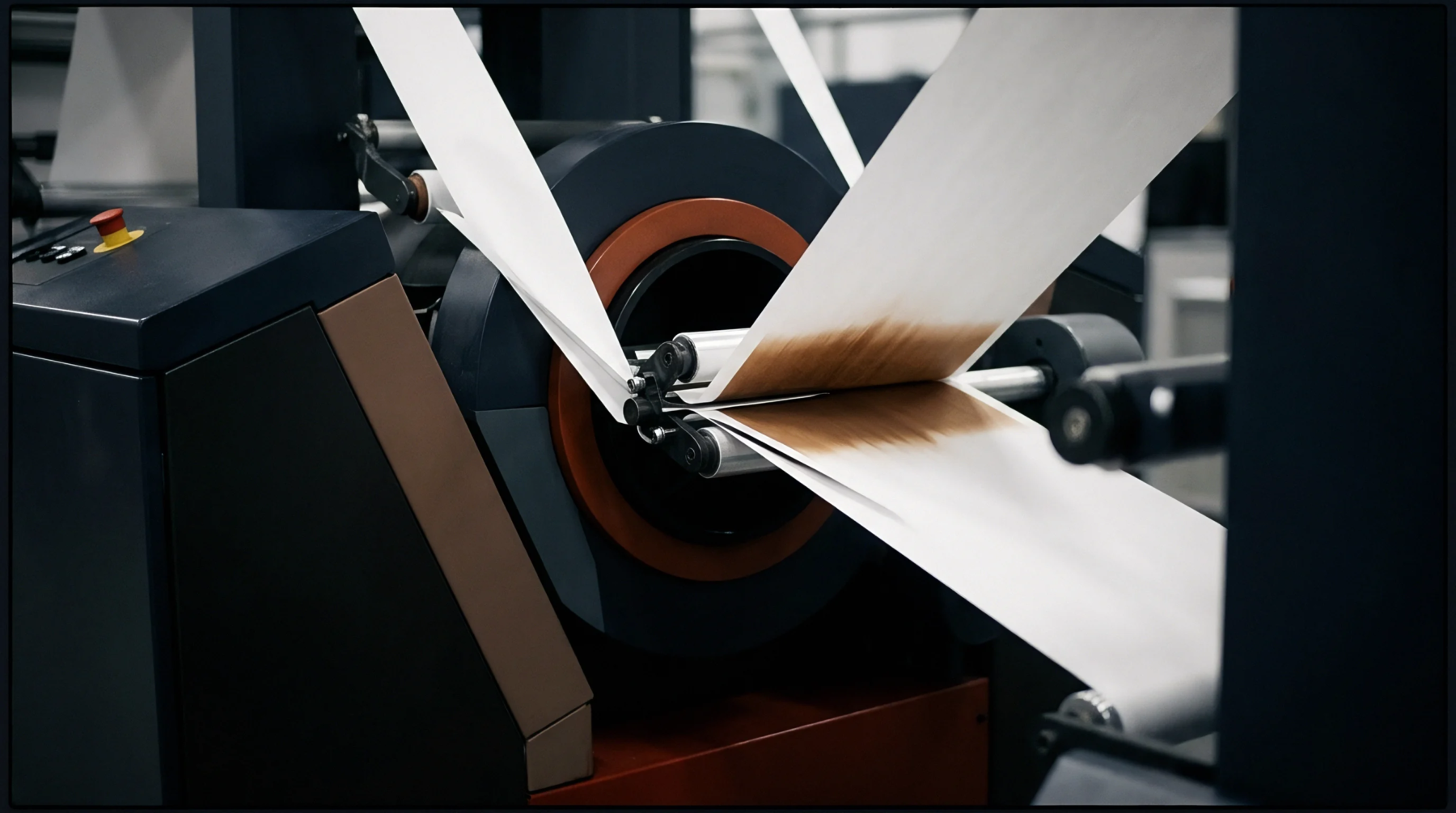
Adhesive Interface Morphology
Gelatinized polymeric networks join corrugated flute tips to facing linerboards, forming a structural bridge that transfers mechanical shear throughout paper packaging. A starch bond line originates as an aqueous suspension of raw corn, wheat, or tapioca starch carried in an alkaline, cooked carrier phase applied precisely across flute crests. Thermal energy from heated corrugating rolls rapidly drives the ungelatinized starch granules past their gelatinization threshold, swelling the polymers and driving moisture into the adjacent paperboard fibres.
The resulting adhesive meniscus dries into a rigid, crosslinked matrix spanning the paper-to-paper junction. Mechanical cohesion fails if the starch fails to reach its swelling temperature or if the paperboard rapidly siphons off water before the adhesive can wet the paper fibres.
Bond Formulation Physics
Formulations employ the Stein-Hall system, balancing uncooked starch solids within a cooked, viscous carrier containing sodium hydroxide and borax. A starch bond line relies on the caustic soda to lower the natural gelatinization temperature of raw starch granules from seventy degrees down to approximately sixty degrees Celsius. Borax increases the complexing capacity of the carrier, establishing high tack and structural viscosity the moment heat strikes the applied glue line.
Capillary suction pulls carrier water into the linerboard surface, anchoring polymer chains into the porous fibre network while radiant heat cooks the remaining raw granules. If the paperboard sizing prevents adequate wetting, the adhesive beads on the surface without mechanical interlock, yielding brittle, easily separated bond interfaces.
Structural Box Performance
Mechanical performance of shipping boxes directly correlates with the uniformity and structural mass of each corrugated glue joint. Defective starch bond line formation causes dry bond failures, blister separations, or zipper cuts where flutes peel freely from linerboards under minor shear stress. Box manufacturers evaluate bond integrity via standard pin adhesion tests, requiring uniform fiber tear across every flute tip to prove total adhesive penetration.
Excessively wide adhesive lines waste raw material, over-saturate paper plies, and provoke washboarding, where linerboards sag inward between flutes to ruin high-resolution flexographic print fidelity.