Hygro-Mechanical Creep Mitigation in Recycled Packaging Medium Specifications
Mitigating hygro-mechanical creep in recycled containerboard requires dynamic humidity testing and wet-strength starch cross-linking in raw specifications.


Mechanics
Recycled containerboard fluting undergoes progressive structural strain under sustained compressive loads. In cold-chain logistics and maritime shipping, ambient relative humidity fluctuates between fifty percent and ninety percent. This environmental dynamic triggers a physical phenomenon known as mechano-sorptive creep.
Mechano-sorptive behavior accelerates irreversible material deformation beyond pure viscoelastic creep measured under constant ambient conditions. Fibre bonds break. Humidity drives creep.
Water molecules enter the amorphous regions of cellulose microfibrils during moisture adsorption. This influx disrupts intermolecular hydrogen bonds, allowing adjacent microfibrils to slip under load before reforming bonds at higher moisture contents.
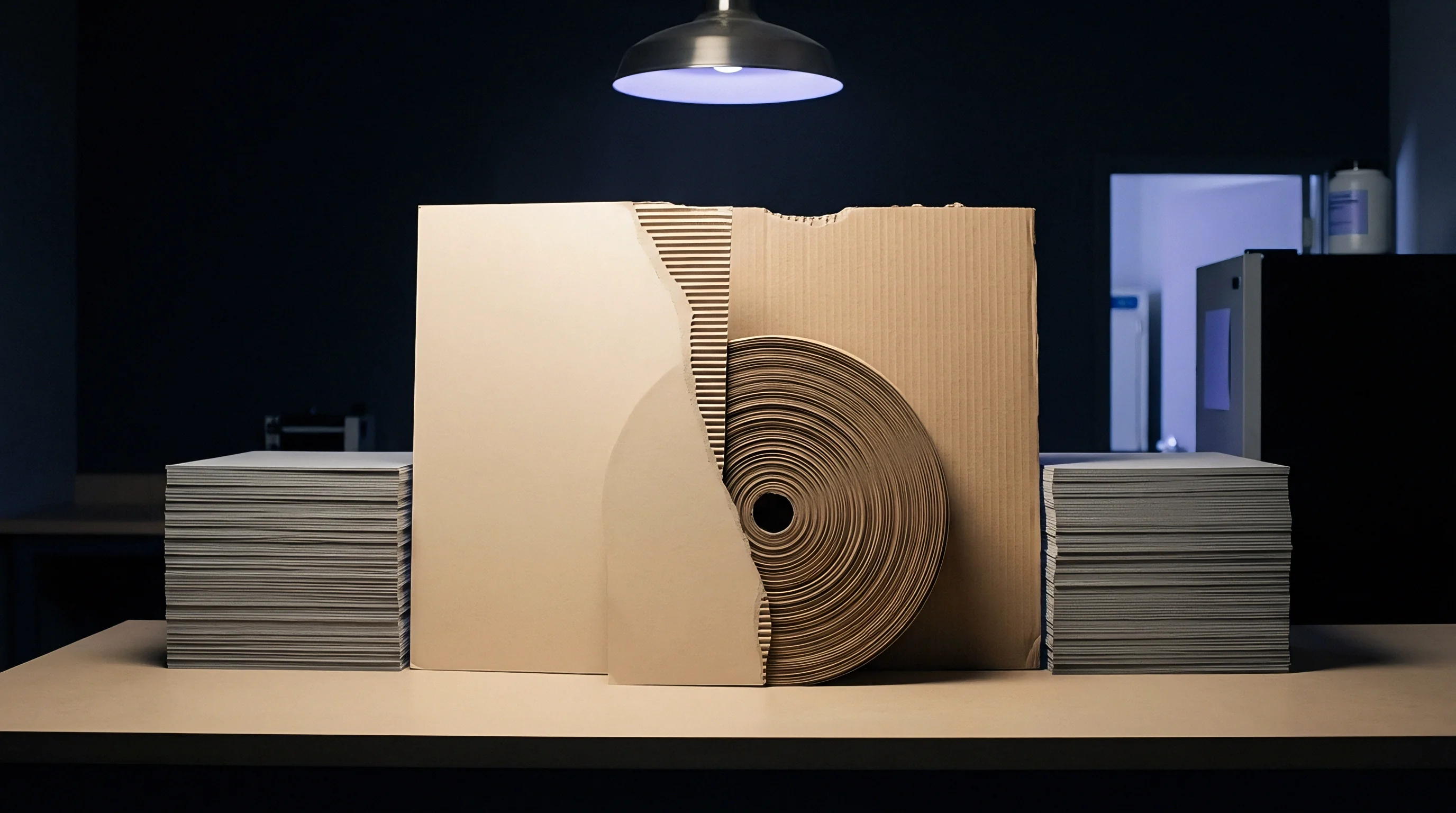
Viscoelastic versus Mechano-Sorptive Strain Dynamics
During desorption phases, evaporating water contracts the fibre network, creating localized transient stress spikes within the corrugated web. Repeating adsorption-desorption cycles act as a mechanical ratchet. Each humidity cycle induces incremental permanent set, rapidly eroding structural box compression resistance.
Recycled fibres display elevated sensitivity to this mechanism because repeated repulping causes fibre hornification, shorter average fibre lengths, and a higher fraction of broken microfibrils. Cellulose swells under moisture.
| Substrate Grade | Basis Weight (g/m²) | Fibre Composition | Static Strain Rate at 80% RH (%/hr) | Cyclic Strain Rate at 50-80% RH (%/hr) | Mechano-Sorptive Acceleration Factor |
|---|---|---|---|---|---|
| Semi-Chemical Virgin Fluting | 120 | 100% Virgin NSSC Hardwood | 0.012 | 0.028 | 2.33x |
| High-Performance Recycled Medium | 120 | 100% Recovered Fibre (OCC/Mixed) | 0.024 | 0.089 | 3.71x |
| Standard Testliner 3 | 120 | 100% Mixed Waste Paper | 0.038 | 0.165 | 4.34x |
| Starch-Reinforced Recycled Medium | 130 | 100% Recovered Fibre + GPAM | 0.018 | 0.045 | 2.50x |
| Data measured according to modified ISO 9830 short-span compression creep testing over 72 hours at 23°C with 6-hour humidity square-wave steps. | |||||
Under cyclic humidity between fifty and eighty percent relative humidity, recycled containerboard exhibits creep rates up to four times higher than under static eighty percent humidity at identical static compression loads.

Micro-Fibre Slip Mechanisms in Secondary Fibres
Cellulose networks in recycled papers contain a reduced number of active inter-fibre contact points compared to virgin chemical pulps. Hornification stiffens internal cell walls, limiting the conformability of secondary fibres during sheet formation. Consequently, external loads concentrate stress across fewer hydrogen bonding nodes.
As moisture diffuses through the web, high stress concentrations at these nodes trigger localized shear failures. Whether sub-micron cross-linking of starch at the size press can fully suppress hydrogen-bond slip without compromising repulpability remains an open empirical question across high-speed paper machines.
Furnish
Secondary paper stocks derived from post-consumer waste collections contain compromised cellulose fibres. Paper mills classify raw waste inputs according to standardized European standard EN 643 or equivalent regional grades. Selection of inputs directly governs the structural resilience of recycled corrugated medium.
Lower-tier OCC fractions carry elevated fine contents, ash loads, and degraded starch residues, which impair sheet formation and inter-fibre bonding. Secondary fibres lose length. Hemicellulose retains water easily.

Fibre Quality and Fibre Bond Degradation
Fibre morphology degrades with each recycling loop. Recycled pulps exhibit diminished swellability and lower beaten freeness, necessitating chemical intervention to recover mechanical strength. Cationic wet-end starches and synthetic strength agents improve initial dry compression, yet their efficacy diminishes when ambient humidity rises.
- Elevated Ash Content reduces available cellulose surface area, weakening hydrogen bond density across the internal web.
- Fibrillar Shortening limits stress transfer across adjacent fibres, concentrating mechanical shear on residual bonding nodes.
- Residual Contaminants such as waxes and stickies create void networks that accelerate moisture vapor migration into the sheet core.
- Pore Structure Collapse caused by fibre hornification reduces water uptake capacity while increasing sensitivity to localized structural slip.

Chemical Surface Sizing and Internal Strength
Applying surface size press treatments mitigates moisture diffusion into the fibre network. Hydrophobic sizing agents, including alkyl ketene dimer and alkenyl succinic anhydride, restrict liquid capillary transport. Synthetic polymers like polyamidoamine-epichlorohydrin deliver wet-strength retention, locking fibre junctions against moisture-induced slipping.
Claims of recycled content under FSC-STD-40-004 require physical accounting ledgers that separate certified post-consumer furnish from uncertified waste streams prior to size-press chemical dosing.
Chain of Custody Claims and Audit Scopes
Chain of custody frameworks under FSC-STD-40-004 and PEFC ST 2002 dictate accounting methods for recycled fibre content declarations. Converting plants buying containerboard verify that certified percentage or credit claims match the specific production run. A certificate issued for a mill entity does not automatically validate that every paper grade produced on site meets certified recycled thresholds.
Section 5.2 of EN 643 limits non-paper components to one percent by weight, which restricts insoluble contaminants that disrupt wet-end starch retention and structural strength development.

Crate
Corrugated packaging integrity depends on flute geometry and board structural rigidity under vertical loads. Converting paper mediums into corrugated board introduces complex geometric stress profiles. Flute profile geometry, such as B, C, or EB double-wall configurations, dictates stress distribution across the container linerboards and fluting medium.
Shear forces multiply. Safety margins collapse. Stacking loads multiply.

Flute Geometry and Stress Concentration
Flute tip bonding surfaces transfer vertical compressive loads into shear forces across the corrugated fluting medium. Under cyclic moisture environments, the flute tips experience asymmetric hygro-expansion, causing micro-delamination at the starch adhesive line. Heavy-duty C-flute and A-flute profiles provide higher vertical column strength but exhibit greater susceptibility to mechano-sorptive wall buckling compared to tighter B-flute profiles.
- Flute Selection specifies B-flute or BC-double wall profiles to balance geometric strain resistance with vertical load capacity in dynamic storage environments.
- Starch Adhesive Formulation mandates water-resistant cross-linked resin additions to prevent flute-liner bond line failure during humidity cycles.
- Linerboard Grammage Matching pairs high-performance recycled fluting with balanced outer liner weights to minimize hygro-expansion curling.
- Creasing Geometry adjusts creasing wheel profiles to prevent micro-cracking of secondary fibres along horizontal box folds.

McKee Formula Deficiencies in Cyclic Humidity
The traditional McKee formula estimates Box Compression Test strength using Edge Crush Test values, caliper, and box perimeter. Standard McKee calculations assume static ambient testing at twenty-three degrees Celsius and fifty percent relative humidity. In real-world cold chains, relative humidity fluctuations invalidate standard McKee constants.
Dynamic humidity exposure weakens the fluting medium faster than outer linerboards, causing early structural collapse before reaching predicted peak BCT values.
Designing corrugated packaging for high-humidity storage requires sizing the structural safety factor against long-term fatigue rather than peak static load strength.
Heavy-duty corrugated structures exposed to variable ambient conditions maintain stability when wall thickness takes precedence over raw paper basis weight additions.


Assurance
Validating long-term load performance in recycled packaging mediums requires rigorous test protocols. Standard static testing methods fail to replicate supply chain realities. Dynamic climate chamber testing subjects containerboard samples to programmed humidity cycling while maintaining constant vertical compression loads.
Dynamic moisture destabilizes boxes. Standard laboratory tests fail.

How Do Humidity Fluctuation Bands Drive Fibre Slip?
Fluctuating relative humidity induces cyclic moisture adsorption and desorption within the paper matrix. As relative humidity steps from fifty percent to eighty-five percent, water molecules penetrate the cellulose lattice, weakening hydrogen bonds and inducing transient inter-fibre slipping. When relative humidity drops back to fifty percent, internal moisture evaporates, locking the displaced fibres in their strained positions.
Repeating this cycle multiplies structural creep exponentially compared to constant relative humidity exposure.
| Standard Reference | Primary Test Parameter | Environmental Conditioning | Measured Output | Compliance Criterion |
|---|---|---|---|---|
| ISO 9830 | Compressive Creep Rate | 50% to 90% RH Cycling at 23°C | Secondary Creep Rate (%/hr) | < 0.050 %/hr under 40% load |
| TAPPI T843 | Short-Span Compressive Strength (SCT) | 50% RH at 23°C (ISO 187) | Peak Load per Width (kN/m) | > 2.2 kN/m for 120 g/m² medium |
| ISO 12048 | Box Compression Creep Resistance | Dynamic RH Chamber over 72h | Deflection Time to Failure (hr) | Zero structural collapse at 72h |
| EN 13430 | Material Recyclability Evaluation | Standard Laboratory Repulping | Coarse Reject Fraction (%) | < 1.5% non-repulpable residue |
| BfR XXXVI | Direct Food Contact Safety | Extraction via Cold/Hot Water | MOSH/MOAH Migration Limits | Below specific detection limits |
Standardized Testing Procedures for Mechano-Sorptive Creep
- Condition test specimens at twenty-three degrees Celsius and fifty percent relative humidity for twenty-four hours in accordance with ISO 187.
- Mount the specimen into a short-span compression creep fixture configured with continuous load cells inside a programmable environmental chamber.
- Apply a static compressive load equal to forty percent of the predetermined short-span compressive strength value.
- Cycle ambient relative humidity between fifty percent and ninety percent at six-hour intervals while maintaining constant ambient temperature.
- Record deformation rate continuously over seventy-two hours to calculate the secondary mechano-sorptive creep rate coefficient.
Laboratory test reports using static room conditions fail to predict structural collapse during oceanic container transport across climate zones.
Paper mills often maintain that laboratory test results under static fifty percent relative humidity fulfill specification commitments despite field collapse occurring under unconditioned transit environments.


Calculus
Determining the structural safety margin for corrugated boxes in humid supply chains demands exact mathematical modeling. Static strength calculations over-state load capacity by failing to integrate load duration and moisture cycling degradation factors. Water weakens hydrogen bonds.
Creep reduces box strength. Pallets fail quietly. Engineering calculations apply reduction factors that account for recycled fibre content and dynamic logistics conditions.
Deriving the Long-Term Load Retention Factor
Structural load capacity decays over time under sustained loading. The long-term load retention factor balances environmental relative humidity, duration of storage, and fibre composition. For virgin semi-chemical mediums under constant fifty percent relative humidity, a standard safety factor of 1.6 suffices.
For recycled mediums subjected to dynamic humidity cycling between sixty percent and eighty-five percent over ninety days, environmental and creep reduction factors decrease usable compression resistance significantly.

Worked Case Study in Cold-Chain Containerboard Sizing
Consider a palletized shipment of agricultural produce stored for sixty days in cold storage with relative humidity cycling between sixty-five percent and ninety percent. Assume a top box dead load requirement of 120 kilograms per bottom box. Standard static testing indicates an initial Edge Crush Test value yielding an initial Box Compression Test strength of 3,200 Newtons.
Applying environmental safety factors: ambient humidity reduction factor of 0.55 for 90% RH exposure, load duration factor of 0.65 for 60 days of storage, and mechano-sorptive creep reduction factor of 0.50 for untreated recycled fluting medium.
Calculated long-term usable BCT = 3,200 N x 0.55 x 0.65 x 0.50 = 572 Newtons.
The required static design capacity exceeds 6,700 Newtons to survive sixty days of cyclic storage. The initial specification of 3,200 Newtons fails under operational conditions.
| Medium Grade | Basis Weight (g/m²) | Initial BCT (N) | 30-Day Retained BCT (N) | 60-Day Retained BCT (N) | 90-Day Retained BCT under Cyclic RH (N) |
|---|---|---|---|---|---|
| Standard Recycled Medium | 120 | 3,200 | 1,144 | 572 | 343 |
| Surface-Starch Recycled Medium | 140 | 3,800 | 1,626 | 988 | 646 |
| GPAM-Crosslinked Medium | 140 | 4,100 | 2,132 | 1,465 | 1,066 |
| Semi-Chemical Virgin Medium | 120 | 4,400 | 2,574 | 1,944 | 1,514 |
Underestimating structural creep coefficients leads to lower stack collapse thresholds, resulting in product damage claims and secondary repacking expenses at importing freight terminals.


Exposure
Commercial liability for transport damage rests on documented technical compliance. When structural failure occurs in international freight, claims shift to party declarations and raw material specifications. Buyers specifying recycled packaging mediums align procurement contracts with verifiable performance thresholds under dynamic climate conditions.
Landed costs increase. Customs holds cost money.
Regulatory Dossier Integrity and Green Claims Enforcement
Enforcement of environmental declarations under the European Union Packaging and Packaging Waste Regulation and anti-greenwashing provisions demands physical proof of recyclability and recycled content origins. Statements claiming high recycled content without chain of custody documentation risk border detentions and regulatory penalties. Packaging dossiers under EN 13430 demonstrate that chemical additives used to mitigate creep, such as wet-strength resins or cross-linked starches, do not impede repulpability during standard paper recycling operations.
Commercial Risk Allocation in Paper Procurement Contracts
Procurement contracts that rely exclusively on static burst strength or room-temperature ring crush test values expose buyers to unrecoverable losses. Defining performance parameters around cyclic humidity short-span compression creep under ISO 9830 shifts technical responsibility to the paper mill. Procurement specifications contain explicit quality assurance clauses governing maximum permitted moisture-induced strain rates and mandatory audit frequency for recycled content claims.
Contractual specifications that enforce verification across dynamic humidity conditions secure legal remedies when shipments collapse before reaching retail shelves.