Short Span Compressive Creep Evaluation for Recycled Packaging Board
Short-span compressive creep evaluation reveals that recycled containerboard loses over fifty percent of stacking strength under cyclic humidity within thirty days.

Load
Under sustained stress, compressive failure in recycled containerboard develops through localized micro-buckling of cellulose structures long before nominal yield points are reached. Paperboard specified for packaging corrugated boxes faces constant static loads when stacked inside warehouses. Standard testing regimes measure instant peak force over a tiny gap using short-span compression methods.
These standard short span compression strength values capture ultimate material resistance across a zero point seven millimeter free span, a setting designed to prevent gross panel buckling and force pure compressive fiber failure.
Static compression behavior diverges sharply from instantaneous strength tests once duration extends from seconds to weeks. Under sustained dead loads, recycled paperboard exhibits viscoelastic deformation characteristics. Viscoelastic creep reduces the effective compressive capacity of recycled linerboard and fluting mediums over operational storage cycles.
Fiber networks deform continuously under sustained loads far below initial short-span peak ratings, accumulating displacement until tertiary creep triggers structural collapse.
Viscoelastic Deformation Mechanics in Short Span Testing
Standard compression measurements evaluate instant peak resistance while ignoring time-dependent dimensional drift. Measuring short span compressive strength per ISO 9895 or TAPPI T 826 yields an ultimate force metric expressed in kilonewtons per meter. This value reflects short-term material performance under rapid loading rates.
Under sustained static loading, recycled containerboard exhibits three distinct creep phases: primary creep with decelerating strain, secondary creep with constant strain rate, and tertiary creep leading to sudden rupture. Recycled fibers lose structural integrity under constant mechanical stress faster than virgin softwood fibers.
| Containerboard Grade | Nominal Grammage (gsm) | ISO 9895 SCT Peak Strength (kN/m) | 1000-Hour Creep Rupture Stress (kN/m) | Sustained Load Capacity Ratio (%) |
|---|---|---|---|---|
| Unbleached Kraftliner | 140 | 3.45 | 2.55 | 73.9 |
| Testliner 1 (Recycled) | 140 | 2.85 | 1.45 | 50.8 |
| Recycled Fluting Medium | 120 | 2.10 | 0.98 | 46.6 |
| High-Performance Testliner | 170 | 3.60 | 1.95 | 54.1 |
Static Thresholds versus Sustained Compression Survival
Containerboard swatches exposed to continuous mechanical forces experience progressive strain accumulation as the initial instantaneous elastic response transitions into irreversible plastic deformation. Recycled containerboard contains shorter fibers, fine content, and disrupted inter-fiber hydrogen bonding networks. These microstructural characteristics lower the threshold stress required to initiate inter-fiber slip.
Under identical normalized stress ratios, secondary creep rates in recycled testliner exceed those of virgin kraftliner by over forty percent.
A 140 gsm recycled testliner retaining 2.85 kN/m short-span compressive strength at 50% relative humidity experiences structural failure under a constant 1.45 kN/m stress within 450 hours.
Mill datasheets routinely emphasize peak short-span force measurements to claim structural equivalence between virgin and recycled linerboard, ignoring the accelerated bond slippage that occurs under prolonged static compression.
Cycling
Relative humidity fluctuations accelerate mechanical deformation in paperboard by triggering transient moisture gradients across sheet thickness. Moisture movement through hydrophilic cellulose acts as a mechanical strain amplifier: as ambient humidity shifts, water molecules enter or leave the cellulose fiber wall. This transient flux induces mechano-sorptive creep at rates that exceed static humidity creep rates by an order of magnitude.
Paper packaging stored in non-conditioned logistics hubs faces relentless ambient humidity cycles.
Evaluating short span compressive creep under cyclic humidity reveals severe structural vulnerabilities in recycled furnish grades that standard constant-environment test reports mask. Recycled testliner subjected to humidity cycles between fifty percent and eighty-five percent relative humidity demonstrates rapid strain accumulation. Moisture absorption weakens hydrogen bonds, while desorption locks displaced fibers into strained configurations, driving additional non-recoverable displacement with every cycle.
Mechano-Sorptive Creep Acceleration Factors
Water molecules entering and leaving cellulose networks during environmental transitions break active inter-fiber hydrogen bonds under load. As relative humidity rises, moisture adsorption plasticizes the amorphous cellulose and hemicellulose matrix, allowing applied compressive force to slide adjacent microfibrils past one another while bonds are temporarily broken. When relative humidity drops, new hydrogen bonds form in deformed positions.
Because recycled fibers absorb water rapidly, the combined effect of mechanical load and moisture transport creates cumulative strain progression that far outpaces simple creep at constant high humidity.
Consider a 140 gsm recycled testliner carrying a constant compressive load equal to thirty-five percent of its static short span compressive strength. Under steady fifty percent relative humidity, the baseline creep strain rate equals 0.012 percent strain per hour during the secondary creep phase. When subjected to a twelve-hour relative humidity cycle alternating between fifty percent and eighty-five percent relative humidity, the average strain rate increases to 0.065 percent strain per hour ~ a mechano-sorptive acceleration factor of 5.42 for this recycled substrate.
Over a 30-day storage period, total accumulated compressive strain reaches 4.68 percent under cyclic conditions compared to 0.86 percent under static humidity, crossing the critical deflection threshold for structural box buckling.
Dynamic moisture absorption accelerates creep strain significantly faster than exposure to a constant high humidity environment.
Creep Strain Extrapolation Models
Predicting time-to-failure requires applying non-linear viscoelastic power law equations to short-term test data. Standard short span creep testing under cyclic environmental conditions utilizes accelerated time-temperature and time-humidity superposition principles. Creep strain as a function of time follows modified Findley power law formulations incorporating a mechano-sorptive shift factor, which depends on relative humidity amplitude, cycling frequency, and furnish origin.
- Hydrogen Bond Redistribution breaking and reforming of hydroxyl bonds during transient water vapor transport under applied force
- Transient Hygro-Expansion Strain local swelling gradients creating micro-shear stresses between adjacent fiber plies
- Matrix Softening plasticization of amorphous cellulose and residual hemicellulose as localized moisture content spikes above twelve percent
- Pore Space Collapse progressive closure of micro-voids in recycled fiber networks leading to irreversible sheet thinning
Whether chemical surface sizing agents can suppress water vapor diffusion rates sufficiently to prevent mechano-sorptive bond rearrangement in recycled pulp remains an active industrial debate.

Clamping
Instrument geometry in short-span testing isolates sheet stiffness by restricting the unsupported test length to less than one millimeter. The ISO 9895 standard mandates a free span of zero point seven zero millimeters between clamp faces to prevent sheet buckling, ensuring pure compressive stress field conditions across the specimen cross-section. Deviations in clamping gap dimension drastically alter measured failure modes: increasing free span distance to one millimeter introduces Euler column buckling phenomena, while decreasing free span below zero point six millimeters causes severe stress concentration and localized crushing at clamp edge boundaries.

Why Does Free Span Clamping Precision Modulate Creep Rates?
Deformation readings require uniform force application across the sample surface to prevent localized stress concentration. In short span creep evaluation, clamping mechanics control measurement accuracy. Pneumatic clamps must exert sufficient pressure to prevent specimen slip during extended testing periods without crushing the paperboard structure.
Excessive clamping pressure fractures internal fiber walls along the grip line, while insufficient clamping pressure allows micro-slippage, producing false creep strain signals.
| Standard Designation | Free Span Distance (mm) | Clamping Pressure (kPa) | Specimen Width (mm) | Dominant Measurement Error Source |
|---|---|---|---|---|
| ISO 9895 | 0.70 ± 0.05 | 2300 ± 500 | 15.0 ± 0.1 | Pneumatic pressure drift causing micro-slip |
| TAPPI T 826 | 0.70 ± 0.05 | 2300 ± 500 | 15.0 ± 0.1 | Clamp face misalignment inducing shear gradient |
| ASTM D7030 | 0.70 ± 0.07 | 2000 ± 400 | 15.0 ± 0.2 | Relative humidity chamber sensor calibration drift |
| Test methods require environmental conditioning stability within ± 2.0 percent relative humidity and ± 0.5 degrees Celsius prior to clamp engagement. | ||||
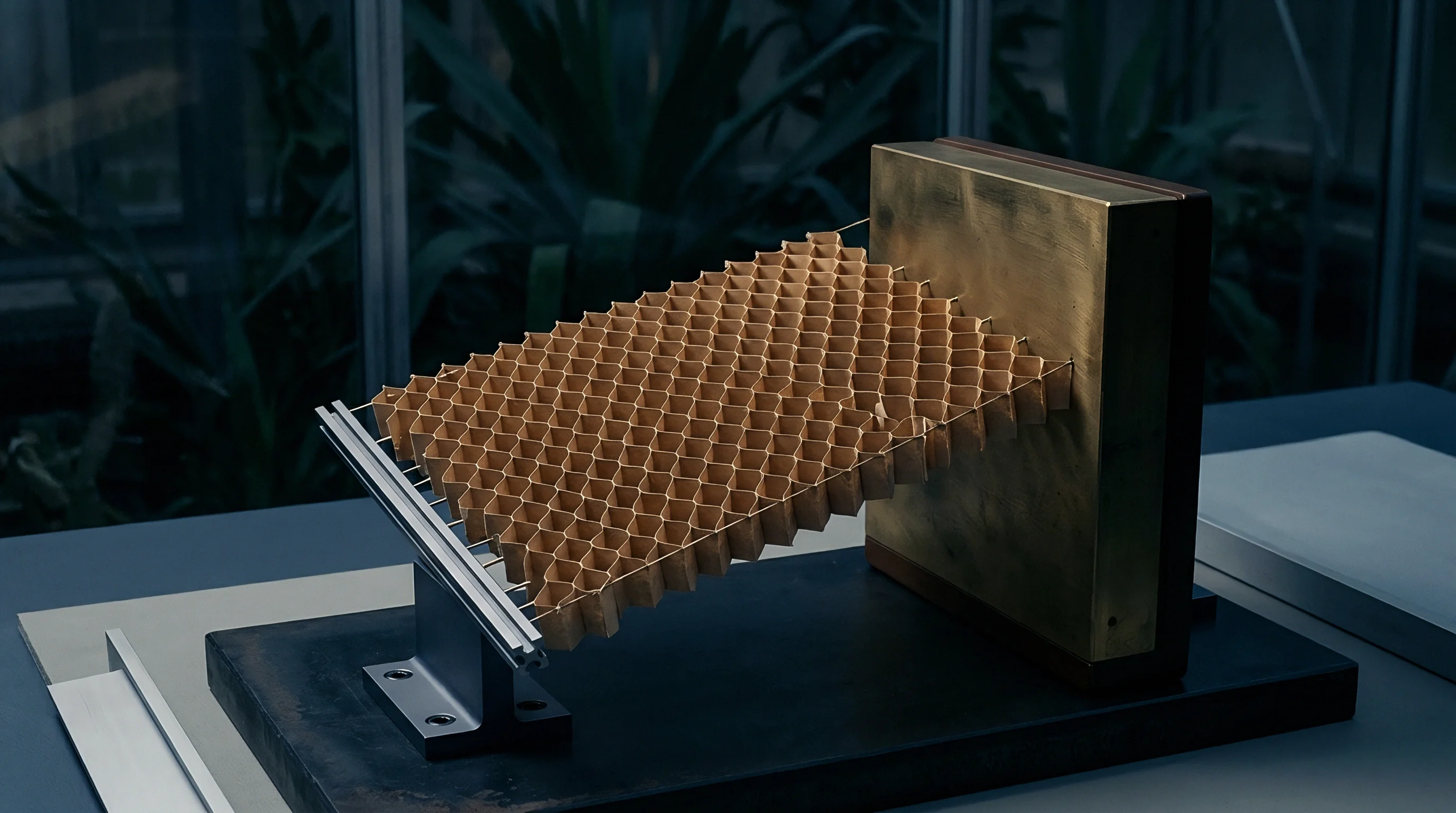
Boundary Condition Artifacts in Standardized Methods
Variations in side clamping pressure introduce friction gradients that alter measured compressive strain values. Physical alignment of upper and lower clamp surfaces must remain parallel within tight micrometer tolerances. Parallelism errors force unequal load distribution across the fifteen-millimeter specimen width, accelerating localized creep along one edge and initiating early structural failure.
ISO 9895 specifies clamp surface parallelism within two micrometers across the test width to avoid artificial reduction of measured compressive strength values.
Executing accurate short-span creep evaluation requires strict adherence to bench preparation steps.
- Align test jaws using an optical alignment gauge to verify parallelism across the full fifteen millimeter clamping width.
- Set pneumatic clamp pressure to twenty-three hundred kilopascals using a calibrated digital pressure transducer.
- Verify free span distance setting at exactly zero point seven zero millimeters using precision feeler gauges.
- Position the relative humidity environmental chamber around the test jaws and stabilize conditions at fifty percent relative humidity.
- Mount the paper specimen without introducing pre-stress or localized bending along the free span axis.
Clause 7.3 of ISO 9895 defines maximum permitted clamping face tilt tolerances, preventing early specimen failure from being misattributed to material defects when bench alignment falls out of specification.
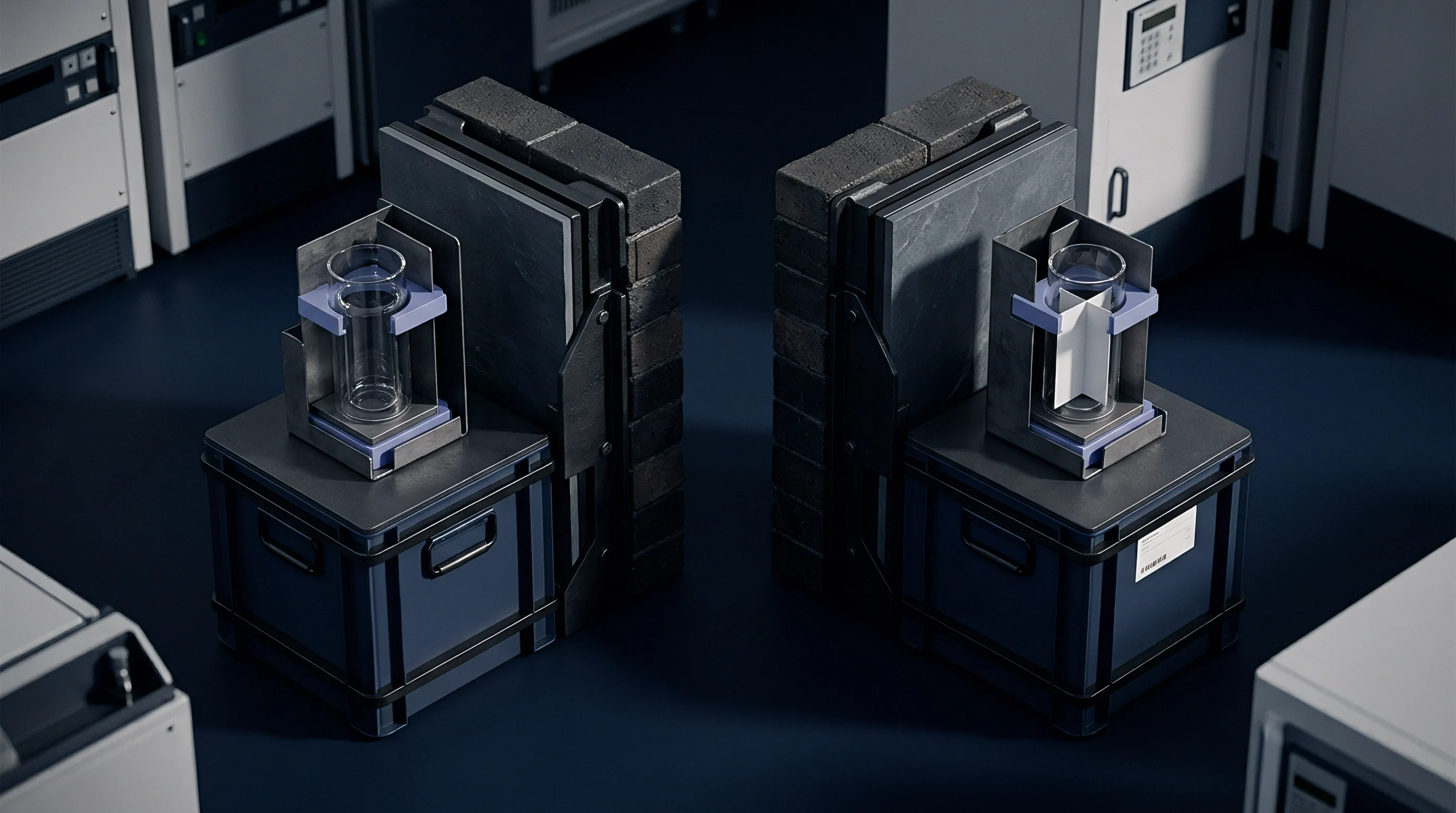

Fiber
Secondary pulp undergoes structural hornification during repeated drying cycles, permanently altering internal swelling potential. Recycled furnish consists of fibers that have experienced multiple repulping, pressing, and thermal drying sequences. Thermal processing causes irreversible micro-fibrillar collapse within fiber walls; these hornified fibers exhibit reduced flexibility and lower specific surface area available for hydrogen bonding.
Consequently, recycled paperboards depend heavily on starch additions to meet initial short span compressive strength targets.
Fibre quality dictates long-term performance under sustained compression. Hornified recycled fibers absorb water differently than virgin fibers: while virgin softwood fibers retain flexible hemicellulose structures that accommodate moisture shifts, recycled fibers possess rigid, pore-restricted cell walls. Under compressive loading, recycled fiber networks concentrate mechanical stress at brittle inter-fiber bond nodes, where added surface starches soften rapidly under high relative humidity and trigger a loss of inter-fiber cohesion.
Recycled Furnish Degradation and Microstructural Collapses
Repeated repulping shrinks cellulose lumen dimensions and reduces inter-fiber bonding surface area. Recycled containerboard contains high proportions of short hardwood fibers and fines, which increase sheet density but offer minimal length for load transfer across compressive shear planes. Because fiber length governs compressive yield, low-aspect-ratio recycled fibers subjected to short span compressive creep evaluation slip past each other under lower sustained loads than long virgin softwood fibers.
Higher fines content accelerates secondary creep rates by increasing the density of stress-concentrating fiber ends per unit volume.
Chemical Additives and Moisture Isotherm Behavior
Wet-end starches increase initial dry compression values but degrade rapidly during humidity cycling. Paper mills apply cationic starches and synthetic strength resins to elevate static short span compressive strength numbers, reinforcing dry inter-fiber contacts. However, native starches are highly hydrophilic, and exposure to relative humidity above seventy percent plasticizes synthetic starch matrices.
While sizing chemicals reduce bulk liquid water penetration, they fail to stop individual water vapor molecules from migrating into cellulose amorphous regions; hydrophilic additives then exacerbate mechano-sorptive creep by holding moisture directly within inter-fiber contact zones.
- Hornification Index Assessment evaluating fiber water retention value to quantify structural collapse resulting from prior recycling loops
- Fines Fraction Quantification measuring the ratio of short micro-fibers that impair load distribution across the sheet matrix
- Residual Starch Analysis determining the concentration of enzymatic starches susceptible to moisture-induced plasticization
- Hemicellulose Content Verification auditing chemical pulp ratios to ensure adequate bound water stability under environmental flux
Ignoring recycled pulp degradation profiles when specifying containerboard grammage results in catastrophic pallet collapses during high-humidity transit, triggering immediate customer chargebacks and full inventory rejections.
Warehousing
Stacking endurance for packaged goods depends directly on preserving the structural integrity of containerboard elements under prolonged shelf storage. Corrugated boxes piled on warehouse pallets experience vertical compressive dead loads for months, during which box compression test values determined in laboratory conditions drop steadily. Containerboard creep in box corners accounts for over eighty percent of total vertical box deflection, with testliner yielding higher creep rates: as recycled linerboard flutes undergo short-span compressive deformation, box corners crease and outward panel bulging accelerates.
Converting short-span compressive creep evaluation metrics into reliable box stacking life predictions demands accurate environmental profiling for safety factor calculation. Traditional safety factors used in packaging design assume virgin fiber performance characteristics under stable humidity; applying historical multipliers to 100% recycled packaging boards operating in variable logistics environments creates severe structural risk, as capacity decays non-linearly over time when static dead loads combine with cyclic relative humidity exposure.

Translating Short Span Creep to Box Compression Decay
Classical formulas calculating box compression resistance rely on static material constants that fail under variable storage climates. The McKee formula estimates box compression test strength using short span compressive strength, total caliper, and box perimeter, but standard McKee calculations assume fixed material strength values. In long-term warehousing, short span compressive strength is a time-dependent variable affected by creep strain, where dynamic relative humidity cycling reduces effective resistance according to a logarithmic decay function.
Stacking safety factors must therefore be scaled upward when replacing virgin kraftliner with recycled testliner.
| Corrugated Board Combination | Outer / Medium / Inner Grammage (gsm) | Static 50% RH BCT Retention (%) | Static 80% RH BCT Retention (%) | Cyclic 50-85% RH BCT Retention (%) |
|---|---|---|---|---|
| Virgin Kraft / Virgin Medium / Virgin Kraft | 170K / 120HP / 170K | 88.5 | 68.2 | 52.4 |
| Recycled Testliner 1 / Recycled Medium / Testliner 1 | 170T / 120R / 170T | 76.2 | 48.1 | 28.5 |
| High-Performance Recycled / Recycled Medium / Recycled | 170HPR / 140R / 170HPR | 81.0 | 54.3 | 35.8 |
Safety Factor Adjustments for Recycled Packaging Stocks
Engineering containerboard structures requires revising traditional load multipliers to compensate for accelerated mechano-sorptive strain. Standard packaging handbooks recommend a safety multiplier of 2.0 for normal warehouse environments, but for recycled packaging boards exposed to unconditioned maritime transit or tropical storage, the realistic environmental creep safety factor must be increased to 3.5 or 4.0. Failure to adjust design multipliers results in creep rupture during transit.
Recycled corrugated boxes stored under fluctuating humidity lose over half of their initial stacking capacity within thirty days.
Initial box compression test results recorded in a dry laboratory offer no guarantee of long-term pallet stability in uncontrolled storage environments.