Tensile Creep Behavior in Uncoated Folding Boxboard Grids
Uncoated boxboard grid ligaments fail through accelerated tensile creep when humidity swings break fiber bonds, requiring slot geometries that limit local dead-load stress.

Notch
Interlocking partition assemblies in cartonboard packaging suspend fragile products within distinct cells, transferring vertical stack forces into lateral tensile stresses across narrow board sections. When bottles or electronic housings sit on pallet tiers, vibration and sustained top weight drive the crossing partition blades against each other. This geometry channels static dead loads into the base of each cut slot.
Uncoated folding boxboard resists initial displacement through the network stiffness of its chemical pulp surface plies. Over weeks in static storage, continuous tension relaxes fiber-fiber bonds within those critical ligaments. Dead loads pull relentlessly.
Cellulosic networks react to sustained mechanical force through timed deformation stages. The primary phase begins immediately upon load application, displaying a decelerating strain rate as individual cellulose fibrils shift along their longitudinal axes. Within uncoated folding boxboard, this stage lasts between twelve and forty hours under typical warehouse conditions.
The material enters secondary creep when the deformation rate stabilizes into a predictable, nearly linear velocity. Fiber segments within the network slip across hemicellulose matrices without total structural disintegration. Interlocking slits concentrate dead weight directly onto uncut board ligaments.
Shear yields first. The stress profile surrounding a square-bottomed or radiused slot knife reveals severe micro-shear zones parallel to the flute or cross-machine direction. Because folding boxboard features anisotropic mechanical values, tensile creep resistance drops by more than fifty percent when tensile stresses act across the cross direction rather than the machine direction.
Web ligaments measuring under fifteen millimeters wide experience localized yielding while average partition stresses remain far below the static tensile breaking limit.
- Ligament thinning develops when continuous lateral drag pulls the uncut web below its nominal caliper, collapsing inner mechanical pulp voids before surface plies rupture.
- Z-direction delamination occurs at the knife radius as shear stress tears the bond between the chemical top layer and the groundwood interior.
- Slot widening allows suspended bottles to tilt, shifting product weight onto carton sidewalls never designed for sustained vertical loads.
- Micro-buckling along the compressed edge opposite the tension zone induces premature secondary creep across the entire grid intersection.
Fibers slip steadily. When convert knives strike dull against folding boxboard sheets during high-speed platen blanking, micro-fissures appear at the base of the slot before any load enters the packaging. These fractures act as stress multipliers during secondary creep.
Over prolonged storage, micro-fissures connect through the fiber matrix, initiating the tertiary creep stage where deformation accelerates exponentially toward structural collapse. When web ligaments fail under these unmonitored tensile stresses, entire pallet layers lean and compress lower tiers, breaking primary packaging seals and destroying product clearance.

Plies
Multi-ply paperboard structures combine differentiated fiber furnishes to balance bending stiffness against total raw material weight. In virgin folding boxboard, bleached chemical kraft pulp constitutes the outer liner layers, providing high tensile modulus and fracture toughness. Groundwood or chemi-thermomechanical pulp fills the middle layer to build bulk and thickness at minimum mass.
Uncoated grades expose these porous surfaces directly to atmospheric vapor. Moisture breaks hydrogen bonds.
A static tensile load equal to forty percent of ultimate tensile strength produces rupture in uncoated folding boxboard within ninety hours at sixty-five percent relative humidity.
Atmospheric humidity alters the molecular mechanics of cellulose creep. Water molecules diffuse into amorphous carbohydrate domains, plasticizing the hemicellulose binder that anchors individual wood fibers. Under sustained tensile loads, this softening accelerates fibril rearrangement.
Mechano-sorptive creep magnifies total strain when relative humidity cycles between day and night cycles. Uncoated boards lack barrier films or polyethylene coatings, so moisture sorption occurs across the exposed fibrous faces within minutes of ambient shifts.

How Do Slot Tolerances Accelerate Ligament Failure?
Slot clearances cut into boxboard partitions dictate how evenly loads distribute across interlocking tabs. Tight interference fits force opposing boards into continuous lateral friction, maintaining static normal forces that aggravate localized tensile fields. Loose slots allow partition blades to tilt out of vertical alignment under product vibration.
This tilt introduces an out-of-plane peel stress directly at the base of the cut slot, compounding the in-plane tensile creep vector.
- Mount precision ground slotted dies with calibrated gap gauges set to board thickness plus five percent.
- Condition test sheets for twenty-four hours in conformance with ISO 187 atmospheric controls.
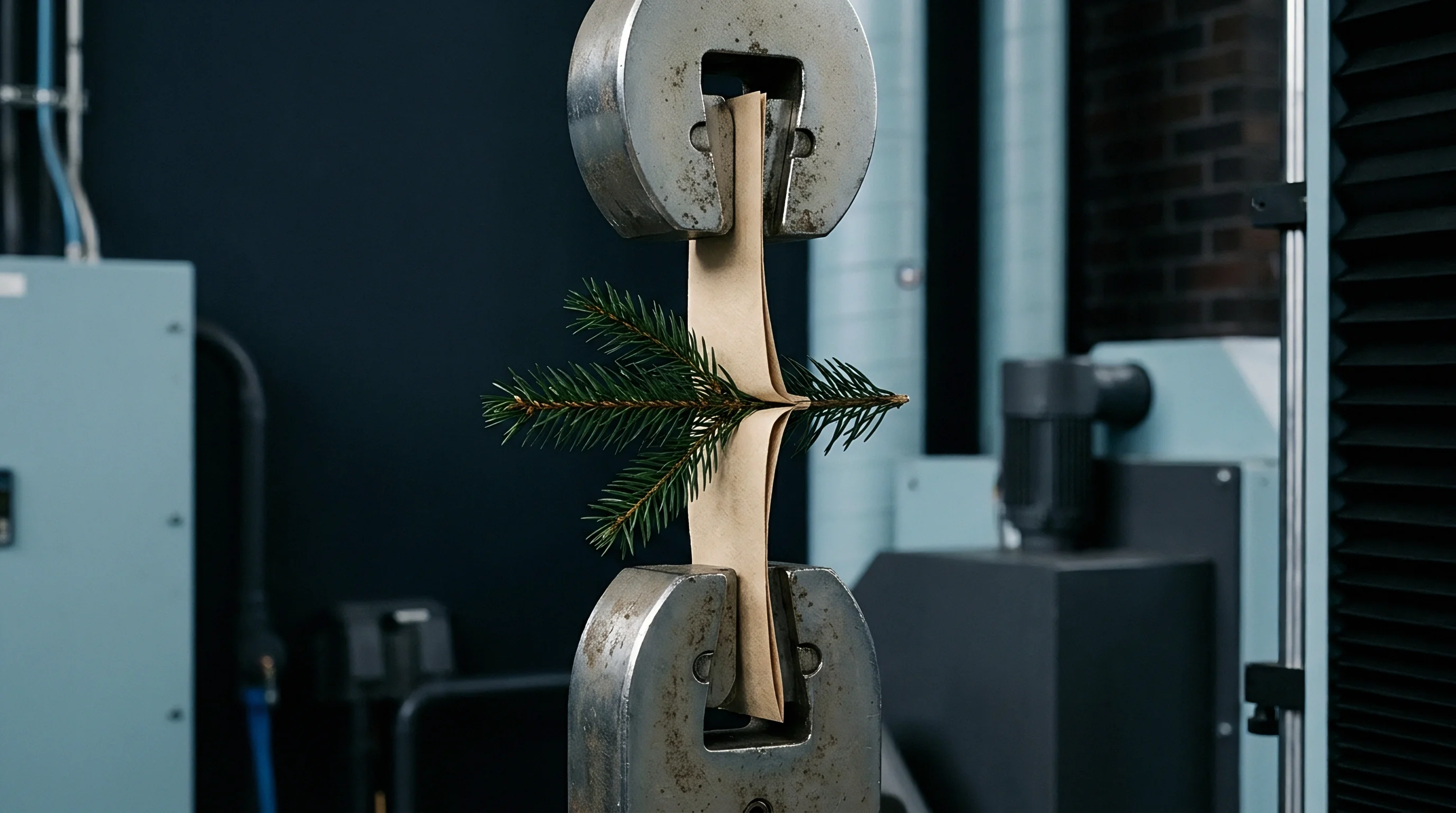
- Clamp sample strips in pneumatic tensile grips with silicone faces to prevent specimen crushing.
- Apply sustained static loads using dead-weight lever arms while recording displacement via optical extensometers.
- Log elongation at thirty-second intervals to map the transition boundary between primary and secondary creep.
Creep triples under humidity swings. The middle ply of mechanical pulp contains high levels of lignin, which maintains stiffness in dry states but slips readily once cyclic moisture loosens secondary wall structures. Chemical pulp liners carry the resulting stress transfer until their tensile creep threshold is exceeded.
Pallets buckle without warning.
| Board Caliper (microns) | Tensile Stiffness MD (kN/m) | Tensile Stiffness CD (kN/m) | Secondary Creep Rate 50% RH (%/hr) | Secondary Creep Rate 80% RH (%/hr) |
|---|---|---|---|---|
| 350 | 680 | 310 | 0.0042 | 0.0165 |
| 450 | 890 | 405 | 0.0038 | 0.0148 |
| 550 | 1120 | 515 | 0.0031 | 0.0121 |
| 650 | 1380 | 630 | 0.0028 | 0.0105 |
Board mills defend caliper retention over long supply chains, asserting that bulk yields provide sufficient structural safety margins regardless of atmospheric exposure.

Rupture
Sustained dead loads eventually terminate the secondary creep plateau, forcing paperboard ligaments into tertiary failure. During this terminal stage, micro-voids coalesce into visible fracture planes along the cross direction. Uncoated folding boxboard exhibits classic power-law creep kinetics under constant tensile stress.
Creep rate accelerates rapidly. Mathematical formulations derived from Findley power-law equations accurately describe this elongation behavior up to the point of catastrophic tearing.
Compliance with DIN 55437 requires slot width deviations to remain under seventy microns to prevent unpredicted shear amplification.
Static load duration dictates the permissible stress level for any given carton partition design. If a partition grid carries thirty percent of its ultimate tensile strength, structural integrity persists for thousands of storage hours. Elevating that static tensile burden to sixty percent drops survival duration to less than twenty-four hours under moderate moisture levels.
Static loads accumulate damage. Uncoated surfaces absorb moisture transients quickly, causing localized swelling that alters inner stress distributions.

Is Mechano-Sorptive Creep Preventable under Variable Warehouse Humidity?
Uncoated boxboards cannot resist mechano-sorptive creep without external environmental isolation. When ambient relative humidity oscillates between forty and eighty-five percent, cellulose fibers undergo repeated expansion and contraction. Each moisture cycle breaks and reforms inter-fiber hydrogen bonds under active tension.
The sheet elongates further during drying phases than it recovers during adsorption phases. This ratcheting effect accelerates tertiary creep dramatically compared to static high-humidity exposure.
| Load Level (% UTS) | Time to Failure 50% RH | Time to Failure 70% RH | Time to Failure 85% RH | Time to Failure Cyclic 50-85% RH |
|---|---|---|---|---|
| 70 | 1.2 hours | 0.3 hours | 0.05 hours | 0.02 hours |
| 60 | 28 hours | 6.4 hours | 1.1 hours | 0.4 hours |
| 50 | 410 hours | 85 hours | 14 hours | 3.8 hours |
| 40 | 4800 hours | 920 hours | 160 hours | 42 hours |
Ligament Stress Calculation in Partition Assemblies
Take an uncoated 450-micron folding boxboard partition grid supporting eighty kilograms of liquid-filled vials across twenty interlocking cells. The partition matrix measures four cells wide by five cells long. Assume an even downward weight distribution where vertical cell friction translates twenty percent of static bottle mass into lateral tensile load across inner ligaments.
Each cell ligament measures twelve millimeters of uncut board width below the die-cut slot.
Total vertical mass equals 784.8 Newtons. The twenty percent lateral conversion generates 156.96 Newtons of outward tension distributed across twelve primary load-bearing web ligaments, producing 13.08 Newtons of static tension per ligament. Uncoated 450-micron folding boxboard possesses an average cross-machine tensile strength of 9.2 kN/m.
A twelve-millimeter ligament demonstrates an ultimate cross-machine tensile breaking force of 110.4 Newtons. The operating static tensile load represents 11.8 percent of ultimate tensile capacity under dry laboratory standards.
Under marine container transit reaching eighty-five percent relative humidity, the effective cross-machine tensile modulus drops by sixty-two percent. Cyclic transit vibrations introduce dynamic amplification factors that spike local stresses by a factor of 3.2. Operative ligament tension reaches 41.85 Newtons, which equates to 37.9 percent of the board baseline dry strength, but constitutes 99.6 percent of its moisture-softened tensile rupture threshold.
The ligament tears within sixty hours of ocean shipping. Settled boxboard yields under stress.
- Creep testing duration spans a minimum of one thousand hours for accurate Findley exponent modeling on virgin furnish lines.
- Environmental monitoring tracks temperature swings alongside humidity gradients to isolate hygro-mechanical variables.
- Specimen orientation maps both machine direction and cross-machine direction tensile creep curves.
- Acoustic emission tracking identifies initial interior fiber cleavage long before surface tears register on optical gauges.
Engineers continue to investigate whether minor adjustments to refining intensity in mechanical pulp furnish can sufficiently depress secondary creep rates without compromising core board bulk.
Toll
Tooling choices govern how cleanly a converting line cuts uncoated boxboard ligaments. Steel rule dies punched into high-caliper boards create compressive damage along cut edges before the rule bevel cleaves the fibers. Tooling wear dictates downtime.
Dull knives crush cell walls. When rule edges round by fifteen microns, the required platen cutting pressure rises by nearly twenty percent. This excess tonnage crushes the mechanical pulp interior along the perimeter of the slot, pre-damaging the very fibers that carry stack loads.
Coarse groundwood fibers resist prolonged tension worse than long chemical kraft fibers.
Clean cuts preserve bond integrity. Rotary die cutting introduces slight bevel drag compared to flatbed cutting, generating asymmetric edge burnishing that shifts stress concentrations toward one side of the partition ligament. Flatbed counter-plates must maintain precise channel alignment to prevent micro-delamination during stripping.
If ejection rubbers exert uneven pressure near the slot base, they impart residual tensile strain to the ligament before the partitions ever assemble.
Board sourcing economics influence partition durability directly. Solid bleached sulfate provides superior tensile creep resistance due to its hundred-percent chemical fiber formulation, yet costs twelve to eighteen percent more per metric ton than folding boxboard. Uncoated folding boxboard delivers superior caliper per unit weight, creating exceptional panel stiffness at low base sheet cost.
Opting for folding boxboard saves substantial raw material outlay, but exposes fragile grid ligaments to elevated creep rupture risks in uncontrolled climates. Spoilage escalates during convert pass.
Tolerances drift over shifts. When slot width drifts by twenty percent due to die wear, grid assemblies bind on automatic inserters, halting production lines and forcing manual packing workarounds. Oversized slots introduce slack that permits product acceleration during rail transit, generating shock loads that fracture weakened partition ligaments.
The commercial exposure encompasses pallet collapse, product loss claims, sorting costs, and shipping line penalties. Selecting suitable board grammage requires calculating the landed cost of failure rather than the sheet price alone.
A partition grid designed with generous ligament width consistently outlasts an assembly cut from heavier stock with narrow connective margins.