Adhesion Energy Optimization for Thermal Polyurethane Film on Folding Cartons
Optimizing thermal polyurethane lamination on cartonboard relies on matching nip heat to surface energy, balancing polar contact against fold stiffness.
Melt
Thermal activation of thermoplastic polyurethane lamination web relies on precise thermal energy delivery across the laminator nip. Elastomeric films constructed from aliphatic or aromatic block copolymers deliver superior flexibility compared to conventional polyolefin or biaxially oriented polyester webs. Polyurethane polymers exhibit high elongation at break and exceptional abrasion resistance.
Integrating these web materials onto paperboard substrates demands controlled melting of the heat-activated adhesive layer without degrading the elastomeric polyurethane backing.
Heat Transfer Dynamics across Lamination Nips
Heat transfer through thermal polyurethane web occurs via conduction during the brief dwell period inside the heated nip assembly. The composite roll assembly typically combines a heated chrome steel cylinder with a resilient rubber backup roll. Operating temperatures for thermal polyurethane films range between 105°C and 130°C, depending on the softening point of the low-density polyurethane co-extrusion layer.
Line speed directly dictates dwell time. At sixty meters per minute, a twenty-millimeter nip contact zone yields a dwell duration of twenty milliseconds.
Polymer chains require relaxation time. Pressure across the nip forces the softened adhesive phase into the micro-topography of the paperboard surface. Steel roll temperatures set too low generate incomplete polymer flow, leaving air pockets that reduce optical clarity and create failure sites.
Chrome roll temperatures elevated above 135°C cause thermal degradation of aliphatic polyurethane backings, leading to web distortion, variable tension, and severe roll curl.
Co-extruded polyurethane films require precise nip temperature regulation within plus or minus two degrees Celsius to prevent thermal shrinkage while maintaining polymer flow into board pores.
Nip pressure drives contact. Hydraulic or pneumatic actuators apply linear nip forces between twenty and fifty Newtons per millimeter. High pressure compensates for reduced dwell time on high-speed converting lines, driving the molten polyurethane layer into the porous fibrous network.
Excessive linear pressure crushes the bulk caliper of folding cartonboard, diminishing bending stiffness and structural strength.
| Film Construction | Adhesive Phase | Melt Peak (°C) | Nip Temp (°C) | Nip Pressure (N/mm) | Max Line Speed (m/min) |
|---|---|---|---|---|---|
| Aliphatic TPU (25 µm) | Low-Melt TPU | 98 ~ 102 | 110 ~ 118 | 25 ~ 35 | 65 |
| Aromatic TPU (30 µm) | Ester Copolymer | 108 ~ 112 | 120 ~ 128 | 30 ~ 40 | 50 |
| Soft-Touch TPU (32 µm) | Ether Copolymer | 95 ~ 100 | 105 ~ 112 | 20 ~ 30 | 70 |
| High-Gloss TPU (20 µm) | Aliphatic Ester | 104 ~ 108 | 115 ~ 122 | 35 ~ 45 | 60 |
Web tension management prevents post-lamination curl. Thermoplastic polyurethane possesses a low flexural modulus and high elastic recovery. Pulling film under excessive web tension stretches the polymer prior to nip entry.
As the laminated sheet cools, the stretched polyurethane web contracts, pulling the rigid paperboard substrate into a concave curl. Equalizing web tension across the unwind stand and matching thermal expansion coefficients keeps sheets flat for automated sheet feeding.
Film suppliers frequently claim that delamination on printed cartons stems entirely from improper operator settings on the laminator nip rather than inconsistent adhesive layer thickness across the web roll.


Substrate
Paperboard receivers present complex, porous topographies governed by fiber refining, binder concentration, and mineral coating structure. Solid Bleached Sulfate board offers a smooth, bright surface with dense clay coatings. Folding Boxboard combines mechanical pulp inner layers with double-coated chemical pulp outer surfaces.
Coated Recycled Board carries a higher ash content and lower internal bond strength. Laminating elastomeric polyurethane to these varied surfaces requires analyzing the chemistry of the receiver interface.
Surface Energy Matching across Interfaces
Thermodynamic wetting dictates whether a molten adhesive layer achieves intimate atomic contact with clay-coated paperboard. Wetting occurs when the surface energy of the substrate exceeds the surface tension of the molten polymer film layer. Clean paperboard coatings composed of kaolin clay, calcium carbonate, and styrene-butadiene latex binders exhibit surface energies between 38 and 46 millinewtons per meter.
Thermal polyurethane melt phases typically exhibit surface tensions ranging from 32 to 38 millinewtons per meter.
Corona treatment decays rapidly. Uncoated or coated board surfaces stored in high-humidity environments absorb ambient moisture, depressing effective surface energy. On-line corona discharge units raise substrate surface energy by generating hydroxyl, carbonyl, and carboxyl functional groups on the board surface.
Increasing surface energy to 50 millinewtons per meter promotes molecular attraction across the boundary layer.
Substrates with total surface energy below forty millinewtons per meter impede complete wetting by molten polyurethane adhesives during short nip dwell windows.
Offset printing inks alter substrate chemistry. Wet-on-dry offset printing applies alkyd resins, vegetable oils, and synthetic pigments over the board coating. Residual solvents or wax additives in sheet-fed inks migrate to the ink surface, forming a low-energy barrier layer.
Uncured inks impede bonding. Laminating polyurethane film over wet offset ink causes micro-tunneling and complete adhesive failure. Ink formulations containing silicone or polyethylene waxes reduce surface energy down to 28 millinewtons per meter, preventing mechanical keying.
- Micro-tunneling defects form narrow air channels along print solids where ink solvent emissions vaporize during thermal nip entry.
- Edge delamination occurs along sheet margins where unprinted coating exhibits higher moisture levels than heavy ink coverage zones.
- Optical haze appears when incomplete polymer flow leaves sub-micron voids between the polyurethane film and board topography.
- Blistering under heat develops when residual isopropyl alcohol from dampening solutions expands inside porous paperboard fibers during thermal lamination.
Water-based overprint varnishes seal ink layers but create distinct interfacial challenges. Acrylic dispersions must fully crosslink prior to thermal lamination. Incompletely cured varnishes soften under thermal nip heat, mixing with the molten polyurethane adhesive layer and destroying structural integrity.
A reliable board surface always exhibits a higher total polar surface energy component than the molten adhesive layer placed upon it.
Peel
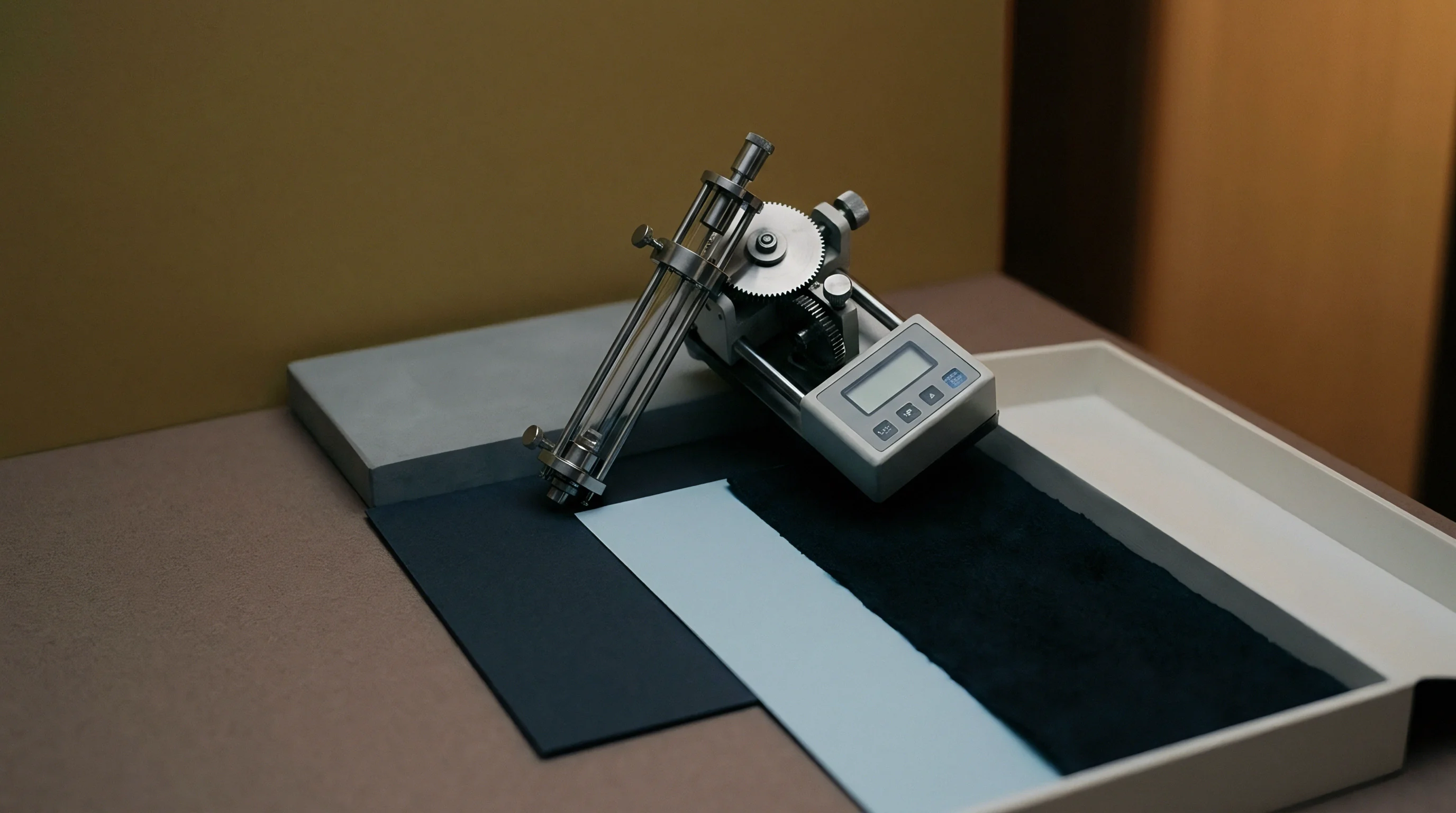
Adhesion energy density quantifies the mechanical energy required to separate the flexible polymer film from the rigid paperboard base. Measuring this performance relies on standardized mechanical testing. Standard testing formats include 180-degree peel testing under ASTM D903 and 90-degree peel testing under ISO 8510-2.
Evaluating adhesion strength on folding carton composites requires separating pure interfacial work of adhesion from the plastic strain energy dissipated inside the deforming polyurethane backing.
What Surface Energy Threshold Prevents Delamination?
Interfacial fracture resistance scales non-linearly with the polar component of the receiver board. Total substrate surface energy must reach at least 44 millinewtons per meter, with the polar force component contributing no less than 12 millinewtons per meter. Lower polar values fail to induce adequate hydrogen bonding between the ester or ether carbamate linkages in the polyurethane chain and the mineral coating particles on the board surface.
Consider a mathematical evaluation of interfacial fracture energy during a 180-degree peel test. Take a 350 gram per square meter Solid Bleached Sulfate cartonboard substrate laminated with a 30-micrometer aliphatic thermal polyurethane film, trimmed to a test specimen width of 25 millimeters. The total energy release rate G in Joules per square meter during peeling is expressed through the classic Rivlin relation:
G = fracFb (1 – costhη) + Wplastic
Here, F represents the measured peel force in Newtons, b is the specimen width in meters (0.025 m), thη is the peel angle (180 degrees, where cos(180circ) = -1, simplifying 1 – costhη to 2), and Wplastic accounts for work spent bending and stretching the polyurethane film. When plastic deformation of the elastic film is minimal, G approaches the effective interfacial work of adhesion Gic.
Two distinct processing conditions illustrate how thermal activation modifies peel performance on SBS paperboard:
Under Case A, lamination runs at a nip temperature of 110°C, a linear speed of 40 meters per minute, and a nip pressure of 3.0 bar. Mechanical testing on a universal testing machine yields an average steady-state peel force F of 14.5 Newtons over the 25-millimeter width. Applying the formula:
GA = frac14.50.025 × 2 = 1160 J/m2
Visual analysis reveals clean interfacial separation between adhesive and clay coating with no paper fiber extraction. The bond strength remains insufficient to withstand subsequent folding operations without edge lifting.
Under Case B, lamination runs at an optimized nip temperature of 125°C, identical line speed, and elevated nip pressure of 4.5 bar. Testing yields a steady-state peel force F of 28.0 Newtons across the 0.025-meter width before failure transitions into substrate destruction:
GB = frac28.00.025 × 2 = 2240 J/m2
The fracture pathway shifts from interfacial adhesive separation to 100 percent fiber tear inside the top paperboard layer. The mechanical strength of the adhesive interface exceeds the internal cohesive shear strength of the paperboard fibers.
A peel force exceeding one thousand Joules per square meter on 350 gram per square meter board indicates that interfacial bond strength has surpassed the internal fiber cohesion of the substrate.
| Board Type | Surface Energy (mN/m) | Nip Temp (°C) | Measured Peel Force (N/25mm) | Calculated Energy (J/m²) | Observed Failure Mode |
|---|---|---|---|---|---|
| SBS Board (350 gsm) | 46 (Polar: 14) | 125 | 28.0 | 2240 | Cohesive Deep Fiber Tear |
| SBS Board (350 gsm) | 40 (Polar: 8) | 110 | 14.5 | 1160 | Interfacial Delamination |
| Folding Boxboard (300 gsm) | 42 (Polar: 10) | 120 | 21.5 | 1720 | Surface Clay Layer Delamination |
| Coated Recycled (380 gsm) | 38 (Polar: 6) | 125 | 11.2 | 896 | Adhesive Peel / No Fiber Tear |
Quality control specifications demand detailed verification parameters. Purchasing contracts must incorporate standardized peel criteria to guarantee incoming carton consistency across production lots.
- Sampling frequency mandates testing three sheets per production pallet at the lead edge, center, and tail sections.
- Conditioning standards enforce twenty-four hours of sample exposure at 23 degrees Celsius and 50 percent relative humidity under ISO 187.
- Peel velocity settings require universal testing machines to operate at a fixed crosshead speed of 300 millimeters per minute.
- Minimum threshold criteria specify a lower limit of 18 Newtons per 25 millimeters or complete fiber tear on unprinted board areas.
Inadequate adhesion leads directly to carton failure on filling lines, causing machinery jams, ruined product loads, and rejected shipments.
Score
Creasing folding boxboard introduces severe shear and tensile stress distributions across the laminated composite structure. Converting flat laminated sheets into folded cartons requires deep localized deformation. The outer polyurethane film must elongate around the outer score radius while maintaining structural adhesion to the crushed fiber core underneath.

Mechanical Integrity during High-Speed Converting
Folding carton converting lines run up to fifty thousand blanks per hour, subjecting female channel matrices and male steel rules to continuous impacts. Crease matrix width and creasing rule thickness dictate the severity of strain in the polyurethane layer. Standard scoring rules feature a 2-point thickness (0.71 mm) with rounded edges.
Channel depth must match substrate thickness, while channel width calculation follows established converting equations:
W = 1.5 × S + trule
In this equation, W represents matrix channel width, S equals cartonboard caliper, and trule is the creasing rule thickness. Incorrect creasing geometry strains the outer lamination layer. Selecting a channel width that is too narrow shears the paperboard fibers, inducing stress concentrations that tear the elastomeric film along the fold line.
Aliphatic polyurethane exhibits elongation capabilities exceeding 300 percent. Soft aromatic polyurethanes stretch up to 600 percent before tensile rupture occurs. This high elasticity prevents outer score cracking, a common failure mode in brittle biaxially oriented polypropylene laminates.
Film tension across the crease line generates elastic springback. Crease stiffness causes springback. High elastic recovery in thick polyurethane films increases carton opening force, hindering high-speed automated carton erection on cartoning machinery.
Flap gluing demands specific surface preparation. Polyurethane lamination films present non-porous surfaces that resist standard water-based cold emulsion glues like ethylene-vinyl acetate. Folding carton plants must apply localized mechanical skiving, plasma jet treatment, or high-intensity corona discharge onto glue flap areas on the folder-gluer.
Plasma treatment increases surface energy above 56 millinewtons per meter, allowing water-borne adhesives to wet the film surface and form durable fiber-tearing bonds.
Applying atmospheric plasma discharge directly onto polyurethane glue flaps on the folder-gluer enables reliable bonding with standard vinyl-acetate cold emulsions at production speeds of three hundred meters per minute.
Line bring-up and setup validation on a high-speed laminator-folder proceeds through a controlled, logical sequence:
- Verify cartonboard moisture content using RF dielectric sensors to ensure levels remain between 6.0 and 7.5 percent.
- Set heated roll temperature on the thermal laminator to 120°C and stabilize nip pressure at 3.5 bar.
- Mount male creasing rules and calibrate female matrix channels using precision feeler gauges to match board caliper.
- Run ten make-ready sheets through the die-cutter and inspect scores under tenfold optical magnification for micro-fissures.
- Perform 180-degree manual fold tests along score lines running perpendicular and parallel to the paperboard grain direction.
- Activate folder-gluer plasma nozzles at sixty kilohertz frequency to prepare glue flap zones prior to cold glue application.
- Erect sample cartons and test opening force using an automated mechanical load cell to confirm stiffness limits.
How much elastic recovery can a carton structural design tolerate before high-speed cartoning machine pusher arms misfeed during automated flat blank erection?

Tariff
Commercial feasibility depends on balancing higher raw film costs against scrap rates and end-of-life recycling liabilities. Thermoplastic polyurethane thermal lamination films cost three to five times more per square meter than conventional biaxially oriented polypropylene or polyester films. Justifying this price premium requires evaluating the finished packaging performance, scrap reduction during creasing, and compliance with packaging waste regulations.
Repulpability Scoring and Waste Arithmetic
Recyclability assessments following European paper industry protocols evaluate how effectively film layers detach during hydrapulping. Standard laboratory disintegrators repulp laminated carton scrap under Cepi 4.0 guidelines or PTS-RH 021/97 methods. Thermoplastic polyurethane film maintains cohesive mechanical integrity during aqueous pulping.
Unlike brittle coatings that break into tiny micro-plastic fragments, elastomeric polyurethane stays intact as large film sheets easily captured by coarse screen plates with 1.5-millimeter perforations.
Yield losses during coarse screening remain low. Paperboard fibers detach cleanly from the polyurethane film interface when initial thermal lamination parameters avoid excessive chemical crosslinking. Clean fiber separation yields an overall repulpable paper fiber recovery rate exceeding 92 percent.
High fiber recovery allows polyurethane-laminated cartons to qualify for standard paper stream recycling designations, avoiding heavy financial penalties under extended producer responsibility schemes.
Modulated packaging fees calculate liabilities based on recyclability grading. Laminated packaging structures that fail repulpability criteria incur substantial surcharges per tonne placed on the market. Certified repulpable polyurethane-laminated cartons obtain reduced fee rates, offsetting initial material costs.
| Cost Parameter | Standard BOPP Thermal Film | Thermal TPU Film Construction | Commercial Variance Impact |
|---|---|---|---|
| Base Film Cost (€/m²) | €0.12 | €0.48 | +€0.36 per m² |
| Make-Ready Waste (Sheets) | 1,200 | 450 | -750 waste sheets |
| Score Cracking Scrap Rate (%) | 3.5% | 0.1% | -3.4% running scrap |
| EPR Waste Fee (€/Tonne) | €380 (Non-recyclable) | €85 (Certified Repulpable) | -€295 per tonne fee |
| Net Finished Unit Cost (€/Carton) | €0.185 | €0.202 | +€0.017 net difference |
Make-ready waste calculations demonstrate operational savings. Thermoplastic polyurethane film tolerates wider temperature variations during machine startup without blistering. Reduced startup waste saves high-value paperboard sheets.
Trim waste increases total cost. Lower scrap rates during high-speed die-cutting and creasing further narrow the net cost difference between premium polyurethane and standard polypropylene lamination.
Packaging waste regulations levy higher administrative fees on non-separable composite packagings that yield less than eighty-five percent usable paper fiber during pulping assays.
Standard purchase contracts must incorporate explicit compliance terms regarding delamination tolerances and repulpability metrics:
Under Clause 14.3 of international packaging supply contracts, the converter guarantees that thermal polyurethane film lamination shall exhibit zero interfacial separation across score lines after forty-eight hours of storage at 40 degrees Celsius and 80 percent relative humidity, while maintaining a minimum repulpable fiber yield of 90 percent under PTS-RH 021/97 testing standards.