Polymer Laminate Surface Energy and Foil Adhesion Dynamics
Foil adhesion succeeds when polymer film surface energy exceeds forty-two dynes per centimeter and sizing chemistry matches the polar surface component.


Tension
Holding a first-off printed sheet under an inspection lamp at five in the morning reveals the defect right away. A solid block of metallic leaf stamped across gloss lamination shows pinholes, ragged borders, and partial lifting along the trailing edges of the lettering, with the inspection tape pulling clean away from the film. Thirty-six dynes per centimeter on corona-treated biaxially oriented polypropylene film failed to anchor the sizing layer at production press speeds.
The sheet heads straight to the scrap bin.
Surface wetting governs whether an applied coating, adhesive, or thermal sizing layer can establish molecular contact with an extruded or oriented polymer film. Solid surfaces possess a specific free energy expressed in millinewtons per meter or dynes per centimeter, whereas liquid and molten adhesives exhibit surface tension. Spontaneous wetting occurs exclusively when the substrate’s surface energy exceeds the surface tension of the liquid phase brought against it.
Under heat and nip pressure, the sizing layer of a hot stamping foil transitions into a viscoelastic liquid; if the film’s surface energy sits below the critical surface tension of that molten polymer, the adhesive beads into microscopic droplets instead of spreading across the interface.
ASTM D2578 test solutions establish that biaxially oriented polypropylene films treated below thirty-eight millinewtons per meter experience complete foil lift under cross-hatch tape stripping.
Under the Owens-Wendt-Rabel-Kaelble model, total surface energy splits into dispersive and polar components. The dispersive fraction stems from universal London van der Waals interactions, while polar forces encompass dipole-dipole interactions, hydrogen bonding, and acid-base exchanges. Untreated polyolefins such as standard polypropylene and polyethylene exhibit almost purely dispersive surface energies between twenty-nine and thirty-one dynes per centimeter, with polar readings hovering near zero.
Hot stamping sizes, UV-curable cold foil adhesives, and heat-seal lacquers rely on polar functionalities like acrylic esters, polyurethanes, and modified polyesters to generate bond strength. Establishing reliable adhesion on non-polar films requires driving up the polar fraction through deliberate oxidative surface treatments.
A total surface energy of forty-four dynes per centimeter looks sufficient on a material requisition sheet, yet the composition of those dynes governs the final bond. A film exhibiting forty-two dynes per centimeter of dispersive energy and two dynes per centimeter of polar energy sheds a polar stamping size. Conversely, a film measuring thirty-four dynes dispersive and ten dynes polar accepts the identical foil size with complete transfer.
That thermodynamic boundary reflects the wetting envelope of the laminate. Converters who track only total dyne numbers miss the underlying thermodynamic mismatch that triggers foil flaking along carton creases.
| Polymer Laminate Substrate | Dispersive Component (mN/m) | Polar Component (mN/m) | Total Surface Energy (mN/m) | Wetting Status with Polar Acrylic Sizes |
|---|---|---|---|---|
| Untreated BOPP Film | 30.2 | 0.8 | 31.0 | Complete dewetting and flaking |
| Corona-Treated BOPP (Fresh) | 33.4 | 10.8 | 44.2 | Total continuous wetting |
| Untreated PET Film | 37.6 | 4.1 | 41.7 | Marginal wetting with pinholing |
| Atmospheric Plasma PET | 38.2 | 14.3 | 52.5 | Total continuous wetting |
| Cellulose Diacetate Film | 32.1 | 12.4 | 44.5 | Total continuous wetting |
| Corona-Treated Cast Polyamide | 34.5 | 16.2 | 50.7 | Total continuous wetting |
Specifying an incorrect dyne level on a purchase order causes foil flaking across an entire production run, leading directly to warehouse quarantine and unsalvageable carton rejection.
Decay
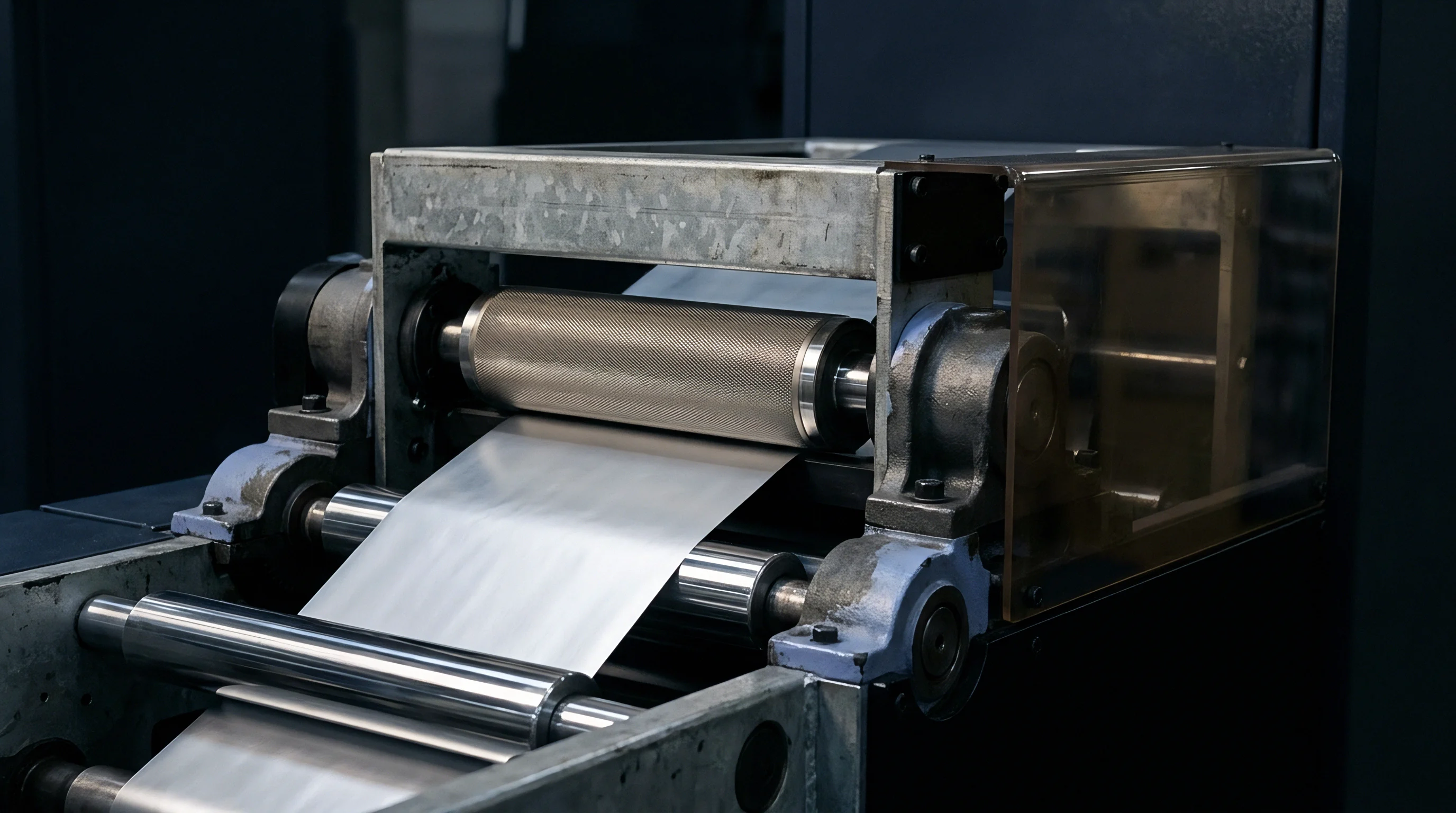
Atmospheric oxidation introduced during film extrusion diminishes steadily with elapsed time and ambient storage temperature. Dielectric barrier discharge systems direct high-voltage electrical arcs through process air, ionizing molecular oxygen and nitrogen into ozone, hydroxyl radicals, and nitrogen oxides. These reactive species attack the hydrocarbon backbones of polyolefin webs, grafting carbonyl, carboxyl, and hydroxyl groups directly onto the outermost molecular layers.
The newly created functional groups elevate the polar surface energy of the laminate web. Once the processed reel winds onto the core and sits in storage, however, a secondary physical rearrangement begins at the molecular level.
Polymer chains retain natural thermodynamic mobility, continuously driving the interface toward its lowest free energy state. Through hydrophobic recovery, macromolecular chains rotate their newly formed polar groups away from the air interface, burying them into the bulk polymer matrix while exposing untreated, low-energy methyl groups back to the surface. Higher warehouse temperatures accelerate this thermodynamic inversion.
A reel treated to forty-six dynes per centimeter at the extrusion facility drops to thirty-eight dynes within thirty days of summer transit. If the finishing department feeds this aged stock into a stamping press without prior testing, the molten foil size meets an inert, chemically unreactive surface.
Low-molecular-weight processing additives compound this loss of surface energy, with slip agents like erucamide blooming out across the web in as little as five hours. Slip additives, anti-static compounds, and internal lubricants migrate out of the amorphous zones of the polymer structure toward the exterior face. Erucamide and oleamide, introduced to lower the coefficient of friction on high-speed folder-gluers, possess lower surface energies than the treated base polymer.
As these aliphatic fatty acid amides accumulate into a continuous migratory layer, they shield the corona-generated polar functional groups. Washing a low-dyne sample with pure isopropyl alcohol strips this bloomed slip away and instantly recovers forty-four dynes per centimeter on dyne test ink, demonstrating that internal additives, rather than electrical treatment failure, created the wetting barrier.
The rubber manufacturing sector exploits the identical physical phenomenon, formulating paraffin waxes and anti-ozonants to bloom deliberately onto tire sidewalls to protect the vulcanized diene matrix against environmental oxidation. In tire compounding, this surface bloom serves a defensive role. On a laminated folding carton destined for hot foil stamping, the same blooming mechanism forms an unintended release layer that destroys adhesive bonding between the sizing lacquer and the underlying film.
Converters evaluate surface treatment retention through standardized dyne test inks formulated in compliance with ISO 8296 and ASTM D2578. The testing sequence determines the exact wetting limit of the material before mounting dies.
- Substrate Preparation ~ Lay the laminated sheet flat on a level, non-absorbent granite bench held at twenty-three degrees Celsius and fifty percent relative humidity.
- Fluid Application ~ Draw an even, unbroken liquid line across the film face using a calibrated spring-loaded felt applicator charged with a known mixture of 2-ethoxyethanol and formamide.
- Wetting Evaluation ~ Monitor the continuous fluid film for exactly two seconds under grazing incidence light, checking for droplet reticulation or edge retraction.
- Threshold Determination ~ Advance to the next dyne level fluid when the film remains continuous without pooling for two seconds, identifying the surface energy at the transition point.
A corona treater may run at full discharge wattage at the extrusion line, yet film reels can still lose dyne levels by absorbing ambient moisture in an unconditioned warehouse.

Foil
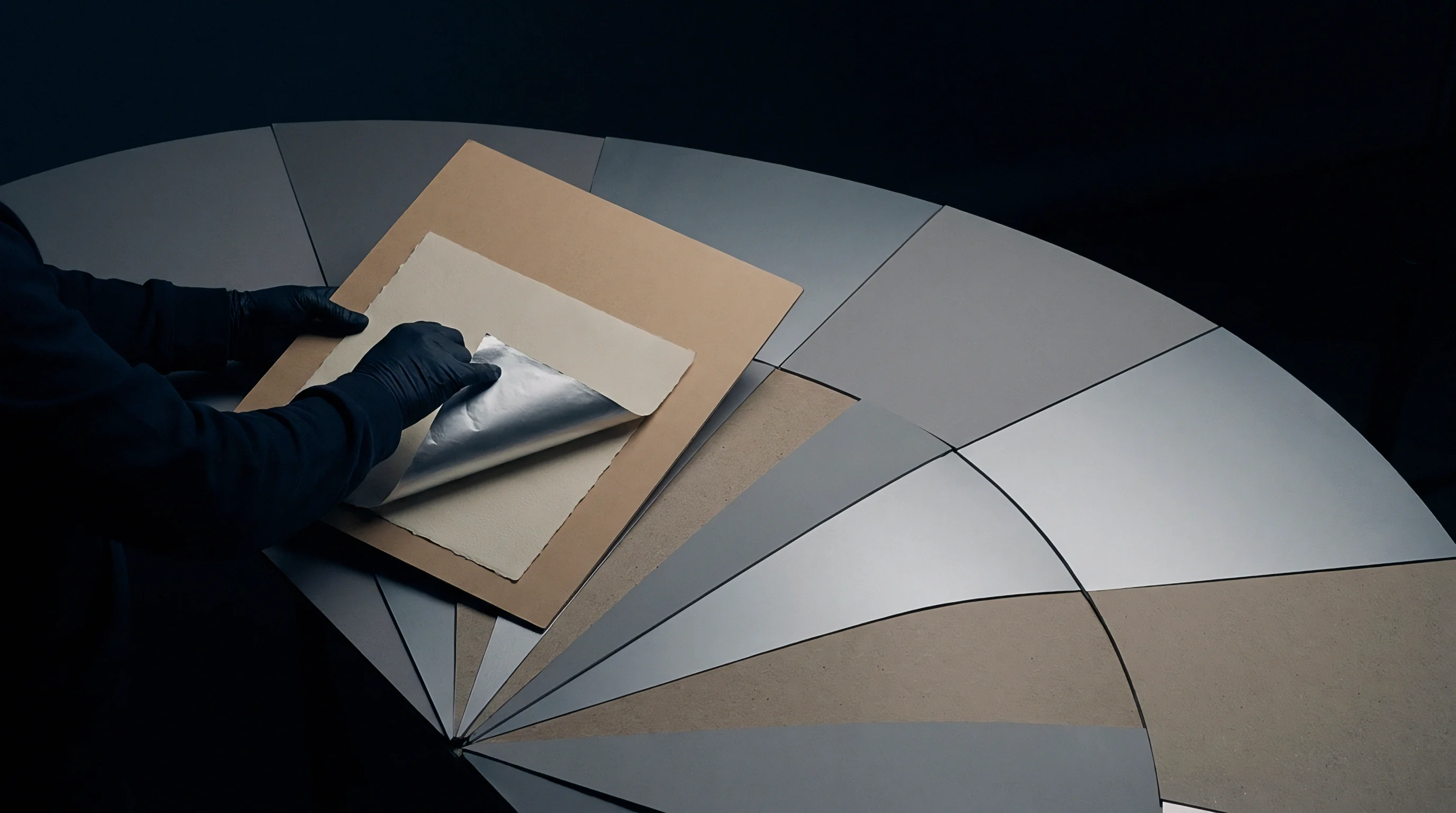
Transfer mechanics depend on a multi-layer consumable stack functioning in split-second synchronization under thermal load. Hot stamping foil incorporates a carrier film, a release layer, a vacuum-deposited aluminum or pigment layer, and a heat-activated sizing adhesive coat. The carrier, typically a biaxially oriented polyester film measuring twelve micrometers in caliper, supports the active layers through the press unwind and feed rollers.
The release coat consists of modified waxes or low-melting carnauba blends formulated to fracture cleanly between ninety and one hundred and thirty degrees Celsius. When the heated brass or copper die compresses the foil sandwich against the laminated cartonboard, heat transfers through the carrier, melting both the release coat and the sizing lacquer simultaneously.
High-speed platen presses and rotary stamping cylinders introduce severe physical boundaries on dwell time, operating between fifteen and seventy milliseconds per impression. Within this narrow mechanical window, the sizing lacquer must melt, wet the polymer film surface, flow into micro-roughness contours, and develop sufficient green strength to anchor the metallized layer before the carrier film strips away on the take-up reel. Sizing chemistry governs compatibility with specific laminate surfaces: acrylic-based sizes demonstrate excellent adhesion to corona-treated polyester and cellulose acetate films, whereas polyurethane and modified vinyl copolymer sizes bond reliably to treated polypropylene and polyethylene films due to their lower activation temperatures and favorable polar solubility parameters.
A dwell time drop below twenty milliseconds on a platen press lowers effective sizing interface temperature by fifteen degrees Celsius, converting a cohesive foil split into complete adhesive failure.
Cold foil processes bypass thermal activation entirely, substituting a liquid UV-curable adhesive applied via an offset or flexographic printing unit. The adhesive image prints onto the polymer laminate, enters a nip station where a cold foil leaf mates with the wet film, and passes immediately under high-intensity ultraviolet LED lamps to trigger radical polymerization. Cold foil transfer dynamics rely on adhesive cure speed, wetting kinetics, and cohesive shear strength.
If the UV adhesive fails to achieve adequate surface wetting across the laminate within the eighty-millisecond transit time between the print nip and the curing lamp, interfacial bonding fails. Uncured monomer residues at the film interface also generate catastrophic release when cartons undergo flatbed die-cutting.
What Governs Mechanical Keying across Polymeric Interfaces?
Interfacial anchoring relies on microscopic surface morphology in conjunction with chemical bonding. Polymer films finished with liquid anti-scuff coatings or matt particulate dispersions exhibit irregular surface profiles filled with micron-sized silica or calcium carbonate particles. While these particulate additives introduce mechanical keying sites, they also disrupt continuous film-to-adhesive contact by creating micro-voids.
Molten sizing lacquer must exhibit sufficiently low melt viscosity under die pressure to bridge these cavities completely. If the viscosity remains excessive, entrapped air pockets act as stress concentrators, promoting lateral tearing and ragged foil edges during carrier stripping.
| Laminate Surface Type | Recommended Die Temperature (°C) | Optimum Dwell Time (ms) | Required Nip Pressure (N/mm²) | Dominant Sizing Chemistry |
|---|---|---|---|---|
| Standard Gloss BOPP (42 dynes) | 105 to 115 | 25 to 40 | 35 to 45 | Modified Acrylic Copolymer |
| Matt BOPP with Silica Flatting | 120 to 135 | 40 to 65 | 45 to 55 | Polyester / Polyamide Blend |
| Soft-Touch Polyurethane Film | 95 to 105 | 20 to 35 | 25 to 35 | Low-Melt Polyurethane |
| Gloss PET Film (50 dynes) | 125 to 140 | 30 to 50 | 40 to 50 | Crosslinking Vinyl Acrylic |
| Metallized PET Laminate | 130 to 145 | 35 to 55 | 45 to 55 | High-Tack Polyester Resin |
Adjusting platen heat upward to force foil adhesion onto under-treated film causes carrier distortion, sizing bleed, and blurred typographic detail. Excessive thermal energy also vaporizes volatile plasticizers inside carton coatings, producing gas bubbles that fracture the metallic leaf across the print image.
Sharp foil edges demand that thermal transfer and chemical affinity work in tandem across the interface.

Peel
Quantifying interfacial bond strength requires destructive mechanical separation under controlled geometry and velocity. Standard tape pull checks using pressure-sensitive adhesive tapes provide quick qualitative indications on the plant floor, yet they fail to capture localized stress distributions or yield quantitative metrics required for packaging qualification. Standard FINAT FTM 1 and ASTM D3359 cross-hatch protocols supply the repeatable procedures necessary to adjudicate disputes between finishing houses and brand buyers.
A properly conditioned test bench isolates the peel force profile across the laminated, foiled substrate, distinguishing adhesive detachment from cohesive rupture inside the board stock.
When an adhesive bond functions correctly, mechanical failure propagates cohesively through the fibrous cartonboard substrate or internally within the foil sizing layer, rather than separating cleanly at the polymer film boundary. Clean release of the foil from the laminate surface indicates an unbonded interfacial state. Measuring this behavior involves scribing a six-by-six lattice grid through the foil and laminate layers down to the fibrous board core using an eleven-blade cutting tool spaced at one-millimeter intervals.
Applying a standardized tape with an adhesive strength of ten Newtons per twenty-five millimeters across the lattice, followed by a rapid ninety-degree manual pull, generates the classification rating.
A cross-hatch adhesion rating below Class 4B under ASTM D3359 triggers complete delamination during rotary embossing and automatic folder-gluer operations.
Instrumented peel testing under ISO 11339 or ASTM D1876 records the exact tensile force required to strip a twenty-five-millimeter wide foil strip from a laminated substrate at a constant crosshead speed of three hundred millimeters per minute. The resulting load-versus-displacement curve displays an initial initiation peak followed by a sustained steady-state propagation plateau. High-performance hot stamping onto corona-treated PET exhibits a propagation plateau exceeding four Newtons per twenty-five millimeters, accompanied by visible fiber tear from the paperboard.
In contrast, under-treated BOPP films yield peel curves that drop below 0.8 Newtons per twenty-five millimeters, characterized by a smooth, mirror-like separation devoid of fibrous residue.
Finishing departments avoid adhesive failure through strict operational controls.
- Dyne Confirmation ~ Verify that film surface tension meets or exceeds forty-two millinewtons per meter prior to mounting the lamination reel on the web infeed.
- Thermal Profiling ~ Measure platen face temperature across all four corners and the center plate using calibrated surface thermocouple probes rather than relying on internal cabinet readouts.
- Pressure Balancing ~ Position carbon-paper impression balance sheets beneath the make-ready jacket to detect uneven mechanical loading across the die chase before setting production pressure.
- Tape Stripping Audit ~ Execute ASTM D3359 cross-hatch tape tests on three consecutive sheets pulled immediately after initial make-ready approval and every five hundred sheets thereafter.
Procurement terms typically specify that any incoming delivery showing less than ninety-five percent foil retention under ISO 2409 Class 1 conditions faces immediate rejection without supplier compensation.
Waste
Each auxiliary process pass added to a cartonboard production run compounds overall sheet spoilage and lengthens the delivery schedule. A folding carton requiring offset printing, gloss film lamination, hot foil stamping, and flatbed die-cutting undergoes four distinct mechanical operations on separate production equipment. Make-ready waste on a high-speed sheetfed lamination line typically consumes between one hundred and fifty and three hundred sheets to establish temperature equilibrium, web tension, and nip pressure across the laminating roll.
Moving those laminated pallets to an offline hot foil platen press generates an additional make-ready allowance of two hundred to four hundred sheets to balance the brass dies, register the image over the print, and tune the foil draw indexing mechanisms.
Across a production run of twenty thousand sheets, baseline waste accumulates in predictable increments: two percent on printing, three percent on lamination, four percent on foil stamping, and two percent on die-cutting. If the film laminate exhibits surface energy decay, the press crew increases die temperature and mechanical pressure to compensate, inflating stamping spoilage from four percent to twelve percent as operators fight intermittent pinholing and edge flaking. On expensive bleached chemical pulp boards like solid bleached sulphate (SBS) or folding boxboard (FBB), throwing away two thousand extra oversized sheets destroys the job margin entirely.
A large-format multi-subject foil stamping die incorporates multiple brass or copper elements mounted on a steel honeycomb chase. Tooling for an intricate cosmetic folding carton run runs between twelve hundred and three thousand euros per chase set. Copper dies yield approximately one hundred thousand clean impressions before edge rounding compromises typographic sharpness, whereas CNC-engraved brass dies survive up to five hundred thousand impressions.
When an operator runs an excessively hard make-ready to force foil transfer onto a degraded thirty-eight-dyne BOPP film, the localized mechanical pressure crushes the fine relief bevels of the tooling, halving the useful operational lifespan of the die set.
| Run Length (Sheets) | Standard Lamination Spoilage (%) | Hot Stamping Make-Ready (Sheets) | Stamping Spoilage at 44 mN/m (%) | Stamping Spoilage at 38 mN/m (%) | Direct Spoilage Cost Variance (€) |
|---|---|---|---|---|---|
| 5,000 | 3.5 | 250 | 4.0 | 11.5 | 485.00 |
| 10,000 | 2.8 | 300 | 3.5 | 9.8 | 760.00 |
| 25,000 | 2.0 | 350 | 2.8 | 8.2 | 1,620.00 |
| 50,000 | 1.5 | 400 | 2.2 | 7.5 | 3,180.00 |
| 100,000 | 1.2 | 450 | 1.8 | 6.9 | 6,120.00 |
Extended finishing sequences also affect post-consumer recyclability classifications and producer responsibility fees. Under European EN 13430 standards and regional recyclability protocols, packaging materials incorporating plastic laminations face strict gravimetric limits. If the polymer film layer exceeds five percent of the total carton weight, standard paper mill pulping screens reject the board fibers, downgrading the substrate from recyclable material to industrial waste.
Hot stamping foil adds an insignificant weight penalty, rarely exceeding 0.1 percent of the pack mass, yet the combination of a non-repulpable film barrier and heavy metallized coverage frequently clogs flotation de-inking systems. Modulated packaging waste fees penalize these composite structures, adding fifteen to thirty-five euros per metric ton compared to uncoated, unlaminated paperboard grades.
An unmonitored loss of film surface energy cascades directly into higher unit costs, driving up press scrap, grinding down expensive tooling, and incurring higher producer-responsibility penalties at the end of the line.