Mercury Intrusion Porosimetry ISO 15901 Dynamic Surface Absorption Inspection Protocols
ISO 15901-1 porosimetry paired with dynamic sorption testing qualifies coating pore structures to prevent back-trap mottle and ink setting failures on press.
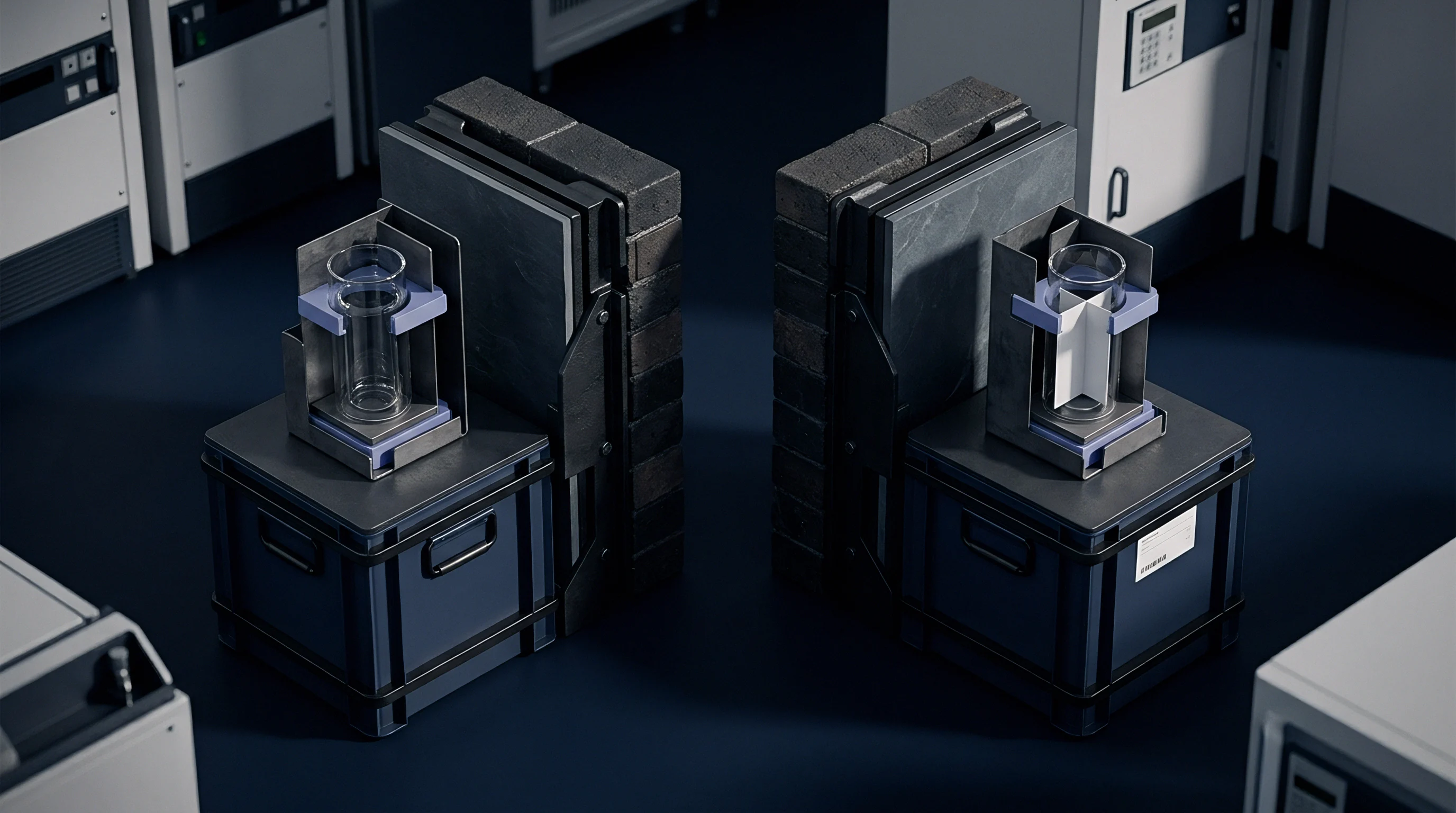

Intrusion
Under ISO 15901-1, mercury intrusion porosimetry quantifies accessible pore volume and pore diameter distribution in coated paper and board. The method drives non-wetting liquid mercury into the void network at stepped pressure increments up to 414 MPa, following the Washburn equation that links applied pressure to equivalent cylindrical pore throat radius:
D = -(4 γ cos θ) / P
Here D is pore diameter, γ is mercury’s surface tension (0.485 N/m at 20 degrees Celsius), θ is the contact angle between mercury and the pore wall (140 degrees for mineral pigment coatings and cellulosic fibers), and P is absolute hydrostatic pressure. Pressurizing stepwise from 0.003 MPa to 400 MPa resolves pore entry diameters from 400 micrometers down to 0.0035 micrometers (3.5 nanometers). That range spans both the macro-voids between uncompressed pulp fibers and the fine interstitial capillaries between ground calcium carbonate and kaolin clay platelets.
At 400 MPa applied pressure, mercury resolves pore throat diameters down to 3.5 nanometers in conditioned mineral coating layers under ISO 187 atmospheric controls.
Sample preparation directly affects measurement accuracy. Specimens conditioned under ISO 187 at 23 degrees Celsius and 50 percent relative humidity are degassed in a vacuum chamber down to 50 micrometers of mercury (6.7 Pa) before filling the penetrometer. Trapped moisture distorts baseline volume readings: when water remains in the interstitial voids, recorded total intrusion volume drops by up to 14 percent on high-yield coated folding boxboards.

Penetrometer Calibration and Baseline Correction
Raw intrusion curves capture system compressibilities alongside true fluid uptake. Liquid mercury compression, volumetric shrinkage of the glass penetrometer bulb, and hydrostatic deflection of the sample cell under high pressure all induce baseline capacitance drift.
| Applied Pressure Range (MPa) | Equivalent Pore Diameter (micrometers) | Mercury Compressibility Coefficient (per GPa) | Penetrometer Blank Deflection (microliters) | Net Correction Bias (%) |
|---|---|---|---|---|
| 0.003 to 0.10 | 400 to 12.0 | 0.040 | 0.8 | +1.2 |
| 0.10 to 10.0 | 12.0 to 0.12 | 0.041 | 3.4 | +2.8 |
| 10.0 to 100.0 | 0.12 to 0.012 | 0.042 | 12.1 | +5.4 |
| 100.0 to 414.0 | 0.012 to 0.0035 | 0.044 | 28.6 | +9.1 |
A blank run sets the deflection coefficient across the pressure ramp, and subtracting this baseline from the sample curve gives the true cumulative intrusion volume. Dual low- and high-pressure manifolds prevent thermal blooming during sample transfer. Equilibrating for 10 to 30 seconds per pressure step lets fluid settle inside tortuous capillaries before capacitance sensors measure volume displacement.
Under the testing clause, baseline runs must occur within 24 hours of sample evaluation using the same penetrometer hardware.


Bore
Coating void networks show bimodal or trimodal distributions. Absorption during high-speed offset and flexographic printing depends on how these internal diameters are arranged spatially. Inter-particle capillaries between 0.05 and 0.20 micrometers drive rapid vehicle uptake by Laplace capillary suction, whereas larger inter-fiber voids from 1.0 to 10.0 micrometers serve as bulk reservoirs.
Pigment selection dictates pore dimensions. Ground calcium carbonate forms steep, narrow pore throat distributions centered around 0.08 to 0.12 micrometers because of its blocky, rhombohedral crystal shape. Fine kaolin clay, with high-aspect-ratio platelets, packs tightly under a coating blade to produce narrower pore necks between 0.02 and 0.06 micrometers.

Capillary Network Differentiation
Mercury intrusion categorizes the internal structure into distinct functional zones:
- Macro-pore fiber voids spanning 2.0 to 25.0 micrometers govern bulk sheet compressibility and initial pneumatic permeability without contributing to ink solvent separation.
- Inter-pigment capillaries measuring 0.08 to 0.40 micrometers generate the hydraulic suction that extracts mineral oils and vegetable esters from offset ink systems during the initial setting phase.
- Intra-pigment micro-voids smaller than 0.05 micrometers hold optical brightening agents and fix dissolved latex binder chains, preventing binder migration to the outer boundary during drying.
Extrusion curves recorded during depressurization reveal network hysteresis. Mercury becomes trapped in bulbous pore chambers behind narrow entry necks ~ so-called ink-bottle pores. Comparing retracted mercury volume to total intruded volume provides a measure of internal tortuosity.
Steep hysteresis loops during mercury depressurization indicate pronounced ink-bottle pore morphologies that retard ink solvent drainage into the base stock.
If the ratio of throat diameter to chamber body diameter drops below 0.25, ink vehicle drains quickly through the surface but stalls in the interior reservoir. That imbalance causes premature tack build-up on press blankets, triggering surface picking and web delamination on multi-color offset presses.
Pore tortuosity increases when excess synthetic styrene-butadiene latex binder accumulates at inter-pigment junctions.


Sorption
While equilibrium measurements under ISO 15901-1 define static void capacity, transfers in a press nip take only 2 to 15 milliseconds. Bridging that gap requires dynamic absorption measurements. Standard 60-second Cobb tests (ISO 535) reflect bulk sheet swelling instead of the rapid surface wetting, spreading, and initial capillary intake that determine print sharpness.
Dynamic absorption testing reproduces those press conditions:
- Bristow dynamic fluid absorption testers expose a substrate strip moving on a rotating wheel to a liquid applicator head at exposure intervals from 4 milliseconds to 2 seconds.
- Dynamic contact angle analyzers track the rapid collapse of droplet profiles using high-speed optical capture across 10 to 500 millisecond windows under TAPPI T 558 conditions.
- Ultrasonic penetration analyzers broadcast acoustic pulses through the sheet thickness during simultaneous fluid exposure, detecting moisture front movement via acoustic attenuation shifts within 5 milliseconds.

Reconciling Intrusion Geometry with Wetting Kinetics
Dynamic uptake into dry capillaries follows Lucas-Washburn kinetics:
L(t) = sqrt((r γ cos θ t) / (2 η))
Here L(t) is penetration depth at time t, r is mean hydraulic pore radius from mercury intrusion, γ is liquid surface tension, θ is the dynamic advancing contact angle, and η is dynamic viscosity. Shifting a coating formulation from pure kaolin clay to a 70/30 blend of calcium carbonate and clay expands the mean pore radius r from 0.04 micrometers to 0.11 micrometers.
| Substrate Grade Specification | Mean Pore Radius by MIP (nm) | Dynamic Water Absorption (g/m2) | Dynamic Isopropanol Absorption (g/m2) | Advancing Contact Angle at 10 ms (deg) |
|---|---|---|---|---|
| Ultra-lightweight coated (ULWC) 54 gsm | 38 | 0.42 | 1.85 | 82 |
| Double-coated woodfree (WFC) 130 gsm | 65 | 0.88 | 3.10 | 68 |
| Solid bleached board (SBB) 250 gsm | 112 | 1.64 | 5.40 | 54 |
| Folding boxboard (FBB) coated 280 gsm | 94 | 1.32 | 4.65 | 61 |
A threefold increase in mean capillary radius boosts fluid penetration rate by about 73 percent. High dynamic contact angles combined with large internal pore volumes retard initial intake; wetting delays under 20 milliseconds cause ink puddling and increased dot gain on fast presses.
Dynamic contact angle decay curves below 50 milliseconds expose surfactant migration issues that static contact angle testing leaves completely invisible.
Non-uniform sizing through the sheet thickness further alters penetration behavior. Hydrophobic alkyl ketene dimer (AKD) or alkenyl succinic anhydride (ASA) sizing agents change the contact angle (θ) on pore walls without altering the physical radius (r) measured by porosimetry. Consequently, two board stocks with identical total pore volume under ISO 15901-1 can show vastly different dynamic water absorption rates.
Variations in pore wall chemistry explain why boards with matching pore size distributions often perform differently with water-based inks.


Mottle
Non-uniform absorption across the sheet plane produces back-trap mottle and density fluctuations. If ink vehicle drains at varying local speeds, pigment concentration in the setting film consolidates unevenly. On multi-unit offset presses, downstream blankets pull wet ink from slow-absorbing regions while fast-absorbing areas release cleanly.
Worked Absorption Variance on a Triple-Coated Board
Consider a commercial run of 50 tonnes of 300 gsm folding boxboard on an eight-color offset press at 15,000 sheets per hour. Target specification calls for a mean coating pore diameter of 0.080 micrometers and total specific void volume of 0.065 cm3/g. Cross-directional binder migration across the mill web creates localized pore volume variations.
Comparing two adjacent regions on a sheet:
- Zone A (uniform consolidation) displays a mean pore diameter of 0.082 micrometers and a specific pore volume of 0.066 cm3/g, resulting in an ink vehicle filtration time of 42 milliseconds.
- Zone B (binder-enriched surface) exhibits a constricted mean pore diameter of 0.038 micrometers and a specific pore volume of 0.032 cm3/g, slowing vehicle drainage to 168 milliseconds.
At 15,000 sheets per hour, transit time between the first and fourth printing units is 115 milliseconds. In Zone A, the vehicle drains fully before reaching unit four, forming a stable, high-viscosity film. In Zone B, the ink stays fluid past 115 milliseconds; the fourth blanket splits that wet film, lifting ink back onto the blanket and producing visible mottle in solid print areas.
| Surface Region Metric | Mean Pore Diameter (nm) | MIP Specific Void Volume (cm3/g) | Bristow Absorption Rate at 20 ms (ml/m2/s0.5) | Observed Converting Outcome |
|---|---|---|---|---|
| Nominal specification baseline | 80 ± 8 | 0.065 ± 0.005 | 14.2 ± 1.5 | Clean release, zero blanket build-up |
| Binder depleted zone | 125 | 0.092 | 24.8 | Premature tack, sheet picking, linting |
| Binder concentrated zone | 38 | 0.032 | 5.6 | Back-trap mottle, ink refusal, set-off |
| Non-uniform latex dispersion | 58 | 0.048 | 9.1 | Ghosting, slow oxidative drying |
Pore volume variations directly impact press setup time and waste. An uncorrected 25 percent cross-web absorption spread forces operators to add excess fountain solution, emulsifying ink and raising make-ready waste from 350 to 1,200 sheets per reel change.
Attributing print mottle solely to fountain solution chemistry overlooks sub-surface void collapse within the coating structure.

Clearance
Setting up ISO 15901-1 quality checks requires defined tolerance limits in procurement specs. Relying only on surface roughness (ISO 8791) and static air permeance (ISO 5636) leaves converters blind to capillary defects, as roughness gauges record surface profile height without differentiating open pore networks from closed surface contours.
Acceptance criteria for folding carton and publication grades rely on dual qualification: specific void volume by mercury porosimetry paired with dynamic absorption rate measured by Bristow or dynamic contact angle methods.
For double-coated folding boxboard, commercial contracts typically set these limits:
Total specific pore volume between 0.01 and 0.50 micrometers must be 0.055 to 0.075 cm3/g under ISO 15901-1, with pores under 0.03 micrometers making up no more than 18 percent of intruded volume. At 20 milliseconds, dynamic liquid transfer rate under TAPPI T 558 using standard test fluid must fall between 11.0 and 16.0 ml/m2/s0.5 at 23 degrees Celsius and 50 percent relative humidity.
Missing these structural targets creates real practical issues down the line. When capillary void volume falls below 0.050 cm3/g, slow ink drying stretches pallet cure times from 4 hours to 24 hours. That bottleneck backs up die-cutting and folding, causes carton scuffing, and increases conversion scrap.
Contracts without explicit capillary volume ranges leave buyers unprotected when flawed coating runs pass standard smoothness tests.