Air Coupled Ultrasonic Measurement Mechanics for Board Crease Integrity
Air-coupled ultrasound inspects carton crease integrity by measuring Lamb wave velocity and attenuation drops across die-scored fiber delamination zones.


Impedance
A platen die pressing into three hundred and fifty gram folding boxboard strikes seven times per second on high-speed lines, shearing the internal plies to establish a folding hinge. Traditional quality control relies on offline destructive testing, taking cut specimens to mechanical bending gauges minutes or hours after production begins. Noncontact evaluation requires transmitting an acoustic pulse through ambient air directly into the rapid sheet run without physical contact.
The fundamental barrier sits at the sheet boundary, where air meets dense cellulose.
Dry air density measures 1.2 kilograms per cubic meter. The acoustic propagation speed through ambient gas equals approximately 343 meters per second at standard laboratory temperature, producing a characteristic acoustic specific impedance near 413 Pascal seconds per meter. Solid paperboard presents a stark contrast.
Multi-ply bleached or recycled board exhibits an apparent density between 700 and 950 kilograms per cubic meter, coupled with longitudinal compressional sound velocities spanning 1,800 to 3,200 meters per second depending on fiber alignment. The resulting board acoustic impedance ranges from 1.3 to 3.0 million Pascal seconds per meter.
Acoustic mismatch creates immense energy drop. When an incident ultrasonic compressional wave reaches the unconfined boundary, the plane wave transmission coefficient governs the amplitude entering the fiber structure. The mathematical relation for normal incidence energy transmission across two dissimilar media dictates that the transmitted acoustic power scales inversely with the square of the impedance ratio.
At the air-to-board interface, this reflection coefficient exceeds 0.999, driving typical two-way insertion losses between 45 and 65 decibels across the transducer gap.

Transducer Matching Layers and Energy Coupling
Piezoelectric transducers designed for noncontact air-coupled testing operate between 200 kilohertz and 1 megahertz to balance penetration depth against spatial resolution across narrow score channels. Achieving usable signal-to-noise ratios over open spans demands specialized acoustic matching layers applied to the transducer face. Standard piezoelectric ceramics exhibit acoustic impedances exceeding 30 million Pascal seconds per meter.
Direct contact with air reflects virtually all excitation energy back into the crystal.
Quarter-wavelength matching transformers bridge this gap by staggering acoustic properties. Modern noncontact probes utilize low-density aerogels, syntactic foams, or microporous silicone elastomer composites with acoustic impedances engineered between 0.03 and 0.15 million Pascal seconds per meter. By tuning the layer thickness to precisely one fourth of the acoustic wavelength at the center excitation frequency, destructive interference within the matching layer minimizes reflected waves, maximizing wave propagation into the surrounding gas envelope.
Signal insertion losses reach fifty decibels. Focused transducer geometries narrow the sound beam down to a focal spot diameter between 0.8 and 1.5 millimeters at working clearances of 15 to 30 millimeters. This beam diameter matches the typical width of cartonboard crease channels, which vary from 0.7 to 2.2 millimeters depending on sheet caliper and matrix channel rules.
Pumping high-voltage tone bursts through these matching networks delivers sufficient acoustic amplitude to interrogate internal ply structures without disturbing running web positions.
At 400 kilohertz, pristine 350 gsm solid bleached sulfate displays an ultrasonic insertion loss of 52 decibels at 23 degrees Celsius and 50 percent relative humidity.

Transmission Loss through Fibrous Porous Networks
Sound energy entering the sheet does not encounter a homogeneous polymer block. Paperboard consists of layered networks of cellulose fibers, mineral pigments, synthetic sizing agents, and internal air voids. In folding boxboard grades, the furnish changes through the thickness: chemical pulp liners flank bulky mechanical pulp or recycled fiber cores.
The porous network introduces viscous and thermal boundary layer damping, converting acoustic energy into heat within micro-scale pore channels.
Attenuating forces intensify with frequency. Viscous boundary layer thickness decreases inversely with the square root of acoustic frequency, concentrating shear stresses within narrow fiber interstices. For virgin bleached kraft board, material attenuation ranges from 15 to 40 decibels per millimeter at 500 kilohertz, climbing toward 80 decibels per millimeter above 1 megahertz.
This rapid dissipation establishes an upper frequency ceiling for industrial crease verification. Frequencies above 800 kilohertz struggle to penetrate heavy calipers, whereas frequencies below 250 kilohertz generate wavelengths too broad to resolve the mechanical shear zone within a single score line.
Tooling suppliers often state that minor variations in paperboard moisture and bulk are fully absorbed by mechanical scoring tools without shifting the acoustic signature of the run.

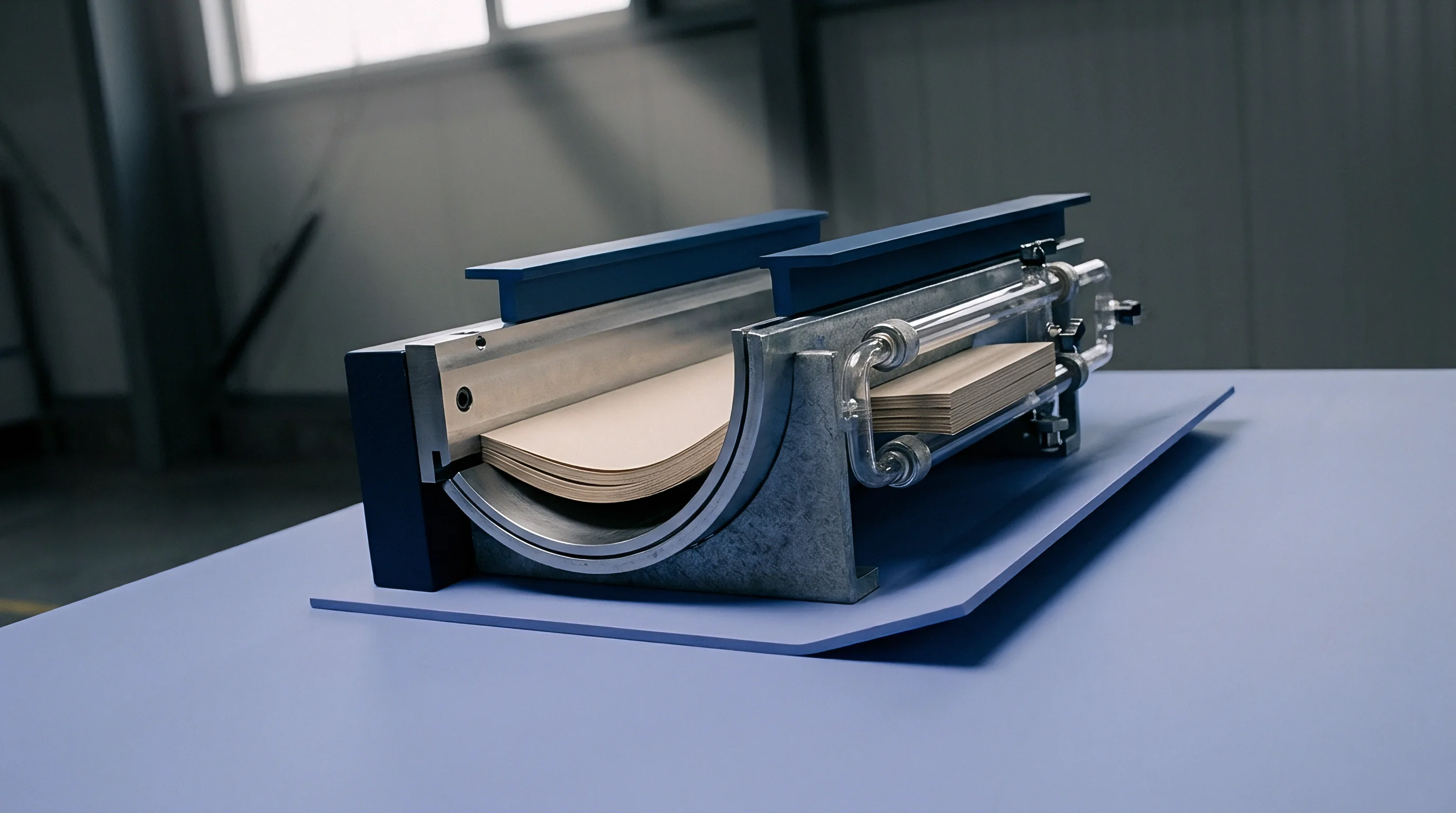
Pulse
Excitation bursts directed at a sheet generate multiple acoustic wave modes inside the multi-ply structure. When the sound beam enters the board surface, mode conversion produces both out-of-plane compressional waves and guided plate waves, known as Lamb modes. In paperboard converted for folding cartons, caliper dimensions range between 300 and 700 micrometers, which sits below the ultrasonic compressional wavelength in cellulose.
This geometric constraint forces the dominant guided energy into the fundamental symmetric and anti-symmetric plate modes.
Uncreased plies maintain high elastic rigidity. The fundamental anti-symmetric mode governs flexural behavior, exhibiting phase and group velocities directly tied to board bending stiffness and basis weight. In virgin solid bleached boards, uncreased out-of-plane flexural velocities sit between 600 and 1,100 meters per second.
When the scoring rule forces the sheet into the female matrix, it intentionally breaks internal fiber-fiber hydrogen bonds and initiates delamination cracks between adjacent plies. This internal separation creates the sliding planes necessary for a clean 90-degree or 180-degree carton fold without rupturing the tensioned exterior print liner.
Lamb Wave Propagation in Creased Calipers
Passing an acoustic wave across this mechanically disrupted zone transforms the transmitted waveform. The internal delamination crack serves as an acoustic reflector and scatterer. Delamination lowers out-of-plane stiffness sharply.
As the anti-symmetric plate mode enters the creased channel, the local reduction in plate thickness and interlaminar shear stiffness drops the wave group velocity. Concurrently, acoustic energy scatters off micro-fractures, void pockets, and decoupled fiber bundles within the core mechanical plies.
Group velocity drops thirty percent immediately. An intact board exhibits a sharp, high-amplitude transmitted envelope arriving at a predictable time of flight across a fixed pitch-catch sensor pair. Over a properly delaminated crease, the arrival time shifts later, and the transmitted amplitude drops by 8 to 22 decibels relative to uncreased base stock.
If the crease is under-formed, exhibiting insufficient internal delamination, the amplitude drop remains minimal, warning that the board will resist folding and split its outer liner under mechanical erecting forces.
Shear failure severs internal fiber bonds. The table below illustrates the shift in acoustic propagation metrics across virgin and recycled packaging grades subjected to standardized matrix scoring depths, evaluated under controlled laboratory conditions per standard ISO 187 atmospheres at 23 degrees Celsius and 50 percent relative humidity.
| Substrate Grade | Caliper (um) | Scoring Depth (um) | Base Velocity (m/s) | Crease Velocity (m/s) | Amplitude Attenuation (dB) |
|---|---|---|---|---|---|
| Solid Bleached Sulfate (SBS) | 350 | 140 | 980 | 710 | 14.2 |
| Solid Bleached Sulfate (SBS) | 350 | 210 | 980 | 590 | 21.8 |
| Folding Boxboard (FBB) | 420 | 160 | 840 | 620 | 12.5 |
| Folding Boxboard (FBB) | 420 | 250 | 840 | 480 | 19.6 |
| Coated Recycled Board (CRB) | 480 | 180 | 760 | 580 | 11.1 |
| Coated Recycled Board (CRB) | 480 | 290 | 760 | 410 | 18.4 |

Attenuation Profiles across Delaminated Shear Planes
Tracking the signal across the width of the crease profile yields a localized spatial map of internal fiber disruption. High-resolution scanning across the creased axis uncovers distinct signature patterns that separate functional delamination from structural fiber fracture. Functional scoring confines shear delamination between internal plies, leaving the top liner and bottom back liner intact to carry tensile and compressive folding loads.
Defective creases display acoustic anomalies that indicate impending carton failure on automated packaging lines:
- Tension liner cracking produces an abrupt, high-frequency spectral notch accompanied by complete loss of transmitted plate amplitude exceeding 30 decibels, signaling ruptured surface cellulose.
- Insufficient delamination depth exhibits an acoustic transmission drop below 4 decibels, indicating intact internal plies that will cause carton bulging and excessive springback torque.
- Asymmetric shear banding creates a double-trough attenuation envelope across the matrix width, revealing uneven mechanical rule pressure or female counter misregistration.
- Complete core crush generates broadband acoustic dispersion with erratic phase delays, pointing to excessive penetration depth that destroyed board structural integrity.
Sound energy moves through dense bonded cellulose and dissipates where mechanical scoring ruptures internal fiber contacts.


Scatter
Finishing treatments alter sheet surface mass and interface boundaries before the die cutting pass occurs. Modern consumer packaging frequently carries multi-layer functional or aesthetic coatings, including aqueous dispersion barriers, UV curable gloss varnishes, vacuum metallized transfer layers, and laminated polymer films. Each added layer modifies the overall composite density and surface wave propagation speeds, complicating the acoustic evaluation of underlying fibrous cores.
The polypropylene film adds surface mass. Biaxially oriented polypropylene film applied with polyurethane adhesive at 15 micrometers thickness increases basis weight by 14 grams per square meter while significantly elevating out-of-plane surface damping. When ultrasonic plate waves encounter a laminated carton board, acoustic energy couples into the viscoelastic polymer layer.
The polymer dampens high-frequency wave components through mechanical hysteresis, creating baseline attenuation that occurs independently of score line delamination.
Surface lamination film suppresses high-frequency air transmission while preserving lower-order flexural modes across the score channel.

Why Do Barrier Coatings Shift Peak Acoustic Attenuation?
Aqueous barrier coatings formulated with styrene-butadiene, acrylic lattices, or mineral pigments penetrate the porous fibrous surface of the top liner. This absorption alters the acoustic impedance of the outer board skin by filling surface void fractions and raising localized density. The filled void structure reduces normal surface reflection slightly, transferring more energy into the sheet while simultaneously steepening high-frequency dissipation.
Signal processing routines must differentiate between the steady baseline attenuation introduced by surface finishes and the localized mechanical attenuation generated by die score delamination. In unvarnished boards, the background attenuation remains flat across uncreased sheet areas. Laminated or heavily coated surfaces produce background acoustic loss profiles with higher spatial noise, caused by coating weight variations, localized drying stresses, and micro-scale adhesive nip variations.
| Surface Finish State | Coating Weight (gsm) | Nominal Caliper (um) | Baseline Insertion Loss (dB) | Score Net Attenuation (dB) | Crease Velocity Shift (%) |
|---|---|---|---|---|---|
| Uncoated Virgin Base | 0 | 350 | 51.4 | 15.8 | -27.5 |
| Double Mineral Blade Coated | 24 | 355 | 53.2 | 15.4 | -26.8 |
| Aqueous Gloss Varnish | 6 | 358 | 54.1 | 14.9 | -25.2 |
| UV Curable Matt Varnish | 8 | 360 | 55.8 | 14.1 | -23.9 |
| Gloss BOPP Film Lamination | 14 | 372 | 59.6 | 11.8 | -19.4 |
| Soft-Touch Polyurethane Film | 22 | 384 | 64.2 | 9.6 | -15.1 |
| Data measured at 400 kHz with normal incidence transducers using calibrated substitution techniques at 23 degrees Celsius and 50 percent relative humidity. | |||||

Polymer Lamination Damping versus Solid Bleached Cores
Film lamination bridges over the mechanical score zone, maintaining physical continuity across the crease even when the underlying cellulose liners crack completely under severe die penetration. This masking behavior presents severe operational challenges for visual inspection systems. Optical line cameras view an intact polymer film surface and classify the crease as acceptable, while the fiber hinge beneath sits fractured and devoid of bending resistance.
Acoustic pulses penetrate through the masking film to interrogate the load-bearing fiber core directly. The air-coupled pulse drives right through the 15-micrometer plastic skin, sensing the sheared void networks within the center plies. Where a liner fracture occurs beneath the film, the Lamb wave encounters a complete mechanical discontinuity in the cellulose substrate, inducing extreme phase disruption and an amplitude collapse exceeding 25 decibels despite the unbroken plastic overlay.
Setting up acoustic inspection lines requires systematic calibration to account for these surface passes:
- Uncoated board baselining registers baseline sound velocity and attenuation on raw stock before finishing passes apply chemical coatings or films.
- Coating weight compensation adjusts sensor amplification gains to counterbalance broad-spectrum signal damping introduced by polymer and varnish layers.
- High-pass phase filtering separates localized score line fractures from long-wavelength thickness variations across the converted web.
- Dynamic baseline normalization tracks reel-to-reel moisture changes across long converting shifts, preventing drift in delamination classification thresholds.
Uncalibrated acoustic attenuation thresholds let over-creased cartons enter packing lines where crushed scoring beads jam automated erecting arms and stop the line.


Anisotropy
Paperboard exhibits distinct orthotropic mechanical properties governed by the preferential alignment of wood pulp fibers during web formation on the paper machine. The machine direction displays elastic tensile moduli typically two to three times greater than the cross machine direction. In-plane acoustic velocities map directly to this mechanical orientation, running fastest along the machine axis and slowest across the transverse direction.
Mechanical scoring behavior shifts depending on crease orientation relative to fiber alignment. Creasing parallel to the machine direction forces the scoring rule to push between aligned fibers, creating delamination through shear wedging with minimal fiber breakage. Creasing across the machine direction forces the rule against aligned fibers, requiring higher penetration force to induce interlaminar slip and raising the risk of tensile liner burst.
Consequently, acoustic attenuation profiles for valid, functional creases differ substantially between machine directions.
Elastic Moduli Matrix across Machine Orientations
Determining crease integrity requires resolving the complete planar stiffness matrix of the running substrate. The velocity of the zeroth-order symmetric Lamb mode scales directly with the in-plane elastic modulus, density, and Poisson ratio. By utilizing two orthogonal pairs of air-coupled transducers, noncontact systems measure the acoustic velocity vector in real time, capturing both machine and cross direction moduli before the sheet reaches the cutting die.
Tool wear alters score crease depth. As female counter channels wear down across a hundred thousand impressions, scoring bead height decreases, diminishing the depth of internal delamination. In a high-volume folding carton plant running 150,000 units on 350 gsm board, counter channel degradation typically reduces delamination depth by 35 micrometers across an eight-hour shift.
If unmonitored, the board bending resistance increases by 40 percent, leading to skewed carton folding and carton gluer stoppages.
A delaminated score line slows plate wave propagation when internal shear fractures decouple the outer liners from the core fibers.
Transducer positioning demands precise geometric alignment relative to the running board web. A worked engineering calculation clarifies the operational margins required on line. Consider a converting web running at 300 meters per minute, which translates to 5 meters per second of linear velocity.
The ultrasonic sensor pair operates at a pulse repetition frequency of 5 kilohertz, firing an acoustic burst every 0.2 milliseconds. During the interval between successive acoustic pulses, the running sheet advances exactly 1.0 millimeter beneath the probe head.
Achieving reliable spatial resolution across a 1.2-millimeter crease channel dictates that the acoustic beam focal diameter must not exceed 1.0 millimeter at the sheet plane. If the beam diameter expands to 2.5 millimeters through beam defocusing or excessive sensor standoff distance, the acoustic footprint overlaps both the sheared crease channel and the adjacent uncreased board shoulders simultaneously. The received signal becomes a spatial average, suppressing the measured attenuation drop from an actual 18 decibels down to an apparent 6 decibels, obscuring defective, under-delaminated creases.
Will Caliper Variations Destabilize Time of Flight Tracking?
Incoming board stocks exhibit natural basis weight and caliper variations across master reels, commonly spanning plus or minus five percent around nominal values. Because guided plate wave group velocities depend on sheet thickness, raw stock thickness fluctuations shift baseline wave arrival times. A ten-micrometer increase in virgin board caliper produces an acoustic phase advance that can mimic an under-creased joint if the processing unit relies solely on absolute arrival time.
Robust signal discrimination pairs arrival time delay with relative peak attenuation and frequency-dependent spectral shifts. Modern noncontact processing algorithms employ wavelet decomposition to isolate the specific spectral signature of core delamination from bulk caliper drift. Sensor gap drift skews arrival timing.
Tracking the differential signal between an on-crease transducer and an adjacent off-crease reference transducer cancels out ambient temperature shifts, air turbulence, and incoming raw board thickness variations in real time.
Converting engineers establish rigorous setup protocols prior to running critical carton orders:
- Standoff distance verification fixes transducer face clearance at precisely 20 millimeters using micrometer stages to maintain beam focal spot geometry.
- Acoustic axis alignment positions transmitter and receiver probes coaxially within 0.2 degrees of normal incidence to prevent phase cancellation across the receiver aperture.
- Differential channel balancing calibrates off-crease reference probes against the primary crease inspection channel to null out environmental air density swings.
- Velocity vector calibration maps machine direction and cross direction sound speeds against known laboratory tensile stiffness orientation benchmarks.
Whether oblique shear-wave transducers can isolate cross-direction fiber buckling from delamination micro-cracking across heavily recycled board remains disputed across test laboratories.


Rejection
Translating acoustic wave measurements into automated rejection actions requires establishing hard correlation gates against physical mechanical bench standards. Converting operations rely on historical physical parameters, primarily the crease recovery ratio measured on mechanical instruments like the Lorentzen and Wettre Crease Tester according to standard ISO 2493-1 or TAPPI T 829. The crease ratio represents the bending force of the creased board divided by the bending resistance of the uncreased board, expressed as a percentage.
An ideal carton crease displays a mechanical crease ratio between 45 and 60 percent. A crease ratio exceeding 70 percent indicates insufficient internal ply delamination, meaning the board remains too stiff to fold cleanly, risking carton bowing and jam-ups inside high-speed packaging machinery. Conversely, a crease ratio dropping below 35 percent points to excessive mechanical crush, where the die has sheared the exterior liners, leading to fractured carton corners and aesthetic rejection on retail shelves.

Threshold Envelopes on Continuous Folding Gluers
Automated noncontact inspection units mounted on folder-gluers compare real-time acoustic signatures against calibrated acceptance windows. High bending resistance jams automatic carton packers. As carton blanks stream past the ultrasonic inspection head at speeds up to 400 meters per minute, the sensor evaluates each score line in milliseconds.
When the measured acoustic attenuation falls below an 8-decibel drop or exceeds a 24-decibel drop relative to adjacent reference stock, the system flags the blank as defective.
Reject gates discard out-of-spec blanks instantly. High-speed pneumatic blow-off valves or mechanical diverter fingers physically kick rejected blanks into a scrap bin before they enter the folding section. Operating without real-time acoustic feedback, a plant converting two million pharmaceutical cartons typically experiences make-ready scrap rates between two and four percent, alongside unpredictable customer returns caused by carton hang-ups on customer packaging lines.
Under DIN 55437-1 scoring tolerances, failure to maintain the designated groove width voids mill liability for exterior liner split defects during automated folding.

Mechanical Score Benchmarks versus Noncontact Signals
Empirical correlations link noncontact acoustic parameters directly to standardized mechanical bending resistance metrics. Ultrasonic attenuation captures the micro-structural breakdown of internal fiber bonds, providing a direct physical proxy for the mechanical hinge properties of the fold. The data table below illustrates the observed correlation between air-coupled acoustic parameters and mechanical bench tests performed across 400 gsm folding boxboard lots.
| Crease Quality State | Acoustic Attenuation (dB) | Plate Velocity Shift (m/s) | L&W Crease Ratio (%) | Visual Liner Condition | Line Performance Status |
|---|---|---|---|---|---|
| Severely Under-Creased | < 4.5 | < -80 | > 78 | Intact, No Delamination | Rejected: Packer Jam Risk |
| Borderline Stiff | 4.5 to 8.0 | -80 to -140 | 68 to 78 | Slight Delamination | Flagged: High Springback |
| Target Specification | 8.1 to 18.0 | -141 to -280 | 45 to 60 | Uniform Core Shear | Approved: Optimal Run |
| Borderline Deep | 18.1 to 23.5 | -281 to -360 | 35 to 44 | Deep Shear, Minor Liner Necking | Approved: Monitor Tooling |
| Severely Over-Creased | > 23.5 | > -360 | < 35 | Tension Liner Micro-Fractures | Rejected: Split Corner Risk |
Carton flap springback halts packing lines. Deploying noncontact ultrasonic testing mechanics shifts process verification from historical post-mortem sampling to real-time closed-loop die control. Converting lines equipped with noncontact acoustic heads track die wear patterns dynamically across hundred-thousand-sheet runs, prompting operators to shim cutting plates or swap worn counter matrix strips before out-of-tolerance creases reach the folder-gluer.
Incorporating ISO 12625-15 acoustic velocity tolerances directly into the master board purchase contract binds the converter to replace rejected lots without charging make-ready spoilage back to the brand owner.