Dynamic Impression Compensation and Crease Uniformity across Wide Format Platens
Dynamic impression compensation balances wide format platen beam flexure to ensure uniform crease depth and prevent score cracking across large paperboard sheets.
Deflection
When large format flatbed die cutters operate at maximum production speeds, structural beam bowing across platen widths exceeding 1400 millimeters alters the distribution of cutting forces. Structural steel components absorb immense energy under loads reaching 350 to 500 metric tons. Cast iron upper beds flex upwards at the center span, while the lower main beam moves downwards against its toggle linkages.
This mechanical divergence creates a pressure gradient across the sheet, reducing impression force at the center relative to the outer edges. Steel rule knives situated near the perimeter make full contact with the cutting plate while rules located in the central bed quadrant fail to penetrate substrate fibers to the required depth. Substrate caliper variations amplify these physical deviations, creating systemic instabilities during high-speed packaging runs.
Structural Flexure under High Tonnage Loads
Press bed framing distorts vertically as tonnage rises to penetrate heavy caliper paperboard. The central structural mass yields under cyclic loading, generating dynamic mechanical displacement across the working surface area. Center bed rule pressure drops rapidly.
At 350 metric tons of load, a 1420 millimeter upper platen exhibits center sagging ranging between 0.12 and 0.18 millimeters relative to the side frames. This dimensional gap exceeds the elastic limits of standard folding carton substrates, which typically require depth consistency within 0.015 millimeters across all sheet quadrants. Steel cutting rules require consistent pressure to achieve clean severance without crushing adjacent paper fibers.
When platen flexure starves central rules of mechanical load, operators frequently increase total machine tonnage to force center cutting. Higher pressure forces edge rules deeper into the anvil plate, accelerating knife dulling and driving premature matrix wear.
| Platen Format Width (mm) | Applied Load (Metric Tons) | Center Beam Deflection (mm) | Edge Impression Force (%) | Center Impression Force (%) | Uncompensated Caliper Loss (%) |
|---|---|---|---|---|---|
| 1060 | 300 | 0.08 | 100 | 91.2 | 4.5 |
| 1420 | 350 | 0.15 | 100 | 82.4 | 11.8 |
| 1420 | 450 | 0.21 | 100 | 76.1 | 16.2 |
| 1620 | 450 | 0.26 | 100 | 71.5 | 19.7 |
| 1620 | 550 | 0.32 | 100 | 64.8 | 24.3 |
Center Span Bowing Mechanics
Mechanical leverage across wide platen formats concentrates physical stress away from the driving toggle links. Corner tonnage peaks first. Because drive mechanisms connect near the lateral frame columns, bending moments reach maximum values at the exact mid-point of the platen beam.
Central score lines receive substantially less vertical compression than peripheral lines, creating uneven internal displacement within paperboard plies. Substrates subjected to deficient central force exhibit poorly formed crease beads. The internal delamination of fiber layers fails to occur correctly, causing the outer linerboard to stretch around a wide radius during folding.
This mechanical failure yields high folding resistance torque, inconsistent box squareness, and frequent failure on automated packing lines.
A 1420 millimeter platen subjected to 350 metric tons of cutting load exhibits structural beam sagging up to 0.18 millimeters at center bed under uncompensated static impression.
Platen structural flexure generates distinctive failure profiles across large paperboard sheets. The conversion of wide format board requires balanced mechanical force to yield uniform crease definition without fracturing surface liners.
- Crease bead shearing destroys inner liner integrity when excessive pressure forces rule tips beyond optimal depth.
- Incomplete score definition occurs in central sheet zones where reduced mechanical penetration leaves board fibers unworked.
- Asymmetric fold resistance causes automated carton erecting lines to jam due to uneven torque requirements across opposing panels.
- Surface liner splitting develops along outer fold lines when localized over-compression starves surrounding material of elasticity.
Ignoring structural beam flexure guarantees elevated waste rates, premature tooling wear, and structural carton failures that compromise automated high-speed packing operations.

Shim
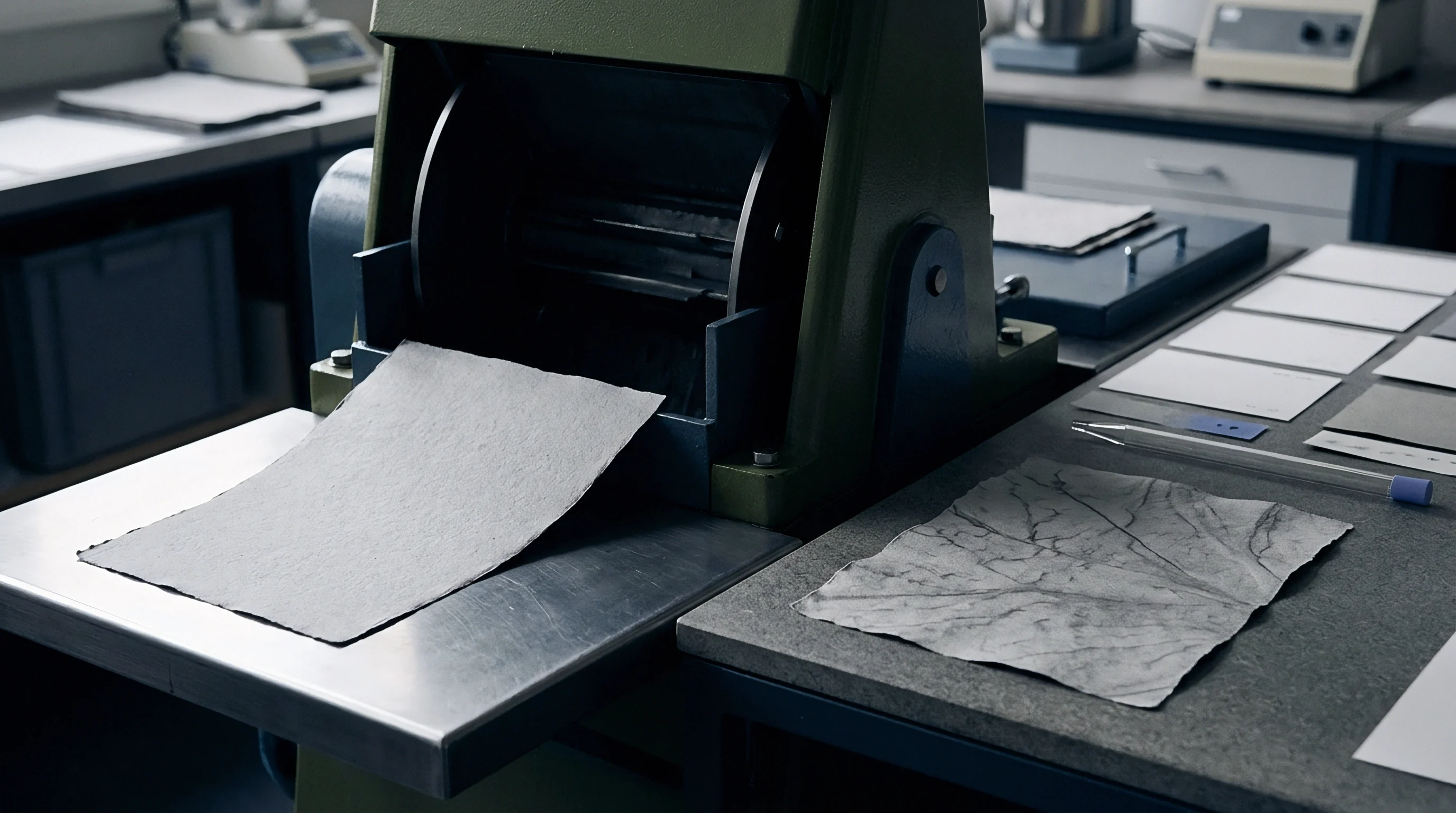
Traditional makeready procedures rely on paper or foil patches placed beneath the cutting plate to equalize impression across uneven press beds. Operators pull an initial carbon impression proof to identify zones where steel rules fail to register adequate cutting or creasing force. Tissue paper patches measuring 0.03 to 0.05 millimeters in thickness are affixed by hand to a zoned backing sheet.
This manual build-up fills physical voids created by platen flexure, restoring surface contact across central sheet zones. Manual patching remains highly labor-intensive, requiring multiple press stoppages and substantial initial sheet waste before achieving acceptable impression uniformity across wide sheets.
Zonal Overlays and Volumetric Balancing
Layered paper tape built up behind high-wear zones compensates for localized bed indentation. Static overlays cannot adapt. As press tonnage forces the central platen beam upward, manual patches build volume behind the die chase to bridge the physical gap between upper and lower platen surfaces.
Thin tissue sheets of 30 grams per square meter provide granular height control, allowing press crews to build targeted impression crowns. Over-patching central bed areas concentrates force on specific steel rules, which distorts the die board wood itself. The wooden die block compresses under localized high tonnage, displacing embedded steel rules sideways and causing blade misalignment relative to female counterboard channels.
- Pull a full-format impression proof on 150 gram per square meter carbon paper at low tonnage.
- Inspect impression density across all four quadrants to identify central pressure deficits.
- Apply 0.03 millimeter paper overlays to back-plate regions corresponding to weak score areas.
- Step press load incrementally up to target cutting pressure while monitoring rule penetration depth.
- Measure creasing force across outer and inner carton blanks using a handheld fold tester.
Static Makeready Limitations
Manual patching techniques fail to adapt as operational temperatures shift during extended converting shifts. Press drive components warm up under continuous load, causing thermal expansion within main bearings, toggle shafts, and side frames. Bed parallelism shifts.
Mechanical friction elevates internal frame temperatures by 15 to 25 degrees Celsius over four hours of continuous operation. Thermal expansion alters machine dimensions, shifting the optimal impression pattern established during cold press setup. Manual paper shims compress over time under cyclic impact, losing up to 20 percent of their original thickness across a 50,000-sheet production run.
As paper overlays flatten, central crease quality degrades steadily, forcing machine operators to halt production and perform secondary patch adjustments.
Patches placed near bed support pillars crush board fibers faster than equal-thickness overlays situated near open span centers.
Static makeready procedures create inherent friction between setup efficiency and long-term running stability. Mechanical wear patterns develop unevenly across the platen plate when reliance on localized patching remains high. Overlay paper added to correct central crease weakness accelerates steel rule blunting along the outer margins.


Geometry
Crease rule dimensions and counter channel profiles establish the physical boundaries within which paperboard fibers deform during score creation. Scoring rule height, tip radius, channel width, and channel depth must correlate with substrate caliper and fiber orientation. When wide format platens exhibit impression variance, theoretical channel geometry breaks down.
In central zones where effective impression drops, the male creasing rule fails to drive substrate material completely into the female counter channel. The resulting crease bead exhibits insufficient height and poorly defined shoulders, preventing localized fiber delamination within the internal board structure. Without clean internal ply separation, folding stress concentrates on the outer linerboard rather than distributing safely across internal fiber layers.
Steel Rule and Counter Channel Alignment
Proper positioning of male scoring blades relative to female phenolic channels prevents micro-fracturing of top-coat layers. Alignment demands precision within 0.02 millimeters across the entire platen surface. Wide format dies containing hundreds of individual carton blanks face severe thermal expansion differential between the steel cutting plate, the wooden die block, and the milled phenolic counterboard.
As ambient pressroom humidity shifts, wooden die blocks expand across the grain, shifting score rule locations relative to fixed counterboard grooves. Male rules that enter counter channels off-center pinch substrate fibers against one channel wall. This pinching action shears internal fiber bonds on one side of the score while leaving the opposite side unworked, resulting in skewed panel folding during high-speed carton assembly.
| Substrate Grade | Caliper (mm) | Rule Thickness (pt) | Channel Width (mm) | Channel Depth (mm) | Crease Stiffness Target (mNm) | Max Resistance Deviation (%) |
|---|---|---|---|---|---|---|
| Solid Bleached Sulfate (SBS) | 0.40 | 2.0 (0.71 mm) | 1.30 | 0.40 | 110 | ±8.0 |
| Solid Bleached Sulfate (SBS) | 0.60 | 3.0 (1.05 mm) | 1.90 | 0.60 | 185 | ±8.0 |
| Folding Boxboard (FBB) | 0.45 | 2.0 (0.71 mm) | 1.45 | 0.45 | 95 | ±10.0 |
| Coated Recycled Board (CRB) | 0.50 | 3.0 (1.05 mm) | 1.70 | 0.50 | 140 | ±12.0 |
| Coated Recycled Board (CRB) | 0.65 | 3.0 (1.05 mm) | 2.10 | 0.65 | 210 | ±12.0 |
Substrate Caliper Compliance
Solid bleached sulfate boards absorb score displacement differently than multi-ply recycled substrates under equal penetration loads. Primary virgin fibers exhibit high tear resistance and elastic elongation, permitting deep score penetration without surface cracking. Coated recycled board contains shorter reclaimed fibers with lower structural elasticity.
CRB layers shear easily when subjected to excessive localized rule penetration. When platen flexure forces press operators to increase overall impression, recycled board liners split along peripheral score lines while central scores on the same sheet remain under-formed. Substrate moisture content governs fiber flexibility.
At relative humidity levels below 45 percent, paperboard fibers grow brittle, rendering score lines susceptible to outer liner fracture even when crease channel geometry matches nominal caliper specifications exactly.
Milled counterboard material selection influences long-term crease stability. Phenolic resin matrix strips provide uniform channel walls capable of withstanding millions of platen impacts without wall collapse. Soft counter channels mask underlying deflection.
Counterboards manufactured from vulcanized fiber or low-density synthetic polymers compress under high tonnage, dynamic impression changes alter effective channel depth over the course of a production run. As counter channels widen under repeated impact, male creasing rules meet reduced lateral resistance, yielding wider, soft-shouldered crease beads that increase carton folding resistance torque.
- Rule thickness selection requires matching scoring blade width to board caliper to prevent internal delamination.
- Counter depth calculation must incorporate film lamination thickness when processing barrier-coated folding cartons.
- Channel width sizing dictates whether outer liner fibers stretch smoothly or fracture during right-angle folding.
- Bead height verification confirms that female counter groves produce sufficient internal rib height without puncturing substrate layers.
Tooling suppliers frequently maintain that score cracking stems entirely from raw material moisture fluctuations rather than inaccuracies in counterboard channel milling.


Calibration
Active load compensation systems integrate dynamic sensors and hydraulic actuators to adjust bed elevation in real time during production. Modern wide format flatbed converting presses utilize dynamic impression control to offset mechanical deflection automatically. Piezoelectric strain sensors embedded within bed frames continuously monitor force distribution during each impact stroke.
Fast micro-processors calculate deflection curves based on tonnage feedback and drive corner-mounted servo-hydraulic rams or eccentric wedges to adjust local bed height during the dwell phase of the cutting stroke. This automated compensation maintains uniform clearance between upper and lower platens across the entire sheet span, regardless of total press speed or substrate caliper shifts.
Dynamic Hydraulic Force Balancing
Closed-loop pressure control modules dynamically alter fluid volume within lower platen support cylinders across high-speed cycles. Hydraulic rams adjust within milliseconds. When sensor arrays detect central tonnage dropping below target thresholds during impact, secondary hydraulic cylinders beneath the central platen span apply localized upward counter-pressure.
This targeted lifting force counteracts structural beam sagging, maintaining flat platen parallelism throughout the cut cycle. Dynamic load adjustments prevent bead shearing. Real-time tonnage balancing eliminates the need for aggressive manual patching, reducing press makeready duration from hours to minutes while establishing consistent score formation across all sheet zones.
| Operational Metric | Manual Paper Patching | Fixed Crown Platen | Dynamic Hydraulic Compensation |
|---|---|---|---|
| Average Makeready Duration (Minutes) | 115 | 65 | 22 |
| Setup Sheet Spoilage (Sheets) | 450 | 220 | 45 |
| Crease Depth Variation across Sheet (%) | ±18.5 | ±11.2 | ±2.5 |
| Maximum Speed on 1420mm Bed (SPH) | 5,200 | 6,500 | 8,500 |
| Steel Rule Replacement Interval (Sheets) | 120,000 | 180,000 | 350,000 |

Real-Time Deflection Feedback
Piezoelectric strain sensors embedded within bed frames continuously monitor force distribution during each impact stroke. Thermal sensors track temperature gradients across drive columns, feeding data to control software that recalculates platen expansion vectors continuously. As machine frame components warm up, the automated calibration system modulates hydraulic pressure to maintain consistent impression clearance without operator intervention.
Dynamic impression systems collect per-stroke force data, creating a electronic quality record for every converted pallet. Statistical process control algorithms identify gradual tool wear patterns by tracking steady pressure increases required to maintain clean severance over long production runs.
DIN 55437-1 scoring performance criteria mandate that fold resistance torque on folded cartonboard remains within fifteen percent of target values across all sheet positions.
Quality management specifications dictate precise documentation for converted packaging lots intended for high-speed automated packaging lines. Standardized verification procedures ensure that physical properties match technical dossier claims prior to final buyer sign-off.
- Parallelism certification data records angular platen alignment across four quadrants under maximum static load testing.
- Dynamic response logs document hydraulic valve correction speeds and bed elevation adjustments across full-speed production runs.
- Caliper variance records track incoming paperboard thickness profiles to correlate raw material shifts with active pressure adjustments.
- Crease torque test reports detail bending resistance values taken from first-off and final-sheet carton samples.
Compliance specifications in international converting agreements require continuous platen parallelism monitoring logs to validate batch score uniformity prior to lot acceptance.
Economics
Makeready downtime, sheet spoilage, and high-speed gluer jams dictate the landed unit cost of converted paperboard packaging. Wide format flatbed die cutters represent substantial capital investments, where hourly operational rates routinely exceed 350 Euros per hour. Setup delays caused by repetitive carbon impression pulls and manual paper patching reduce line availability and increase unit production costs.
On long-run packaging orders, an reduction of 90 minutes in makeready duration restores valuable capacity to the converting floor, allowing operations to absorb additional shifts without purchasing supplementary die-cutting machinery.
Make-Ready Downtime and Scrap Reduction
Extended press set-up times consume valuable floor capacity while generating hundreds of non-compliant test sheets. Sheet spoilage during impression balancing incurs direct raw material costs, particularly when processing premium virgin fiber boards or foil-laminated substrates. Consider a typical job running 50,000 sheets of 450 micron SBB board through a 1420 millimeter press.
Manual makeready methods consume up to 450 setup sheets before achieving uniform score definition across all carton blanks on the die. At a substrate cost of 1.40 Euros per square meter, setup spoilage generates over 1,000 Euros in direct material waste per job setup. Automated dynamic impression systems reduce setup sheet scrap by up to 90 percent, saving substantial material costs across annual production volumes.
Active hydraulic compensation loops continuously balance lower platen elevation based on real-time strain sensor measurements taken at the four bed corners.
Tooling Longevity and Unit Carton Margins
Excessive cutting tonnage applied to overcome center bed deflection accelerates steel rule wear and ruins counterboard channels prematurely. Tooling tolerance limits score precision. When operators boost press pressure by 50 metric tons to force central cutting rules through board fibers, edge rules crush against the hardened steel anvil plate under extreme force.
Cutting edges dull rapidly, developing micro-burrs that tear paperboard fibers rather than severing them cleanly. Premature die wear forces mid-run press stops for knife replacement or rule re-rubbering, adding unplanned labor costs and reducing net hourly output. Tooling replacement intervals drop from 350,000 impressions down to 120,000 impressions when operating under uncompensated platen deflection, effectively tripling die tooling costs per finished carton.
What threshold of capital expenditure for automated dynamic impression technology yields a positive return when balanced against the declining profit margins of high-volume commodity carton converting?