Dynamic Press Thermal Stabilization and Substrate Hygroexpansivity Interface Optimization
Stabilizing cylinder temperatures at twenty-six degrees Celsius limits fountain water pickup, keeping cross-direction sheet expansion below critical register.

Coupling
Mechanical shear inside high-speed roller trains transfers continuous thermal energy into the passing paper web. Friction generated between oscillating distributor rollers, rubber form rollers, and steel transfer drums elevates ink train temperatures from ambient shop levels to beyond forty-five degrees Celsius during sustained production. Viscosity collapses as ink warms.
Press operators counteract this thinning fluid by increasing dampening water delivery, flooding the plate with acidic fountain solution to maintain clean non-image areas. The fibrous sheet absorbs this excess fluid under direct nip pressure. Incoming cellulosic fibers expand instantaneously in response to moisture uptake, initiating dimensional distortion across the sheet profile before the second ink unit prints.
Ink tack increases roller heat.
Cross-direction expansion dominates this mechanical reaction. Papermaking fibers align predominantly parallel to the machine direction during web forming on the Fourdrinier wire, establishing an anisotropic structural matrix. Fiber diameter swells four to seven times more than fiber length upon moisture absorption.
Consequently, a paperboard sheet subjected to surface wetting experiences lateral dimensional growth while machine-direction stretch remains comparatively restrained. The simultaneous application of heat from unchilled roller surfaces accelerates the diffusion rate of aqueous fountain solution into the porous coating and base fiber network. Thermal energy expands the metal press cylinders while softening the hemicellulose matrix that binds individual wood fibers together.
A three-percent shift in core sheet moisture shifts lateral register by up to zero point four millimeters across a forty-inch press sheet.
Water migration softens fiber bonds.
The resulting physical mismatch degrades print fidelity and spatial alignment across successive print stations. When temperature gradients across the cylinder face remain uncorrected, peripheral ink units transfer variable moisture volumes across the lateral profile of the sheet. Center-to-edge moisture differentials produce wavy edges, localized puckering, and sheet fan-out.
Print units downstream receive a substrate whose physical dimensions differ from the original layout plate, destroying dot register and ink trap uniformity.
- Trapped edge fluting develops when uneven drying evaporates water from sheet perimeters while the center retains liquid fountain solution, inducing compressive stress along the pile edges.
- Circumferential dot elongation occurs as thermal expansion enlarges the effective diameter of plate cylinders, shifting the surface speed relative to the blanket and smearing halftone dots along the print axis.
- Lateral fan-out drift pushes process color dots outward toward the drive and operator sides, producing visible cyan and magenta color fringes on external carton panels.
- Coating surface pick intensifies when localized cylinder heat bakes wet varnish layers against blanket surfaces, tearing mineral pigments away from the raw board base.
Trapped moisture triggers edge curl.
Neglecting these coupled thermo-hygrometric reactions converts thousands of printed sheets into unsalvageable scrap before downstream hot foil stamping or flatbed die-cutting units receive the pallet.
Chill
Circulating refrigerated fluid through internal roller cavities extracts heat generated by mechanical drive trains and high-energy ultraviolet curing lamps. Temperature conditioning circuits isolate the oscillating distribution cylinders, maintaining a stable surface boundary between twenty-six and twenty-eight degrees Celsius. Fluid circulation loops remove excess thermal loads before heat migrates into the ink fountain, fountain solution pans, or plate surfaces.
Stabilized roller surfaces hold ink tack within intended rheological limits, preventing the viscosity collapse that forces press operators to over-dampen the lithographic plate.
Cool water circles each core.
Impression cylinder chill jackets play an identical stabilizing role on the paperboard substrate itself. High-output interdeck ultraviolet and LED curing systems emit intense radiant energy alongside curing wavelengths. Unfiltered infrared radiation heats the paperboard to over sixty degrees Celsius in fractions of a second, driving structural water out of the cellulose web and exhausting it into the press exhaust air.
Chilled counter-pressure cylinders absorb this radiant shock, pinning substrate bulk temperature near ambient pressroom conditions and blocking moisture loss before the sheet enters subsequent printing or varnishing nips.
Will Fluid Chillers Stabilize Web Temperature?
Continuous closed-loop heat exchangers balance caloric generation against active refrigeration across eighteen-thousand-sheet-per-hour production runs. Modern press installations integrate individual temperature zones for plate cylinders, blanket bars, and inking tables. Independent fluid regulation allows operators to run upstream inking units at twenty-five degrees Celsius while holding downstream varnishing and coating units at twenty-two degrees Celsius to counter viscous dissipation in heavy coating pumps.
Press speeds alter thermal saturation.
| Station Position | Roller Setpoint | Substrate Exit Temp | Moisture Loss | Cooling Loop Flux |
|---|---|---|---|---|
| Unit 1 (K) | 26.0 °C | 24.2 °C | 0.12 % | 1.4 kW |
| Unit 2 (C) | 26.5 °C | 25.1 °C | 0.18 % | 1.6 kW |
| Unit 3 (M) | 27.0 °C | 26.4 °C | 0.25 % | 1.8 kW |
| Unit 4 (Y) | 27.0 °C | 27.8 °C | 0.31 % | 1.9 kW |
| Interdeck UV | 18.0 °C | 38.5 °C | 0.85 % | 6.2 kW |
| Coater (Aqueous) | 22.0 °C | 31.0 °C | -1.20 % | 3.1 kW |
| Delivery Pile | 20.0 °C | 28.5 °C | 0.20 % | 2.4 kW |
The sequence for setting fluid chiller parameters follows rigorous make-ready stages:
- Circulate conditioning fluid through roller cores for twenty minutes before engaging ink duct motors.
- Verify fluid inlet and outlet temperature differentials remain below one point five degrees Celsius across all distributor rollers.
- Engage chill impression circuits simultaneously with ultraviolet lamp shutter opening commands.
- Monitor substrate surface exit temperature using non-contact infrared sensors positioned above transfer drums.
Chill units demand constant wattage.
Machinery manufacturers frequently argue that pressroom ambient humidity variations render internal roll chilling ineffective whenever press doors remain open during make-ready.
Variance
Cellulose packaging grades demonstrate diverse dimensional responses when exposed to press thermal dynamics and aqueous fluids. Solid Bleached Sulfate (SBS) boards manufactured entirely from chemical pulps display uniform internal fiber networks with high dimensional stability under moderate moisture fluctuations. Folding Boxboard (FBB) utilizes mechanical pulp within its interior plies sandwiched between chemical pulp outer liners.
Mechanical groundwood plies retain higher lignin concentrations, yielding bulkier cross-sections that absorb dampening fluids quickly along raw edges. Recycled White Lined Chipboard (WLC) contains heterogeneous secondary fibers that swell unpredictably under thermal shifts, producing severe registration anomalies during multi-pass processing.
High grammage resists cross stretch.
Laboratory conditioning according to ISO 187 establishes baseline equilibrium at twenty-three degrees Celsius and fifty percent relative humidity. Substrates delivered to press floors frequently deviate from these standard parameters. A skid unwrapped at forty percent relative humidity gives up moisture to the surrounding air, contracting at the edges while the insulated center retains mill moisture.
Feeding this unbalanced stock into heated press units creates uneven contact pressure across the impression nip, exaggerating lateral elongation across the gripper margin.
Paperboard conditioned outside five-percent moisture tolerance limits forfeits standard manufacturer dimensional warranties under international converting trade rules.
Uncoated sheets drink dampening solution.
Furnish Response Profiles
Testing substrate absorbency via the Cobb method detailed in ISO 535 reveals the rate of water pickup across coated and uncoated faces. Triple-coated SBS limits sixty-second water absorption to less than twenty-five grams per square meter. In contrast, porous back plies on duplex boards absorb over eighty grams per square meter over identical durations.
When double-sided printing or heavy perfecting passes apply dampening fluid directly to uncoated board backs, hygroexpansive strain increases exponentially.
Sizing delays water penetration.
| Furnish Grade | Caliper | Cobb 60 (Top) | Cobb 60 (Back) | CD Hygroexpansivity | MD Hygroexpansivity |
|---|---|---|---|---|---|
| SBS Virgin Chemical | 350 µm | 18 g/m² | 22 g/m² | 0.055 % / %RH | 0.012 % / %RH |
| FBB Mechanical Core | 400 µm | 20 g/m² | 75 g/m² | 0.082 % / %RH | 0.018 % / %RH |
| WLC Recycled Waste | 450 µm | 24 g/m² | 88 g/m² | 0.115 % / %RH | 0.026 % / %RH |
| Kraft Liner Unbleached | 280 µm | 35 g/m² | 42 g/m² | 0.070 % / %RH | 0.015 % / %RH |
| Cast Coated Label | 115 µm | 12 g/m² | 58 g/m² | 0.095 % / %RH | 0.021 % / %RH |
Cross-direction dimensional coefficient values determine how much plate image scaling must occur prior to burning aluminum lithographic plates. Virgin chemical packaging boards exhibit stable coefficients that allow standard press register marks to align within fifty micrometers across all four process separations. Mixed recycled stocks demand wider register tolerances, frequently exhibiting unpredictable lateral movement between print units three and six.
Board buyers seeking to reduce raw material expenditures by substituting recycled furnishes for virgin fiber often discover that the material savings disappear through excessive register make-ready and high sheet reject tallies.
Standard purchase contract clause DIN 19303 specifies that board shipments must adhere strictly to stated fiber furnish ratios, preventing unscheduled moisture expansion spikes caused by unannounced furnish alterations.
Register
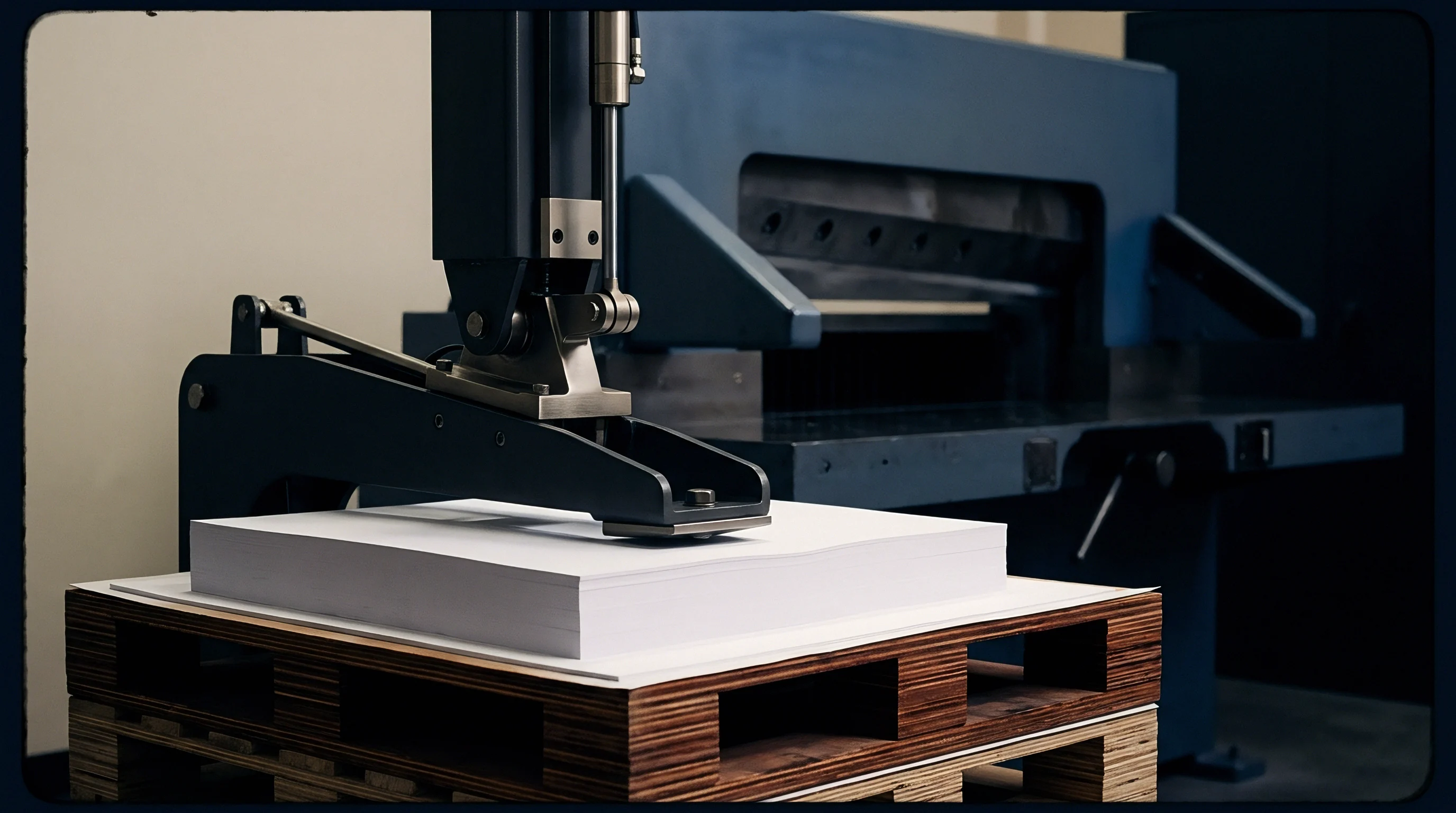
Mechanical web tension profiles interact directly with thermal expansion to determine lateral sheet behavior on press. Gripper bars pull sheets through successive cylinder nips under severe mechanical clamping force. When elevated roller temperatures soften the sheet matrix, this pulling force elongates the web along the machine direction while Poisson contraction narrows the sheet laterally.
Dampening water acts in direct opposition to Poisson contraction, forcing the cellulose network outward. The balance between mechanical pulling forces and fluid-induced expansion shifts continuously throughout a production shift as printing units warm up.
Web tension pulls hot fibers.
Modern printing presses combat lateral fan-out through plate-cocking motors, remote bustle wheels, and segmented cylinder squeeze adjustments. Bustle wheels push physically against the trailing edge of the sheet on impression cylinders, introducing a slight mechanical bow that compensates for cross-direction growth. If the sheet loses moisture inside an interdeck dryer, the board shrinks rather than expands, rendering positive bustle wheel compensation useless.
Operators must detect substrate shrinkage instantly, reversing mechanical adjustments to prevent severe centerline register binding.
Cylinder temperature stability dictates image position accuracy across all multi-pass converting conversions.
Second pass units lose tracking.

Is Dimensional Growth Contained across Multiple Passes?
Multi-pass finishing operations reveal the permanent structural consequences of thermal and hygroexpansive cycling. A sheet printed with six UV colors undergoes four intense ultraviolet heating passes followed by forced-air extraction. Moisture content plummets from seven percent down to three point two percent.
The pallet arrives at the flatbed foil stamping press twenty-four hours later in a severely contracted state. As ambient pressroom air transfers moisture back into the edges of the pallet, the sheet margins expand while the pile center remains compressed. Brass hot-stamping dies heated to one hundred and twenty degrees Celsius hit this distorted sheet, crushing the unstable surface and failing to hit graphic borders with precision.
- Verify incoming pallet temperature against ambient finishing room conditions before opening stretch wraps, preventing rapid condensation onto board edges.
- Measure core equilibrium relative humidity with an insertion sword hygrometer to confirm substrate moisture matches pressroom air within four percent.
- Engage de-curler bars gradually on coating units to avoid micro-fracturing the surface mineral coating while the sheet remains hot and desiccated.
- Compensate downstream foil dies by applying a zero point one five percent linear scale reduction on artwork along the cross direction to counter post-cure board shrinkage.
Dies crush warped stock unevenly.
Run stable stock through stable temperatures to keep print elements aligned from first pull to pallet drop.
Reckoning
Dimensional instability carries direct commercial penalties across every stage of folding carton production. Press make-ready waste accumulates rapidly when operators spend hours chasing register marks across four process colors and two spot PMS stations. An offset press running unchilled roller trains consumes hundreds of additional sheets per color station trying to reach dynamic thermal equilibrium.
The time spent dialing in register across an unstable substrate burns machine time valued at four hundred to six hundred dollars per hour, converting thin conversion margins into direct job losses.
Unsold cartons generate landfill fees.
Downstream converting passes compound this economic damage. When thermal fluctuations cause printed cartons to drift out of register by more than zero point two millimeters, automated inspection cameras on hot foil stampers and die cutters reject finished blanks at full production speeds. High-end cosmetic and pharmaceutical cartons carrying tight graphic borders around embossed elements tolerate zero register overlap.
Misaligned sheets destroy expensive male-female embossing dies when warped, uneven boards cause localized stress concentrations that fracture thin brass counter dies.
Make-ready delays destroy press profitability.
| Substrate Category | Make-Ready Waste | Run Register Scrap | Press Machine Cost | Die Tooling Damage | Total Financial Loss |
|---|---|---|---|---|---|
| Virgin SBS (Stabilized) | 350 sheets | 450 sheets | $280 | $0 | $1,040 |
| Virgin SBS (Uncooled) | 1,200 sheets | 2,800 sheets | $1,450 | $1,200 | $6,250 |
| Recycled WLC (Stabilized) | 850 sheets | 1,400 sheets | $680 | $0 | $2,720 |
| Recycled WLC (Uncooled) | 2,600 sheets | 7,200 sheets | $3,850 | $2,400 | $13,550 |
Foil dies cost real capital.
Consider a typical packaging converter running a fifty-thousand-sheet order of liquor packaging cartons on four-hundred-micrometer folding boxboard. A single pass of cold foil followed by six offset colors and an aqueous coat demands precise spatial fidelity. Without active roller chilling and substrate thermal control, running waste escalates from a benchmark two percent up to seven point five percent of total job volume.
That five point five percent delta burns two thousand seven hundred and fifty oversized board sheets, costing over three thousand dollars in raw material alone, completely ignoring lost machine hours, electrical utility waste, and downstream sorting labor.
Extended finishing operations amplify this financial liability. When embossed foil passes fail quality audits, converters must either reprint the entire job or negotiate discounted acceptance margins with unforgiving brand owners. Furthermore, European packaging levies penalize defective lots that cannot enter primary recycling streams due to heavy adhesive and foil contamination applied over ruined cartons.
Scrap pallets stripped at the die cutter represent total economic write-offs that erode annual operating income.
How close can press chilling loops and drying controls bring high-recycled substrates to the dimensional stability of virgin bleached board before material physics imposes an absolute mechanical limit?