Strain Rate Dependence in Z Direction Compression Testing of Board
Dynamic strain hardening increases board Z-direction compressive resistance by over fifty percent, causing embossed reliefs to shallow out at production press speeds.

Anvil
Rigid parallel compression surfaces in laboratory universal testing machines move at controlled velocities between 0.1 and 10 millimeters per minute. At these baseline crosshead settings, a 400-micrometer folding boxboard experiences an initial out-of-plane engineering strain rate roughly between 0.004 and 0.04 reciprocal seconds. Production flatbed die-cutters, rotary creasing cylinders, and hot foil stamping platens close within 5 to 25 milliseconds.
The physical board stock inside those machine nips encounters instantaneous strain rates reaching 50 to 500 reciprocal seconds. Measuring out-of-plane compressive response under quasi-static laboratory regimes yields numbers that collapse when transferred to high-speed converting lines.
The contact mechanics governing the Z direction hinge on the structural orientation of cellulose fibers. Papermaking processes lay fibers primarily in the machine direction and cross direction plane, leaving the thickness axis dominated by fiber lumen cavities, inter-fiber void space, and thin cell wall contacts. Compressing this network forces individual hollow fibers to flatten before any substantial axial deformation of the cell wall material occurs.
A slow laboratory press measures fiber wall collapse long after internal stresses have relaxed into the surrounding air voids.
The initial loading phase compresses surface roughness and high spots across the sheet. Dynamic stiffness increases nonlinearly as the contact area expands. The platen decelerates instantly against dense plies.
The sequence of mechanical deformation through the board caliper follows an ordered progression through four distinct structural regimes:
- Asperity contact phase absorbs early platen travel while surface topography flattens under minimal contact pressure.
- Elastic network compression strains the uncollapsed fiber network while air escapes from inter-fiber voids across the sheet thickness.
- Lumen collapse plateau proceeds at roughly constant stress as individual fiber walls buckle into their central voids. Two sentences govern this threshold. High testing speeds elevate this plateau stress by preventing viscoelastic stress dissipation.
- Cell wall densification drives steep stress escalation once internal voids vanish and solid cellulose carries the compressive load.
Fiber walls resist deformation. Converting lines tolerate zero blindspots. When testing instrumentation lacks sufficient structural rigidity or dynamic frequency response, recorded Z-direction curves blend machine compliance with substrate behavior.
Viscoelasticity
Solid cellulose, hemicellulose, and lignin compounds exhibit pronounced time-dependent mechanical properties. At slow deformation rates, polymer chains within the amorphous regions of the fiber wall undergo conformational rearrangement under applied load. This molecular slippage relaxes internal stresses continuously during the test stroke.
High-rate testing compresses the network faster than the characteristic relaxation times of the constituent biopolymers. The apparent out-of-plane compressive modulus climbs steeply as the strain rate shifts from quasi-static conditions to industrial production velocities.
Moisture content governs this rate sensitivity. Water molecules act as plasticizers inside the amorphous carbohydrate matrix, lowering the glass transition temperature of hemicellulose down toward ambient operating environments. At standard conditioning levels of 50 percent relative humidity and 23 degrees Celsius under ISO 187, equilibrium moisture content settles between 6.5 and 8.5 percent depending on pulp furnish.
Static ratings deceive buyers. Elevated moisture accelerates viscous relaxation during slow tests, widening the gap between laboratory measurements and dynamic press performance.
Conditioning folding boxboard at 50 percent relative humidity establishes an eight percent equilibrium moisture level that doubles out-of-plane dynamic stiffness when strain rates jump from 0.01 to 100 reciprocal seconds.
The internal ply construction of multilayer boards introduces differential rate sensitivities across the sheet cross-section. Solid bleached sulfate boards, formed from homogeneous chemical pulp layers, display relatively uniform Z-direction yield behaviors across their entire caliper. Folding boxboard combines bleached chemical pulp outer skins with thick mechanical pulp center plies.
Mechanical groundwood and thermomechanical pulp retain high concentrations of lignin, producing stiff, uncollapsed fibers with rigid lumen structures. White lined chipboard incorporates recycled fibers that have suffered repeated wetting, refining, and drying cycles, resulting in hornified fiber walls and unpredictable internal consolidation.
Lumen collapse governs initial yield. Dynamic loading stiffens the mechanical middle plies of folding boxboard far more aggressively than the chemical pulp liner plies. The table below compiles measured out-of-plane compressive metrics across five decades of strain rate for common packaging grades tested under controlled laboratory environments.
| Substrate Grade | Basis Weight (g/m²) | Strain Rate (s⁻¹) | Apparent E_z (MPa) | Compressive Yield (MPa) | Permanent Set (%) |
|---|---|---|---|---|---|
| Solid Bleached Sulfate | 300 | 0.01 | 32.4 | 1.85 | 42.1 |
| Solid Bleached Sulfate | 300 | 1.0 | 44.8 | 2.45 | 36.8 |
| Solid Bleached Sulfate | 300 | 100.0 | 68.2 | 3.80 | 28.4 |
| Folding Boxboard | 280 | 0.01 | 18.6 | 0.92 | 54.2 |
| Folding Boxboard | 280 | 1.0 | 27.5 | 1.38 | 46.5 |
| Folding Boxboard | 280 | 100.0 | 45.1 | 2.30 | 37.0 |
| White Lined Chipboard | 350 | 0.01 | 22.1 | 1.15 | 48.6 |
| White Lined Chipboard | 350 | 1.0 | 31.0 | 1.62 | 41.3 |
| White Lined Chipboard | 350 | 100.0 | 51.4 | 2.75 | 33.2 |
Recycled plies buckle unpredictably. Higher velocity yields stiffer boards. The relationship governing peak yield stress and applied strain rate follows an empirical power law formulation across commercial operating ranges.
Fitting experimental data across three logarithmic decades reveals rate sensitivity exponents between 0.08 and 0.14 for virgin chemical furnishes, climbing to 0.18 for heavily lignified mechanical centers.
Air entrapment contributes an additional velocity-dependent resistance term during rapid compression strokes. Paperboard porosity allows air to evacuate through open edges and surface capillaries during slow loading. At compression rates exceeding 50 reciprocal seconds, the viscous drag of air escaping the collapsing pore structure generates transient pneumatic back-pressure within the sheet core.
This phenomenon artificially elevates measured peak stresses on wide-area test platens.
The unresolved question remains whether high-speed pore pressure truly alters internal fiber fracture mechanics or simply registers as an external inertial artifact on the load sensor during sub-millisecond impact intervals.
Stamping
Embossing dies and hot stamping blocks apply localized out-of-plane compression over micro-scale image areas. Production lines run flatbed tooling at speeds exceeding 7,000 sheets per hour, while rotary hot-stamping units process up to 120 meters of web per minute. Contact dwell times under the raised die elements shrink to between 2 and 15 milliseconds.
Tool deflection absorbs stroke energy. When a buyer specifies a deep multi-level blind emboss or sharp-radius foil line based on slow manual proof press samples, the production run behaves differently.

How Fast Does Commercial Embossing Compress Fiber Networks?
A platen moving through a stroke depth of 120 micrometers into a 300-micrometer sheet over a 5-millisecond impact window generates an operational strain rate of 80 reciprocal seconds. Under this deformation speed, the board core exhibits elevated resistance to permanent deformation. Die pressure spikes abruptly.
Achieving the identical embossing depth on press demands 40 to 65 percent higher peak tonnage than slow hand-pulled make-ready proofs suggest. Raising tonnage on press to overcome strain-rate stiffening introduces severe structural risks into the finished carton blank.
Dynamic nip impacts convert excess die tonnage into internal shear failures along middle ply interfaces.
Excessive peak loads applied against rate-stiffened fibers initiate micro-cracking across pigment coatings and break internal ply bonds. Converting engineers observe three recurring structural breakdown patterns when running dense finishes on dynamic stamping equipment:
- Pigment coat fracturing appears along sharp die borders where local out-of-plane shear strains exceed the elongation limit of the binder formulation. This issue exposes base fibers to atmospheric humidity.
- Intra-ply core shear splits mechanical pulp centers horizontally when trapped air pressure and elastic recoil force the sheet thickness apart immediately past the nip exit.
- Foil release haze develops when inadequate thermal dwell fails to melt hot-stamp sizing resins during the shortened compression pulse, leaving ragged edges across embossed reliefs.
Embossing depths deviate at volume. The sheet recovers a greater fraction of its compressed thickness when struck rapidly because plastic slip mechanisms lack sufficient time to complete within the fiber walls. Caliper loss measured thirty seconds after a high-speed stamping nip is regularly 30 percent lower than caliper loss produced by a sustained static load of identical peak pressure.
Springback forces continue relaxing across the pallet over subsequent storage hours, altering stack heights and downstream folder-gluer feeding stability.
A die profile configured for sharp relief on static proofs will round its edges and lose definition as production press speed increases.

Dispute
Laboratories and converting plants routinely clash over out-of-plane compression numbers. Standard methods like TAPPI T 576 specify quasi-static plate displacement velocities between 0.5 and 2.5 millimeters per minute, designed around the mechanical capabilities of screw-driven load frames. These static testing configurations provide reproducible material metrics for raw mill quality control, but they produce zero actionable data regarding dynamic converting lines.
Technicians defending standard laboratory reports argue that slow tests isolate pure material properties from dynamic system resonance.
Rigid platens mask local weakness. Measuring high-strain-rate compression requires piezoelectric quartz force sensors, ultra-low-mass titanium compression anvils, and laser Doppler vibrometry or high-speed optical extensometry to bypass machine frame flexure. Standard load cells fail above 50 hertz due to internal ringing, whereas recording a 5-millisecond compression pulse requires instrumentation bandwidths exceeding 10 kilohertz.
Converting engineers reject mill certificates that substitute standard in-plane short-span compression values (ISO 9895) or ring crush values (TAPPI T 822) for true out-of-plane dynamic data.
Standard supply contracts specifying board stiffness via quasi-static laboratory crossheads leave converters unprotected against core splitting under dynamic tooling speeds.
The structural differences between quasi-static test systems and commercial high-speed converting machinery demonstrate why correlation breaks down between lab dossiers and press performance.
| Parameter | Laboratory UTM (ISO 5626 / TAPPI T 576) | Dynamic Platen Tester | Rotary Die Nip | Flatbed Foil Press |
|---|---|---|---|---|
| Contact Time | 5 to 30 seconds | 2 to 10 milliseconds | 1 to 3 milliseconds | 8 to 20 milliseconds |
| Effective Strain Rate | 0.001 to 0.05 s⁻¹ | 50 to 500 s⁻¹ | 200 to 1,000 s⁻¹ | 20 to 100 s⁻¹ |
| Load Sensor Bandwidth | 10 to 50 Hz | 20 to 100 kHz | Unmonitored inline | Piezo press monitor |
| Deformation Zone | Full specimen surface | Full specimen surface | Narrow cylinder strip | Tooling image area |
| Primary Failure Mode | Uniform plastic flow | Core shear and delamination | Crease shear collapse | Relief micro-fracturing |
Calculations assume absolute platen rigidity. Resolving commercial disputes over collapsed calipers or unachieved emboss depths demands rigorous laboratory protocols that match production physics. Sourcing teams establishing purchasing specifications must execute a disciplined verification protocol before signing high-volume substrate contracts:
- Instrument calibration check establishes the compliance baseline of the test frame and subtracts load-cell deflection from recorded displacement.
- Rate-sweep profiling measures Z-direction stress-strain curves across four velocity decades to determine the substrate rate sensitivity exponent.
- Moisture equilibration verification tracks specimen conditioning within a narrow half-percent tolerance window to prevent plasticization distortions.
- Edge-effect screening verifies specimen aspect ratios exceed twenty to one to eliminate lateral stress relief artifacts during compression.
Suppliers routinely dismiss downstream finishing splits by stating that their delivered rolls fulfilled every laboratory caliper and ring crush specification listed on the agreed purchase order.

Penalty
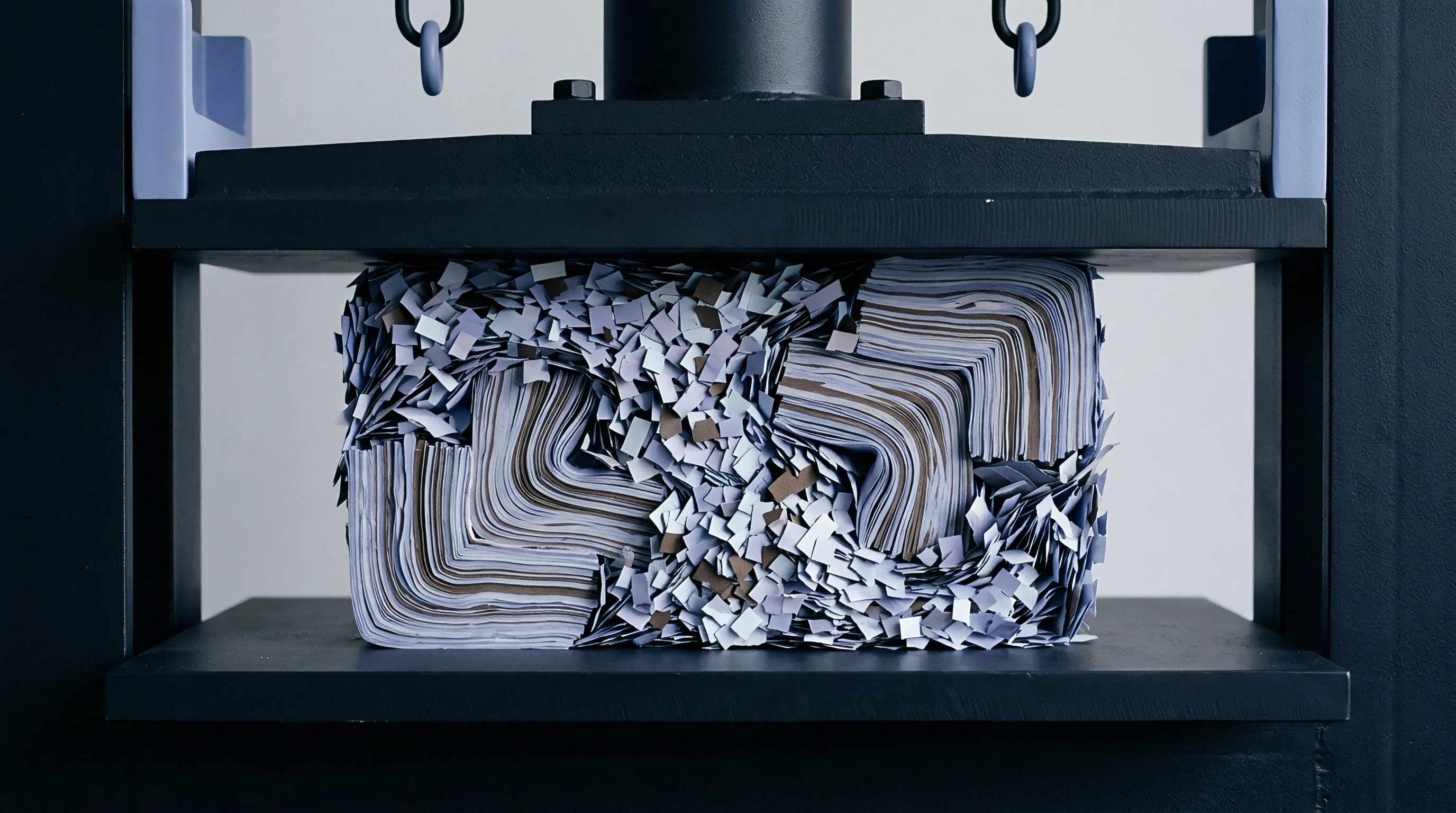
Procuring substrate inventory against misleading static compression data triggers immediate financial losses across the converting run. When a 350-micrometer board stiffens under the dynamic impact of a multi-level embossing die, the press operator faces an unavoidable trade-off between visual definition and structural integrity. Increasing die pressure to force the relief image into a rate-stiffened sheet crushes the adjacent non-embossed zones, reducing carton panel rigidity and weakening package stacking strength.
Why Do Quoted Caliper Losses Drift across Runs?
Make-ready technicians adjust impression settings during slow setup jogs to match approved visual targets. Once the operator throttles the press up to full production cadence, dynamic strain hardening prevents the fiber network from penetrating die cavities to the depth achieved at low speed. The embossed relief shallows out.
If the press crew leaves the impression untouched, the brand owner rejects the finished pallets for deficient visual definition. If the crew adds packing shims behind the die to drive the image home at 7,000 sheets per hour, the excess load crushes internal plies and fractures surface coatings.
Uncalibrated presses ruin entire runs. Consider a production run of 250,000 luxury folding cartons converted from 350 g/m² folding boxboard, carrying a multi-level hot foil stamp pass and deep debossed branding. Tooling costs for precision brass hot-stamping dies average 4,800 dollars.
Running waste on a complex two-pass finishing job typically accounts for 4 percent of total board consumption. When dynamic stiffening forces an unpredicted impression increase, sheet spoilage escalates as coatings check and core plies shear apart along scorelines.
The financial ledger deteriorates across three distinct mechanisms:
- Excess make-ready waste consumes an additional 3 to 6 percent of substrate stock while operators continually re-shim tooling to balance depth against cracking.
- Speed throttling penalties cut press run rates from 6,500 down to 3,800 sheets per hour to widen dwell times and lower dynamic resistance, adding costly line hours to the job docket.
- Downstream packing line failures occur when crushed panel calipers fail top-to-bottom compression tests, leading to entire pallet rejections at automated filling lines.
On a 250,000-pack order, a 5 percent increase in sheet waste combined with a 40 percent loss in press operating speed adds between 3,500 and 7,200 dollars in direct operating costs. Tooling recuts to adjust relief angles consume an extra five working days of die shop turnaround. The entire margin built into a high-end converting quotation evaporates before the first finished pallet clears warehouse inspection.
Failing to account for Z-direction strain rate dependence leaves the packaging buyer holding millions of visually defective or structurally compromised cartons that buckle under distribution loads and trigger total invoice rejections.