Condensation Prevention in Stretch Wrapped Cold Chain Packaging
Controlling cold chain pallet condensation requires matching stretch film water vapor permeance to cargo pull-down thermal kinetics to protect container strength.
Dew
Atmospheric moisture transforms into liquid phase when cold product surfaces drop below surrounding air saturation thresholds. In stretch-wrapped pallet loads, this thermodynamic shift occurs within the boundary layers separating corrugated boxes and plastic film. Warm, humid air trapped during wrapping cools rapidly upon entering cold storage rooms.
As the air temperature within the wrapped enclosure drops, its vapor holding capacity decreases according to psychrometric principles. Dew forms rapidly. Saturation point reaches one hundred percent relative humidity, triggering condensation directly onto box surfaces, film interiors, and corner posts.
Temperature gradients drive migration. Water vapor moves continuously from regions of high vapor pressure to low vapor pressure. When a warm pallet enters a refrigerated warehouse at two degrees Celsius, heat transfers outward through the stretch film.
The outer film layer cools faster than the internal corrugated boxes. This temperature differential establishes a steep relative humidity gradient across the air gaps inside the load. Moisture condenses on the cold inner face of the stretch film, creating water droplets that trickle downward into the underlying paperboard structures.
Enclosed air space relative humidity reaches one hundred percent within forty minutes when product enters a room six degrees warmer than the pallet core.

Sub-Surface Psychrometrics in Cold Packaging
Enclosed air volumes within a wrapped unit load contain specific quantities of vapor determined by ambient temperature. Air at twenty degrees Celsius and sixty percent relative humidity carries approximately ten grams of water vapor per cubic meter. Cooling that same cubic meter of air to four degrees Celsius reduces its maximum vapor capacity to six and a half grams.
Excess vapor condenses into liquid water on ambient surfaces. Paper absorbs moisture quickly. Corrugated container fibers absorb this free surface liquid, softening the cellulose matrix and degrading the structural compression strength of the box walls.
Refrigerated staging bays present distinct psychrometric risks during pallet transfer operations. Moving chilled pallets through warm transfer zones elevates air temperatures around the outer film wrap without warming the cold interior cargo. Condensation then occurs on the exterior face of the film, which runs off onto pallet skids or seeps through wrap overlaps into bottom-tier packaging.
Saturated linerboards lose strength. Standard box compression resistance calculations fail when paperboard equilibrium moisture content exceeds thirteen percent by weight.


Permeance
Water vapor migration through flexible packaging materials dictates humidity accumulation rates inside unit loads. Standard linear low-density polyethylene films present a continuous moisture barrier that traps evaporated moisture inside the pallet core. Measuring water vapor transmission rate under ASTM F1249 conditions demonstrates that solid film configurations restrict gas exchange severely.
Modifying film structures through physical perforation or substituting cellulosic substrates alters vapor movement pathways, preventing localized humidity saturation.
Film thickness dictates barrier strength. Standard cast and blown stretch films exhibiting calipers between fifteen and twenty-three micrometers produce water vapor transmission rates below twelve grams per square meter per twenty-four hours at thirty-eight degrees Celsius and ninety percent relative humidity. This minimal permeance prevents moisture escape.
Macro-perforated stretch films, featuring mechanically punched die-cut holes across ten to forty percent of their surface area, eliminate vapor accumulation by facilitating continuous convection current airflow through the wrapped load.
| Wrap Substrate Grade | Open Area Ratio (%) | WVTR (g/m²/24h) | Gurley Air Permeability (s/100 mL) | Retained Force At 200% Pre-stretch (N) |
|---|---|---|---|---|
| Solid Blown LLDPE (23 µm) | 0.0 | 8.5 | Infinite | 145 |
| Micro-Perforated Cast LLDPE (17 µm) | 3.5 | 145.0 | 450 | 130 |
| Macro-Perforated Cast LLDPE (20 µm) | 22.0 | 3200.0 | 12 | 92 |
| High-Porosity Kraft Wrap (70 gsm) | 0.0 | 1850.0 | 18 | 110 |

Barrier Film Properties versus Open Ventilation Area
Standard linear low-density polyethylene films block moisture movement between internal box spaces and cold room air. Solid film wrap locks trapped ambient moisture against corrugated walls during temperature pull-down cycles. Micro-perforated films introduce microscopic pinholes via hot-needle machinery, raising water vapor transmission rates while maintaining partial dust protection.
Macro-perforated options incorporate stamped vents ranging from fifteen to forty millimeters in diameter, providing unobstructed convective pathways that equalize internal and external relative humidity instantly. Macro-perforated film prevents moisture trapping inside tight packaging layers.
Airflow eliminates vapor pockets. Without physical openings, internal air circulation relies entirely on thermal convection through narrow channels between stacking columns. Macro-perforated films allow external cold storage evaporator units to pull heat and moisture directly out of pallet centers.
Fast transit limits damage. Vent spacing must align with box fluting directions and pallet corner posts to maintain structural stability while maximizing open ventilation surface area.

Kraft Paper Wrapping Alternatives
Unbleached porous cellulosic webs enable rapid gas exchange while maintaining physical load containment. Extensible paper wraps manufactured from long-fiber unbleached softwood pulp exhibit high Gurley air permeability alongside balanced machine and cross-direction tensile properties. Paper wraps absorb initial surface moisture spikes without immediately transferring liquid through to internal corrugated containers.
Cobb sixty values for specialty pallet wrapping kraft grades range between twenty-five and thirty-five grams per square meter, resisting brief wetting while allowing vapor diffusion.
Paper substrates present distinct physical behaviors when exposed to high-humidity storage environments. Softwood fiber structures absorb moisture until reaching equilibrium with ambient air, expanding slightly without sacrificing containment integrity. Unlike polyethylene, kraft wraps remain gas-permeable even when completely saturated with liquid vapor.
Roll stretch capabilities engineered through wet-microcreping processes yield elongation rates between ten and twenty percent, providing sufficient elasticity for automated wrapping systems without tearing at pallet corners.
Suppliers often assert that stretching standard solid LLDPE film above two hundred percent thins the polymer wall sufficiently to permit vapor diffusion, eliminating the need for vented substrates. Physical testing under ASTM E96 proves this assertion incorrect. Ultra-thin stretched polyethylene maintains a continuous hydrophobic barrier that blocks water vapor transmission despite reduced thickness.


Transitions
Thermal shifts during loading dock cross-docking create immediate condensation risk on outer packaging surfaces. Rapid temperature variations alter saturated vapor pressure balances within minutes. When cold pallets encounter warm, unconditioned loading bays during truck loading or unloading, moisture condenses rapidly on exposed outer packaging.
Managing these thermal interfaces requires precise operational control over staging duration and air exchange boundaries.
Core temperatures shift slowly. Dense cargo retains cold thermal mass long after surrounding ambient air temperatures rise. This temperature differential converts ambient moisture into liquid water across outer packaging faces.
Preventing moisture buildup depends on controlling staging environments, wrapping sequences, and temperature stabilization intervals prior to final load unitization.
When Does Temperature Fluctuation Trigger Pallet Condensation?
Moving a pallet load from a zero-degree storage freezer into a twelve-degree staging room initiates rapid moisture precipitation. Cold outer boxes act as condensing surfaces for warmer ambient moisture. If the pallet is already wrapped in solid stretch film, moisture forms on the exterior of the film wrap and pools in horizontal film overlaps.
If wrapped after warming without cooling, moisture traps under the film layer, wetting internal corrugated containers directly.
Condensation severity depends on relative humidity levels within transfer areas. Staging bays operating at eighty percent relative humidity cause dew point formation on cargo running just three degrees Celsius below ambient bay temperature. Equipping loading docks with dehumidification equipment or rapid-roll thermal curtain doors reduces moisture ingress during truck loading cycles.
Minimizing exposure time in unconditioned zones prevents surface temperatures from dropping below local dew points.
Dwell Time Calibration in Loading Docks
Staging duration on unconditioned transfer bays dictates the total thermal energy absorbed by corrugated cartons. Short transfer windows limit outer box surface temperature elevation, preserving cold chain integrity. Operating procedures must define strict dwell time maximums for unit loads positioned in non-refrigerated staging areas.
- Precool unpackaged goods in forced-air chilling tunnels until core and surface temperatures reach equilibrium within one degree Celsius of target cold room storage.
- Transport pre-cooled pallets directly into humidity-controlled packaging zones maintained at or below forty-five percent relative humidity.
- Apply macro-perforated stretch film or breathable kraft wrap using controlled tension parameters to secure cargo without occluding ventilation pathways.
- Transfer unit loads into refrigerated transport vehicles immediately, verifying wall airflow clearances to ensure continuous thermal management during transit.
Precooling unpackaged product fully before stretch wrapping eliminates interior boundary layer moisture formation during cold storage staging.
Cold cargo must only be stretch wrapped after internal product temperature matches staging room air thermal equilibrium.
Containment
Structural stability of unitized loads depends on tension maintained by elastic polymers wrapped under pre-stretch elongation. Solid stretch films deliver continuous containment force across all pallet faces, securing individual corrugated boxes into a rigid unified block. Punching mechanical vents into stretch film alters stress distribution patterns across the plastic web.
Engineers must balance ventilation requirements against load holding capability to prevent pallet leaning, layer slippage, or structural collapse during dynamic transit.
Elastic recovery retains stability. Pre-stretching LLDPE film past its yield point aligns polymer chains, maximizing elastic force applied to cargo corners. Stamped ventilation openings disrupt continuous tension bands, concentrating stress along hole perimeters.
Proper film formulation using high-hexene or octene copolymer resins resists tear propagation around cutouts while maintaining required containment forces under transit vibration.
| Perforation Pattern Geometry | Punch Die Hole Size (mm) | Effective Width Reduction (%) | MD Elmendorf Tear (g/flute) | Containment Force Loss At 5 Days (%) |
|---|---|---|---|---|
| Solid Baseline (No Vents) | N/A | 0.0 | 420 | 8.2 |
| Continuous Slit Pattern | 50 x 5 | 15.0 | 180 | 34.5 |
| Reinforcing Banded Round | 25 (Round) | 20.0 | 380 | 14.1 |
| Reinforced Edge Oval | 40 x 20 | 28.0 | 310 | 18.6 |

Mechanical Retention in Perforated LLDPE Wraps
Removing solid film surface area to create air channels reduces overall elastic recovery forces. Solid LLDPE wraps applied at two hundred percent pre-stretch deliver between one hundred and one hundred and sixty Newtons of containment force at middle pallet height. Punching twenty percent open vent area lowers retention force by fifteen to thirty percent depending on hole distribution and web reinforcement.
Cold surfaces attract vapor.
Maintaining structural integrity requires compensating for vent area losses through increased film gauge or targeted strand reinforcement. Macro-perforated films featuring built-in rolled edges or thick reinforced bands along vent margins distribute tension evenly across the web. These reinforced strands absorb dynamic shocks during transport, preventing structural failure without blocking critical airflow channels.
Tear Propagation around Vent Dies
High tension application of perforated wrap subjects circular cutout edges to localized stress concentrations. Transport shocks caused by forklift handling or truck vibrations trigger micro-tears along non-reinforced die edges. Once initiated, tears propagate rapidly along the machine direction, causing total wrap unraveling and load destabilization.
- Hole web propagation occurs when sharp tension spikes cause tears to extend from vent margins through adjacent solid polymer bands during transport acceleration.
- Neck-down containment loss results from excessive longitudinal film stretch, which narrows vent openings into tight slits and reduces effective containment width across pallet corners.
- Unwinding tension snap happens during high-speed automated application when perforated film edges catch on roll dispensers and rupture before reaching target pre-stretch levels.
- Top-cap seam separation develops when upper wrap layers lack sufficient overlap with top sheets, allowing moisture ingress and film peeling under high overhead airflow.
Standard ASTM D4649 testing mandates minimum retention of seventy percent baseline containment force after forty-eight hours of static cold room storage.
Freight carriage contracts specify maximum allowable lateral pallet deflection of no more than five degrees from vertical alignment during dynamic transit testing under ASTM D4169 guidelines.

Drainage
Managing free liquid inside unit loads requires active moisture capture or absorbent liner materials. When ventilation alone cannot prevent condensation formation during extreme ambient transitions, secondary packaging elements absorb or channel runoff liquid away from structural corrugated containers. Integrating active sorbents, wicking top sheets, and hydro-absorptive paperboard inserts protects carton integrity during multi-day cold chain transits.
Desiccants adsorb ambient moisture. Strategically positioning moisture-absorbing substrates inside stretch-wrapped loads controls relative humidity levels within enclosed air pockets. Evaluating the financial landed cost of desiccant integration against corrugated container crush resistance loss provides a clear operational framework for high-humidity logistics design.
| Auxiliary Protection Substrate | Absorption Capacity (g/m²) | Wet Mullen Burst Retention (%) | Cobb 60 (g/m²) | Unit Cost Per Pallet Load (USD) |
|---|---|---|---|---|
| Standard Virgin Kraft Tier Sheet | 15 | 42.0 | 28.5 | 0.85 |
| Hydro-Wicking Cellulosic Insert | 110 | 78.0 | 120.0 | 1.45 |
| Calcium Chloride Desiccant Sheet | 450 | N/A (Non-woven) | N/A | 3.20 |
| Wet-Strength Recycled Board (Sized) | 22 | 85.0 | 18.0 | 1.10 |
Desiccant Dosing and Wicking Paperboard Inserts
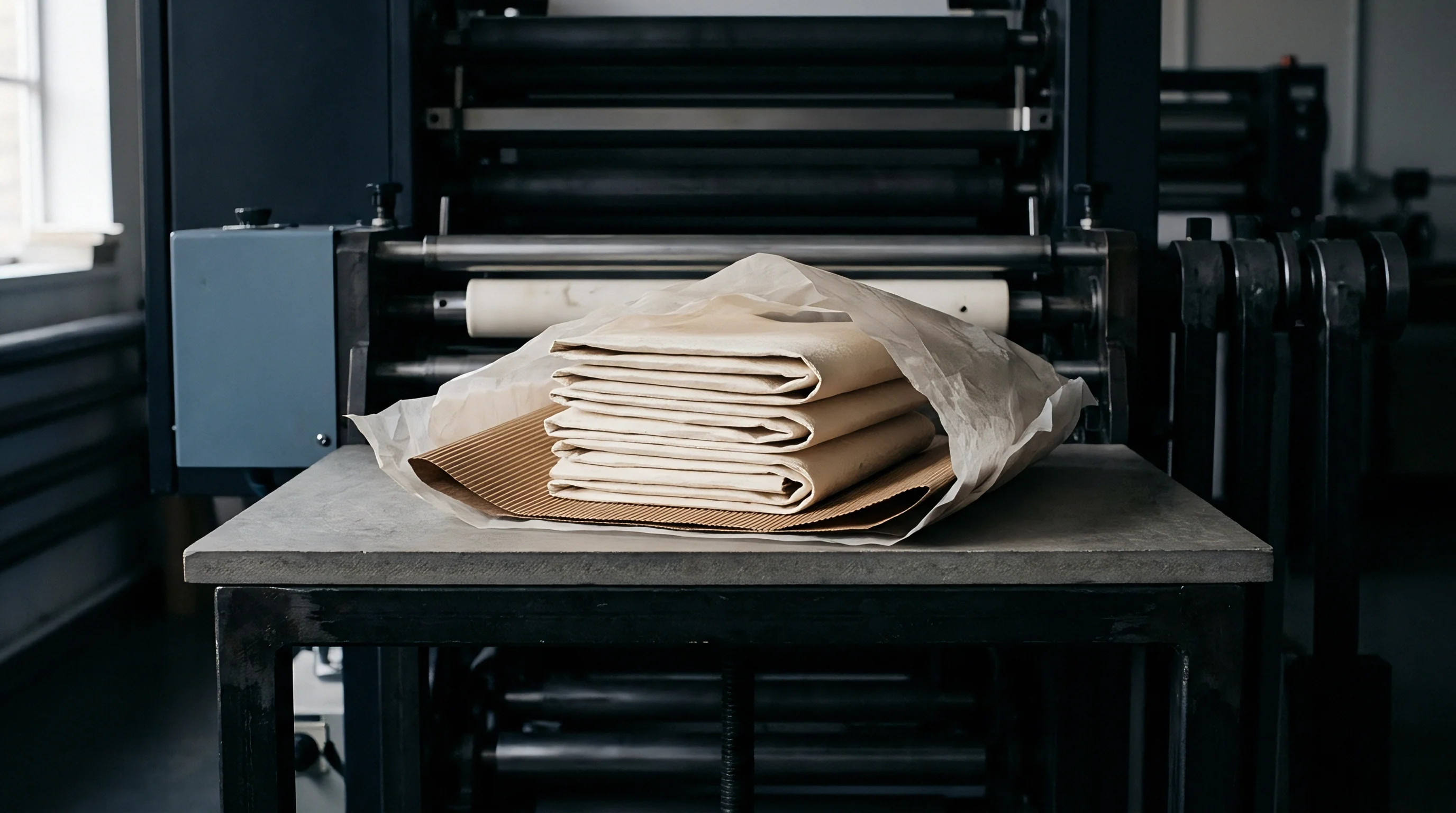
Desiccant packs containing active calcium chloride absorb surplus moisture before paperboard fibers reach saturation. Standard bentonite clay or silica gel sorbents exhibit equilibrium capacities between twenty and thirty-five percent of their dry weight at ninety percent relative humidity. Calcium chloride salt blends combined with gelling polymers adsorb over two hundred percent of their dry weight in liquid vapor, converting moisture into a non-leakable gel phase.
Positioning absorbent wicking sheets directly beneath top pallet wrap caps captures dripping condensation before liquid saturates top-tier boxes. Wicking paperboard inserts feature un-sized, highly porous virgin cellulosic fibers that pull surface moisture inward via capillary action, distributing liquid across a broad surface area for rapid evaporation through perforated wrap vents. Wet cartons collapse easily.
Packaging Material Unit Yield Economics
Calculating landed protection costs requires evaluating both substrate price per square meter and product loss rates from carton collapse. Assume a baseline pallet load carrying eighty corrugated containers valued at fifty dollars per box, yielding four thousand dollars total pallet cargo value. Standard solid stretch wrap costs approximately one dollar and twenty cents per pallet.
Using macro-perforated film increases wrap film cost to two dollars and ten cents per pallet. Adding calcium chloride desiccant top sheets adds three dollars and twenty cents per unit load, raising total protective packaging expenditures to five dollars and thirty cents per pallet.
- Cobb sixty threshold determines the maximum mass of water absorbed by outer paperboard liners within one minute of liquid exposure, dictating wet-defense limits.
- Desiccant equilibrium capacity measures total vapor mass trapped per unit weight of active sorbent before saturation halts further moisture drawdown.
- Wet Mullen burst index quantifies retained puncture resistance of paperboard materials after exposure to liquid water film run-off during transport transitions.
- Recyclability fee classification defines statutory packaging waste levies applied to multi-material composite wraps versus pure cellulosic or mono-material LLDPE substrates.
Desiccants adsorb ambient moisture efficiently during static staging cycles.
Corrugated container compression strength drops sharply when paperboard liners absorb free surface water during temperature spikes.
Whether plant-derived bio-based desiccant sheets can achieve equivalent moisture absorption kinetics without raising pallet packaging costs beyond standard tariff limits remains an open operational question.