Constitutive Cohesive Zone Modelling of Visco Plastic Interlaminar Shear Degradation in High Speed Converting Operations
Rate-dependent cohesive zone models prevent high-speed converting delamination by accurately predicting paperboard interlaminar shear failure at production speeds.
Rheology
The mechanical response of multi-ply paperboard under rapid dynamic loading couples elasticity, plastic deformation, and viscous flow in non-linear ways. Standard characterization carried out at quasistatic speeds misses the rapid stiffening and subsequent softening that take place when fibrous webs pass through rotary converting operations at three hundred to eight hundred metres per minute. Bound by hydrogen bonds and starch matrix formulations, the cellulose fibre network behaves as a rate-dependent orthotropic medium.
During scoring, creasing, and high-speed folding, out-of-plane shear stresses force internal deformation to concentrate along the weaker interfaces between furnish layers.
Viscoplastic shear degradation within the interlaminar region involves simultaneous damage accumulation and rate-dependent slip. At low strain rates, hydrogen bonds break and reform readily, accommodating shear displacement through stable viscoelastic dissipation. Once strain rates exceed one hundred per second, stress relaxation cannot keep up with mechanical displacement; high local shear stresses concentrate at ply boundaries, driving micro-cracks through the starch adhesive layers and interfibre bonding zones.
High Strain Rate Shear in Fibrous Networks
Substrates run through rotary converting equipment undergo severe deformation within milliseconds. The furnish’s strain rate sensitivity dictates whether it deforms plastically or fails through catastrophic interlaminar delamination. High strain rates raise the initial yield stress of the polymeric binder matrix, stiffening the interface during early loading while viscous flow delays matrix cracking.
Mode II shear fracture energy drops by twenty-four percent when testing speed increases from one millimetre per minute to five hundred millimetres per minute at twenty-three degrees Celsius and fifty percent relative humidity.
Plastic displacement accumulates permanently once local shear traction crosses the dynamic yield threshold. In recycled board grades containing short hardwood fibres and elevated ash contents, viscoplastic slip localizes into narrow shear bands that accelerate microvoid coalescence and reduce the effective load-bearing area along the board’s mid-plane.
- Interlayer micro-shear localization concentration of plastic displacement within thin adhesive and starch-refining layers between individual plies.
- Rate-dependent strain hardening initial rise in shear yield stress triggered by hindered polymer chain mobility at elevated deformation rates.
- Viscous stress relaxation lag inability of cellulose fibre networks to dissipate elastic energy when deformation times are shorter than material relaxation constants.
- Softening-induced shear band formation rapid loss of shear capacity following microcrack formation within the interlaminar matrix.
Time Dependent Viscoplasticity across Layer Boundaries
Irreversible displacement at ply interfaces accumulates rapidly as line velocities exceed five hundred metres per minute. Multi-ply folding boxboards sandwich bulkier mechanical pulp center plies between bleached kraft outer plies, and the resulting elastic modulus mismatches generate severe out-of-plane stress components under web tension and bending.
Viscoplastic constitutive formulations address this by decoupling elastic strain rates from plastic and viscous components. Perzyna-type or Duvaut-Lions flow rules model the rate at which stress exceeds the static yield surface. When converting tools strike the sheet, the instantaneous traction vector drives the material state past the static yield threshold, producing rapid plastic flow until damage exhausts the interface’s shear capacity.
Whether thermal softening from localized friction during high-frequency creasing dominates over purely strain-rate-induced viscoplastic yielding remains an open question in current constitutive formulations.

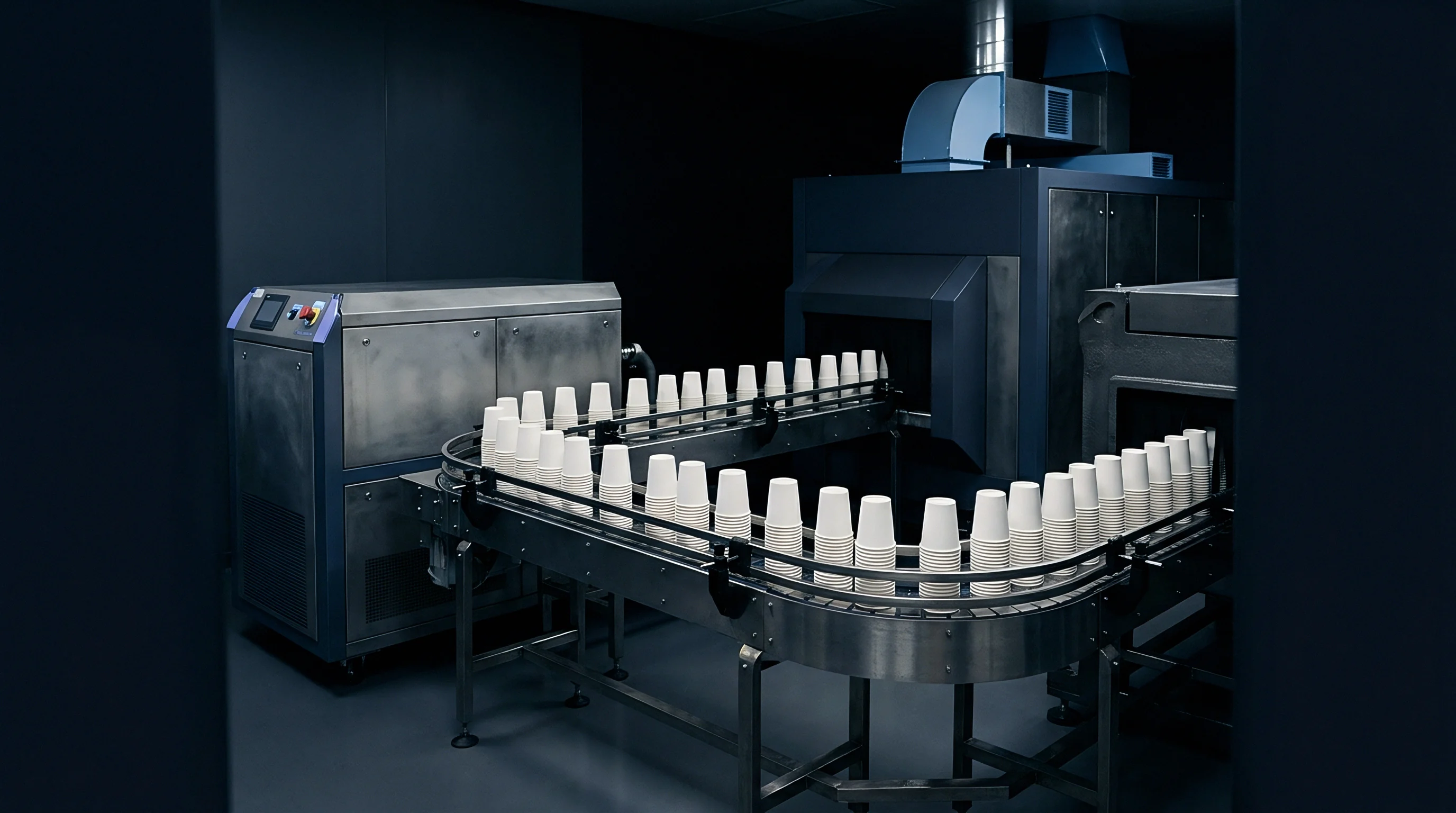
Nip
Rotary converting units impart sharp mechanical gradients into multilayer paperboard webs. Creasing wheels, rotary dies, and folder-gluer belts deform the sheet through combined compression and transverse shear. As the web enters the tooling zone, thickness reduction puts the outer plies in tension while inner plies experience heavy transverse shear compression.

Mechanical Shear Generation at Conversion Tooling Interfaces
Creasing matrix geometry dictates the internal displacement profile across the paperboard plies. Male creasing rules force the web into female matrix channels, driving shear deformation along two parallel lines on either side of the rule center.
Increases in board bulk lower interlaminar shear resistance faster than increases in total basis weight.
At high operating speeds, contact time inside the tooling zone drops below two milliseconds. Under these conditions, the through-thickness shear stress distribution peaks sharply at the interfaces between the mechanical pulp core and the bleached chemical pulp top liner. If the sheet cannot accommodate this stress distribution, the surface cracks rather than splitting cleanly along internal plies.
- Web enters the rotary creasing tool where male and female elements apply localized out-of-plane compression.
- Transverse shear stresses propagate diagonally from tool contact points toward the board core.
- Interlaminar shear traction reaches dynamic yield strength at the top-ply-to-core boundary.
- Viscoplastic slip develops, initiating controlled internal delamination along pre-defined ply interfaces.
- Web exits the tool zone, leaving a residual crease score with reduced bending stiffness suitable for right-angle folding.
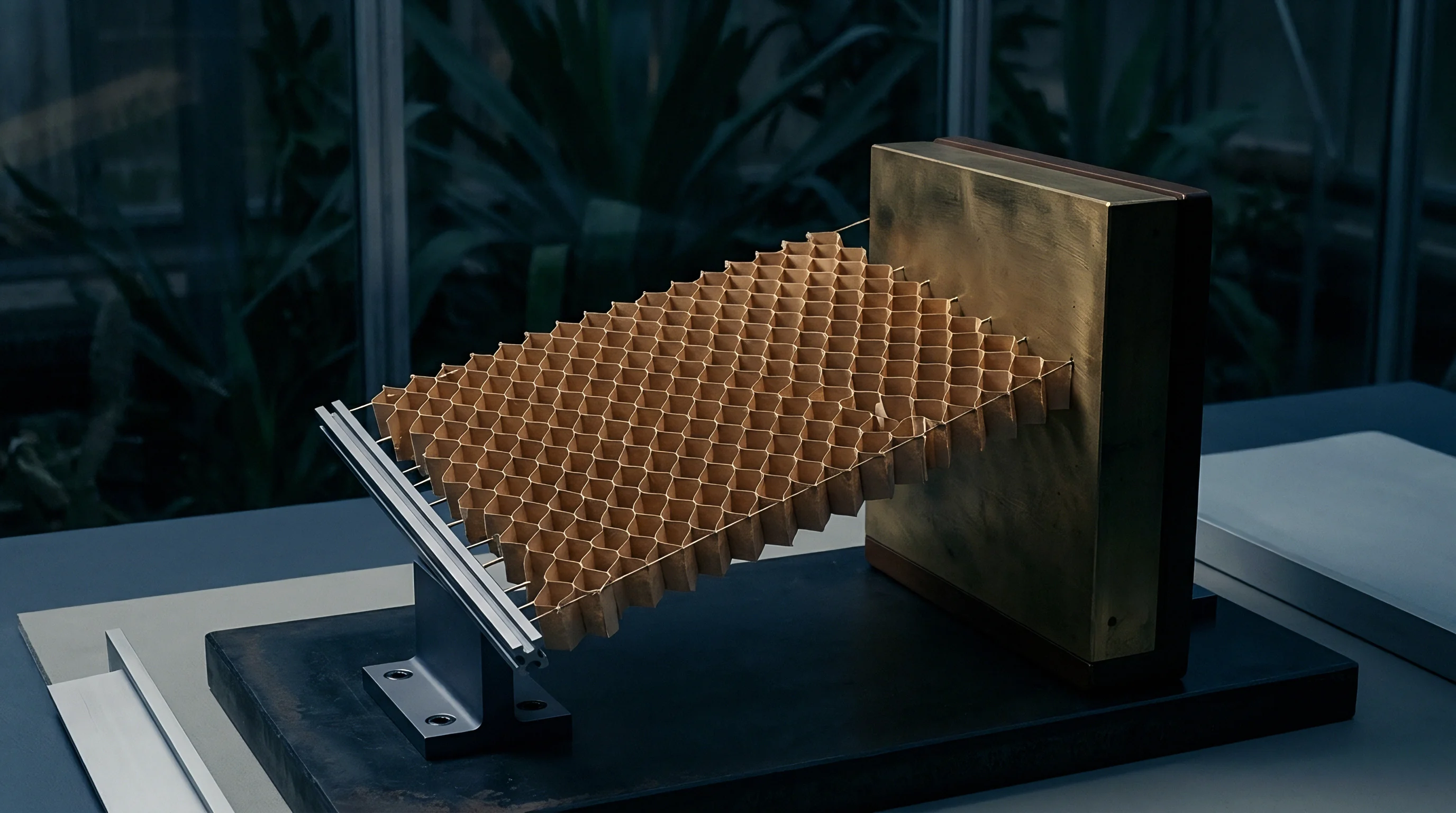
Delamination Mechanics during Rapid Scoring and Folding
Internal ply splitting begins once local interlaminar traction exceeds matrix cohesion limits. Controlled delamination is a functional requirement in folding boxboard packaging: without internal shear failure, outer liner fibres burst during high-speed ninety-degree carton folding.
| Paperboard Grade | Grammage (g/m²) | Caliper (µm) | Converting Speed (m/min) | Peak Shear Traction (MPa) | Interlaminar Shear Energy (J/m²) |
|---|---|---|---|---|---|
| Folding Boxboard (FBB) | 300 | 450 | 150 | 2.85 | 210 |
| Folding Boxboard (FBB) | 300 | 450 | 600 | 3.90 | 155 |
| Solid Bleached Board (SBB) | 320 | 410 | 150 | 3.40 | 280 |
| Solid Bleached Board (SBB) | 320 | 410 | 600 | 4.65 | 205 |
| Coated Recycled Board (CRB) | 350 | 480 | 150 | 2.10 | 140 |
| Coated Recycled Board (CRB) | 350 | 480 | 600 | 3.15 | 95 |
Peak shear traction rises with line speed across all board grades, while total interlaminar shear energy declines. Solid Bleached Board retains higher shear strength because of its long chemical softwood fibres, whereas Coated Recycled Board loses strength quickly under dynamic loads. Higher-bulk furnish requires wider crease die channels to avoid internal shear failure during fast rotary converting.


Formulation
Mathematical modeling of interlaminar shear degradation requires combining rate-dependent plastic slip with cohesive fracture mechanics. Standard cohesive zone models rely on static traction-separation relationships where normal and shear tractions depend strictly on relative displacement jumps across zero-thickness interface elements. For high-speed converting analysis, these classical laws must be extended to incorporate viscoplastic yield surfaces, rate-dependent damage variables, and non-irreversible separation kinetics.

Viscoplastic Cohesive Zone Constitutive Equations
State variables define the current mechanical damage across the cohesive interface. The total displacement jump splits into an elastic recovery component and an irreversible viscoplastic component, with elastic traction vectors governed by interface stiffness tensors multiplied by elastic displacement jumps.
Yield functions for shear degradation employ modified Drucker-Prager or Hill criteria adapted for planar zero-thickness interfaces. The shear yield function governs the transition from pure elastic traction to rate-dependent plastic slip:
f = |tau| – (tau_0 + q)
Where tau represents the instantaneous tangential shear traction, tau_0 defines initial shear yield stress under quasistatic conditions, and q represents isotropic hardening or softening traction. Rate dependency enters through Perzyna viscoplastic flow rules, defining the rate of plastic displacement jump evolution:
d(delta_p)/dt = <(f / eta)^N> sign(tau)
Parameter eta represents the interface viscosity coefficient in Pascal-seconds per metre, exponent N governs rate sensitivity, and angle brackets denote Macaulay brackets, ensuring viscoplastic flow occurs only when shear traction exceeds the yield surface.

Damage Evolution and Rate Dependent Softening Kinetics
The constitutive response transitions from elastic stiffness to irreversible dissipation once traction reaches critical thresholds. Shear damage variable D evolves from zero (undamaged interface) to one (complete debonding). Total shear traction under damaged conditions scales according to continuum damage mechanics relations:
tau = (1 – D) K_s (delta – delta_p)
Initial shear stiffness K_s drops monotonically as damage parameter D increases. Damage evolution follows an exponential softening formulation tied to energy dissipation rate G_II relative to critical Mode II fracture toughness G_IIc ~
dD/dt = (1 / (1 – D)) (tau / G_IIc) |d(delta_p)/dt|
ISO 1924 specifications dictate testing across machine directions, or web delamination claims fail during press trials.
Critical Mode II fracture energy decreases with increasing displacement rate. To capture this behavior in finite element routines, G_IIc is specified as a rate-dependent function:
G_IIc(rate) = G_IIc_static (1 + C_rate ln(1 + |d(delta)/dt| / rate_0))
Where C_rate is a dimensionless rate parameter calibrated from high-speed mechanical bench tests, and rate_0 defines a reference displacement jump velocity.
| Constitutive Parameter | Symbol | Units | Bleached Kraft Layer | Mechanical Core Layer | Recycled Liner Layer |
|---|---|---|---|---|---|
| Initial Shear Stiffness | K_s | MPa/mm | 850 | 420 | 310 |
| Quasistatic Shear Yield Stress | tau_0 | MPa | 3.80 | 2.10 | 1.65 |
| Interface Viscosity Coefficient | eta | Pa·s/m | 1.2e4 | 8.5e3 | 5.2e3 |
| Rate Sensitivity Exponent | N | – | 1.45 | 1.20 | 1.10 |
| Static Fracture Energy | G_IIc_static | J/m² | 310 | 180 | 125 |
| Rate Dependency Constant | C_rate | – | -0.18 | -0.24 | -0.31 |
Mathematical Implementation of Traction Separation Laws
Numerical integration algorithms update cohesive stresses using instantaneous displacement jump rates. Predictor-corrector return mapping schemes calculate trial elastic tractions at each integration point; if trial traction exceeds the rate-dependent yield surface, radial return algorithms determine viscoplastic slip increments and update scalar damage terms.
- Mathematical Decision Checklist for CZM Implementation
- Elastic stiffness definition establish initial tangential stiffness K_s using low-strain ultrasonic web testing to prevent spurious numerical compliance.
- Viscoplastic thresholding set rate sensitivity exponent N based on high-rate shear test data to avoid overestimating yield strength at converting speeds.
- Softening regularization apply viscosity-based viscous regularization parameters to maintain numerical convergence during localized damage localization.
- Energy dissipation check verify that total work consumed by cohesive elements equals experimental Mode II fracture energy under dynamic conditions.
Elevated cross-direction tensile stretch is often cited to offset weak interlaminar cohesion, but it fails to prevent shear delamination at high converting speeds.
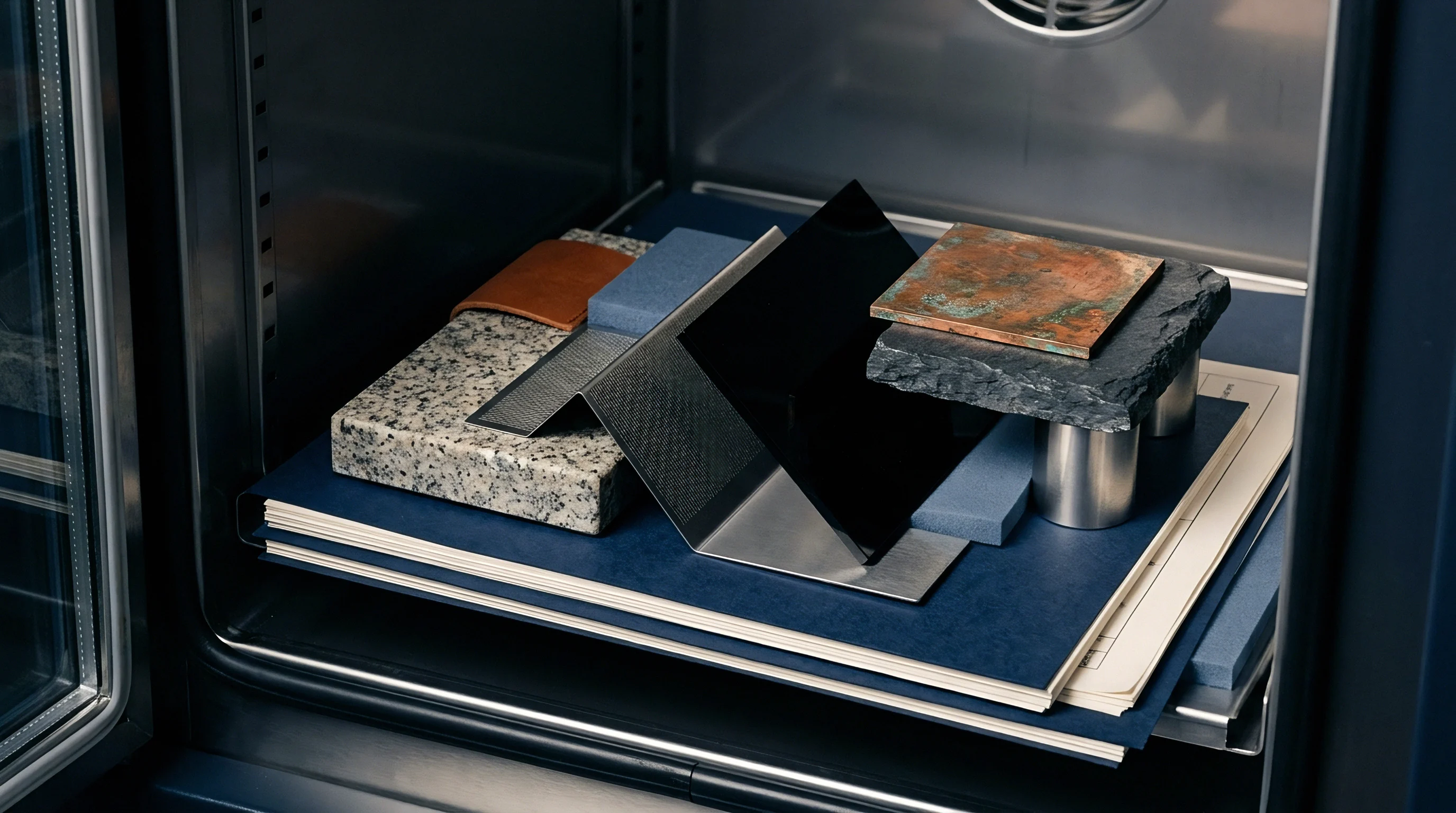
Bench
Measuring interlaminar fracture parameters requires specialized high-rate material testing platforms. Standard tensile test frames running at crosshead speeds of ten millimetres per minute do not reach the viscoplastic strain rates produced by commercial creasing tooling. Tests must instead run on high-speed servohydraulic frames or dedicated rotary shear jigs equipped with piezoelectric load cells and high-speed optical deformation tracking.

High Speed Interlaminar Fracture Toughness Measurement Methods
Laboratory testing relies on modified double cantilever beam and end-notched flexure setups fitted with fast load cells. End-Notched Flexure (ENF) tests under three-point bending apply pure Mode II in-plane shear along starter cracks located at the mid-plane. Loading speeds are stepped from 0.01 millimetres per second to five thousand millimetres per second to map out rate-dependent fracture energy curves.
Polymer binder softening under rapid shear stress causes delamination before fibre fracture occurs.
Specimen conditioning follows ISO 187 parameters at twenty-three degrees Celsius and fifty percent relative humidity. Substrate moisture content substantially shifts both viscosity parameter eta and static fracture energy G_IIc_static ~ an increase from five percent to eight percent cuts shear yield stress by over thirty percent and increases viscoplastic creep compliance.

Does Rate Sensitivity Alter Crack Propagation?
Dynamic energy release rates measured across different loading velocities show distinct transitions in failure mode. At low strain rates, cracks propagate stably through fibre pull-out and interfibre bond failure across a broad process zone. At high converting strain rates, crack growth shifts to unstable, brittle delamination confined within thin starch adhesive layers.
| Test Method Standard | Loading Configuration | Primary Output Parameter | Target Strain Rate Range (s⁻¹) | Conditioning Standard |
|---|---|---|---|---|
| ISO 14125 Short Beam Shear | Three-Point Bending | Interlaminar Shear Strength | 10⁻² to 10¹ | ISO 187 (23°C / 50% RH) |
| ASTM D7905 ENF Fracture | Three-Point Shear Crack | Mode II Fracture Energy G_IIc | 10⁻¹ to 10² | ISO 187 (23°C / 50% RH) |
| ASTM D5379 Iosipescu Shear | V-Notched Rail Shear | Pure In-Plane Shear Modulus | 10⁻² to 10² | ISO 187 (23°C / 50% RH) |
| High-Speed Split-Hopkinson Bar | Dynamic Impact Shear | High-Rate Yield Stress & Viscosity | 10² to 10⁴ | ISO 187 (23°C / 50% RH) |
Parameter Extraction and Rate Dependency Calibration Protocols
Curve fitting routines extract viscous damping coefficients from force-displacement histories recorded during mechanical testing. Inverse finite element analysis optimizes CZM parameters by adjusting stiffness, yield traction, and viscosity values until simulated load-deflection curves match experimental bench measurements across all test velocities.
- Sampling frequency setup configure digital load recording data acquisition equipment to at least one hundred kilohertz to capture millisecond force peaks.
- Specimen moisture lock seal cut paperboard specimens in vapor-impermeable bags immediately following ISO 187 conditioning until mounting in test fixtures.
- Fixture alignment verification align ENF loading pins within five micrometres to prevent unsymmetrical edge-loading and mixed-mode Mode I contamination.
- Optical strain tracking utilize digital image correlation cameras running at twenty thousand frames per second to directly measure displacement jumps across individual plies.
Standard purchase dockets incorporating ISO 1924 cross-direction Mode II shear fracture limits allow converters to reject board lots that show excessive rate-dependent delamination.


Penalty
Converting failures stemming from unmodelled interlaminar shear degradation cause substantial losses on modern packaging lines. When paperboard webs delaminate prematurely or crack during scoring, high-speed cartoning machines suffer repeated feeding failures, mis-folds, and jams. Line speeds must then be dialed back to prevent tearing packages apart, reducing press productivity and undermining the return on high-speed equipment.
Financial Consequences of Web Creep and Debonding Defects
Delamination during folding and gluing operations triggers line stoppages, downtime, and unscheduled maintenance. A high-speed folder-gluer operating at six hundred metres per minute turns out tens of thousands of blanks an hour; uncontrolled shear degradation that causes score cracking or glue-flap debonding voids quality guarantees, leaving converters to scrap entire runs.
Substrate selection directly governs converting headroom. Substituting virgin-fibre Folding Boxboard with unrefined Coated Recycled Board lowers raw material purchase costs by fifteen percent per tonne. However, the recycled grade has lower Mode II fracture toughness and degrades more steeply under rate-dependent loading.
Running it forces a thirty-five percent reduction in machine speed to avoid score splitting, driving up the net cost per thousand finished cartons once hourly press operating rates are factored in.
Contractual Specifications for High Rate Converting Headroom
Procurement documents need clear physical guarantees for interlaminar strength under rapid dynamic deformation. Technical specifications that rely solely on static Z-direction tensile strength (TAPPI T 541) fail to protect buyers against converting line defects: Z-tensile testing captures out-of-plane normal strength under static load, whereas creasing and folding subject the sheet to combined dynamic shear and compression. Working specifications must instead set rate-dependent Mode II shear limits derived from ENF bench testing at strain rates matched to the line.
Neglecting rate-dependent shear degradation during packaging line setup yields catastrophic box line jam-ups, elevated material scrap rates, and severe financial penalties from rejected packaging shipments.