Dynamic Contact Angle Testing Methods for Paperboard Substrates
Dynamic contact angle testing measures millisecond liquid wetting and penetration on paperboard to predict converting line glueability and ink adhesion.
Drop
Liquid volume applied to a fibrous surface initiates spreading and penetration within five milliseconds of contact. Standard static test methods like TAPPI T 458 report equilibrium contact angles measured after several seconds, overlooking the early physical interactions that govern industrial adhesive bonding and ink transfer. High-speed video goniometry measures the advancing fluid profile between ten milliseconds and sixty seconds under standardized atmospheres of 23 degrees Celsius and 50 percent relative humidity as defined by ISO 187 and TAPPI T 558.
Paperboard absorbs water nonlinearly. The rate of contact angle decrease during the initial two hundred milliseconds separates functional internal sizing from raw porous capillary uptake.
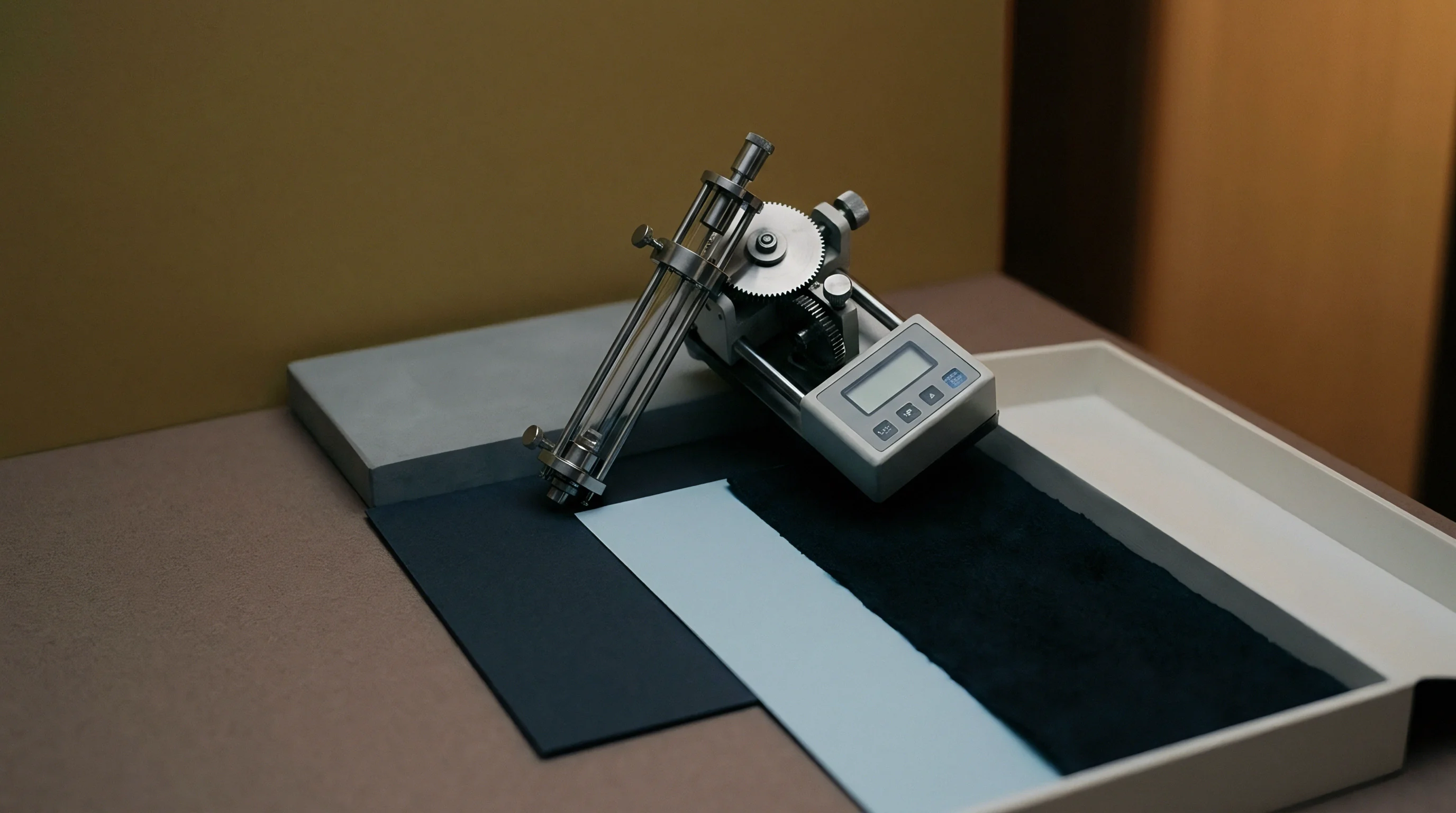
Automated dosing systems dispense deionized test fluid droplets between two and four microlitres through narrow-gauge stainless steel needles. Mechanical vibration during deposition introduces kinetic distortion into the contact line. Controlled motorized stages bring the paperboard specimen upward to touch the hanging pendant droplet, detaching the fluid without velocity spikes.
Millisecond-scale image acquisition records the base diameter expansion alongside left and right contact angles across both machine direction and cross direction. Fiber orientation guides fluid spreading. Anisotropic wettability creates distinct contact angle decay curves along parallel and perpendicular fiber axes, reflecting differential capillary suction along wood pulp lumens.
A stationary contact angle recorded after five seconds records liquid evaporation rather than initial surface reception.
Uncoated liners exhibit rapid droplet sink. The liquid perimeter recedes while the contact line pins to micro-fibrils, producing an apparent contact angle drop from 110 degrees to under 30 degrees in less than three hundred milliseconds. Coated grades resist immediate penetration through mineral barrier layers, holding contact angles above 80 degrees beyond two seconds before internal sizing agents yield to capillary suction.
Evaluating transient contact angle slope rather than static final values isolates surface chemical energetics from bulk porous absorption. When converting equipment bonds packaging blanks at web speeds exceeding four hundred metres per minute, the initial adhesive wetting window lasts forty milliseconds, rendering equilibrium contact angle data operationally irrelevant.
Ignoring initial liquid contact dynamics leads directly to unbonded carton side-seams, blistered lamination plies, and machine downtime on high-speed folder-gluers.
Topography
Roughness values measured by Parker Print-Surf or Bendtsen instruments directly perturb apparent contact angles across multi-ply cartonboards. Wenzel wetting regimes govern droplet behaviour on rough, hydrophilic paper surfaces where actual surface area exceeds geometric projection, accelerating initial contact line advance. In contrast, Cassie-Baxter regimes trap micro-pockets of air between raised surface fibers, producing artificially high apparent contact angles on poorly calendared bleached boards.
Profilometry data paired with contact angle decay rates resolves whether poor liquid holdout stems from insufficient chemical sizing or open surface texture. Surface sizing suppresses capillary suction.
Which Optical Methods Isolate Dynamic Penetration Rates?
Contact angle instruments isolate liquid penetration through simultaneous tracking of droplet volume, base diameter, and apex height over time. On non-porous polymer films, droplet volume remains static while base diameter and angle adjust to surface tension balances. On porous paperboard, drop volume decreases continuously as fluid penetrates z-directional sheet pores, causing apparent contact angles to drop even when the triple contact line remains mechanically pinned.
Differentiating the volume reduction curve from the contact angle decay curve identifies the onset of true fluid penetration into the fibrous matrix.
| Substrate Grade | Caliper (µm) | PPS Roughness (µm) | Initial Angle (10 ms) | Angle at 100 ms | Angle at 1000 ms | Decay Rate (deg/s) |
|---|---|---|---|---|---|---|
| Solid Bleached Sulfate | 380 | 1.2 | 108° | 102° | 88° | 20.2 |
| Folding Boxboard | 450 | 1.6 | 104° | 96° | 76° | 28.5 |
| White Lined Chipboard | 420 | 2.8 | 98° | 81° | 42° | 56.8 |
| Uncoated Kraftliner | 310 | 6.4 | 92° | 54° | 12° | 81.4 |
| Barrier Coated Cupstock | 400 | 1.1 | 114° | 112° | 109° | 5.1 |
Chemical sizing formulations introduce additional interfacial complexity across the sheet thickness. Alkyl ketene dimer and alkenyl succinic anhydride impart hydrophobicity by anchoring fatty aliphatic chains to cellulosic hydroxyl groups during the paper machine drying section. Incomplete sizing curing leaves receptive hydroxyl sites open to rapid moisture penetration.
Recycled grades containing white lined chipboard display uneven hydrophobic sizing distributions caused by residual deinking chemistries, starch fragments, and calcium carbonate filler agglomerations. Baseline errors distort measured angles.
TAPPI standard T 558 mandates automated droplet application and millisecond video capture to eliminate operator bias in fast wetting determinations.
Variance in surface characteristics creates distinct converting challenges across packaging grades:
- Mineral coating porosity dictates vehicle absorption rates from flexographic inks and water-based adhesives, determining print dot gain and adhesive setting speed.
- Internal sizing concentration prevents edge-wicking during refrigerated transport while altering glue joint mechanical interlocking.
- Recycled fiber fraction introduces localized surface energy variation across delivered reels, producing erratic contact angle decay rates within single manufacturing batches.
- Machine calender nip pressure compresses surface voids, shifting the sheet wetting mechanism from capillary suction to surface diffusion.
The technical representative from the board mill attributed erratic aqueous glue open times to seasonal atmospheric variations rather than uneven surface starch application.
Optics
High-speed digital imaging hardware forms the backbone of transient contact angle determinations on absorbent packaging stocks. Monochromatic telecentric lenses paired with diffused backlighting eliminate optical distortion, delivering high-contrast silhouettes of the droplet profile against the sheet baseline. Frame rates between one hundred and one thousand frames per second catch the advancing boundary without motion blur.
Edge detection algorithms apply Young-Laplace or polynomial fitting routines to calculate tangent angles at the triple contact point. Evaporation alters tiny droplets swiftly.
Baseline determination presents the single largest source of measurement error on fibrous materials. Protruding surface fibers and macro-roughness create ambiguous optical planes, causing software algorithms to misplace the solid-liquid-gas junction. Shifting the baseline upward by fifteen micrometres artificially lowers calculated contact angles by four to seven degrees, distorting decay kinetics.
Advanced optical goniometers employ sub-pixel edge detection combined with tilted optical axes to isolate the true liquid boundary from underlying surface shadows. Fast cameras capture initial wetting phases.
A ten millisecond delay in image capture on raw uncalendered board drops the recorded advancing angle by twelve degrees under standard laboratory atmospheres.
Testing laboratories follow rigorous calibration sequences to guarantee repeatable goniometer output:
- Mount the target substrate specimen on the motorized stage using a vacuum plate to eliminate sample curl and cockling.
- Fill the precision dosing syringe with ultra-pure deionized water exhibiting surface tension of 72.8 millinewtons per metre at 20 degrees Celsius.
- Calibrate image magnification using an optical calibration ball with traceable diameter tolerance within one micrometre.
- Position the dispenser tip exactly one millimetre above the board surface to prevent droplet freefall deformation during release.
- Trigger synchronized image recording and motorized stage elevation, logging droplet interaction across thirty seconds at varying logarithmic intervals.
Contact angle decay curves split into three distinct physical regimes: pure spreading, capillary absorption, and bulk wetting. During the initial twenty milliseconds, spreading dominates as kinetic energy dissipates into interfacial tension. Between twenty and five hundred milliseconds, capillary suction pulls fluid down inter-fiber channels.
Beyond five hundred milliseconds, molecular swelling of cellulose fibers alters internal pore geometry, altering liquid uptake rates. Mechanical roughness perturbs the contact line.
| Acquisition Speed (fps) | Initial Frame Time (ms) | Contact Line Velocity (mm/s) | Baseline Placement Error (µm) | Calculated Initial Angle Variance |
|---|---|---|---|---|
| 30 | 33.3 | 0.8 | ±18.4 | ±6.8° |
| 120 | 8.3 | 3.2 | ±11.2 | ±3.9° |
| 500 | 2.0 | 12.5 | ±4.6 | ±1.4° |
| 1000 | 1.0 | 24.1 | ±2.1 | ±0.8° |
Whether automated fitting routines can differentiate between physical fluid penetration and droplet shrinkage caused by localized room convection currents remains an unresolved practical testing question.

Adhesion
Converting facilities rely on transient wettability measurements to predict cold emulsion glue bonding performance and water-based ink setting. Folding boxboard cartons running on modern packaging lines experience compression times under three hundred milliseconds inside the folder-gluer transfer belt. The adhesive must wet the board surface completely before pressure releases, or the joint suffers fiber tear failure during pack erection.
Static contact angle values above 90 degrees suggest an unbondable surface, while dynamic analysis often reveals rapid wetting to 45 degrees within one hundred milliseconds, confirming converting suitability. Adhesives demand rapid surface wetting.
Will High Sizing Levels Prevent Glue Failures?
Excessive internal sizing agents repel water-based adhesives, preventing the liquid carrier from penetrating the porous sheet matrix to establish mechanical anchors. Take an order of 60 tonnes of 350 g/m² solid bleached sulfate folding carton stock running on a multi-point gluer at 350 metres per minute with a standard cold emulsion adhesive. The mill delivered stock exhibiting an equilibrium contact angle of 102 degrees at five seconds, compliant with standard mill specifications.
Dynamic contact angle testing revealed that the advancing angle remained at 98 degrees past six hundred milliseconds, failing to reach the required 55-degree threshold necessary for aqueous glue setting within the line compression window. Fiber tear dropped from the required 85 percent down to 12 percent, forcing a complete halt to the manufacturing run.
Resolving this bonding failure requires understanding the direct financial balance of line adjustments versus substrate rejection:
- Mechanical plasma surface treatment installed on the folder-gluer increases polar surface energy, lowering the contact angle to 35 degrees within twenty milliseconds at an added operational cost of 4.20 dollars per thousand finished cartons.
- Switching to specialized synthetic resin adhesive accelerates setting speeds on high-sized boards, increasing wet adhesive raw material costs by 38 percent across the production campaign.
- Rejecting the 60-tonne paperboard lot back to the producing mill demands rigorous dynamic goniometry proof, avoiding 84,000 dollars in defective carton production while imposing freight and schedule delays of fourteen business days.
Sizing agents migrate during board drying. Uneven drying cylinder temperatures in the paper machine cause hydrophobic sizing to concentrate near outer liner plies. This migration creates a steep contact angle gradient across the board thickness, producing surfaces that resist initial glue wetting while raw cut edges drink moisture voraciously.
Viscosity alters liquid penetration kinetics.
A substrate that fails to reach a contact angle below fifty degrees within two hundred milliseconds will not produce fiber tear under standard cold emulsion compression.
Water-based flexographic inks exhibit identical sensitivity to initial wetting dynamics. If the dynamic contact angle remains above 80 degrees at ten milliseconds, ink droplets bead on the mineral coating surface, generating pinholes, mottling, and poor rub resistance on finished consumer packaging. Mill certificates omit transient wetting metrics.
A simple operational rule dictates that initial contact angle decay rate determines glue setting speed while final equilibrium angle determines moisture barrier longevity.
Specification
Incorporating transient contact angle thresholds into paperboard procurement contracts bridges the operational gap between mill laboratory testing and converting performance. Buyers historically relied on Cobb sizing values per ISO 535, which measure water weight gain over sixty or twelve hundred seconds. Cobb tests fail to detect surface chemical differences that occur during millisecond converting operations.
A sheet displaying an acceptable 60-second Cobb value of 25 grams per square metre can still exhibit sluggish initial wetting that shuts down high-speed gluing operations. Transient contact angle metrics capture this early surface behavior with microsecond precision.
Procurement dossiers for high-speed folding boxboard must include both initial contact angle values at twenty milliseconds and wetting decay slopes measured across the first five hundred milliseconds. Defining these parameters restricts mills from shipping over-sized or under-calendared board lots under the same commercial grade name. Specifying these criteria in purchase agreements shifts quality verification from post-failure disputes to pre-shipment reel clearance.
Liquid volume dictates initial wetting behavior.
| Application | Test Liquid | Initial Angle Max (20 ms) | Angle Max (200 ms) | Decay Slope Min (deg/s) | Governing Standard |
|---|---|---|---|---|---|
| High-Speed Folding Carton Gluing | Deionized Water | 100° | 55° | 65.0 | TAPPI T 558 |
| Water-Based Flexo Printing | Water / IPA Mix (85/15) | 75° | 35° | 80.0 | ASTM D5725 |
| Aqueous Heat-Seal Barrier Board | Deionized Water | 112° | 105° | 12.0 | ASTM D5725 |
| Corrugated Box Side-Seaming | Deionized Water | 95° | 45° | 75.0 | TAPPI T 558 |
Wetting proceeds across distinct physical regimes. When qualification testing identifies sub-par wetting kinetics on delivered reels, goods-in inspectors compare the mill batch curves against qualified benchmark profiles. A commercial specification clause explicitly stating that delivered board must achieve an advancing contact angle below 55 degrees within two hundred milliseconds under TAPPI T 558 conditions invalidates mill claims that 60-second Cobb compliance satisfies contractual delivery requirements.