Standard Laboratory Test Methods for Paperboard Bending Resistance
Standard paperboard bending resistance tests fix clamp distance, deflection angle, and rate to isolate true flexural rigidity from shear delamination.
Jaw
Bending resistance in paperboard measures the force needed to push a clamped test strip through a specified angular deflection. Mill certificates record this value in millinewtons, Taber stiffness units, or gram-centimetres, but instrument geometry dictates the number. In a two-point tester such as a Lorentzen and Wettre apparatus operating under ISO 2493-1, the specimen acts as a cantilever beam loaded at a set distance from the clamping line, with the free end resting against a cylindrical load-cell pin.
Deflecting the sheet 15 degrees across a 50-millimetre span establishes one stress profile through the thickness; running TAPPI T 489’s legacy 15 degrees across a shorter 38.1-millimetre span drives up shear stress within the internal plies. Clamping jaw geometry alone alters the measured bending moment on identical solid bleached sulphate stock.
Different standards mandate different geometries, producing numbers that cannot be swapped directly. Converting values between test methods requires empirical cross-calibration against matching production lots. Mathematical conversion formulas break down whenever basis weight or ply structuring changes.
| Standard Designation | Supported Geometries | Test Span Length | Deflection Angle | Nominal Board Range |
|---|---|---|---|---|
| ISO 2493-1 | Two-point cantilever | 50 mm or 10 mm | 15 degrees | 150 to 1500 µm |
| TAPPI T 489 | Two-point balanced pendulum | 38.1 mm | 15 degrees | 150 to 1000 µm |
| TAPPI T 556 | Two-point or four-point motor driven | 10 mm to 50 mm | 15 or 7.5 degrees | 100 to 1200 µm |
| ISO 5628 | Two-point, three-point, four-point | Variable spans | Calculated radians | Multi-ply paperboards |
| DIN 53121 | Cantilever and beam deflection | Variable free length | Small angle limit | Heavy packaging boards |
Cantilever clamping exerts transverse compression straight across the clamp line. Excessive torque crushes the mechanical pulp core in folding boxboard, rupturing internal fiber bonds before rotation begins and depressing the measured resistance. Pneumatic jaws distribute clamping force more evenly across the strip width.
Conversely, loose jaws allow the board to slip, extending the effective span and creating false plastic yield before peak resistance registers. Heavy multi-ply boards require strict torque limits on manual clamping screws to protect internal sheet architecture.
Because cellulose fibers are viscoelastic, deflection speed alters the reading. Standard protocols fix angular speed between 1.0 and 5.0 degrees per second. High deflection velocities drive up peak resistance by preventing internal fiber relaxation during strain; low testing speeds give fibers time to slip microscopically, dragging the recorded peak down.
Holding a 400-micron board inside mechanical clamps without pneumatic pressure controls introduces a fifteen percent measurement spread across identical cross-direction samples.
Test geometry has to match packaging conversion demands. Testing across a short 10-millimetre gauge length targets localized folding behavior around carton creases. The 50-millimetre span isolates beam deflection, predicting how wide side panels hold up under warehouse stack loads.
Testing on an inappropriate span generates false passes in quality control, leading to carton bulging, erratic erecting, and packaging line stoppages during high-speed runs.
Deflection
Bending resistance scales with the third power of paperboard thickness. This cubic relationship governs substrate design across both virgin and recycled packaging grades: a slight loss of caliper causes a major drop in rigidity, even if total sheet grammage holds steady. Paper mills exploit this mechanic by placing high-modulus virgin chemical pulp on the outer faces and bulking the core with lower-density mechanical pulp or recycled fiber.
A 350-micrometre sheet with an elastic modulus of 4.5 gigapascals resists bending far more than a 300-micrometre sheet made from the identical furnish recipe. Caliper retention during calendering and coating operations is what protects finished board stiffness.
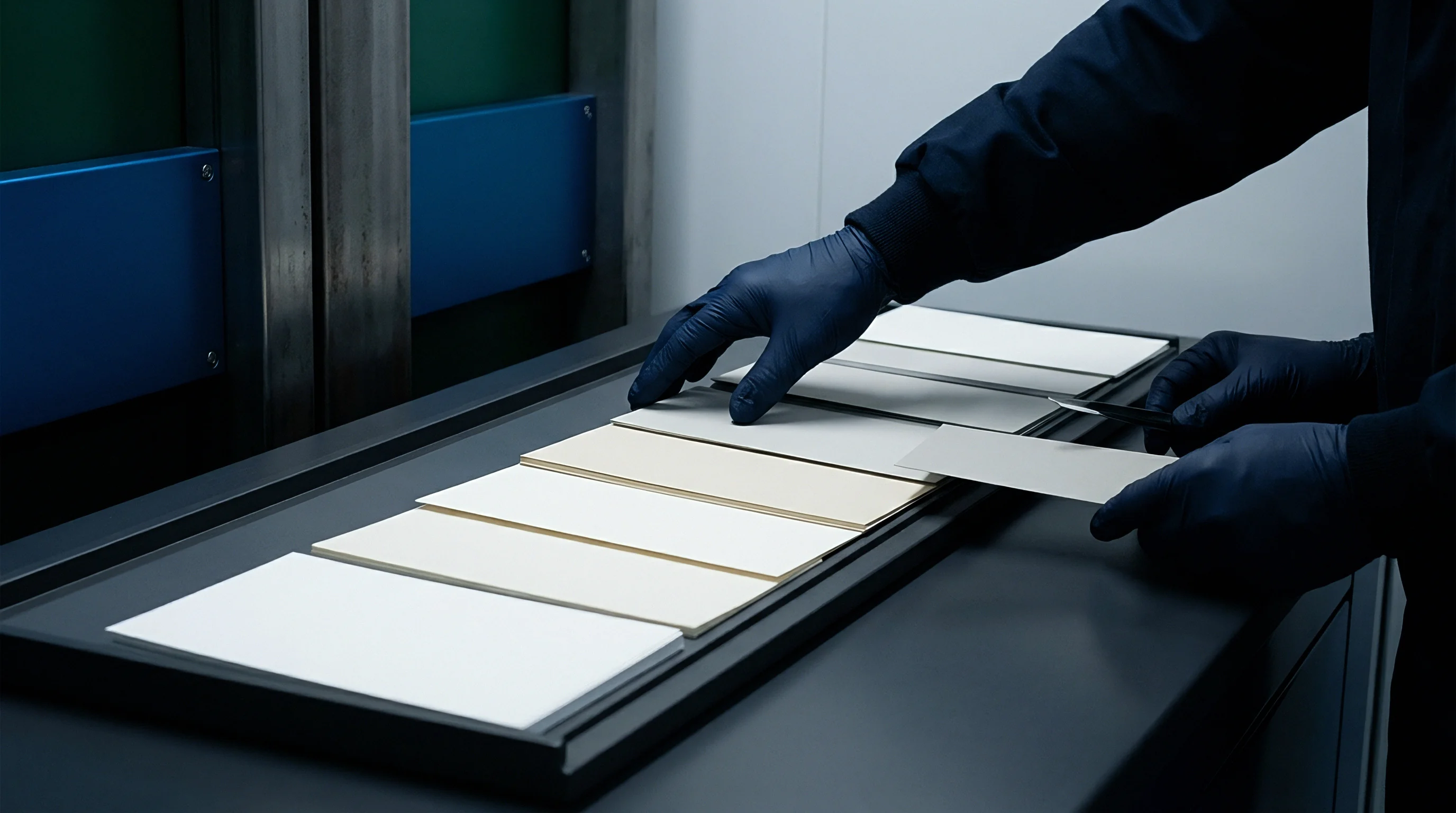
Which Angle Prevents Premature Score Delamination?
Deflecting paperboard beyond its elastic limit triggers shear failure between plies. The standard 15-degree angle in ISO 2493-1 works reliably on cartonboard under 300 micrometres, but heavier folding boxboards and solid bleached sulphate grades exceeding 450 micrometres often delaminate before reaching 15 degrees. Once internal layers fracture, the resistance trace drops sharply, recording internal structural failure rather than flexural stiffness.
Packaging laboratories address this threshold by employing the 7.5-degree option provided in ISO 2493-1 and TAPPI T 556.
Testing at 7.5 degrees keeps the outer liners within their proportional elastic limit. Mathematical models convert 7.5-degree force values to 15-degree equivalents with a multiplier of two, provided deformation remains strictly elastic. On denser boards made with brittle furnish components, that linear doubling fails because non-recoverable micro-cracking occurs before the strip reaches four degrees of rotation.
Elastic deformation behavior guides instrument selection across carton grades:
- Pure Elastic Bending maintains direct proportionality between angular deflection and opposing force, permitting reliable extrapolation across small angle increments.
- Shear Induced Delamination severs fiber bonds within the central ply, splitting what functioned as a single beam into independent thin layers.
- Tensile Face Rupture splits the outer coated surface during large-radius bending, destroying appearance and barrier properties.
- Compressive Creasing Yield forces internal buckling of the inward liner, absorbing energy while measured resistance levels off or falls.
A four-point bending setup removes shear stress from the central evaluation span. While two-point cantilevers superimpose shear onto tensile and compressive loads, four-point testers support the sample on two outer pins and deflect it with two inner loading points. The segment between those inner points experiences a pure bending moment with zero shear force, allowing an unambiguous calculation of the apparent flexural modulus of elasticity under ASTM D790 principles adapted for fibrous structures.
| Substrate Classification | Grammage Basis | Nominal Caliper | ISO 2493-1 MD Force | ISO 2493-1 CD Force |
|---|---|---|---|---|
| Solid Bleached Sulphate | 280 g/m² | 355 µm | 280 mN | 140 mN |
| Folding Boxboard | 280 g/m² | 450 µm | 530 mN | 260 mN |
| Coated Kraft Back | 290 g/m² | 410 µm | 420 mN | 210 mN |
| White Lined Chipboard | 320 g/m² | 430 µm | 310 mN | 150 mN |
Paper machines align fibers predominantly along the direction of web travel, so machine-direction bending resistance outstrips cross-direction values by a factor of 1.8 to 3.2. Machine-direction orientation lines long softwood fibers up with the test strip axis, boosting tensile and flexural resistance. Cross-direction stiffness relies instead on hydrogen bonding without that axial fiber reinforcement.
Designing carton blanks requires orienting the primary stiffness axis across packaging panels where bulking loads run highest.
Thick boards hold their shape when fiber alignment follows the primary load path.

Equilibrium
Paperboard is an active hygroscopic network that exchanges moisture with surrounding air. Reliable testing depends on the strict environmental controls defined in ISO 187 and TAPPI T 402 at 23 degrees Celsius and 50 percent relative humidity. Bringing cartonboard pallet stock from an unconditioned processing floor into the lab requires a calibrated equilibration procedure.
Moisture shifts destabilize hydrogen bonds, lowering the elastic modulus while altering sheet thickness; readings taken outside strict equilibrium limits are invalid for commercial arbitration.

What Governs Cross Direction Resistance Loss?
Moisture uptake reduces cross-direction resistance far more aggressively than machine-direction values. Absorbed water breaks hydrogen bonds in amorphous cellulose regions, plasticizing the fiber matrix. Because cross-direction stiffness depends on inter-fiber bond connectivity rather than individual fiber tensile strength, an ambient humidity increase from 50 percent to 65 percent drops cross-direction bending resistance by 18 to 24 percent.
Machine-direction values on the same sheet contract by only 8 to 12 percent over the identical humidity excursion. This uneven loss distorts carton squareness, encouraging panels to bulge in humid distribution channels.
Testing laboratories follow a sequential conditioning workflow to eliminate moisture-induced measurement errors:
- Precondition test sheets in an environmental chamber at 20 to 35 percent relative humidity and 40 degrees Celsius for twenty-four hours to ensure desorption equilibrium.
- Transfer specimens directly to standard test atmosphere chambers operating at 23 degrees Celsius and 50 percent relative humidity without exposing paperboard to shop-floor conditions.
- Hold boards suspended on open wire racks for four to twenty-four hours depending upon basis weight to reach final sorption equilibrium.
- Verify specimen mass stability using an analytical balance reading to 0.001 grams until consecutive weighings spaced one hour apart show variation below 0.1 percent.
- Cut individual test strips to finished width using twin-blade parallel guillotine cutters immediately prior to physical testing to prevent edge-wicking distortions.
Moisture uptake in paperboard exhibits pronounced physical hysteresis. A board brought up to 50 percent relative humidity through sorption carries less moisture than an identical sample brought down from elevated humidity through desorption. The resulting gap of 0.8 to 1.5 percent in moisture content translates to an uncalibrated 5 to 10 percent deviation in measured bending resistance on virgin fiber grades.
ISO 187 mandates preconditioning paperboard below thirty-five percent relative humidity prior to final chamber balancing to eliminate the ten percent stiffness variance generated by sorption hysteresis.
Thermal stability matters as much for the test instrument as for the board. Mechanical load cells drift when exposed to shifting laboratory temperatures; frames mounted near loading docks, heating vents, or unconditioned production spaces register frame expansion alongside board properties. Bending equipment requires isolation inside climate-controlled enclosures held to plus or minus one degree Celsius and plus or minus two percent relative humidity.
When testing contracts establish compliance tolerances, formal protocols require continuous logging of chamber conditions throughout the conditioning window to verify true equilibrium.
Crease
Erecting cartons on modern packaging lines involves bending board panels and folding pre-scored hinges simultaneously. High-speed cartoning machines run at speeds exceeding 400 cartons per minute, relying on predictable resistance differentials between the main board panels and the creased edges. If the uncreased board panel bends too easily, the panel bulges under the force of the erecting fingers.
If the creased score offers excessive resistance, the carton fails to open squarely, jamming the machine feed track. The relationship between board bending resistance and crease recovery force governs packaging line efficiency.
Evaluating creased board performance requires specialized adaptations of the standard two-point bending test, specified under TAPPI T 556 and related cartonboard testing protocols. The laboratory cuts a strip containing the score line centered directly across its width. The test instrument clamps the uncreased base, rotating the creased hinge through 90 degrees while measuring the opposing force.
High opening resistance indicates improper rule-and-die geometry during the die-cutting operation, inadequate crease depth, or poor internal delamination capacity in the substrate furnish.
Scoring operations force localized internal delamination within the multi-ply board structure. The mechanical creasing rule pushes the board into an open channel die, breaking shear bonds between plies without rupturing the surface liners. When the carton erects, the inner plies buckle inward cleanly, forming a mechanical hinge.
A board with excessive internal bond strength resists delamination, creating stiff creases that crack the exterior print finish. Low internal bond strength generates weak, sloppy creases that produce skewed cartons and structural failure under vertical warehouse stacking loads.
Production facilities monitor several mechanical hinge failure mechanisms:
- Springback Force Retention where a folded flap continues exerting continuous outward pressure against glued joints, fracturing hot-melt adhesive bonds inside the sealing station.
- Liner Tensile Splitting caused by insufficient crease channel width forcing the outer coated face to stretch beyond its fracture elongation limit.
- Rolling Crease Deformation where an off-center score line migrates during angular rotation, generating dimensional variation in finished carton geometry.
- Asymmetric Hinge Stiffening occurring when die rule penetration depths vary across the cutting form, producing unpredictable folding angles under mechanical pusher lugs.
Crease recovery ratio establishes the baseline for carton performance. Technicians calculate this metric by dividing the bending resistance of the creased score by the bending resistance of the intact, uncreased paperboard, expressing the result as a percentage. Standard pharmaceutical and food folding cartons target a crease ratio between 35 and 50 percent.
Ratios climbing above 60 percent predictably trigger feed failures in high-speed reciprocating cartoning stations.
Virgin folding boxboards deliver forty percent lower crease resistance than recycled white lined chipboards of matching caliper due to optimized mechanical pulp plies collapsing cleanly under scoring rules.
Advanced vision systems and electronic strain gauges trace dynamic opening resistance profiles throughout the entire 90-degree erecting stroke. Peak force occurs within the initial 15 degrees of carton opening, where the scored hinge breaks free from its flattened state. Once initial movement begins, resistance drops to a plateau before climbing slightly as internal plies pack against one another at right angles.
Packaging converters continuously evaluate whether laboratory tests measuring static resistance at fixed angles capture the transient dynamic forces exerted by modern high-speed packaging machinery.

Surcharge
Specifying paperboard bending resistance impacts landed packaging unit costs directly. Mills price substrate by the metric tonne, while packaging converters sell finished cartons by the thousand units. High bending resistance allows a converter to downgauge sheet caliper, capturing higher sheet yield per tonne of purchased board.
Substituting a 350-micrometre folding boxboard with a high-bulk 310-micrometre grade of identical stiffness cuts raw material mass per pack by eleven percent. This mass reduction yields more packaging blanks per input roll, offsetting the price premiums mills assess for mechanical pulp multi-ply forming.
A mill calculation demonstrates the commercial mechanics of downgauging for an annual volume of twenty million small folding cartons. Assume a standard carton blank area of 0.035 square metres. Option A specifies a standard solid bleached sulphate grade at 280 grams per square metre with a delivered price of 1,350 dollars per metric tonne.
Total material mass consumes 196 metric tonnes of substrate, establishing an annual raw material outlay of 264,600 dollars. Option B substitutes a premium high-bulk folding boxboard grade at 235 grams per square metre, delivering equivalent cross-direction bending resistance via a middle ply of chemithermomechanical pulp. The high-bulk grade carries a mill premium price of 1,480 dollars per metric tonne.
Total material mass drops to 164.5 metric tonnes, resulting in an annual substrate spend of 243,460 dollars. The downgauged substrate yields 21,140 dollars in direct substrate savings while lowering shipping freight weight by 31.5 tonnes.
Recycled white lined chipboard delivers poor stiffness efficiency compared to virgin furnishes. Secondary fibers suffer irreversible hornification, shortening fiber length and eliminating internal fiber flexibility. To match the 260-millinewton cross-direction bending resistance of a 280-gram folding boxboard, a white lined chipboard must deploy a grammage of 360 grams per square metre.
The converter purchases 28 percent more fiber mass to bridge the flexural deficit. The apparent cost-per-tonne discount offered on recycled stock rapidly evaporates under the weight penalty required to prevent warehouse carton collapse.
| Furnish Grade Class | Required Grammage | Caliper Requirement | Price Per Tonne | Raw Cost Per 1,000 Packs |
|---|---|---|---|---|
| Solid Bleached Sulphate | 280 g/m² | 355 µm | $1,350 | $13.23 |
| Virgin Folding Boxboard | 235 g/m² | 380 µm | $1,480 | $12.17 |
| Coated Unbleached Kraft | 260 g/m² | 365 µm | $1,280 | $11.65 |
| White Lined Chipboard | 360 g/m² | 480 µm | $1,020 | $12.85 |
Quality disputes originate in mill specification tolerance bands. Mills routinely write supply contracts with a plus or minus five percent tolerance on grammage paired with a plus or minus ten percent tolerance on bending resistance. A ten percent downward drift in cross-direction stiffness cuts structural carton performance past the threshold of line runnability.
When line jams occur, delivered parent rolls often test within certified commercial tolerances even as the board fails under converter pressroom settings.