Z-Direction Shear Delamination Resistance Thresholds in High-Grammage Bleached Kraft Board Creasing
High-grammage bleached kraft board relies on z-direction tensile strength between 320 kPa and 450 kPa for controlled shear delamination during creasing.

Physics
Bleached kraft board operating above 350 g/m² relies on a balance between surface tensile capability and internal shear yield. During folding operations, the outer plies endure intense elongation while the inner plies suffer extreme compressive compaction. Solid Bleached Kraft (SBS) board constructed from multi-ply virgin chemical pulp exhibits high stiffness, yet this structural strength becomes a liability during folding unless internal delamination occurs in a controlled zone.
Without internal ply separation, the tensile forces acting on the outer liner exceed its ultimate elongation capacity, resulting in visible liner splitting and cracking along the crease line.
Z-direction shear delamination resistance defines the material’s capacity to yield internally along horizontal planes parallel to the sheet surface under localized bending. Shear planes fail cleanly. When the creasing rule strikes the board into the female matrix channel, high transverse shear stresses develop along the fiber network interfaces between individual plies.
The internal mechanical bond must break intentionally inside the core ply structure, creating a controlled micro-delamination zone. This internal breakdown lowers the bending stiffness locally, allowing the board to form a clean, raised bead on the underside that absorbs the inner material bulk without generating excessive outer tensile stress.

Mechanics of Interlaminar Fibre Network Shear
When a metallic creasing rule forces a sheet into a female channel, the structure undergoes intense localized bending alongside out-of-plane compression. The top liner experiences high tensile stress while the bottom liner experiences high compressive force. High humidity softens bonds.
Between these two boundary layers, the internal core layers experience maximum shear strain. Interlaminar bonding strength, measured via Z-direction tensile (ZDT) testing according to ISO 15754 or Scott Bond internal energy absorption according to TAPPI T 569, determines whether the sheet delaminates cleanly or resists deformation until surface catastrophic fracture occurs.
Refining intensity during pulp stock preparation establishes the density of inter-fiber hydrogen bonding within each ply. Excessive refining increases Scott Bond values beyond 300 J/m², rendering the core ply structure too rigid to shear internally under standard creasing loads. Softwood fibers resist tear.
Conversely, insufficient refining or poor formation drops ZDT values below 250 kPa, causing widespread internal collapse, loose ply separation, and soft creasing edges that fail to maintain box geometry during folding and gluing operations. Hardwood fibers reduce bulk. Multi-ply SBS boards optimize this behavior by utilizing long softwood kraft fibers on the surface plies for maximum tensile stretch and short hardwood fibers or bulky mechanical pulp mixtures in the middle plies to encourage uniform internal shear initiation.
Fibre length distribution across multiply SBS sheets dictates whether internal shear failures propagate clean delamination planes or ragged tears.
Z-direction shear resistance thresholds shift dynamically based on board moisture content and caliper. Heavy SBS grades ranging from 18pt (457 µm) to 24pt (610 µm) exhibit high internal stress concentration due to their thick geometry. Core density governs delamination.
Low moisture content below 5.5 percent stiffens the inter-fiber hydrogen bonds, raising the shear yield threshold and causing outer liner cracking. Moisture levels exceeding 7.5 percent reduce internal shear strength excessively, causing the board to bulge unevenly and lose crease stiffness. Whether chemical refining modifications can widen the allowable shear delamination window without sacrificing box compression strength remains unresolved across current mill trials.
Matrix
Female counter-groove selection establishes the geometric envelope within which high-grammage board deforms during die-cutting. Selecting incorrect matrix channels invalidates even the highest quality virgin board furnish. Matrix alignment dictates force.
Precision packaging lines utilize press-calibrated steel rules and micro-milled phenolic or plastic counter-matrix channels to induce exact local shear deformation without damaging adjacent uncreased board areas.

Counter Channel Dimensions for Heavy Packaging Calipers
Converting engineers specify rule thickness and clearance relative to sheet thickness. The width of the female matrix groove follows a precise formulation based on board caliper and rule thickness. Smooth channels reduce scoring friction.
For solid bleached kraft board exceeding 350 g/m², channel width is set using the standard packaging formula where groove width equals 1.5 to 1.7 times the board caliper plus the creasing rule width. Channel depth is selected to match the nominal board caliper, ensuring that the creasing rule penetrates to a depth that forces internal shear delamination without cutting or crushing the bottom liner.
| Nominal Caliper (µm) | Grammage (g/m²) | Rule Width (pt / mm) | Channel Width (mm) | Channel Depth (mm) |
|---|---|---|---|---|
| 400 (16 pt) | 310 – 330 | 2 pt / 0.71 mm | 1.30 – 1.40 | 0.40 |
| 450 (18 pt) | 340 – 360 | 2 pt / 0.71 mm | 1.45 – 1.55 | 0.45 |
| 500 (20 pt) | 380 – 410 | 3 pt / 1.07 mm | 1.85 – 1.95 | 0.50 |
| 550 (22 pt) | 420 – 440 | 3 pt / 1.07 mm | 1.95 – 2.05 | 0.55 |
| 600 (24 pt) | 460 – 490 | 3 pt / 1.07 mm | 2.05 – 2.15 | 0.60 |
| Matrix channel depth tolerance holds within plus or minus 0.02 mm; testing conditioned at 23 C and 50 percent relative humidity per ISO 187. | ||||
Standardized Procedures for Counter Plate Fitting
Press operators verify alignment across the cutting base using carbon impression paper before starting high-speed production runs. Misalignment between the male creasing rule and female channel introduces asymmetrical shear forces, leading to uneven delamination and score deviation. Crease stiffness drops abruptly.
- Clean the cutting platen thoroughly to eliminate debris that alters impression height.
- Install the prepared cutting and creasing die into the press chase and lock it securely.
- Apply self-adhesive matrix channels directly onto the creasing rules across the entire die layout.
- Remove the protective backing tape from the matrix channel base to expose the mounting adhesive.
- Inching the die-cutting press to bottom dead center transfers the matrix channels permanently onto the counter plate.
Matrix selection errors directly affect folder-gluer efficiency and pack integrity. Excessive channel width fails to generate the local shear stress required to split the internal plies, resulting in high fold resistance and bulging carton panels. Score depth changes stiffness.
Conversely, narrow channel width pinches the board along the crease shoulders, causing surface fracture and bottom liner rupture during high-speed folding. Standard delivery contracts referencing DIN 55437 Clause 4 enforce maximum allowable crease stiffness variation, shifting financial liability to the mill if crease failure causes press jams.
Rupture
Outer liner failure during a 180-degree fold indicates that internal z-direction shear stress failed to exceed the delamination threshold before surface tensile strain limits were breached. High-grammage SBS boards suffer from two distinct failure modes during converting: tensile tearing on the outer convex surface and compressive bead bursting on the inner concave surface. Rule width governs deformation.
Both structural breakdowns originate from improper shear plane formation within the core furnish.
Outer Liner Tensile Strain Limits
Bleached softwood kraft fibers in the top ply provide maximum stretch under bending load. Solid bleached kraft board typically exhibits an ultimate elongation at break between 3.5 percent and 5.5 percent in the machine direction and up to 7.0 percent in the cross direction under ISO 1924-3 testing conditions. When a crease is formed, the outer surface is forced around the outer bend radius, inducing localized strain that often reaches 8 to 12 percent.
Outer liners withstand tension. If internal shear failure occurs smoothly across the core plies, the effective neutral axis shifts inward, reducing the outer surface elongation to a level below the failure threshold.
At 23 °C and 50% relative humidity, Z-direction tensile strength of 380 g/m² bleached kraft board reaches 410 kPa under ISO 15754.
Internal Bond Failure Modes during High Speed Creasing
When Scott Bond values exceed 250 J/m², the core plies resist separation during rapid rule penetration. Internal plies buckle inwardly. Instead of cleanly splitting into multiple parallel delamination sheets, the inner fiber network remains rigidly intact, transmitting bending stress directly to the outer printable surface.
Delamination prevents liner splitting. This structural rigidity forces the outer liner to absorb all deformation energy, causing micro-cracks in the clay coating that expand into visible fibre fractures upon folding.
- Liner Tensile Splitting occurs when core ply shear resistance exceeds surface tensile strength, causing parallel surface cracking along the crease axis.
- Compressive Bead Rupture stems from overly deep rule impression that crushes core fibers, causing the inner folded bead to explode open during 180-degree folding.
- Shear Axis Drift arises from non-uniform ply weight distribution, driving the delamination plane into the printable top liner instead of the core.
- Double-Line Shoulder Cracking develops when female channel width is excessive, causing secondary bending points on either side of the rule line.
Optimizing the ratio between hardwood and softwood fibers inside the multi-ply furnish controls internal shear susceptibility. A outer layer composed of 100 percent long-fiber softwood kraft provides high tensile strength, while core layers incorporating 40 to 60 percent short-fiber hardwood kraft lower the shear initiation threshold. Low moisture reduces ply bond.
The table below illustrates the mechanical performance split across three distinct virgin SBS furnish configurations operating at a nominal 450 g/m² grammage.
| Furnish Layering Configuration | ZDT Strength (kPa) | Scott Bond (J/m²) | Crease Stiffness (mN·m) | Outer Liner Crack Limit |
|---|---|---|---|---|
| Single-ply homogeneous softwood kraft | 520 | 310 | 18.5 | Fails at 90° fold |
| 3-ply balanced (30% SW / 40% HW / 30% SW) | 380 | 220 | 12.2 | Passes 180° fold |
| 4-ply asymmetric (20% SW top / 60% HW core / 20% SW bottom) | 310 | 175 | 9.8 | Passes 180° fold |
Selecting stock with inadequate z-direction delamination performance leads to severe liner splitting at the folder-gluer, resulting in rejected finished cartons and complete loss of converted stock value.

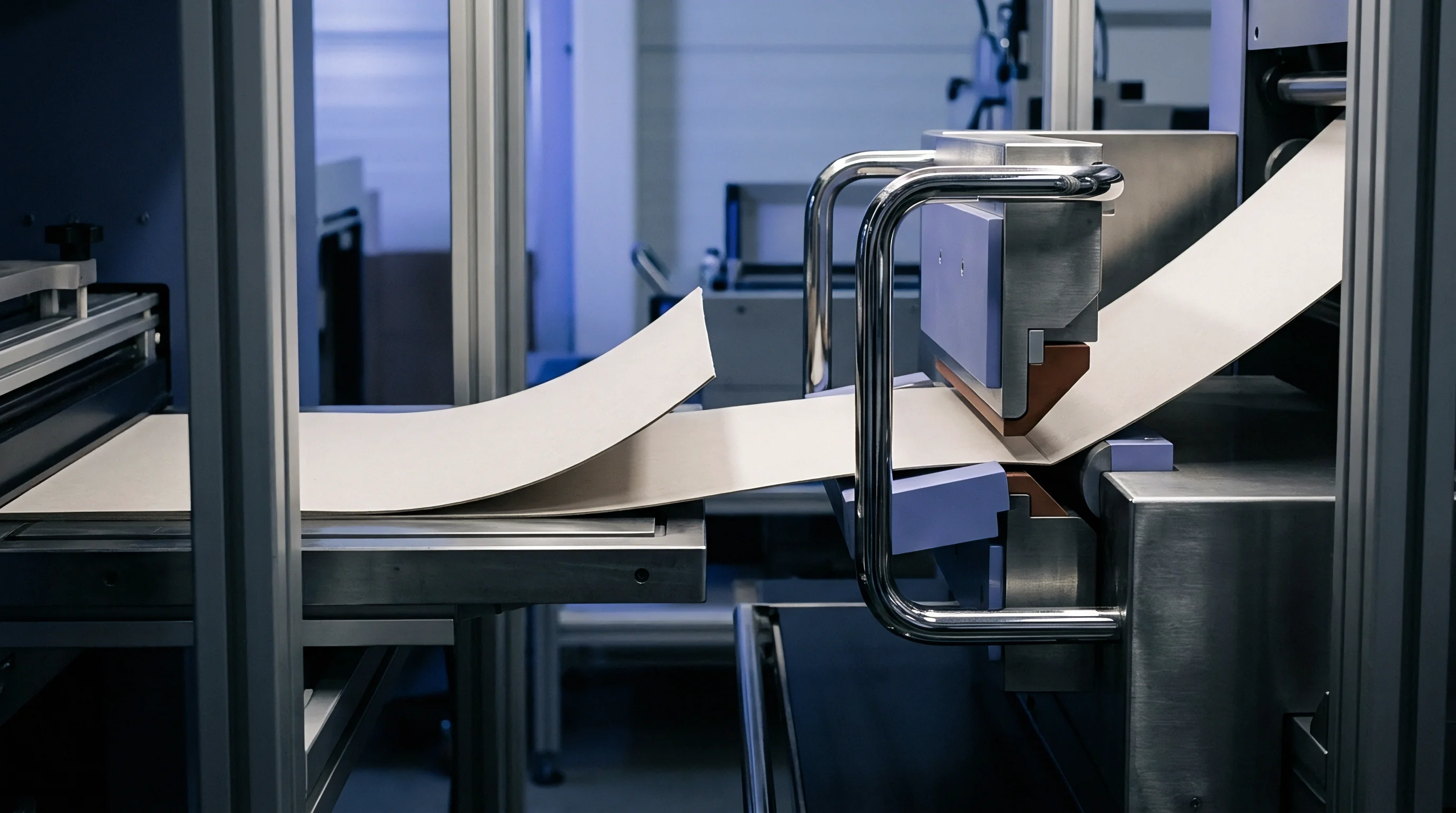
Envelope
Operating windows for heavy bleached kraft board depend on balancing pulp furnish costs against converting yield losses. High-grammage SBS boards represent a major material investment in luxury, pharmaceutical, and spirits packaging. A tight creasing window forces converters to constantly adjust press impression depth and change matrix channels to prevent stock failure, driving up setup times and waste rates.
Should Crease Depth Scale with Caliper Variance?
Mill basis weight drift across the paper machine web creates localized thickness fluctuations that disrupt rule impression consistency. In a standard 40-tonne order of 450 g/m² (610 µm / 24pt) solid bleached kraft board, caliper varies across a manufacturing tolerance band of plus or minus 5 percent, resulting in localized sheet thicknesses ranging between 580 µm and 640 µm. Scott Bond strength across the same batch fluctuates between 180 J/m² and 260 J/m² due to minor wet-end starch distribution variations.
When a die-cutting press operates at 7,000 sheets per hour with fixed rule and matrix channel geometry set for nominal 610 µm stock, a 640 µm thick sheet experiences 30 µm of over-compression. This over-compression elevates localized shear force, crushing the core ply and causing inner bead rupture. Conversely, a 580 µm sheet lacks sufficient impression depth to reach the z-direction shear initiation threshold, causing outer liner cracking upon folding.
Deep crease matrix channels reduce outer liner cracking on heavy kraft boards at the expense of flap fold stiffness.
To quantify the economic impact of this physical relationship on a converting run, consider a packaging job utilizing 100,000 sheets of 24pt SBS board measuring 720 mm by 1020 mm. Scrap rates generated by score failure scale non-linearly with board caliper variance.
- Impressional Compression Range must remain within 15 to 22 percent of nominal sheet caliper to achieve full internal delamination without surface crushing.
- Moisture Content Specification requires tight mill control between 6.0 and 7.0 percent to stabilize inter-fiber hydrogen bond shear sensitivity.
- Relative Humidity Control inside the converting plant must be maintained at 50 percent plus or minus 5 percent to prevent post-delivery board embrittlement.
- Rule Penetration Limits must be recalibrated whenever switching between cross-direction and machine-direction score lines to compensate for tensile orientation anisotropy.
Matching creasing rule penetration to moisture content variations across seasonal stock deliveries prevents outer liner fracture while preserving carton flap squareness.

Specimen
Laboratory verification of z-direction shear resistance relies on controlled tensile and z-axis bursting tests. Test methodology dictates whether laboratory certified strength values match real-world converting line behavior. Papermaking laboratories utilize standardized atmospheric conditioning to isolate material performance from environmental moisture bias.

Standardized Test Protocol Correlation Analysis
Data generated by ISO 15754 Z-direction tensile testing connects closely with Scott Bond TAPPI T 569 energy absorption measurements. Double-sided adhesive tape secures the board specimen between two rigid metal anvils during ZDT testing. The testing apparatus pulls the anvils apart vertically at a controlled velocity, measuring the maximum tensile force per unit area sustained by the sheet before internal separation occurs.
ZDT testing isolates the absolute tensile strength of the weakest internal ply interface.
ISO 187 conditioning mandates standard atmosphere dwell times before crease stiffness testing to prevent false compliance certifications.
Scott Bond testing measures the dynamic kinetic energy required to rupture the internal fiber network using a heavy pendulum impact hammer. While ZDT measures static stress limits, Scott Bond reflects the high-speed impact dynamics occurring inside a high-speed die-cutting press. Board specimens conditioned according to ISO 187 at 23 °C and 50 percent relative humidity for 24 hours provide repeatable test values, whereas unconditioned samples tested directly off a freight truck show wide error bands due to temperature and moisture gradients.
Board suppliers frequently claim that liner cracking during cold weather converting stems entirely from warehouse conditioning failures rather than deficient internal bond strength.