Reconciling Laboratory Stiffness Test Discrepancies between Taber and LW Instruments under PPWR Packaging Minimisation Rules
Reconciling Taber and L&W stiffness requires empirical grade-specific calibration curves rather than linear conversion to prevent PPWR minimisation audit failures.


Clamp
Laboratories handling imported paperboard encounter conflicting bending stiffness numbers between North American test certificates and European re-test certificates on identical mill rolls. A bleached kraft cartonboard specified at 24 Taber stiffness units in cross direction on a United States mill certificate yields an unexpected 420 millinewtons when tested on a European Lorentzen & Wettre instrument. The arithmetic conversion factor of 19.61 millinewtons per Taber unit indicates the reading should register 471 millinewtons.
This 11 percent deficit creates immediate contractual friction between overseas mills and domestic converters. The gap originates in the mechanical interface between the clamping jaws and the fibrous core of the board.
Pneumatic pressure stabilizes readings.
Bending resistance determinations under ISO 2493-1 specify an electronic load-cell mechanism that grips the lower 20 millimetres of a 38-millimetre-wide strip with parallel, flat pneumatic clamping faces under controlled pressure of 400 to 600 kilopascals. In contrast, the traditional Taber instrument governed by ISO 2493-2 and TAPPI T 489 relies on a mechanical thumb-screw or spring-loaded eccentric clamp. The manual clamp concentrates mechanical force along a narrow, uneven contact line.
This uneven line pinches the specimen, crushing delicate bulk structures in multi-ply folding boxboard and solid bleached board. The crushed cell walls cannot transmit bending moments cleanly across the neutral axis.
Clamping force variations shift measured bending resistance across high-bulk folding boxboards long before material yield occurs.
Tolerances compound rapidly.
European Union packaging legislation accelerates this mechanical friction. Under Regulation 2025/40 on packaging and packaging waste, specifically the Article 9 packaging minimisation rules, packaging manufacturers must prove that secondary and tertiary cartons use the minimum material mass necessary for structural function. Every gram per square metre of fiberboard must defend its presence in the technical documentation file.
When quality control teams identify discrepancy bands between mill origin certificates and incoming inspection benches, technical directors face an audit dilemma. Declaring minimum mass based on inflated stiffness assumptions leads to unexpected structural box collapse on high-speed cartoning machines, whereas declaring mass based on depressed laboratory readings inflates the reported packaging weight and invites non-compliance penalties from national packaging enforcement agencies.
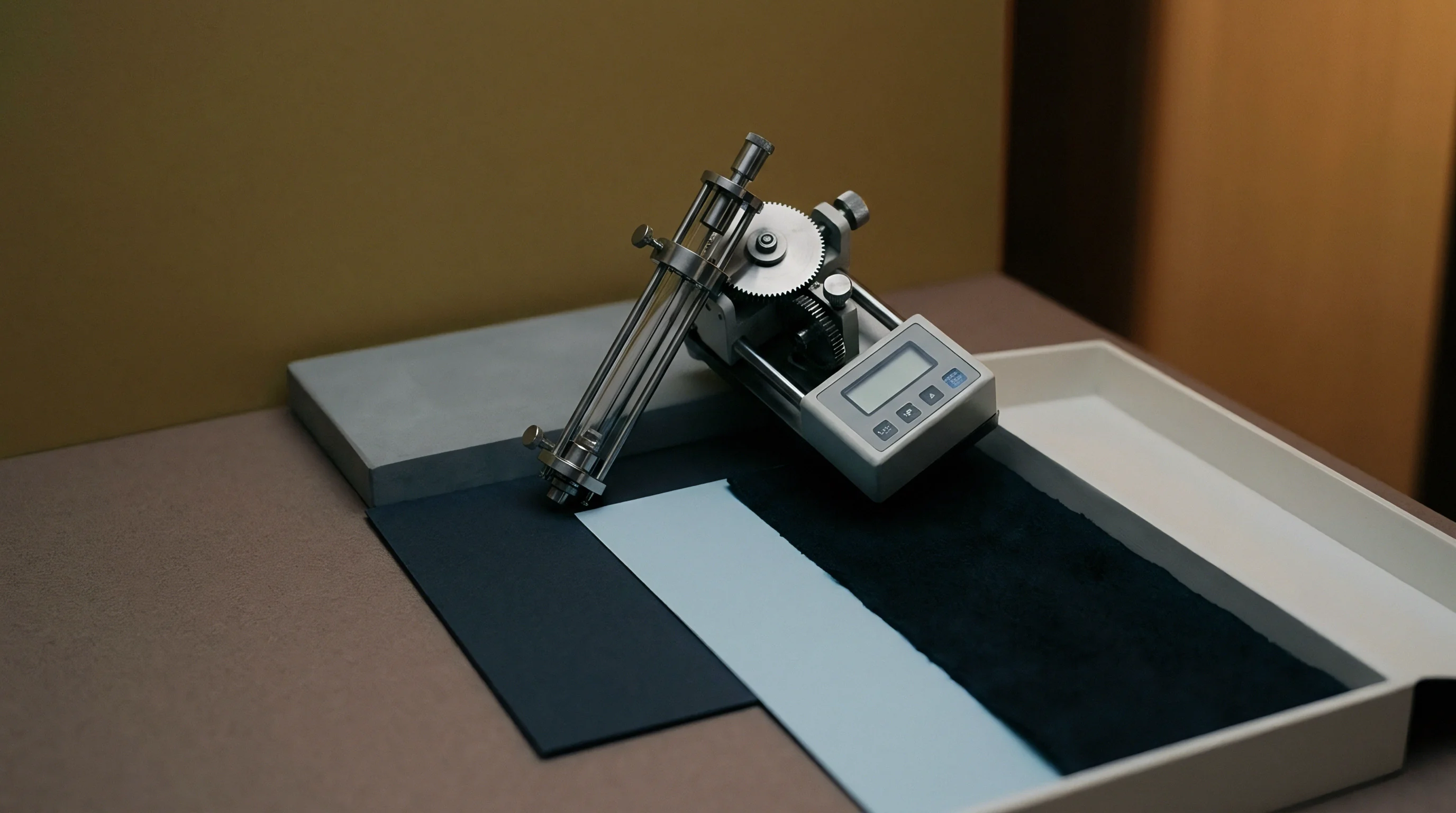
Instrument Architecture and Specimen Engagement
Bending resistance determinations demand precise gripping mechanics to isolate substrate flexure from unwanted compression. The Lorentzen & Wettre two-point bending tester holds the sample vertically while a polished contact pin moves horizontally against the upper edge through a rotary motor. The load cell resides directly at the contact pin or within the rotating clamping base, measuring the reaction force in millinewtons at an exact cantilever length of 50 millimetres or 10 millimetres.
The specimen engages the sensing pin along a tangential curve, preventing edge gouging.
Fibre orientation dictates resistance.
The Taber instrument mounts the test strip vertically between mechanical clamping blocks while two adjustable guide rollers flank the upper free end. As the clamping arbor rotates at a constant angular velocity of 180 degrees per minute, the specimen deflects against one of the free-rolling pins. The rolling pin drives an internal pendulum away from vertical balance.
The resistance reading reflects the torque required to displace that swinging pendulum counterweight to a specific angular offset, traditionally 15 degrees. Pendulums introduce gravitational artifacts. Because the contact roller must rotate freely to minimize frictional drag against the board face, any minor surface roughness, coating stickiness, or varnish drag introduces parasitic shear loads that distort the angular deflection reading.
A loose clamping collar on an analog instrument produces an artificially elevated stiffness number that collapses when transferred to an automated converting line.


Deflection
Mechanical configurations between ISO 2493-1 and ISO 2493-2 create distinct load states within identical paperboard swatches. The two-point cantilever method operates by applying a pure bending moment combined with transverse shear stress. Transverse shear stress acts parallel to the cross-section of the board.
In solid bleached sulphate boards with uniform density, this transverse shear contributes less than two percent of total beam deflection at a standard 50-millimetre test span. In bulky folding boxboard containing mechanical pulp centers or white lined chipboard with recycled fiber plies, the low out-of-plane shear modulus allows interior layers to slide horizontally before the outer plies reach maximum tensile and compressive stress.
Edge compression causes slippage.
The mechanical Taber tester applies its load through rollers that exert an unconstrained vertical sliding action along the board surface as the specimen bends. This sliding vector changes the effective cantilever span during the test cycle. At a deflection angle of 15 degrees, the actual lever arm shortens from 50.0 millimetres to approximately 48.3 millimetres.
The load cell on an L&W instrument adjusts for this geometric chord shortening through microprocessor-driven kinematic equations or maintains the span via calibrated pin movement. The uncorrected span shortening in manual Taber devices creates an artificial stiffness spike of 3.5 to 5.0 percent that paper buyers misinterpret as structural fiber performance.
Bending resistance readings taken at 50 millimetres span on a 350-micrometre folding boxboard drop 14.8 percent when measured on an L&W load cell compared to pendulum torque calculations at 23 degrees Celsius and 50 percent relative humidity.
Bulkier substrates amplify divergence.

Does Clamping Geometry Explain the Systematic Bias?
Pneumatic parallel jaws in modern European two-point instruments exert uniform contact pressure across the width of the board. The mechanical jaws of a Taber tester compress the sample edges more tightly than the center. This differential compression initiates micro-delamination along the ply interfaces immediately adjacent to the clamp line.
When micro-delamination occurs before the 15-degree bending threshold is reached, the measured moment drops precipitously. The test house records a lower stiffness value, not because the fiber furnish lacks rigidity, but because the clamp crushed the specimen before the test commenced.
The following physical failure mechanisms explain why laboratory readings diverge across board grades:
- Clamp Creep manifests when low-density mechanical middle plies crush beneath rigid mechanical jaws, reducing the effective section modulus of the board strip at the clamp boundary.
- Face Friction develops when uncoated unbleached kraft liners drag across Taber roller bearings, transferring axial thrust into the specimen and artificially inflating the measured torque.
- Transverse Shear Slip occurs in multi-ply recycled chipboard grades where low internal bond strength allows center layers to shear horizontally before outer liners reach full elastic deflection.
- Span Shortening Error arises when angular deflection pulls the upper board edge down between support rollers, reducing the actual moment arm without mathematical correction on analog dials.
Shear deformation absorbs energy.
| Board Grade | Caliper (μm) | Grammage (g/m²) | Test Method Standard | Nominal Bending Angle | Mean L&W Value (mN) | Calculated Taber Equivalent (mN) | Observed Divergence (%) |
|---|---|---|---|---|---|---|---|
| Solid Bleached Sulphate (SBS) | 310 | 240 | ISO 2493-1 / ISO 2493-2 | 15 deg | 185 | 202 | +9.2 |
| Folding Boxboard (FBB) | 450 | 280 | ISO 2493-1 / ISO 2493-2 | 15 deg | 395 | 455 | +15.2 |
| Folding Boxboard (FBB) | 600 | 350 | ISO 2493-1 / ISO 2493-2 | 15 deg | 810 | 960 | +18.5 |
| White Lined Chipboard (WLC) | 400 | 320 | ISO 2493-1 / ISO 2493-2 | 15 deg | 290 | 331 | +14.1 |
| Coated Kraft Back (CKB) | 480 | 310 | ISO 2493-1 / ISO 2493-2 | 15 deg | 540 | 615 | +13.9 |
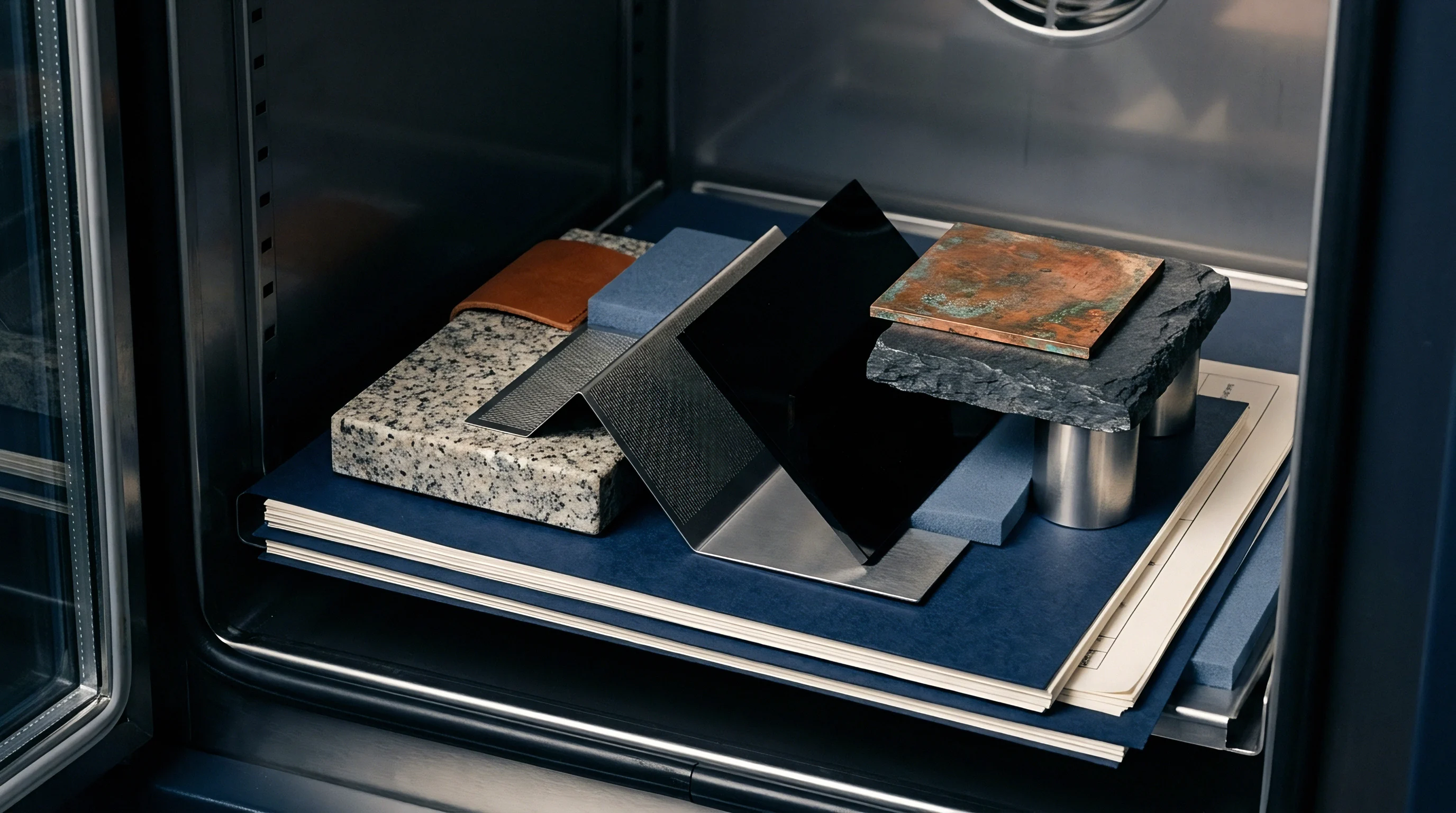
Angular Strain at Fifteen versus Seven Degrees
Test standards define specific deformation angles to maintain linear elastic response during substrate evaluation. The historical Taber standard establishes 15 degrees as the universal benchmark for paperboard. At 15 degrees, heavy calipers and brittle boards cross their elastic limit, entering plastic deformation.
When a 500-micrometre folding boxboard bends to 15 degrees, the tensile strain on the outer liner exceeds 1.2 percent. The outer fiber matrix develops micro-fractures, especially on the tension face.
The revised ISO 2493-1 standard recognizes this non-linear breakdown and incorporates an alternative bending angle of 7.4 degrees or 5.0 degrees for heavy industrial cartonboards. Measuring bending resistance at 7.4 degrees preserves structural integrity, capturing pure elastic springback force. Taber testing equipment cannot resolve small-angle forces accurately due to initial gear slack and pendulum inertia.
The mechanical reading from a 15-degree Taber deflection reflects both elastic stiffness and partial internal rupture, whereas an L&W load cell reading at 7.4 degrees captures pure elastic resistance before fiber bond degradation begins.
Does the industry possess sufficient empirical data to define whether plastic deformation during a 15-degree test invalidates the resulting stiffness metric as a basis for regulatory lightweighting verification?

Conversion
Mathematical equations between Taber stiffness units and Lorentzen Wettre millinewtons rely on idealized beam theory derived from pure elastic bending. Classical mechanics defines the relationship between bending resistance and bending moment across a fixed span. The theoretical conversion formula states that bending resistance measured in millinewtons equals the bending moment in millinewton-metres divided by the bending span in metres.
For an instrument configured with a standard 50-millimetre test length, bending resistance equals bending moment divided by 0.05 metres, which simplifies to the bending moment multiplied by 20.
Nominal caliper masks density.
The conversion between Taber Units (gram-centimetres) and millinewton-metres introduces another constant. One Taber Unit represents a torque of one gram-centimetre, which equals 0.0980665 millinewton-metres. Combining these two relationships yields the standard laboratory multiplier.
One Taber Unit equals 1.96133 millinewtons of bending resistance at a 50-millimetre span. Technicians routinely multiply Taber values by 1.961 to populate European technical data sheets. This direct linear multiplication assumes zero shear strain, zero specimen compression, zero friction, and infinite clamping rigidity.
Linear mathematical conversion factors fail when applied to low-density cartonboards with high caliper to span ratios.
Converting values across cartonboard specifications requires a structured operational sequence to correct for material non-linearity:
- Verify that the incoming test certificate documents whether the Taber rating was obtained using the 10-to-100 Taber Unit range or an augmented counterweight range using 500, 1000, or 2000 unit weights.
- Confirm the laboratory atmospheric conditioning parameters, verifying exact compliance with ISO 187 at 23 degrees Celsius and 50 percent relative humidity, because moisture variations alter fiber shear modulus far faster than tensile modulus.
- Establish the actual caliper and bulk density of the sample lot, noting that boards with bulk exceeding 1.4 cubic centimetres per gram display significant shear deformation at 50-millimetre test spans.
- Calculate the apparent bending resistance using the unadjusted multiplier of 1.961 millinewtons per Taber Unit for solid bleached kraft, or apply an empirical de-rating factor of 0.85 to 0.88 for bulky multi-ply folding boxboard.
- Record both machine direction and cross direction values independently, eliminating geometric mean averaging that obscures asymmetric cross-direction stiffness collapses during high-speed folding operations.
Uncalibrated models fail audits.

Mathematical Correlation across Caliper Bands
Standard physical formulas relate bending moment to bending force through the length of the cantilever span. However, the theoretical conversion multiplier of 1.961 rests entirely on elastic beam assumptions published in ASTM D5342 and ISO 2493-2. The validity of this multiplier collapses when the shear modulus G of the board drops below 120 megapascals.
For a 300-micrometre solid bleached board, the ratio of caliper to span remains small (0.006), keeping shear deflection under 1.5 percent of total deformation. When cartonboard caliper reaches 600 micrometres, the caliper-to-span ratio doubles to 0.012. Shear deflection now accounts for more than 8 percent of total movement on the L&W load cell.
Naval architects encountered this identical structural discrepancy during post-war standardization of destroyer hull plating, discovering that rotating arm moment tests systematically overestimated the flexural rigidity of thick stiffened plates compared to stationary electronic load gauges. The same physics governs paperboard plies.
A statistical analysis across mixed recycled board grades indicates an average cross-direction discrepancy of 14.2 percent between calculated Taber conversions and actual L&W measurements. The technical basis for this specific 14.2 percent figure remains difficult to defend across every furnish because recycled fiber morphology, ash filler content, and starch spray applications shift unpredictably between production runs. Sourcing engineers handle this uncertainty by applying a mandatory 15 percent safety tolerance band when reconciling North American recycled board declarations for European processing lines.
| Nominal Caliper (μm) | Board Type | Reported Taber (g·cm) | Theoretical L&W (mN) | Empirical L&W (mN) | Conversion Error (mN) | Packaging Minimisation Impact |
|---|---|---|---|---|---|---|
| 300 | FBB | 75 | 147.1 | 136.0 | -11.1 | Compliant within design tolerance |
| 380 | FBB | 150 | 294.2 | 262.0 | -32.2 | Marginal packaging line jam risk |
| 450 | FBB | 260 | 509.9 | 441.0 | -68.9 | Overestimated stiffness causes failure |
| 520 | FBB | 410 | 804.1 | 685.0 | -119.1 | Significant non-compliance exposure |
| 600 | WLC | 580 | 1137.6 | 955.0 | -182.6 | Critical box bulge failure in transit |

Dynamic Shear and Core Delamination Risks
Multi-ply folding boxboard structures feature distinct mechanical layers designed to maximize moment of inertia at minimal density. Dense, chemical-pulp outer plies provide tensile and compressive strength, while bulky, mechanical-pulp middle plies space the outer skins apart. The moment of inertia increases with the cube of caliper.
When this composite structure deflects during testing, horizontal shear stresses concentrate in the middle plies. The Taber tester applies its load slowly over several seconds as the pendulum swings, allowing viscous stress relaxation within the core fiber network. The L&W tester drives the bending motor at a rapid 5.0 degrees per second, capturing peak dynamic resistance before internal relaxation dissipates energy.
The mill representative claimed that mathematical table conversion between Taber and L&W has served the international merchant trade without commercial dispute for forty years.


Margin
European packaging minimisation targets compel carton converters to shave basis weight down to the mechanical threshold of collapse. Under PPWR Article 9, packaging manufacturers cannot simply choose an arbitrary board caliper to guarantee carton safety factors. The regulation restricts empty space, wall thickness, and weight to the minimum necessary to maintain structural integrity across distribution and storage.
A packaging engineer designing a secondary pharmaceutical carton or food shelf pack must calculate the precise critical compression strength and crease recovery required to run on automated packaging machinery.
Downgauging reduces structural safety.
Packaging minimisation audits evaluate technical files against standardized performance benchmarks. If an engineer specifies a 400-micrometre board based on a theoretical Taber stiffness conversion that overstates bending resistance by 15 percent, the real box fails on the cartoning line. High-speed carton erecting machines exert rapid multi-point bending loads against side panels and bottom flaps.
Cartons that lack sufficient dynamic bending resistance fail to open cleanly, buckling beneath the erecting suction cups and triggering automated machine stops.
Article 9 technical documentation requires demonstrated structural performance limits validated against verified test methodologies rather than historical supplier trade charts.
Carton lines jam unexpectedly.

Article Nine Lightweighting Targets and Audit Exposures
National regulators inspecting packaging formats focus on unnecessary material mass across tertiary and secondary folding cartons. Annex IV of the packaging regulation establishes performance criteria including product protection, packaging manufacturing processes, logistics, and consumer safety. To justify a specific grammage and caliper, the manufacturer must compile empirical test evidence showing that reducing basis weight by another five percent causes package failure under one of these performance criteria.
When auditing authorities review the technical dossier, laboratory test certificates form the backbone of the defense.
Discrepancies trigger border holds.
If the technical dossier lists board stiffness using an uncorrected Taber conversion, the calculated safety factor appears artificially robust. An auditor checking the pack against European harmonised standards will demand verification according to ISO 2493-1. When laboratory re-testing reveals that actual bending resistance is 12 percent lower than declared, the auditor concludes that the packaging was engineered with unverified, arbitrary safety margins, or that the packaging dossier contains inaccurate technical data.
Either finding invalidates the minimisation declaration.
Engineers structuring minimisation documentation navigate several distinct regulatory verification pitfalls:
- Unverified Multipliers appear when technical files apply a single 1.961 factor across all board grades without verifying internal shear properties or caliper effects.
- Missing Conditioning Logs expose files to rejection when test certificates omit temperature and relative humidity data, which directly alters board flexural modulus.
- Creep Omission occurs when static compression calculations fail to account for long-term top-to-bottom compression losses in humid warehousing environments.
- Crease Ratio Confusion develops when converters test board stiffness using Taber methods but evaluate crease bending resistance on L&W instruments, generating meaningless crease-to-board stiffness ratios.
Enforcement officers demand records.
Which Benchmark Governs the Packaging Minimisation File?
Procurement teams encounter conflicting expectations between converter design teams and external regulatory inspectors. Converters purchasing paperboard across global supply chains receive reels accompanied by TAPPI or ASTM documentation from North and South American suppliers, while European quality systems demand CEPI and ISO alignment. Adopting the wrong test protocol into the formal packaging dossier compromises regulatory compliance.
European national market surveillance authorities enforce EN standards referenced in European Commission implementing acts. Under this enforcement structure, test data derived from ISO 2493-1 stands as the primary reference method for bending resistance verification.
A packaging brand owner calculating minimal allowable caliper on an unverified Taber-to-LW conversion formula risks full product delisting and administrative fines when customs or market authorities pull random warehouse samples for verification testing.


Dossier
Technical compliance files prepared for European Union national market surveillance bodies compile raw mill test certificates alongside structural performance proofs. The dossier demonstrates that the packaging format satisfies the minimisation mandate of Article 9 and the design criteria of Annex IV. When cross-border supply chains feed raw paperboard into European packaging converting plants, the technical file must reconcile laboratory measurement discrepancies at the point of specification rather than during post-shipment regulatory inquiries.
Paper buyers and packaging engineers secure compliance by executing a dual-protocol certification policy. When procurement contracts specify paperboard from mills that operate Taber instruments, the technical agreement must explicitly state whether stiffness parameters represent empirical ISO 2493-2 pendulum measurements or calibrated ISO 2493-1 L&W equivalents. Relying on generic trade sheet conversion factors introduces an undocumented tolerance gap of up to 18 percent into the compliance dossier.
This gap compromises structural integrity assessments and leaves the packaging manufacturer exposed to regulatory penalties under European Union waste prevention rules.

Technical Documentation under Annex Four Criteria
Manufacturers compiling proof of minimisation gather certified laboratory logs that demonstrate real operational limits. Annex IV requires documented evidence that further weight reduction impairs structural functionality. A valid compliance dossier pairs machine performance logs from packaging filling lines with ISO 2493-1 bending resistance test reports.
If the filling line encounters a carton failure rate exceeding 0.1 percent when processing board below 380 millinewtons of bending resistance, that 380-millinewton figure represents the minimum functional limit. The manufacturer incorporates this physical test threshold into the technical file to justify the specified basis weight.
When the underlying test certificate expresses that limit as 194 Taber Units via a unverified mathematical conversion, the evidentiary value collapses. A competent regulatory auditor requests the raw test data and instrument calibration records. If the technical file reveals that the laboratory never executed physical testing on a calibrated two-point load cell instrument, the declared minimisation threshold lacks legal standing under European standard EN 13428.

Commercial Allocation of Downgauging Penalties
Cross-border supply contracts designate financial liability when delivered carton blanks cause automated packaging machinery shutdowns. When a converter downgauges cartonboard caliper to meet brand sustainability mandates, the mechanical margin of error narrows. If the board arrives with physical stiffness 10 percent below the purchase order specification due to unresolved Taber-to-LW laboratory discrepancies, the material jams high-speed folder-gluers and cartoning lines.
Commercial contracts must define testing protocol primacy in clear operational terms. Supply agreements must designate ISO 2493-1 at 23 degrees Celsius and 50 percent relative humidity as the sole binding referee test method for all dispute settlements. Mill specifications that express stiffness values in Taber Units must carry an attached empirical calibration curve generated specifically for that mill’s furnish and caliper range.
This contractual mechanism shifts compliance and performance risk from the purchasing brand back to the primary material manufacturer.
Supply contracts must insert the following binding clause to eliminate ambiguity: In the event of measured bending resistance variance between mill origin certificates and incoming laboratory verification, ISO 2493-1 test results determined at 15 degrees bending angle and 50 millimetres free span under ISO 187 conditioning shall supersede all theoretical conversions, and any delivered lot demonstrating a negative variance exceeding five percent against the agreed millinewton specification shall entitle the buyer to immediate rejection of the consignment.