Moisture Regain between Mill Conditioning and an Unheated Warehouse
Unheated storage drives moisture ingress along sheet edges via psychrometric gradients, requiring sealed barrier wraps and strict thermal acclimation before press run.

Shed
A reel of 250 gsm solid bleached board leaves the off-machine coater at a tightly controlled 6.2 percent target moisture content, sealed in polyethylene outer wrap, and enters an unheated transit depot where ambient conditions sit at 4 degrees Celsius and 88 percent relative humidity. The thermal mass of a bulk paperboard pallet acts as a cold sink. Air entering the perimeter of an unheated storage facility cools as it contacts the cold stack, driving local relative humidity at the boundary surface near saturation.
Water vapor then moves along vapor pressure gradients from the surrounding atmosphere toward the colder, drier fiber matrix of the paper reel or sheet stack.
The gap between mill exit specifications and warehouse storage reality creates immediate hygral instability. Standard mill conditioning under ISO 187 fixes testing environments at 23 degrees Celsius and 50 percent relative humidity, establishing an equilibrium moisture content between 5.8 percent and 6.5 percent for virgin kraft fibers. When those same pallets enter an unconditioned distribution hub during autumn or winter, local ambient relative humidity frequently exceeds 80 percent while temperatures hover between 2 and 8 degrees Celsius.
Under these conditions, the equilibrium moisture content of the substrate shifts from 6.2 percent to over 9.5 percent.
When reams enter an unconditioned facility during November, temperature differentials between the transport trailer and ambient air drive immediate surface condensation. The temperature difference between the core of a 1,000-kilogram paper skid and the ambient warehouse environment dictates the speed and severity of vapor transfer. Moving a pallet stored at 5 degrees Celsius into an ambient environment of 20 degrees Celsius with 60 percent relative humidity drops the air temperature immediately adjacent to the packaging film below its dew point.
Condensation forms on the inner face of the wrapper or directly on exposed sheet edges if the seal suffers any micro-punctures during transport.
Thermal Transitions across the Receiving Dock
Transport vehicles operating in winter conditions maintain internal trailer temperatures close to ambient exterior levels. Unloading wrapped pallets onto an unheated receiving apron exposes the cargo to wind drafts and ambient humidity spikes. The outer layers of paper on a reel or skid react within minutes to ambient thermal shifts, while the core retains its original mill-exit temperature for days due to the insulating properties of compressed cellulosic fiber layers.
The temperature gradient across the skid generates an opposing water vapor pressure gradient. Air inside the unheated warehouse contains a specific absolute humidity, but the micro-climate within the porous structure of the cold paper stack exhibits lower saturated vapor pressure. Water vapor migrates inward from the surrounding air through the packaging barrier seams, seeking vapor pressure equilibrium.
This moisture absorption continues until the paper moisture content matches the high relative humidity corresponding to the lowered temperature at the stack boundary.
| Ambient Temperature (°C) | Relative Humidity (%) | Air Dew Point (°C) | Substrate EMC (%) | Condensation Risk Level |
|---|---|---|---|---|
| 23 | 50 | 12.0 | 6.2 | Negligible |
| 15 | 65 | 8.4 | 7.4 | Low |
| 8 | 80 | 4.8 | 9.1 | Moderate |
| 4 | 88 | 2.2 | 10.3 | Severe |
| 1 | 92 | -0.1 | 11.4 | Critical |
Psychrometrics of Cold Stored Pallets
The psychrometric relationship between dry-bulb temperature, relative humidity, and dew point explains why unheated warehouses consistently degrade paperboard flatness. As ambient dry-bulb temperature falls in an unconditioned building, relative humidity rises even when absolute moisture content in the air remains constant. Paper fibers are hygroscopic, exchanging water vapor with the immediate surrounding micro-atmosphere until equilibrium is established.
Vapor moves along temperature paths. A fully wrapped pallet stored in an unheated room at 5 degrees Celsius and 85 percent relative humidity reaches equilibrium at approximately 10 percent total moisture content. If that same pallet is moved directly to a climate-controlled pressroom operating at 22 degrees Celsius and 45 percent relative humidity without thermal acclimation, the exposed outer wrapper surfaces rapidly warm while the interior paper matrix remains cold.
Warm air carrying excess moisture comes into contact with the cold sheet edges, resulting in rapid moisture pick-up along the perimeter of every sheet in the stack.
Moisture complaints originating from unheated warehouse storage frequently reflect improper pressroom acclimation protocols on the buyer side rather than manufacturing defects or inadequate mill packaging protection.


Diffusion
Water absorption into a dense paper stack follows a non-linear temporal path governed by Fickian transport physics across cell walls. Cellulosic fibers possess amorphous regions containing accessible hydroxyl groups that form hydrogen bonds with ambient water molecules. The initial stage of moisture regain involves monolayer adsorption onto these internal pore surfaces, followed by multilayer absorption and capillary condensation within the inter-fiber pore network.
The rate of vapor transport through the edges of a sheet skid is orders of magnitude faster than transport through the sheet surface in the Z-direction. Paper is an anisotropic matrix, with fibers oriented predominantly in the machine direction and cross direction within the XY-plane. Moisture travels along the longitudinal axes of fibers and through the open capillary channels between parallel sheet layers with significantly less resistance than across the compressed, calendared thickness of the sheet.
Consequently, sheet edges absorb moisture rapidly when exposed to humid environments, while the geometric center of the sheet inside the stack remains untouched by ambient changes for weeks.
Sorption Hysteresis and Moisture Isotherms
The path paper takes to arrive at a specific moisture content dictates its physical dimensions and mechanical properties. Paper exhibits sorption hysteresis: at any given relative humidity, a sheet undergoing desorption (drying down from a wet state) retains a higher equilibrium moisture content than a sheet undergoing adsorption (gaining moisture from a dry state). Mill conditioning processes typically dry the web down to the target moisture level on the paper machine, placing the substrate on the desorption arm of its hysteresis loop.
Exposure to high relative humidity in an unheated warehouse shifts the substrate onto the adsorption loop. When the sheet later re-equilibrates to pressroom conditions, it does not return to its original mill-exit moisture content or dimension, leaving permanent residual structural shifts. The internal stress network established during machine drying undergoes localized relaxation as water molecules break and reform inter-fiber hydrogen bonds under tension.
A virgin bleached softwood kraft sheet conditioned at 23 degrees Celsius and 50 percent relative humidity absorbs 1.8 percent additional water weight when exposed to 85 percent relative humidity at 5 degrees Celsius under TAPPI T412 testing.
Z-Direction Gradient Formation in Paper Skids
Moisture ingress into a solid stack of paperboard creates distinct moisture profiles along both the horizontal radius and the vertical height of the skid. The top sheets of an open or loosely wrapped pallet experience direct face adsorption, establishing a sharp moisture drop from the top sheet down to the twentieth sheet. Simultaneously, all four vertical faces of the skid absorb water along their exposed sheet edges, creating a wet perimeter surrounding a dry central core.
The depth of moisture penetration along the sheet edge depends on exposure time, temperature, furnish density, and sizing degree. Densely calendared, highly filled offset sheets resist capillary suction longer than bulky, uncoated mechanical grades. Internal sizing with alkyl ketene dimer (AKD) or alkenyl succinic anhydride (ASA) slows liquid water uptake under ISO 535 Cobb testing, yet provides minimal barrier protection against phase vapor diffusion into the pore matrix over extended storage periods.
- Edge Expansion Profile creates localized sheet growth along the perimeter, producing wavy edges that cause double-sheet feeds and registration misalignments on sheet-fed offset presses.
- Blistering Susceptibility increases in coated grades when trapped edge moisture turns to high-pressure steam inside heatset drying ovens.
- Delamination Resistance Loss occurs when absorbed water weakens internal fiber bonding networks, causing Z-direction sheet splitting under high-tack ink transfer.
- Coating Pick Defect Rates escalate as localized fiber swell disrupts latex binder matrices on clay-coated folding boxboard surfaces.

Mass Transfer Rates in Fiber Interfaces
Quantifying mass transport inside a paper skid requires measuring the effective vapor diffusion coefficient of the bulk furnish, which accounts for the porosity, tortuosity, and chemical affinity of the fiber network. In virgin bleached softwood pulp, moisture diffusion occurs rapidly due to high fiber length and open pore structures. In recycled board grades containing short, highly beaten fibers and elevated ash contents, higher tortuosity slows the initial rate of ingress, though total water retention capacity increases due to fines content.
Moisture regain rates accelerate dramatically when ambient relative humidity passes 70 percent. At this threshold, capillary condensation begins within microscopic pores smaller than 50 nanometers in diameter. Water molecules no longer merely coat fiber surfaces; liquid water bridges form within the inter-fiber matrix, causing accelerated swelling of individual fibers in their radial direction.
Radial fiber swell is ten times greater than axial fiber swell, directly causing the severe cross-direction dimensional drift observed on printing lines.
Mathematical modeling of this ingress pattern demonstrates that a 1.2-meter-wide skid stored in an unconditioned facility for fourteen days develops a moisture differential exceeding 2.5 percent between its outer 50 millimeters and its core. The core moisture remains locked at the mill exit specification, while the outer perimeter climbs toward equilibrium with the cold warehouse air.
This sharp internal moisture gradient establishes differential internal stresses within each sheet, leaving structural stresses that cannot be fully relieved by subsequent pressroom drying. The unresolved question remains whether thermal re-conditioning of unopened skids can fully restore planar fiber alignment without permanently compromising conversion tolerances.


Distortion
Dimensional instability is the direct physical outcome of non-uniform moisture regain. Cellulosic fibers swell preferentially in diameter rather than length when absorbing water molecules. Because fibers in a paper machine line up predominantly in the direction of web travel, cross-machine direction (CD) expansion is significantly greater than machine direction (MD) expansion.
A 0.5 percent increase in total sheet moisture content produces a cross-direction dimensional expansion between 0.10 percent and 0.25 percent depending on furnish makeup and refining intensity.
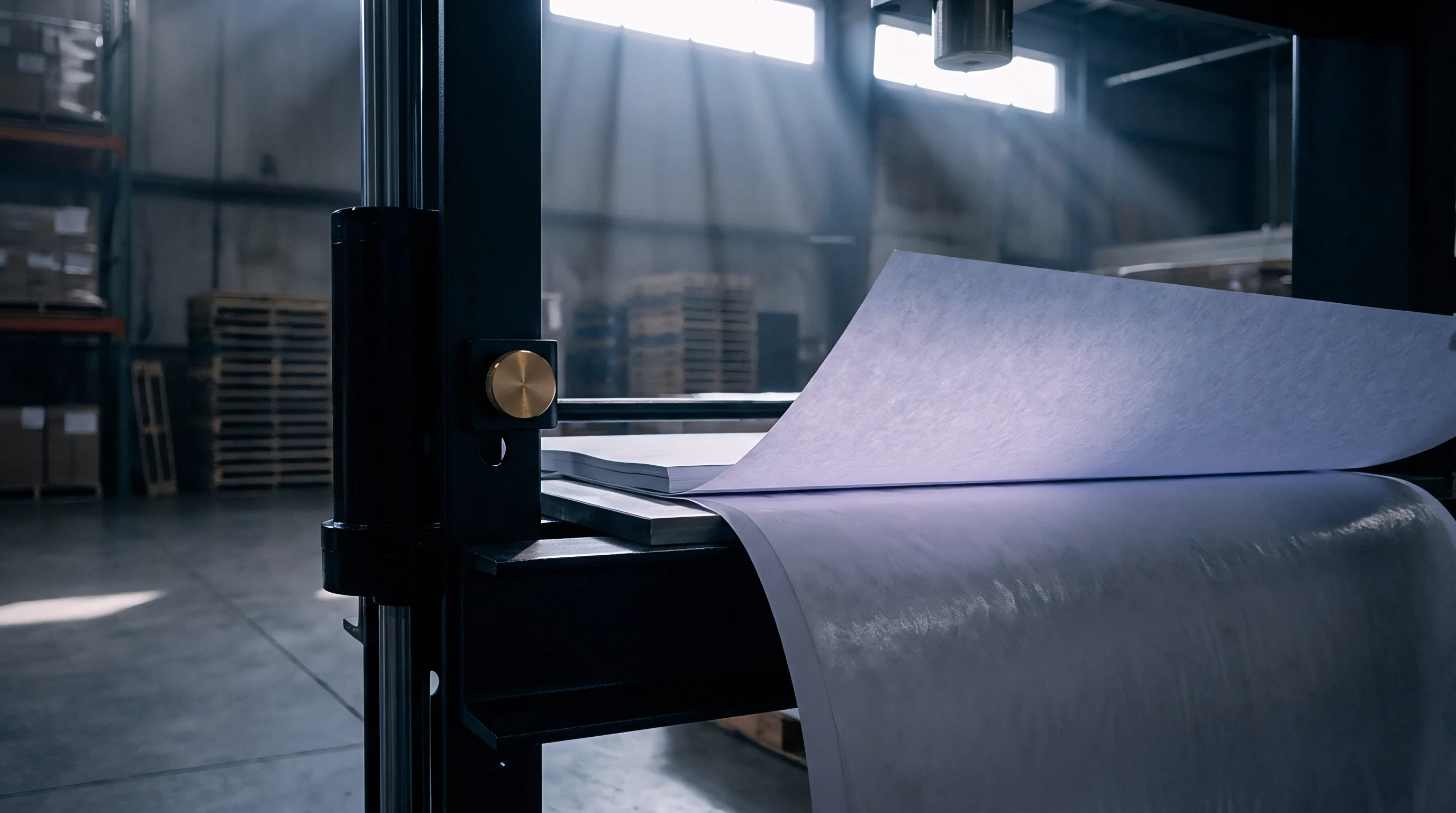
When moisture absorption occurs while sheets are compressed inside a heavy pallet, expansion cannot take place evenly. Sheet perimeters, free to expand outwards into space, swell in size. The interior of the sheet, restrained by mass and friction from adjacent sheets, cannot move.
The expanded edge material has a larger surface area than the dry center, forcing the perimeter of the sheet to buckle, forming characteristic wavy edges across all four sides of the skid stack.
Hygral Expansion and Dimensional Drift
Hygral expansion coefficients define how much a given substrate expands per unit change in moisture content. Coated solid bleached sulfate (SBS) boards exhibit low hygral expansion coefficients relative to uncoated recycled linerboards due to synthetic binder networks and chemical sizing density. High-bulk mechanical pulp papers exhibit extreme hygral sensitivity, expanding rapidly upon minor atmospheric moisture changes.
When wavy-edged sheets pass through the impression nip of a multicolor sheet-fed press, excess paper surface area at the edges gets pressed flat against the cylinder. This action forces excess material toward the trailing edge of the sheet, causing tail-end misregister, fan-out defects, and in severe cases, actual paper creasing or diagonal wrinkling across the printed image area.
Cold paper opened in a warm pressroom attracts ambient moisture immediately, expanding sheet edges while the core remains rigid and dry.

Wavy Edges and Tight Centers on Press
The inverse phenomenon occurs when cold, low-moisture paper is unsealed in a hot, humid pressroom environment, or when warm, high-moisture paper is exposed to cold, dry warehouse air. If paper edges dry out faster than the core, sheet perimeters shrink while the core remains expanded. This condition, known as tight edges or dish-shaping, causes the center of the sheet to bow upward, forming a dome that strikes press grippers, damages printing plates, and causes severe feeder delivery jams.
| Substrate Grade | Grammage (g/m²) | MD Hygral Coeff (%/% MC) | CD Hygral Coeff (%/% MC) | Critical Moisture Regain Delta (%) | Primary Converting Failure Mode |
|---|---|---|---|---|---|
| Solid Bleached Sulfate (SBS) | 280 | 0.015 | 0.045 | +1.2 | Color-to-Color Misregister |
| Folding Boxboard (FBB) | 300 | 0.018 | 0.058 | +1.0 | Crease Line Delamination |
| Coated Recycled Board (CRB) | 350 | 0.022 | 0.072 | +0.8 | Sheet Edge Waving / Feeder Jam |
| Uncoated Woodfree (UWF) | 100 | 0.025 | 0.085 | +0.6 | Diagonal Sheet Creasing |
| Thermo-Mechanical Pulp (TMP) | 70 | 0.035 | 0.110 | +0.4 | Web Edge Tear / Fan-out |
Surface moisture variations across a sheet disrupt offset ink drying mechanisms. Ink film consolidation relies on controlled absorption of ink solvents into the coating pore structure, followed by oxidative polymerization of resin binders. High localized moisture content fills the capillary voids within the coating layer, preventing solvent absorption.
Inks printed over wet sheet edges remain tacky, transferring onto the underside of subsequent sheets in the delivery pile, generating offset set-off defects and ghosting.
During a winter press trial on 300 gsm folding boxboard, edge swell caused feeder misfeeds that resulted in a total press downtime cost of 4,200 EUR as surface fibers expanded first. The cost of scrapped material and wasted press setup hours fell entirely on the printing facility because pallet storage logs failed to document ambient warehouse conditions prior to unwrapping.

Metrology
Accurate measurement of moisture content within paper pallets requires strict adherence to standardized measurement standards and specialized instrumentation. Conventional gravimetric oven-drying under ISO 287 serves as the absolute standard, requiring samples to be weighed before and after drying at 105 degrees Celsius until constant weight is reached. Gravimetric testing is inherently destructive, requires ream sampling, and cannot provide real-time profiling of intact, wrapped pallets inside an active storage warehouse environment.
Field measurements rely on electronic probes that estimate moisture content via electrical resistance, dielectric capacitance, or equilibrium relative humidity (ERH). Capacitance-based surface meters measure up to a depth of 15 to 20 millimeters, making them ideal for rapid scanning of outer reel wraps, but useless for assessing internal core condition. Sword-type hygrometers, inserted physically between sheets into the center of a skid, measure the relative humidity of the micro-air space trapped between paper layers.

Standardized Conditioning Protocols and Deviations
ISO 187 defines the reference atmosphere for testing pulp, paper, and board as 23 degrees Celsius and 50 percent relative humidity, with absolute tolerances of plus or minus 1 degree Celsius and plus or minus 2 percent relative humidity. TAPPI T402 specifies identical standard conditions for North American testing. Evaluating samples taken from an unheated warehouse without proper atmospheric conditioning yields invalid physical strength, stiffness, and caliper readings.
A sheet containing 9.0 percent moisture measured directly out of a cold warehouse displays significantly lower tensile energy absorption, reduced bursting strength, and altered bending stiffness compared to the same sheet evaluated after twenty-four hours of standard ISO 187 re-equilibration. Sword hygrometers are calibrated against saturated salt solutions before probing wrapped pallets on arrival, though standard testing requires twenty hours. Testing stock immediately upon arrival from an unheated depot without standard conditioning results in false rejections for caliper or grammage specification non-compliance.
Compliance with ISO 187 conditioning mandates twenty-four hours of atmospheric equilibrium at standard temperature before any formal strength or moisture assay retains commercial validity.

Destructive versus Surface Measurement Techniques
Evaluating moisture regain across intact supply chains requires combining rapid non-destructive surface screening with selective destructive sampling. The following numbered sequence details the operational protocol required to verify pallet moisture profiles at receiving docks prior to unwrapping.
- Inspect external packaging film for tears, puncture marks, or loose stretch-wrap banding that would permit ambient vapor ingress during unheated warehouse storage.
- Record ambient dry-bulb temperature and relative humidity at the receiving dock using a calibrated psychrometer to calculate local dew point conditions.
- Measure surface temperature across all four side faces and top of the wrapped pallet using an infrared pyrometer to determine thermal equilibrium status.
- Insert a calibrated sword-type equilibrium relative humidity probe through a small slit in the protective packaging wrap into the center of the sheet stack height, penetrating at least 300 millimeters inward from the edge.
- Allow the sword probe indicator reading to stabilize for at least ten minutes until temperature and relative humidity values achieve static equilibrium.
- Compare the measured micro-climate equilibrium relative humidity against the target pressroom equilibrium relative humidity range of 45 percent to 55 percent.
- Seal the probe penetration slit immediately using moisture-barrier adhesive tape to prevent secondary ambient air ingress.
Disagreements between mill test certificates and buyer receiving inspections frequently stem from instrument calibration drift or mismatched measurement parameters. Mill certificate values reflect gravimetric oven testing conducted on samples taken at the reel turn-up under ISO 287 conditions. Buyer measurements taken with uncalibrated dielectric hand meters on cold sheets in an unheated warehouse register elevated dielectric constants caused by free water molecules, overestimating total moisture content by up to 2.0 percentage points.
Under section 6.3 of ISO 287, referee moisture determinations mandate sampling within three minutes of breaking original mill packaging, followed by immediate hermetic sealing in glass containers prior to gravimetric analysis, voiding any field measurements taken with non-standardized handheld electronic meters.
Containment
Preventing moisture regain during extended storage in unconditioned warehouses requires engineered barrier packaging systems designed to isolate paperboard from external relative humidity fluctuations. Standard mill packaging consists of multi-layer wraps combining heavy kraft paper outer facings with internal extrusion-coated polyethylene (PE) or polypropylene (PP) moisture barrier films. The efficacy of these wrappers depends on water vapor transmission rates (WVTR), film continuity, and edge seal integrity.
Water vapor transmission rate measures the mass of water vapor passing through a unit area of barrier material over twenty-four hours under specified temperature and relative humidity gradients (typically ISO 2528 at 23 degrees Celsius and 85 percent RH). A standard 15 g/m² PE extrusion coating on kraft wrap provides a WVTR of approximately 5 to 8 g/m²/day. High-barrier packaging formulations incorporating ethylene vinyl alcohol (EVOH) or aluminum foil laminates lower WVTR below 0.5 g/m²/day, providing long-term protection against ambient humidity ingress in severe storage environments.

Polyethylene Wrap Integrity and Vapor Transmission
Packaging wrap integrity is frequently compromised during transport and handling by forklift clamp pressure, pallet strapping tension, or corner abrasion. Punctures as small as 1 millimeter in diameter create localized pathways for moisture diffusion. Air currents driven by ambient temperature changes actively pump humid warehouse air through wrapper micro-voids directly into contact with cold paper edges.
Water vapor transfer rates across mill-applied stretch films under fluctuating relative humidity show that stretch wrapping alone, applied around pallet perimeters without a top barrier sheet or heat-sealed top cap, offers minimal moisture protection. Vapor easily penetrates between overlapping stretch-wrap layers or down through the open wooden pallet structure into the bottom sheets of the stack.
| Barrier Packaging Material Specification | WVTR at 23°C / 85% RH (g/m²/day) | WVTR at 38°C / 90% RH (g/m²/day) | Effective Storage Horizon (Unheated Shed) | Relative Barrier Performance Index |
|---|---|---|---|---|
| Uncoated Kraft Paper Wrap (80 g/m²) | > 250.0 | > 600.0 | Less than 24 hours | Unprotected baseline |
| Standard PE-Coated Kraft (80 g/m² + 15 g/m² PE) | 6.5 | 22.0 | 14 to 21 days | Standard mill protection |
| High-Density PE Coated Board (25 g/m² HDPE) | 2.8 | 9.5 | 45 to 60 days | Enhanced storage grade |
| Multi-layer PE/EVOH/PE Coated Wrap | 0.6 | 2.1 | 120+ days | Export / Long-term grade |
| Aluminum Foil Laminate (Kraft/PE/Foil/PE) | 0.05 | 0.15 | Indefinite (Sealed) | Absolute moisture barrier |
| Water vapor transmission rates determined per ISO 2528 gravimetric dish method. Storage horizon estimates assume intact side folds and edge seals. | ||||

Pallet Unwrapping Timelines on Press Floors
Mitigating hygral shock requires strict operational protocols when moving cold pallets from unheated storage into climate-controlled conversion environments. Opening protective packaging while paper temperature remains significantly below pressroom air temperature guarantees surface condensation and edge distortion.
Pallets must undergo a mandatory thermal acclimatization period before outer packaging seals are broken. The required equilibration time scales non-linearly with pallet volume and temperature differential. A single 1,000-kilogram skid with a temperature difference of 15 degrees Celsius between warehouse storage and pressroom environment requires a minimum of forty-eight hours of unopened thermal standing to reach safe processing temperatures.
Stretch wrapping prevents bulk liquid penetration but fails to arrest vapor equilibration across extended winter storage periods.
A structured receiving inspection protocol prevents damaged stock from reaching press lines. The following checklist establishes rejection criteria for wrapped pallets arriving at an unheated warehouse dock.
- Thermal Imbalance Detection requires measuring skid surface temperature versus ambient air to calculate required acclimatization time before unwrapping.
- Packaging Membrane Breach identifies tears, pinholes, or split corner seams in PE-coated wrappers requiring immediate barrier taping.
- Pallet Base Vapor Ingress inspects bottom corrugated deck pads for high moisture absorption from wet transport vehicle floors.
- Strapping Impression Damage flags overtightened plastic banding that deforms reel edges and breaches outer protective wrapping layers.
- Condensation Droplet Accumulation verifies whether liquid water has formed on inner film surfaces, indicating severe dew point transit violations.
Intact protective wrapping shields paper from atmospheric moisture ingress only as long as thermal equilibrium remains maintained across all storage transitions.

Dispute
Financial liability for moisture regain defects hinges on establishing precise custody transfer points and proving non-compliance with agreed technical delivery specifications. Mill supply contracts typically stipulate that paperboard moisture content is governed by mill-of-origin certificate values measured under ISO 287 prior to wrapping. Once cargo leaves the mill gate, risk of atmospheric degradation transfers to the buyer or freight forwarder unless specific transport damage or defective barrier packaging can be conclusively proven.
When stock stored in an unheated warehouse displays severe edge distortion on press, resolving commercial claims requires forensic reconstruction of environmental exposure logs. Buyers must prove that the substrate absorbed excess moisture while sealed within factory-applied protective wrap, rather than through premature unwrapping on the press floor. Continuous environmental dataloggers placed within shipping containers or pallet shipments provide clear evidence of ambient temperature and relative humidity spikes during transit and depot storage.

Commercial Settlement and Moisture Adjustments
Rejection of delivered tonnage based on moisture non-compliance requires rigorous documentation. Commercial invoices charge for paper on a total weight basis. If a 20-tonne shipment of paperboard gains 2.5 percent additional water weight due to atmospheric absorption in an unheated depot, the buyer pays for 500 kilograms of excess water at substrate prices while simultaneously incurring converting failure risks.
Standard purchase contracts standardise billed weight back to a baseline dry-matter content. If mill certificate moisture is specified at 6.0 percent, but receiving sampling under referee ISO 287 protocols reveals a true moisture content of 8.5 percent due to inadequate factory packaging barriers, the buyer is entitled to a financial credit reflecting both the weight adjustment and press speed reduction penalties incurred during converting operations.

Drafting Ingress Specifications for Unheated Facilities
Protecting purchasing operations against unheated warehouse degradation requires drafting precise technical clauses into master paper supply agreements. Standard boiler-plate wording referencing good commercial practice fails to protect buyers when stock undergoes extended cold-weather storage.
Contracts specify maximum allowable water vapor transmission rates for mill wrapper materials under ISO 2528 test conditions, mandating high-barrier PE/EVOH co-extrusions for any stock destined for winter storage in unconditioned depots. Specifications define maximum allowable moisture variations across sheet dimensions upon delivery, setting explicit limits such as maximum 0.5 percentage points moisture difference between sheet edge and sheet core when measured via sword hygrometer under ISO 187 reference conditions. Agreements mandate that mill warranties remain valid for up to ninety days in unheated storage provided external wrapper seals remain unbroken, shifting the burden of barrier performance back onto the primary paper producer.
Commercial claims succeed when supported by calibrated sword-hygrometer logs, unbroken barrier wrapper photos, and gravimetric verification performed immediately upon container opening. Mill technical auditors routinely inspect storage facilities during claim investigations to measure ambient warehouse psychrometrics and check wrapper seal integrity. Documented evidence of intact factory wrapping alongside recorded storage temperatures below ambient dew point forces suppliers to accept full financial returns for water-damaged tonnage.