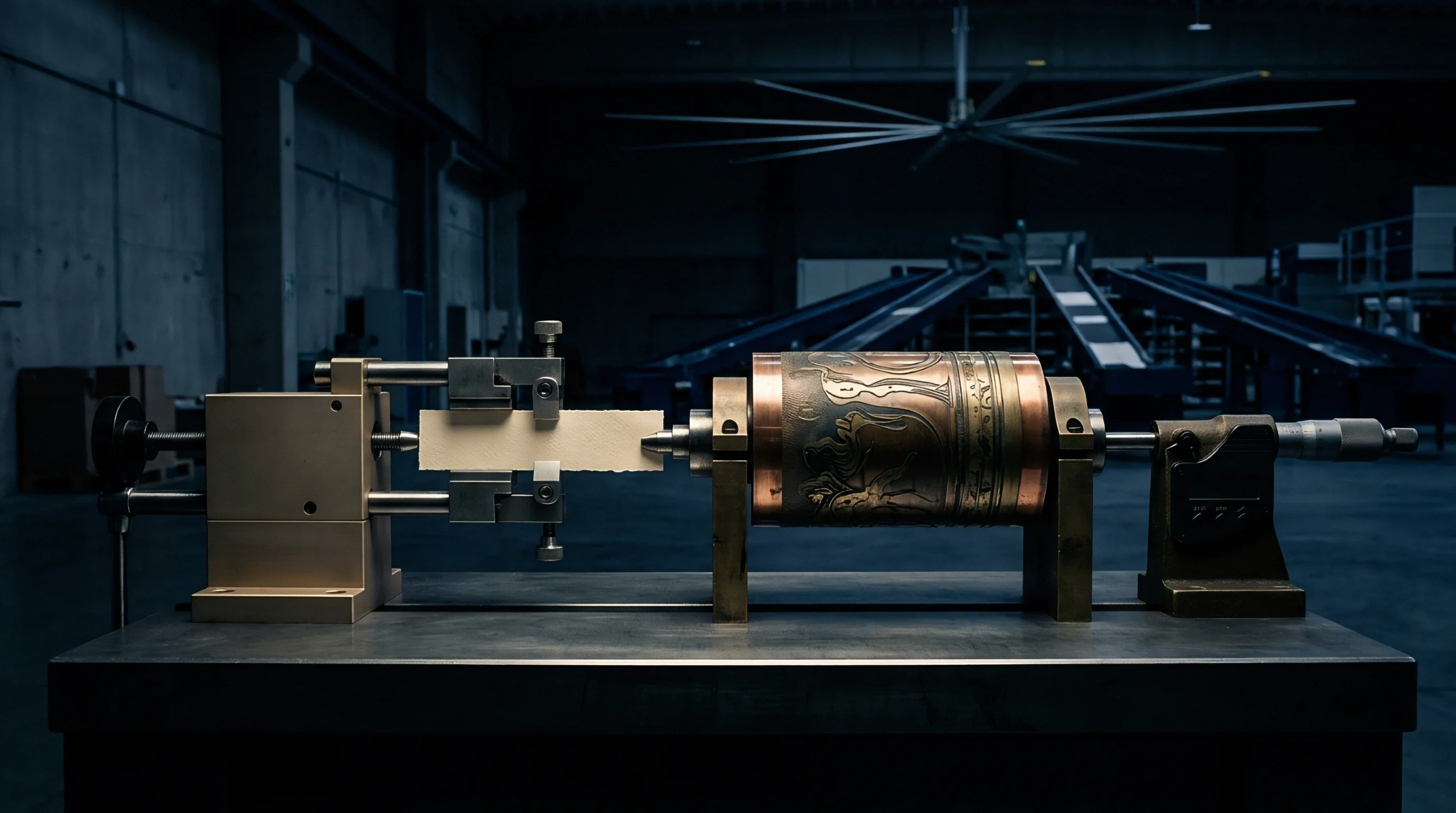
Surface Topography
Variations in the vertical profile of a substrate determine the fidelity of ink transfer during printing operations. Micro-roughness describes the amplitude of these peaks and valleys across a microscopic spatial frequency. Such characteristics directly govern the wetting behavior of aqueous coatings and the final visual density of halftone dots.
Precise control of this parameter remains the primary method for maintaining consistent print quality across different paper stocks.
Production Influence
Refiners and calenders dictate the mechanical deformation of the fibre mat to reduce the severity of these irregular protrusions. High pressure during the calendering stage collapses surface voids to generate a smoother finish for high-gloss applications. Lower levels of compaction produce a higher degree of surface texture which aids the mechanical bonding of certain adhesives.
Adjusting the load on the nip allows technicians to target specific roughness values for distinct grades of board.
Measurement Standard
Instruments using optical or tactile sensors scan the profile to derive a mean deviation from the centerline of the surface. Profilometers convert the vertical displacement of a stylus or light beam into a numerical average or a root mean square value. Each reading maps the uniformity of the substrate to predict potential print mottle or poor toner adhesion on complex packaging geometries.
These measurements provide the quantitative basis for setting performance thresholds in high-speed converting facilities.