Non Newtonian Rheological Modeling of Flexographic Inks under Extensional Shear Regimes within Engraved Micro Cells
Controlling extensional relaxation times in flexographic inks prevents cell emptying failure, eliminates high-speed misting, and maximizes substrate runnability.

Nip
Liquid Splitting under Coupled Kinematics
Ink transfer from an engraved anilox roll to an elastomeric photopolymer plate occurs across a high-speed contact zone operating between 150 and 600 meters per minute. The anilox micro cell presents a localized fluid reservoir whose typical opening width ranges from 15 to 80 micrometers, with depths from 5 to 25 micrometers. As the cell enters the contact zone with the plate, the fluid experiences pure viscometric shearing between the moving surfaces.
The shear rate inside this interface reaches values exceeding 1,000,000 reciprocal seconds under production speeds. Upon exiting the nip contact, the geometric divergence of the rigid anilox roll and the compliant plate changes the flow field into an extensional regime characterized by rapid biaxial stretching, liquid filamentation, and capillary breakup.
Formulations based on waterborne acrylic dispersions, solventborne nitrocellulose resins, and energy-curable acrylates depart sharply from simple viscous models. The fluid mechanics within and immediately above the micro cavity couple simple shear flow with strong extensional deformation. Standard steady-shear viscometry fails to predict ink discharge volume, ink film split ratios, and edge-spitting defects across high-velocity nips.
Predicting the physical transfer requires constitutive equations that account for shear thinning, viscoelastic relaxation times, and resistance to extensional deformation governed by polymer chain architecture.
Capillary breakup extensional rheometry at 23 degrees Celsius reveals extensional relaxation times between 1.2 and 18 milliseconds across commercial waterborne flexographic formulations containing associative alkali-swellable thickeners.
Extensional deformation dominates the exit boundary. The physical liquid bridge elongates until normal stresses overcome interfacial surface tension, yielding filament rupture. When extensional viscosity exceeds shear viscosity by three orders of magnitude, cells fail to empty predictably, retaining up to 60 percent of their theoretical volume.
The press operator observes starved solid densities, haloing on reverse type, and erratic dot reproduction on coated paperboard substrates. Resolving these defects requires balancing the relaxation spectrum of the ink against the mechanical dwell time of the press nip.
A supplier who blames plate mounting tape compressibility for anilox discharge starvation usually avoids discussing the extensional thickener package in the ink formulation.

Cavity

Boundary Layers and Cell Evacuation Physics
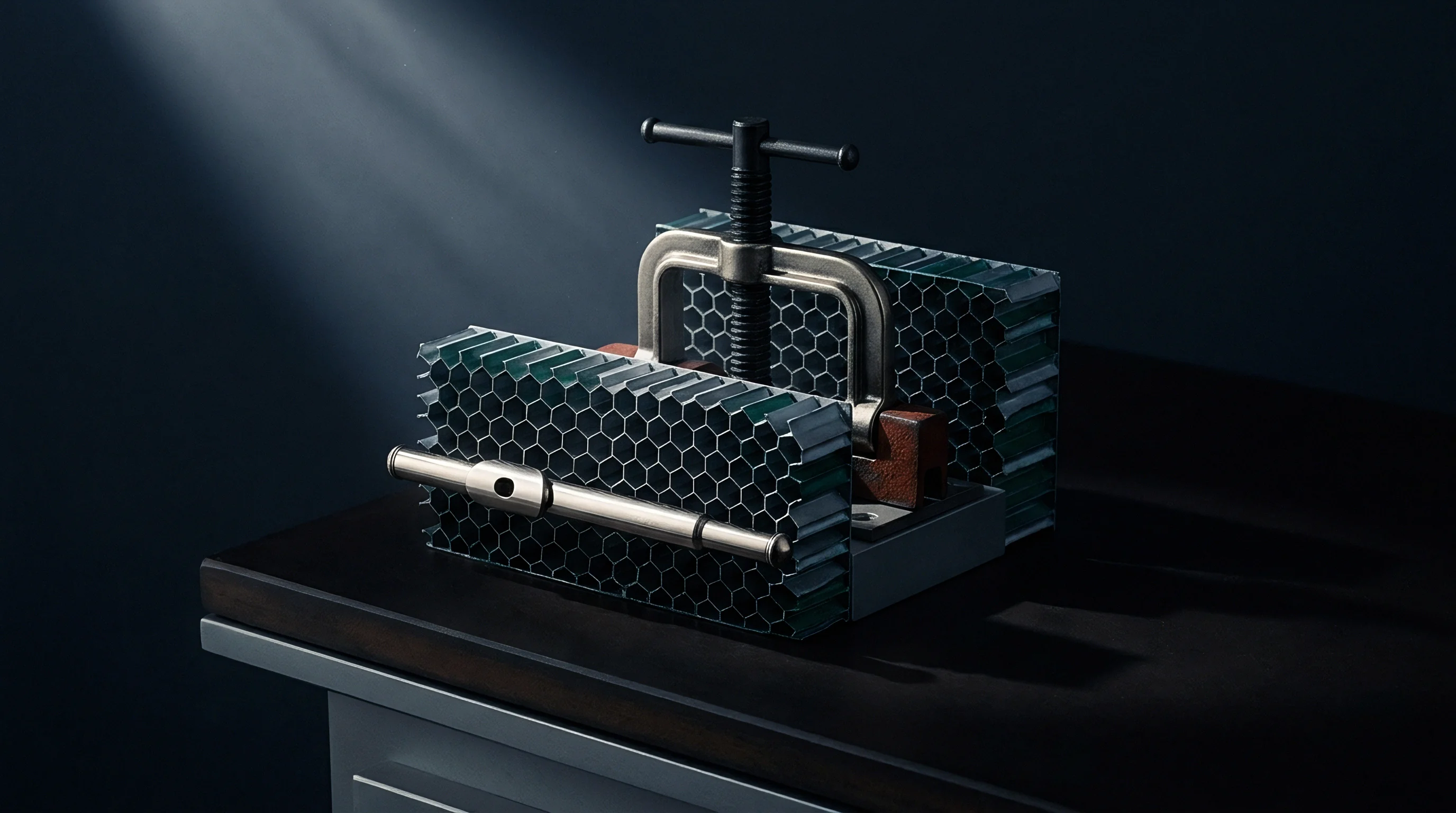
The internal geometry of anilox cavities defines the mechanical boundary conditions governing ink pickup and transfer. Traditional chemical etching and mechanical knurling generated truncated pyramidal or quadrangular cell profiles. Modern laser ablation using fiber lasers produces hexagonal 60-degree arrays, trihelical continuous channels, or elongated channeled geometries.
The internal wall angle typically spans 28 to 35 degrees relative to the cell normal. Cell opening-to-depth ratios range from 2.5:1 to 5:1. An overly deep cell traps ink through viscous drag and capillary pinning along the basal corners, whereas shallow configurations provide clean ejection at elevated web velocities.
Fluid drainage from these micro scale cavities operates under severe confinement. The effective boundary layer thickness scales inversely with the square root of the local shear rate. At press speeds of 300 meters per minute, the liquid boundary layer along the ceramic cell walls occupies between 0.8 and 2.5 micrometers of the cell profile.
For a fine anilox engraving running 400 lines per centimeter with a cell opening of 21 micrometers, this boundary layer consumes nearly a quarter of the available volume. The fluid outside the boundary layer behaves as a bulk core, while the fluid pinned to the walls remains immobilized, accumulating dried resin deposits over extended shifts.
| Engraving Profile | Screen Count (Lines/cm) | Theoretical Volume (cm³/m²) | Depth-to-Opening Ratio | Emptying Ratio (%) |
|---|---|---|---|---|
| Closed Hexagonal 60° | 200 | 10.5 | 0.32 | 46.2 |
| Closed Hexagonal 60° | 360 | 4.2 | 0.28 | 41.8 |
| Closed Hexagonal 60° | 500 | 2.8 | 0.24 | 34.1 |
| Channeled Open Line | 240 | 8.0 | 0.22 | 54.7 |
| Elongated Hexagonal | 320 | 5.5 | 0.26 | 48.9 |
| Stepped Cavity Wave | 400 | 3.5 | 0.21 | 52.3 |
The cross-sectional transition between open channels and closed cells alters the local pressure field. Open channeled architectures permit continuous hydrodynamic pressure relief along the doctor blade contact zone, decreasing air entrainment. Conversely, closed hexagonal geometries experience transient micro-compression cycles followed by rapid expansion, which nucleates micro-cavitation voids within high-volatility solvent inks.
These micro-voids collapse non-symmetrically, promoting unstable filament stalks during subsequent liquid splitting against the plate surface.
Plate surface energy directly governs the meniscus attachment within the cavity. Photopolymer plates typically exhibit surface energies between 32 and 38 millinewtons per meter, whereas cleaned ceramic cell walls possess surface energies ranging from 45 to 65 millinewtons per meter. The thermodynamic driving force for fluid detachment favors retention inside the cell unless mechanical stretching produces tensile stresses exceeding the adhesive wetting forces.
When ink viscosity rises through solvent evaporation, cell clearance decreases systematically, producing dry transfers and pinholing on paper surfaces.
Failure to maintain cell volume within an operational tolerance band of plus or minus 0.3 cubic centimeters per square meter forces press technicians to over-pigment inks, which escalates raw material costs across long-run packaging jobs.
Rheology
Nonlinear Viscoelastic Constitutive Frameworks
Capturing the mechanical response of printing inks across both shear and extensional fields requires specialized constitutive equations. Linear viscoelastic frameworks like the Maxwell model fail under large amplitude deformations. Simple power-law models predict shear thinning accurately but cannot compute extensional strain hardening or normal stress differences.
Advanced non-Newtonian rheological modeling deploys differential viscoelastic models such as the Phan-Thien-Tanner model and the Giesekus model, both derived from network and dumbbell theories of concentrated polymer solutions.
The Phan-Thien-Tanner formulation introduces stress relaxation governed by trace invariants of the polymeric stress tensor. The stress tensor decomposes into a solvent contribution and a polymer contribution. The model accounts for chain destruction and reformation through an exponential or linear parameter, denoted as epsilon.
For inks containing high molecular weight styrene-acrylic resins, epsilon ranges between 0.15 and 0.45. This parameter caps the steady extensional viscosity at finite values, preventing artificial mathematical infinities encountered in simpler Oldroyd-B simulations under high strain rates.
The Giesekus constitutive model provides a distinct mechanism rooted in anisotropic hydrodynamic drag on polymer coils. A mobility parameter, alpha, typically between 0.2 and 0.5 for industrial flexographic formulations, introduces a quadratic stress term into the upper-convective derivative. The equation captures both shear thinning and the first and second normal stress differences simultaneously.
Under purely extensional flows, the Giesekus model predicts mild extension-thickening followed by an extensional plateau, mirroring the observed stress response during liquid bridge stretching in micro-gap geometries.
| Model Framework | Relaxation Time λ (s) | Zero-Shear Viscosity η₀ (Pa·s) | Nonlinear Parameter | Infinite-Shear Viscosity η∞ (Pa·s) |
|---|---|---|---|---|
| Carreau-Yasuda | 0.012 | 1.85 | a = 0.62, n = 0.28 | 0.018 |
| Cross | 0.009 | 1.92 | m = 0.74 | 0.015 |
| Phan-Thien-Tanner | 0.004 | 1.75 | ε = 0.22, ξ = 0.08 | 0.022 |
| Giesekus | 0.005 | 1.80 | α = 0.35 | 0.020 |
| FENE-P | 0.003 | 1.68 | L² = 120.0 | 0.019 |
The Carreau-Yasuda model remains useful for simulating closed doctor blade chamber hydrodynamics where simple shear dominates. The blade-wiping zone experiences shear rates between 200,000 and 800,000 reciprocal seconds. Here, elasticity plays a secondary role compared to the infinite-shear-rate viscosity plateau.
If this high-shear viscosity falls below 10 millipascal seconds, ink leaks past the blade land, generating back-doctoring lines and ink slinging. If the high-shear viscosity exceeds 40 millipascal seconds, blade deflection occurs, accelerating doctor blade tip wear and ceramic anilox scoring.
A doctor blade wiping tolerance specifies a contact pressure between 1.8 and 2.5 bar, with excessive pressure increasing mechanical friction and localized heat build-up that alters bulk ink viscosity by up to 20 percent.
The Weissenberg number, defining the ratio of elastic forces to viscous forces, escalates rapidly inside the micro cell nip. The Weissenberg number is expressed as the product of the polymeric relaxation time and the characteristic flow deformation rate. In flexographic nips running above 300 meters per minute, the characteristic deformation rate easily matches 100,000 reciprocal seconds.
With ink relaxation times of 5 milliseconds, the local Weissenberg number reaches values well above 500. Under such high elasticity, secondary vortex flows develop in the cell corners, restricting ink exchange and preventing complete cavity replenishment during press rotation.
DIN 53211 efflux cup measurements fail completely to capture nonlinear viscoelastic behavior because they measure a combined gravity-driven drainage flow at low shear rates below 500 reciprocal seconds.

Rupture
Extensional Filament Dynamics and Ink Mist
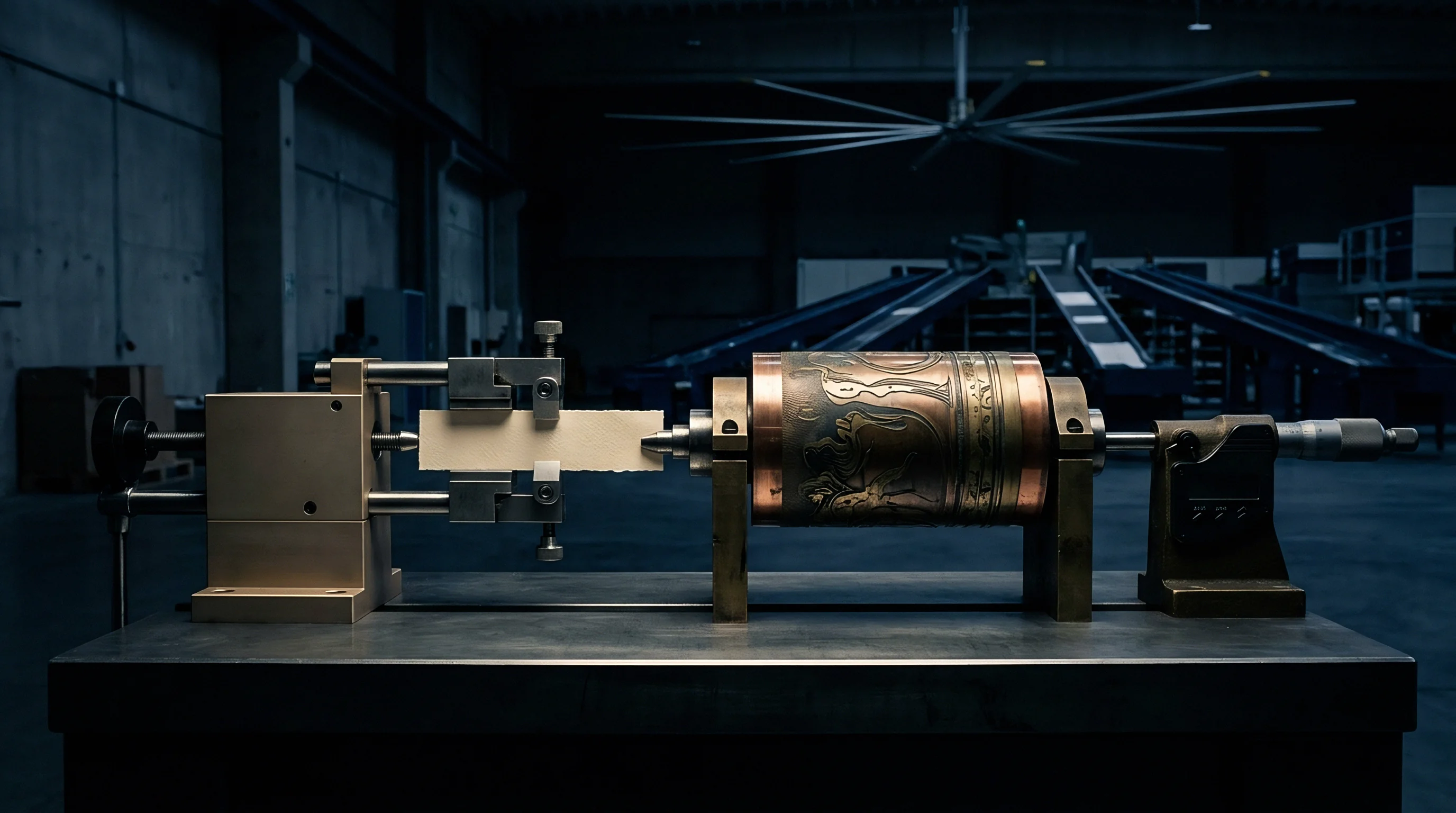
As the flexographic printing plate departs from the anilox surface, liquid filaments form across the diverging gap. The physics of this liquid bridge resembles the dynamics observed in Capillary Breakup Extensional Rheometry. The filament begins as a cylindrical column that narrows under capillary pressure driven by surface tension.
Simultaneously, resisting viscous and elastic stresses retard necking. The balance between these opposing forces dictates whether the filament separates cleanly at its midpoint or draws out into an extended liquid thread that atomizes into airborne aerosol droplets.
In low-molecular-weight Newtonian systems, filament pinch-off proceeds via an inertio-capillary or visco-capillary balance. The filament diameter decreases linearly or according to a power-law exponent of two thirds. In polymer-modified flexographic formulations, the stretching flow uncoils resin chains, producing a dramatic increase in tensile stress.
This transient extensional strain hardening shifts the thinning dynamic into an elastocapillary regime. The filament diameter decays exponentially with time, governed strictly by the longest polymeric relaxation time.
Satellite droplet generation follows the eventual breakup of these hyper-extended filaments. The filament often disintegrates via an end-pinching mechanism or through the formation of bead-on-string structures. High molecular weight thickeners increase ink elasticity, preserving thread stability over longer distances.
The extended threads shatter under aerodynamic drag, scattering microscopic droplets across press frames, anilox journals, and unprinted substrate webs. This phenomenon, known as ink spitting or misting, contaminates clean white borders on corrugated board and folding cartons.
The Deborah number governs the degree of elasticity expressed during filament cleavage. The Deborah number is defined as the ratio of the ink relaxation time to the mechanical process observation time. The process time represents the residence time within the nip exit zone, typically spanning 0.1 to 1.0 milliseconds.
If the Deborah number remains below 0.1, the ink behaves predominantly as an inelastic fluid, undergoing clean, localized capillary rupture. When the Deborah number exceeds 1.0, the fluid exhibits pronounced solid-like elasticity, dragging extended liquid filaments out of the cells and generating heavy misting.
| Web Velocity (m/min) | Relaxation Time λ (ms) | Capillary Number Ca | Deborah Number De | Observed Splitting Mode |
|---|---|---|---|---|
| 150 | 0.8 | 1.2 | 0.24 | Viscous capillary pinching |
| 150 | 8.5 | 1.2 | 2.55 | Elastocapillary filament drawing |
| 300 | 1.2 | 2.4 | 0.72 | Transition bead-on-string |
| 300 | 12.0 | 2.4 | 7.20 | Severe elastomeric thread spatter |
| 450 | 0.5 | 3.6 | 0.45 | Symmetric mid-bridge break |
| 450 | 6.0 | 3.6 | 5.40 | High-velocity misting ejection |
Polymer architecture directly controls extensional strain hardening. Branched resin polymers and hyperbranched acrylic polymers exhibit rapid strain-softening at high extension rates, terminating filament threads quickly. Linear chain associative thickeners, such as hydrophobically modified ethoxylated urethanes, display severe extensional strain hardening.
Sourcing teams specifying waterborne inks for high-speed multi-color presses must ensure ink manufacturers limit long-chain linear additives, prioritizing core-shell or dendritic structures that truncate the relaxation spectrum.
Contractual agreements specifying dot gain tolerances cannot be enforced against converters when ink formulation changes introduce unmeasured extensional hardening that destabilizes nip transfer.

Stock
Fluid transfer from the photopolymer plate to the final packaging material completes the dynamic ink train. The physical properties of the paper substrate dictate fluid drainage, absorption kinetics, and final ink film anchorage. Printing paper grades range from rough, porous unbleached kraftliner to double-blade-coated bleached boards.
The mechanical structure of the web, its chemical sizing, and its pore size distribution act directly upon the freshly ruptured, non-Newtonian ink film during the second printing nip.
Pore Structure and Viscous Penetration
Substrate porosity controls the initial capillary uptake of ink vehicles. Uncoated recycled liners exhibit broad pore radius distributions spanning 1.0 to 10.0 micrometers, along with Bendtsen roughness values exceeding 1,200 milliliters per minute under ISO 8791-2. Coated solid bleached sulfate boards feature narrow pore distributions centered between 0.05 and 0.2 micrometers, with Parker Print-Surf roughness figures under 1.5 micrometers at 1,000 kilopascals clamping pressure under ISO 8791-4.
Penetration into porous matrices follows the Lucas-Washburn equation, modified for non-Newtonian shear-thinning behavior.
The local shear rate during the board printing nip pushes the fluid into the paper pores under external mechanical pressure. This forced penetration competes with surface-energy-driven capillary suction. For shear-thinning inks, the extreme shear stress generated by surface asperities collapses ink viscosity, causing rapid vehicle penetration into porous unbleached fibers.
The pigment particles filter out onto the fiber surface, creating a resin-starved, under-bound pigment layer susceptible to rub-off and dry-scuffing during corrugated board conversion.
Sizing treatments applied at the paper machine modulate this penetration rate. A paper substrate exhibiting a one-minute Cobb value of 25 grams per square meter under ISO 535 restricts waterborne vehicle uptake, keeping the ink film on the surface. When recycled furnish substitutions cause Cobb values to drift above 45 grams per square meter, the ink vehicle drains rapidly into the sheet before extensional filaments relax.
This rapid loss of fluid causes incomplete film leveling, generating mottled solids and washed-out tonal scales.
A porous paper surface absorbs waterborne ink vehicle within 15 to 40 milliseconds, truncating the mechanical leveling time of viscoelastic liquid bridges and fixing print mottle into the fibrous topography.

Substrate Sourcing Considerations?
Selecting paperboard substrates requires matching surface characteristics to ink rheology and press speeds. Sourcing managers must evaluate trade-offs between surface topography, ink yield, and printing speeds to optimize operational efficiency.
- Uncoated recycled testliner absorbs vehicle phases aggressively, requiring ink formulations with elevated high-shear viscosities and rapid thixotropic recovery to maintain sharp dot margins.
- White top kraftliner provides superior mechanical tensile strength and moderate porosity, accommodating higher pigment loadings and lower transfer volumes without dot bridging.
- Double coated folding boxboard presents a tight, uniform pore network that preserves vehicle volumes on the surface, requiring low-relaxation-time inks to avoid film splitting defects.
- Cast coated specialty board exhibits minimal surface roughness, demanding precise rheological balance to eliminate trailing blade marks and micro-pinholes under high-speed flexo transfer.
The cost equation connects directly to paper yield and ink mileage. Highly porous substrates consume between 2.5 and 4.0 grams of wet ink per square meter to reach target optical densities. Smooth, double-coated boards reach identical colorimetric targets with only 1.2 to 1.8 grams per square meter.
A conversion plant running 50 million square meters of corrugated board annually reduces ink procurement expenditures by thousands of kilograms simply by moving from an open, uncalendered liner to a barrier-coated or calendered white-top grade.
The uncalendered sheet demands thicker anilox volumes that worsen misting defects across extended runs.
Yield
Press Optimization and Cost Allocation
Operational profitability in flexographic printing operations hinges on ink transfer efficiency from cell to plate, and ultimately from plate to paperboard. Inefficient transfer leaves residual dried ink within the anilox cavities. The resulting loss of color density forces press crews to compensate by adjusting impression pressure, applying excessive mechanical squeeze to the photopolymer plate.
This mechanical over-impression causes dot gain to spike from a nominal 12 percent to over 28 percent on fine process screens, destroying detail in packaging artwork.
Extensional ink behavior governs cleanup intervals and mechanical maintenance downtime. Formulations displaying pronounced extensional strain hardening generate stubborn buildup on the trailing edges of doctor blades, plate cylinder shoulders, and impression drums. Cleaning cycles consume between 15 and 45 minutes per eight-hour shift.
In high-volume operations, this unproductive downtime erodes press capacity and generates substantial solvent or detergent disposal costs under regional environmental discharge directives.
To quantify the commercial impact of ink rheology and cell geometry on press efficiency, consider a typical high-volume corrugated packaging converter running three shifts over 250 operating days per year.
| Operational Cost Variable | Formulation A (High Elasticity) | Formulation B (Low Elasticity) | Cost Variance (EUR) |
|---|---|---|---|
| Press Operating Speed | 220 m/min | 340 m/min | Productivity Gain |
| Downtime for Anilox Washup | 187.5 hours/year | 62.5 hours/year | -31,250 |
| Make-Ready Substrate Spoilage | 120 tonnes/year | 45 tonnes/year | -63,750 |
| Anilox Deep Cleaning Cycles | 48 cycles/year | 12 cycles/year | -14,400 |
| Total Wet Ink Consumption | 145,000 kg/year | 122,000 kg/year | -57,500 |
| Annual Cost Differential | Base Operational Cost | Optimized Execution | -166,900 |
The financial ledger shows that raw material savings obtained by purchasing cheaper, unrefined ink vehicles are quickly wiped out on the press room floor. Formulation A relies on conventional associative thickeners that produce excessive extensional resistance, forcing press operators to drop production speeds from 340 meters per minute down to 220 meters per minute to prevent ink spitting. The slower speed reduces machine throughput, inflating fixed overhead costs per thousand delivered packaging units.
Make-ready waste illustrates this penalty directly. Formulations that fail to empty predictably from fine anilox engravings require progressive color adjustments across dozens of linear meters during setup. An operator running premium SBS board at a landed raw material cost of 850 EUR per metric tonne wastes significant capital across hundreds of job setups each year.
Substrate spoilage alone creates a financial penalty that completely dwarfs the per-kilogram price difference between standard and rheologically engineered ink sets.
Anilox roll lifespan decreases under aggressive mechanical cleaning regimes. When high extensional viscosity causes polymer buildup in cell roots, maintenance teams resort to ultrasonic baths or aggressive chemical flushes using high-pH solutions. Ultrasonic cavitation damages fragile cell walls on high-screen ceramic rolls, fracturing the cell partitions.
Once roll cell volume drops by more than 15 percent through mechanical wall erosion, the anilox must be stripped, plasma-coated, and laser re-engraved at considerable expense.
Technical ink purchasing requires writing rigorous rheological limits into supplier contracts. Sourcing teams must demand compliance not only with steady shear viscosity specifications at 100 reciprocal seconds, but also with maximum allowable extensional relaxation times measured under verified laboratory protocols. Incorporating extensional boundary parameters into ink supply agreements safeguards production speeds and locks in predictable print densities across varying packaging paperboards.
Whether non-Newtonian boundary slip within laser-textured micro cavities can be modeled reliably without empirical calibration factors across varying surface chemistries remains an open technical challenge.